Boyz N The Hood

Boyz N The Hood (1991)

Dir. John Singleton

Written by: John Singleton

Starring: Cuba Gooding, Jr., Ice Cube, Laurence Fishburne, Morris Chestnut


Boyz N The Hood arrived in the summer of 1991, the debut feature from John Singleton who was fresh out of film school at USC. The film was both a box office and critical success, and Singleton would eventually be nominated for Best Director at the Academy Awards. He was the youngest person to ever be nominated for the award, and the first African-American filmmaker to ever be nominated for the award. The film likely stands as the high water mark for a career that has seen Singleton chart an interesting course, veering from his socially conscious early films to high profile gigs at the helm of Hollywood action blockbusters and franchise films. Through all of his creative divergences, Singleton has established a persistent thematic interest that ties his filmography together. Many of Singleton’s films serve as meditations on inner city violence and the systemic forces in America that contribute to the proliferation of violence and inequality in the African-American community, but never has he explored these issues as presciently or as urgently as in Boyz N The Hood.

Singleton began to develop the script that would become Boyz N The Hood while he was still a teen, basing much of the film on his own experience growing up in South Central L.A. The film begins with young Tre Styles (played first by Desi Arnaz Hines II, but later by Gooding, Jr.) being suspended from his school in Watts, and subsequently being shipped off to live with his father, Furious (Fishburne), in Crenshaw. As Tre grows, his father tries to give him advice and encourages him to avoid the temptations of crime and drugs that are so abundant in their neighborhood, and that could lead him down a path to destruction. Tre’s best friends, brothers Ricky (Chestnut) and Dough Boy (Ice Cube), choose radically divergent paths, with Ricky choosing football as an escape route from South Central, while Dough Boy graduates from petty crime as a child to more violent and reckless behavior as a teen, sinking deeper into the gangster lifestyle. Despite their differences, the three remain close friends and try to navigate coming of age amidst the turmoil of the constant violence that surrounds them. Ricky receives a scholarship offer from USC, and he and Tre sit for the SAT together, with the hopes that going to college will be their ticket out of Crenshaw. However, a chance encounter with a gang member pulls them both back into the violent realities of life for young African-American men growing up in South Central.

boyz n the hood 3

The film benefits from Singleton’s lived experience, as well as from the performances of its incredibly young cast. Besides Angela Bassett, who plays Tre’s mother, no one in the principal cast of the film was over the age of 30 when it was released, and many of the actors were barely in their 20s. Sometimes I think it takes a younger voice to really connect to the reality that inspires a film, and Boyz N The Hood is definitely the product of a young filmmaker willing to take chances and make bold statements. Singleton was protective of his script when it was being shopped to studios, insisting that he direct the film himself in spite of his lack of feature experience. He knew that someone from outside of the community represented in the film wouldn’t be able to connect to the story in a meaningful way, and the end result of his tenacity is a brave, emotional passion project. Boyz N The Hood explores the root causes of racial inequality in 1990s Los Angeles from a position of informed authenticity. The film doesn’t shy away from depicting graphic gun violence, but it never glamorizes violence, or hold it up as a spectacle, in the way that it often is in traditional Hollywood films. Instead, the film shows us violence as a cyclical phenomenon that has real and devastating consequences on the people and communities that it is acted out upon. Other films of the period that explore inner city crime and violence feel, at best, moralizing and stilted, and, at worst, exploitative. Boyz N The Hood feels like a dispatch from the real world, announcing the struggle of a real community that was heretofore largely underrepresented.

Growing up in the 1990s, I was aware that people of color had a vastly different experience of life in America than did White people like myself. From a young age I followed the news and current events, and I can remember seeing footage of Rodney King beaten on the side of the road by officers of the LAPD. I remember thinking that King’s skin color had something to do with the way that the officers felt they could savagely assault him. In my head, I tied these images to the ones I had seen in books of civil rights protestors being sprayed with hoses and attacked by police dogs, and I started to understand the concept of an institutional sort of racism that persists over generations and is less about individual acts of racial hatred, and more about an overarching denial of basic humanity and an attempt to maintain a repressive status quo. Of course, I didn’t come to all of these conclusions all at once, and certainly not at the young age of seven or eight years old, which I was when I started to consider some of these questions during the time of the Rodney King trial and subsequent riots, and the O.J. Simpson trial. It took time and life experience to understand the complicated issue of race in America, and watching Boyz N The Hood helped to put some of the final pieces into place. I’ve written before about using films as a way to explore other cultures or other experiences different than my own, and Boyz N The Hood was an early example of that in my life. I watched it for the first time when I was in high school, about the same age as the film’s protagonists, and while it didn’t open my eyes to a reality that I was blind to, it did present its central problems in ways that I had never considered them before.

boyz n the hood 5

I’m referring to the scene in the middle of the film in which Furious takes Tre and Ricky to Compton and shows them a billboard advertising cash for homes. He introduces them to the concept of gentrification. This scene was also my first introduction to the concept of gentrification and to the economic ramifications of institutionalized racism. In under two minutes, Furious outlines the attempts to marginalize African-American communities through flooding them with drugs and guns, and by so doing to undermine and devalue African-American lives. He hits on the media’s ignorance of the societal problems of the African-American community, until those problems begin to cross over into suburbia or the “heartland,” at which point they are deemed “epidemics.” The violence of the film is a symptom of the larger disease of institutionalized racism, a centuries’ long campaign on the part of governments and corporations to delegitimize non-White communities. Keeping people fighting amongst themselves is a great strategy to maintain existing power structures, and agents of the State such as the police and the media exist to help foment that infighting, and to uphold the yoke of official power that is exacted over repressed communities. Hearing these sorts of ideas expressed explicitly in the film, coupled with a burgeoning interest in Socialism, helped to influence my worldview as a young man. Though I was a White man, I understood that I could stand in solidarity with minorities by trying to resist the influence of these power structures and exposing the fallacy of race as a factor of contention between people. The scene isn’t the most successful one in the film cinematically, as Furious’s sermonizing on the street corner to a magically arriving crowd of listeners simply feels a bit forced and inorganic, however, it is the most ideologically important moment in the film, because it helps to unpack the complicated gnarl of roots behind the pervasive violence shown in the film.

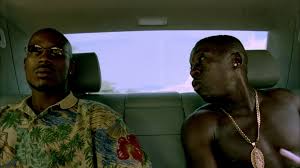
This scene likely sticks out as feeling somewhat inauthentic simply because the rest of the film is so naturalistic. As I’ve mentioned several times now, Boyz N The Hood is simply an authentic movie. The performances are nuanced, naturalistic, and emotionally resonant, and in many cases the performances belie the actors’ lack of professional experience. At the time known only as a rapper, Ice Cube steals the movie with his powerhouse portrayal of Dough Boy. He is both menacing and charming at the same time, displaying the charisma and onscreen presence that would lead him to a crossover career in films. In the early 1990s, Ice Cube was one of the unflinching faces of West Coast gangsta rap, but in Boyz N The Hood, he displays an emotional range not exhibited on his solo albums or with N.W.A. The scene where he and Tre carry Ricky’s lifeless body into his house after he is gunned down by a local gangster whom he had disrespected never fails to make me tear up. The loss of Ricky’s life is senseless, but something about the desperation in Dough Boy’s pleas that he be allowed to take Ricky’s infant son out of the room is the hardest part of the scene for me to watch. “He doesn’t need to see this,” he insists repeatedly, and there seems to be an underlying knowledge that this early trauma could lead the boy down a path towards the same vicious cycle of violence that Dough Boy himself is caught up in. That knowledge is certainly apparent in the single tear that Dough Boy sheds immediately before he pulls the trigger, exacting his revenge on Ricky’s killers. The bullet won’t bring Ricky back, and it will likely serve as a death sentence for Dough Boy, as well.

boyz n the hood 4

Cuba Gooding, Jr. also turns in an emotionally affective performance, portraying Tre as a young man attempting to claim his own masculinity in a world that is set up to undermine it at every step of the way. Though his friends are caught up in gang activity, Tre eschews violence and is generally a law-abiding young man. He takes his father’s lessons to heart, and even though he goes above and beyond to walk the straight and narrow, Tre sometimes still finds himself on the wrong side of forces of oppression. This is most obvious in the scene where Tre and Ricky are pulled over, profiled for “driving while Black,” and Tre is threatened by a racist African-American cop. During the traffic stop, both men are pulled out of the car, and Tre is forced up against the hood. “I hate little motherfuckers like you,” the cop says as he presses his gun into Tre’s chin, threatening to kill him. The police receive a call of a possible murder and let Tre and Ricky go, but the damage has already been done, as Tre realizes the truth in the cop’s words: “I could blow your head off and you couldn’t do shit.” This lack of power in the face of racist, State-sanctioned authority is at the heart of Tre’s crisis of masculinity. How can an individual reclaim agency in a system that is designed to deny him of his basic human dignity?

This is the question at the center of Boyz N The Hood, a film in which its characters are struggling to define personal success as something greater than simply surviving the day. Singleton begins the film with statistics about the homicide rate in the African-American community and ends it with a title imploring its audience to “increase the peace.” In between he paints a vivid picture of a generation rapidly being lost to drugs and violence, turning to nihilism in the face of oppressive powers often too vast to easily comprehend. He paints a picture of a community in crisis. I imagine Boyz N The Hood must have felt like a bomb dropping for audiences who saw it for the first time in 1991. I know that it felt that way for me when I first saw it some ten years later, and it still feels that way today over a quarter century after its release. Ricky’s death left me as emotionally raw watching the film a few days ago as it did the first time I saw it, and its questions of race, identity, and masculinity feel even more relevant today. The film drops knowledge but it also helps to foster empathy, and I think those are two of the highest purposes of any work of art.
Blue Velvet

Blue Velvet (1986)

Dir. David Lynch

Written by: David Lynch

Starring: Kyle MacLachlan, Laura Dern, Isabella Rossellini, Dennis Hopper


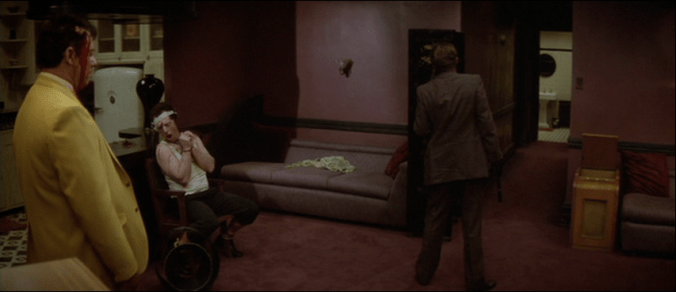
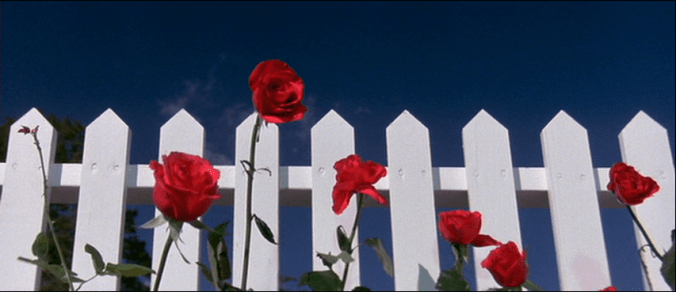
The camera descends from a cloudless, blue sky, settling on vibrant, red roses highlighted against a white picket fence. A shot of a firetruck slowly crossfades in, a firefighter riding alongside, casually waving at the camera. Children cross a street with the aid of a crossing guard. An unidentified man in a hat is watering his lawn, struggling with a kink in the hose. As an ominous hum fades in on the soundtrack, the man drops to his knees and then falls, grabbing his neck, the hose remains in his grip as he writhes painfully, spraying water into the air. A dog comes along barking and nipping at the water as it sprays from the hose wildly, and the film briefly shifts into slow motion, focusing on the snapping jaws of the little dog, giving his playful nips a sinister undertone. The camera cuts to the lawn and begins a slow zoom, turning the blades of grass into a topiary, under which a teeming nest of beetles writhes, crawling over one another. We are then greeted by a bright sign, featuring a beautiful woman waving and welcoming us to Lumberton. We are in suburbia, but something seems slightly off about this glimpse into the heart of Americana. No time is wasted in showing the audience the rotten core underlying the myth of small town tranquility. The opening sequence of Blue Velvet is seared onto my brain, representing something primal, seminal, and profound. It was my first brush with the perfect oddity of the cinema of David Lynch, who would go on to become my favorite filmmaker.

blue velvet 6

I’m really not sure how or why I decided to pick up Blue Velvet. As I mentioned, it was my first experience with David Lynch and I do remember purchasing the DVD without having seen the movie before. I must have seen something about it online, on a list of movies, or maybe I had heard about David Lynch in the commentary of some other movie I’d seen, although I don’t know what that would have been. Regardless, for some reason I picked up a copy of Blue Velvet at my local Circuit City, likely sometime in 2003. When I watched the movie for the first time, I really wasn’t sure what to make of a film like this. Though it doesn’t traffic in the same overt surrealism and narrative disjointedness that have become Lynchian calling cards, Blue Velvet is a perfect introductory film for those looking to get into David Lynch. Leaving The Straight Story aside, Blue Velvet is one of Lynch’s most straightforward and least narratively complex films, but there is plenty of weirdness and mystery creeping around the edges. Like its opening montage, the film seeks to take a look behind the idyllic white picket fences of Middle America and reveal the rot and decay hiding therein.

blue velvet 1

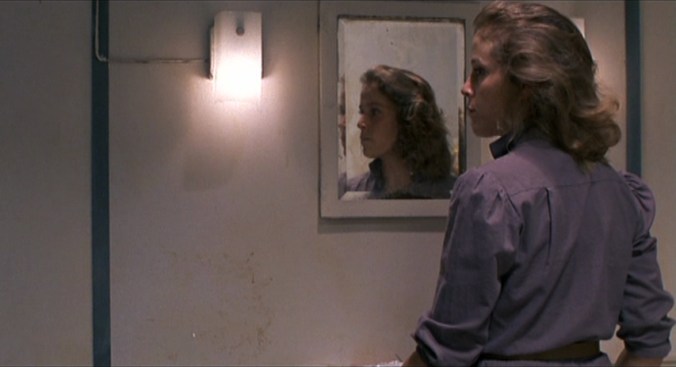
The film stars Kyle MacLachlan as Jeffrey Beaumont, who is returning to Lumberton from his first year of college after his father collapsed while watering the lawn. While returning home from visiting his father in the hospital, Jeffrey finds a severed human ear in an abandoned lot. He inspects the ear, which appears to have mold on it, and takes it to a detective who he knows from the neighborhood. Det. Williams (George Dickerson) thanks Jeffrey for providing him with the piece of evidence and suggests that he not concern himself in the investigation any further. However, after a chance meeting with Williams’s daughter, Sandy (Dern), Jeffrey’s curiosity is once again stoked, and the two decide to continue looking into the mysterious ear themselves. Information gleaned from Sandy eavesdropping on her father’s phone calls leads the junior detectives to the apartment of lounge singer Dorothy Vallens (Rossellini), who has recently been under police surveillance and who may have something to do with the ear. Sandy agrees to help Jeffrey break into Dorothy’s apartment, against her better judgment. Using a key that he had stolen earlier, Jeffrey sneaks into the apartment one night while Dorothy is performing. He’s nearly caught when she returns, but is able to hide in a closet where he spies on Dorothy taking a phone call from a man named Frank (Hopper), who has kidnapped her husband and child, and who is using them to blackmail and coerce her. Dorothy discovers Jeffrey and forces him out of the closet, making him strip off his clothes at knifepoint. Her initial desire is to humiliate Jeffrey, who she takes for a peeping Tom, but then she begins to kiss him. They’re interrupted when there’s a knock at the door, and Frank arrives at the apartment. Jeffrey is again forced to watch from the closet as the sadistic Frank shouts at and assaults Dorothy. All the while, he’s huffing amyl nitrate and practically foaming at the mouth with rage and desire. After Frank leaves, Jeffrey tries to comfort Dorothy. They end up having sex and she asks him to hit her, which he initially refuses, though he will eventually, reluctantly, do it. After their encounter, Jeffrey seems disturbed by what he’s seen and experienced, but also feels a responsibility to help Dorothy, so he continues his investigation into Frank and his crime syndicate, despite Sandy’s protestations. Jeffrey becomes caught between two worlds: one bright and promising, represented by the blonde, youthful Sandy, the other dark and sinister, represented by the seductive Dorothy. He risks getting in too deep with Frank and his dangerous friends, but by the time he realizes just how dangerous they may be, it’s too late. The sickness and malice that Frank represents have begun to infect Jeffrey’s formerly benign day-to-day life in the small town paradise of Lumberton.

blue velvet 5

I mentioned being somewhat perplexed by the film after my first viewing, and that certainly isn’t due to any lack of narrative clarity. I had understood the film fine, but I was left unsettled. I don’t remember if I watched it again in quick succession, or if I let myself stew on the film for a while, but the weirdness of Blue Velvet was lingering around in my head for days. Bugs crawling out of the ear, Isabella Rossellini singing “Blue Velvet” bathed in an ocean of blue light, the savagery of a dog’s jaws opening and closing in slow motion. The images from the film were persistent and strange, and they suggested a certain sort of world view that was maybe a bit skewed. I watched Blue Velvet again and again, becoming more comfortable with its tone and appreciating more and more Lynch’s cynical, surreal take on small town Americana. Growing up in a small town myself, although one that was more urban and was certainly a bit more populous than Lumberton, I had first-hand knowledge that the mythos of the pristine, Middle American, small town experience was often belied by what happened after dark when the shades were drawn.

Blue Velvet launched my obsession with the work of David Lynch. Even though his feature output isn’t necessarily as large as some other filmmakers, Lynch is undoubtedly an auteur, having developed an unmistakable style, sonically, visually, thematically, and in his choices of subject matter. I went next to Mulholland Dr., at the time Lynch’s most recent film, and I was shocked and often terrified by the strange film. If Blue Velvet had left me vexed, then Mulholland Dr. had me flat-out stupefied. I couldn’t put the film together coherently in a narrative or thematic sense, and I really had no idea how to process what I’d just seen. I wanted more, but I couldn’t find copies of Eraserhead or The Elephant Man or anything else Lynch, so I just watched Blue Velvet and Mulholland Dr. repeatedly over the last two years of high school. After I came to college, I had access to so many more movies, and I would start to work my way through Lynch’s filmography. I remember well a bus trip to the Regent Theater to see INLAND EMPIRE, Lynch’s most recent film, in 2006. When I had the opportunity to take a class on the films of both Lynch and Luis Bunuel (which I mentioned when writing about Belle de Jour), I jumped at the opportunity and my fandom was cemented. I filled in most of the gaps in the Lynch filmography through this class and I relished the opportunity to write at length about Mulholland Dr. which had become my favorite of his films, and try to work out some of the questions that I still had about the film. After college, I had less and less time to watch films as I’ve mentioned many times before, but I always came back to Lynch. Every five years or so, I take another deep dive into his work. In 2012, it was sparked by a rewatch of Twin Peaks on Netflix with a roommate. In 2017, it was another rewatch of Twin Peaks in anticipation of the release of the currently airing Twin Peaks: The Return. Lynch has been on my mind quite a bit lately, and rewatching Blue Velvet reminds me of where it all started.

blue velvet 3

Lynch’s original cut of the film was rumored to have run nearly four hours before he cut the runtime in half. Nearly an hour of that excised footage has been recovered and was included on the Bluray rerelease of the film. I don’t have that edition and I haven’t seen the footage, but from what I’ve read, it hints that Lynch’s original version of Blue Velvet was to be a much darker and stranger film, more in line with his later style. Though I would be interested to see some of these deleted scenes, I think that Blue Velvet works best just the way it is. Keeping the Lynchian surrealism to a minimum makes the film’s dark undertones seem all the more sinister. Unlike the later fictional town of Twin Peaks, Lumberton feels like a real place that could exist, indicating that the evil contained there is linked to the evil that exists in our own world. The final cut includes a (seemingly) happy ending that sees Frank defeated, Jeffrey and Sandy united as a couple, and order seemingly restored to Lumberton. The film’s final shot is of a robin crunching on one of the beetles from the film’s beginning, a callback to an earlier line by Sandy where she describes a dream in which there was no love in the world, only darkness, until thousands of robins were released, symbolizing the return of love to the world. However, I think that this happy ending is somewhat facile, because even though the robin eating the beetle might signify the return of natural order and the triumph of love and goodness over evil, it just serves to remind me that there can never be enough robins to do away with all the beetles. Digging deep into the soil of any town will turn up a nest of vile creatures. Lynch films tend to want to expose the teeming underbelly of their worlds, forcing the viewer to confront ugly truths, although often in a distorted, surreal manner.

Even after excising some of the film’s stranger elements, Blue Velvet retains many of the key elements that would come to define Lynch’s cinema over the years. Not only does the film explore themes of hidden darkness and the depths of depravity, it also engages in a light/dark dichotomy that becomes central to Lynch’s symbolism. Lynch loves doubling and doppelgangers and in Blue Velvet, the light/dark dichotomy is very literal, pairing Sandy and Dorothy, whose contrasting hair colors are symbolically representative of their moral standing. The symbolic use of night and day in this film and throughout the Lynch filmography is another example of this light/dark dichotomy. The film additionally features many actors who have come to make up something of a stock cast for Lynch, appearing in multiple films, often playing roles that share some similarities from film to film. Kyle MacLachlan has worked with Lynch frequently, most notably here and in Twin Peaks, while Laura Dern would go on to star in Lynch’s follow up to Blue VelvetWild At Heart. Jack Nance, who plays Paul, a member of Frank’s gang, was a close friend of Lynch’s and the star of his debut feature, EraserheadBlue Velvet also features many of Lynch’s iconic visual motifs, such as lounge singers and night clubs, highly staged and stylized interiors, and overtly performative acting style. The scene where Ben (Dean Stockwell), an associate of Frank’s, lip syncs to “Candy Colored Clown”  is the best example of this type of performative style, and is a decidedly Lynchian set piece. Though the film doesn’t go over the top with its strangeness, its core is rooted in Lynch’s avant-garde, surrealist style.

I think there is a temptation, particularly among those who are maybe not as acquainted with the entire corpus of Lynch’s work but I have even seen it in academic writing, to lump discussion of Blue Velvet in with its obvious influence of Lynch’s television series, Twin Peaks. There are many similarities between the two, and Lynch has even admitted that the idea for Twin Peaks began germinating while he was directing MacLachlan in Blue Velvet, but I think it’s important to point out a major difference between the two texts. There is no hint of supernatural or metaphysical forces at play in Blue Velvet. While both works explore the duality of human nature and the darkness that can be revealed when the veneer of polite society is stripped away, Twin Peaks attributes the evil in its universe to malevolent beings who live in an interdimensional space called the Black Lodge, the entrance to which happens to be in the woods near the town of Twin Peaks. In Blue Velvet, the evil infesting Lumberton is inherently a part of the town. It is represented by a figure of pure destruction in Frank Booth, one who is not being controlled by any forces other than his own desire to hurt others. Frank is an unrestrained id, manifestly evil, but he is real, and represents the terrifying reality that anyone could potentially break bad like this. That realization fuels Jeffrey’s nightmare and anguish the morning after he hits Dorothy during sex. He doesn’t know why or how Frank’s psychosexual fury developed, but he fears that he may have taken the first steps down that same path. I think this insistence on reality makes Blue Velvet a more successful and compelling work of art than the later television show. I love Twin Peaks, but one of my only criticisms of the show is that its insistence on an intentional artificiality makes its darker themes seem less serious, particularly in its troubled second season. I think that Lynch took steps to resolve that in the harrowing prequel film Fire Walk With Me, which he released after the show was canceled, and which marks one of Lynch’s most overt forays into out-and-out horror filmmaking.

blue velvet 7

When I do go back and watch Lynch films, all of which I’ve seen more than a few times now, excepting The Straight Story, I sometimes pass over Blue Velvet. Probably because I’ve seen it so many other times earlier in life, I’ve felt like my time is better spent familiarizing myself with Lynch’s 90’s works, Wild at Heart and Lost Highway, both of which are incredibly interesting, but neither of which work nearly as well as a film as Blue Velvet. I’ve barely scratched the surface of what there is to love about Blue Velvet in this post, from Angelo Badalementi’s gauzy score, to the actors’ strange, exciting performances, to Lynch’s subtle attempts to drop surrealist tropes into a more straightforward narrative. Blue Velvet is packed with information and symbolism; Freudian critics can have a field day with this film, and with the dreamscapes that Lynch creates, in general. While I don’t subscribe to that line of critical thinking, I do find myself finding new ways to arrange the tapestry of signs that make up Blue Velvet, even after 15 years and more than 15 viewings. The film still feels fresh and transgressive after all this time, and I think that makes it the perfect introduction to the cinema of David Lynch. It provides a strong enough narrative foothold to give viewers a sense of security while still introducing the darker elements of Lynch’s visual style and his thematic obsessions. Form and content match up well in the film with its traditional mystery narrative masking Lynch’s more subversive content, which mirrors the idea in the film that there are hidden evils coursing just below the surface of Lumberton. If you’ve been wanting to get on the Lynch bandwagon after hearing about the Twin Peaks revival but don’t know where to start, this would be the perfect place.

Blood Simple

Blood Simple (1984)

Dir. Joel Coen

Written by: Joel & Ethan Coen

Starring: Frances McDormand, John Getz, Dan Hedaya, Samm-Art Williams, M. Emmet Walsh


I’ve written before about the breadth and depth of Coen Brothers’ filmography. Blood Simple is a perfect example of that depth. Their debut film, it serves as an artistic statement that would define the scope of their career. It finds the brothers arriving on the cinematic scene, nearly fully formed. Though later works would achieve more popularity or prestige, Blood Simple stands out as one of the great debuts in all of film, resembling more the work of an established filmmaker at the height of his or her powers than the first offering from a couple of neophytes. It establishes their interest in genre filmmaking, and many of their trademark cinematic devices appear in the film, at least in rudimentary forms. Far from serving as a still-developing sketch, or an indicator of potential artistry, Blood Simple is a fully formed near-masterpiece in its own right. It’s a dark tale of murder, adultery, and deception set against the backdrop of the Texas desert that winds itself up to a frenzy by the third act and maintains a breakneck pace towards disaster. An unyielding thriller that can keep an audience on the edge of their seat for the duration, the film stands up among the best work that the Coen Brothers have done in their long and fruitful career, despite still being somewhat underseen when compared to their more popular works.

The film opens with Ray (Getz) and Abby (McDormand) driving down a Texas highway at night. Their conversation concerns Abby’s failing marriage to Marty (Hedaya), who also happens to own the bar that Ray works at. Though their stated destination is Houston, the two pull into a motel and spend the night. Marty, suspecting their affair, has hired a private investigator, Loren Visser, (Walsh) to follow them, and he snaps a few photos of them in their hotel room as proof of the affair. When he provides this proof to Marty, the detective implies that for the right price he’d be willing to eliminate Marty’s problem, though Marty initially turns him down. Eventually, though, Marty seeks out Visser, hiring him to kill both Ray and Abby for $10,000. Rather than go through with the hit, Visser breaks into Ray’s home and steals Abby’s gun, then takes photos of them sleeping again. He returns to Marty with doctored photos, depicting the sleeping couple as corpses riddled with bullet holes, and after receiving his payment he double-crosses Marty, shooting him in the chest with Abby’s gun and leaving him to bleed out. Later, Ray returns to the bar to find an unresponsive Marty and Abby’s gun. Thinking that she has killed Marty, he decides to cover up the murder. The ensuing cover up leads to miscommunications between Ray and Abby, with each thinking that the other is responsible for the killing of Marty, while Visser engages in a deadly pursuit of the couple, hoping to erase any link to his crime.

blood simple 3

Blood Simple is a master class in economical storytelling. At its core, it’s a straightforward revenge story, and even as its narrative gets more complex with the added double-crosses and misunderstandings, it doesn’t lose any focus or narrative momentum. The film essentially has only five characters, the previously mentioned four, plus Meurice (Williams), the other bartender at Marty’s bar, who finds himself tangentially caught up in the murder plot. Largely though, the film revolves around the principals in the love triangle and the murderous Visser, as they play out a savage game of cat and mouse in the Texas back country. With a few notable exceptions, the Coens eschew narrative ambiguity or overarching mystery as drivers of tension in the film, instead letting the audience in on all of the details of the story. Watching the characters make questionable decisions and wrong assumptions about one another heightens the tension for the audience, as the spectators are able to see the Greek tragedy unfolding in front of them, even as the characters are blind to their surroundings. In fact, the title comes from a turn of phrase in which someone is said to be “blood simple” after being rendered incapable of higher thought or decision making in the face of violent surroundings. The film makes the viewer want to reach through the screen and shake Ray and Abby, warning them of the impending doom that’s closing in.

The Coens also heighten narrative tension through the film’s masterful appropriation of classical noir visual style. The Coens have transported their crime drama from its usual urban setting to the middle of nowhere in the Texas desert, but they otherwise retain many of the stylistic cues of the genre. Aside from a few sunbaked exteriors, the film is dark, scenes often employing contrasting chiaroscuro lighting. Shadows are extreme, with characters’ faces often partially or totally obscured by darkness as they issue straightforward, hardboiled dialogue. There is more than enough visual information in the frame to make up for the paucity of verbal context. The shadows reflect both the dubious nature of the characters’ morality, and their duality. In this film, there are no true heroes; everyone is kissed by darkness in some way. Borrowing a trick from Sergio Leone, the Coens frame their characters in claustrophobic close-up, highlighting every pore and bead of sweat. At times, lazy flies are allowed to buzz in and out of the frame, crawling along Visser’s brow while he meets with Marty to discuss their dirty deals. To say the film is atmospheric would be an understatement, as its mise-en-scene does more than suggest the seediness of its environs, it insists upon the palpability of the griminess of this universe. At times, the desperation practically leaps from the screen.

blood simple 2

In addition to successfully adapting the tropes of the noir film, the Coens begin to establish their own unique visual and narrative style in Blood Simple. The slow burning tension of later films like Fargo and No Country For Old Men is on display here, with the brothers already proving to be masters of pace and timing. The film’s first two acts are languorously paced. Scenes of dialogue are allowed to play out slowly, either unexpectedly erupting into acts of violence, or, rather, expected violence is denied. The Coens punctuate their shot/reverse shot with stylish tracking shots and rapid zooms that force the viewer to take notice. The final third of the film boils over with tension as Visser closes in on Abby and Ray, stalking them through her apartment. The characters have all gotten on a runaway train, and they’re forced to pursue the ride to its logical end. The violence in the film, as in most of the brothers’ later films, is matter-of-fact, an unfortunate consequence of the corrupted world in which these characters live. It seems that the Coens enjoy spinning yarns about everyday people who find themselves embroiled in larger schemes, and the roots of that narrative preoccupation are in Blood Simple.

blood simple 5

The performances in the film are all top notch, with the Coens already showing a deft hand at directing actors. In what was her first ever film role, McDormand is perfect as Abby. Her performance gives the character just enough subtle edge to keep her true nature in the dark until the film’s end. It’s hinted that Abby might be some sort of femme fatale, but her actual level of duplicity is hard to pin down. She’s a woman torn between a man she loves and one she fears, but McDormand never plays her as a dependent. She has steely resolve, and agency, that grows to a lethal capacity in the film’s final showdown with Visser. She’s able to balance manic outbursts of emotion and quietly determined acts of violence, and remain convincing in both circumstances. Neither Getz nor Hedaya are given much dialogue to work with, but they embody both of their roles with a lived-in physicality. Hedaya’s Marty haunts most of the film as a dead or dying presence, his body often visible on the edges of the frame as a reminder of the murder that has embroiled all of these characters. Getz plays Ray as a working stiff who’s simply in over his head, but his workmanlike approach belies a darker side to the character. When it comes time to dispose of Marty’s body, Ray drives him out to the desert where he finds out that Marty is mortally wounded, but not dead yet. He proceeds to bury him alive in a harrowing, slowly-paced scene that escalates the stakes and the tension in the film. There is no dialogue, but both actors give memorable performances, with Hedaya struggling mightily to stay alive while Getz slowly, steadily shovels dirt into his face.

It’s Walsh, however, who steals the film with his unhinged portrayal of the sleazy detective, Visser. Unlike the other characters in the film, there is little duality to Visser. Walsh plays him as purely evil, and in fact, he seems to enjoy and revel in his impurity. He breathes malice and corruption into his words, and his physical performance is palpably slimy. Visser seems to ooze into locked apartments, snapping his covert photographs and stealing bits of evidence, his stealth belied by the actor’s large stature. When it is time for him to pursue his quarry in earnest, Walsh plays Visser as a ruthless, efficient hunter, stalking Abby through her apartment until she is finally able to get the drop on him. Walsh’s performance is similar to John Goodman’s performance as Charlie Mundt in Barton Fink. Both characters come to symbolize evil incarnate in their filmic worlds, but unlike Mundt, Visser is rotten to the core. Where Goodman’s good-natured charm shines through some of Mundt’s cracks, Walsh never allows any light to permeate Visser’s dark patina. Even his humor is black as the Texas asphalt over which he tracks Ray and Abby.

blood simple 6

In lesser hands, a movie like Blood Simple might add up to just another paint-by-numbers pot boiler. The familiar elements are all present here: a spurned lover spurred to murderous rage, cases of double-cross and mistaken identity, a Chekhov’s gun which fulfills its narrative promise. However, the Coens routinely elevate basic subject matter and genre filmmaking to the level of complex, high art, and that streak is begun with their debut. They take a very straightforward story in Blood Simple and filter it through excellently realized character work and impeccable visual style to produce an end result that is engaging and visionary. Most of their films are genre experiments, but rarely are they as pure as Blood Simple. The film sets out to deliver a compelling tale of murder and do it in a suspenseful manner, despite removing narrative ambiguity, and it succeeds entirely. Like the characters in the film, once things start to break bad, the audience is simply along for the ride, hoping to survive to the end. When that end arrives, the audience has been taken on a sickening ride that explores the depths of moral depravity and human capacity for malice. Many of the Coen Brothers’ narrative and stylistic obsessions are on display here, so it is a must watch for any fan of their corpus, as well as any fan of well-realized suspense and crime films.

Big

Big (1988)

Dir. Penny Marshall

Written by: Gary Ross, Anne Spielberg

Starring: Tom Hanks, Elizabeth Perkins, Robert Loggia, John Heard, Jared Rushton


No pun intended, but this is a big one for me. Big is the first live-action film that I can remember ever seeing as a child. I had definitely seen cartoons up to this point, and I had probably seen some other live-action movies, but I first saw Big when I was probably six or seven years old, and it’s definitely the first live-action movie to have made an impression on my memory. If my memory serves me correctly, my parents had recorded Big on VHS at some point and it was this copy that first introduced me to the movie. I also think that my mother had reservations about letting me watch the movie due to its abbreviated sex scene, but I was ultimately allowed to see the film, and it totally enthralled me. I understood the difference between movies and reality at that point, of course. My favorite film up to that point was a cartoon called Fluppy Dogs, in which a boy adopts a magical dog who can make his master’s bed fly when he gets scratched behind the ears. I watched the movie every day for an entire year, but solely because I thought it was cute and entertaining. I understood that it was divorced from any semblance of reality. Big was the first film that I saw that showed me how movies can bridge the gap between fantasy and reality, and open up the imagination to the possibilities of magic and wonder existing in the real world.

big 5

Big is probably the perfect movie to introduce children to the magic of movies because its plot about wish fulfillment and childhood magic is so relatable to children. What child hasn’t, like Josh Baskin (David Moscow/Hanks), wished to be bigger? The movie takes that premise and explores its ramifications as 13-year-old Josh makes a wish on a carnival machine that he could be bigger, and then actually wakes up the next morning in the body of a 30-year-old man. With the help of his best friend, Billy (Rushton), Josh heads to New York City in search of the magical machine that turned him into an adult, hoping that it can also reverse the process. While in New York, Josh takes a job at a toy company, and is quickly promoted due to his unique insight into toys and games. He experiences life as an adult, meets a woman whom he falls in love with, and, ultimately, must make the decision to remain an adult or make another wish and become a child, returning to his life with his family in New Jersey. It’s an urban fairy tale that’s perfect for children and adults, alike.

I watched Big a ton when I was a kid. Until I was about 10 years old, there were several movies that I watched over and over again on rotation and Big was among them, along with The Flight of the Navigator, Newsies, and Hook. I stopped watching those other movies as I got a little older, but Big continued to be a movie that I would always stop to watch if I came across it while I was scrolling through channels. Even more than its wish fulfillment fantasies, I started to become really interested in the movie’s New York City setting. When I was an early teen, I was very taken with the idea of moving to New York and leaving the sleepy, small town that I grew up in behind me. I can certainly chalk a lot of that urge up to simply getting the itchy feet that become so common to those who grow up in a small town and strive to see the bigger world, but I think that watching Big as much as I did probably fed into some of those desires as well. I can remember thinking that the loft apartment (really a warehouse) that Josh moves into after he becomes a VP at the toy company was the coolest place I’d ever seen someone live. An apartment like that couldn’t exist in my town, it was reserved for denizens of the big city. I was equally as enamored, however, with the flophouse hotel that Josh lives in when he first moves to the city. It seemed dangerous and edgy in a way that my habitations certainly were not. In fact, when I finally got to travel to New York City, I was a bit disappointed that many of its pointy edges that I had seen in movies had been smoothed over.

big 1

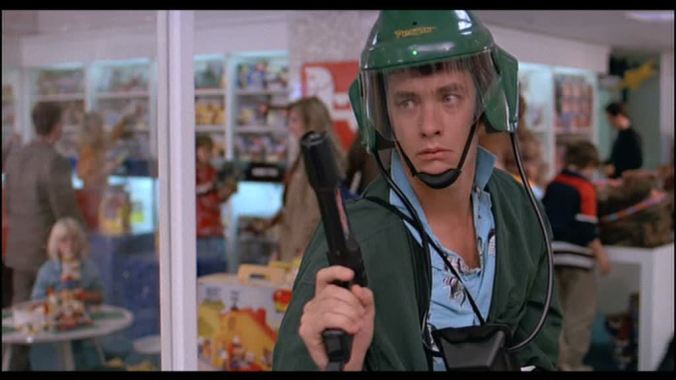
The other big draw for the film, of course, is Tom Hanks’s performance as Josh Baskin. Hanks is probably the most universally well-liked actor ever. He quickly became a mega-star, and by the 1990s, his presence in a film was a signature of a certain type of prestige and quality. Early in his career, however, Hanks was known mostly for his work in comedies, not big budget Oscar hopefuls. After transitioning from television and a co-starring role on Bosom Buddies, Hanks became a household name with 1984’s Splash and starred in other popular comedies throughout the mid-80s. Big is the culmination of this run, with Hanks providing both laughs and an emotional depth to his character. He slips seamlessly into the character of a 13-year-old boy, and watching Hanks react to the adult world with the enthusiasm, and also confusion, of a child is great. The party scene towards the end of the film always stuck out as one of the funniest in the movie. Josh shows up to the office holiday party dressed in a ridiculous white sequined tuxedo, which is funny in its own right, but his nibbling of baby corn on the cob and riotous reaction to trying caviar are the moments that I always lose it in the scene. It’s ridiculous, laugh out loud funny, and endearing all at the same time, and all because of Hanks’s wide-eyed, innocent portrayal of Josh. It’s also impossible to picture any other actor nailing the “chopsticks” scene at F.A.O. Schwarz the way that Hanks does. He and Robert Loggia jumping from note to note on the life-size keyboard while a crowd gathers around to watch has become an iconic scene in all of cinema.

As the film goes on, Hanks adjusts the way he portrays Josh as the character becomes more and more adjusted to his adult life. Early on, Hanks plays Josh as a naïve kid, scared, and often alone in the world. However, as he gains the acceptance of his peers and begins to spend more time with Susan (Perkins) and his other coworkers, and less time with Billy, Josh starts to act more and more like an adult himself. Hanks loses the pensive line delivery, modifies his body language, and becomes more assertive in general. The changes are subtle, but they come to a head when Billy confronts Josh late in the film after having found the Zoltar machine. After Josh is dismissive of Billy, telling him that he has work to do and he’s too busy to spend time with a child, Billy yells at him, “I’m your best friend!” and the illusion of Josh as an adult is shattered. He soon after makes the decision to go to the machine and wish to return himself to his natural state.

big 2

The Zoltar machine has been stashed on a forgotten pier, left there after a carnival has obviously closed up for the season. When Josh arrives on the pier, his transformation back into a child begins even before he approaches the machine and makes a wish. Josh runs to the boardwalk, looking for the machine, and when he sees it, his posture changes. Hanks starts to crumble in on himself, folding his hands in front of him and shifting his weight from one foot to the other, when he sees the machine. The camera zooms in on his pensive face as he weighs the decision that he’s about to make. Taking tiny steps, Josh approaches the Zoltar machine and pulls out a quarter. He unplugs the machine to recreate the exact scenario from the beginning of the film, slapping and kicking the machine until it magically comes to life. Susan arrives on the boardwalk just as Josh makes his wish and drops the quarter into Zoltar’s gaping mouth. Although she can’t comprehend his decision, and doesn’t want to believe his story about the Zoltar machine, Josh shows an emotional purity and depth of understanding that belie his years when he tells Susan that he has “a million reasons to go home, and only one reason to stay.” She’s fallen for him because he is so unlike the professional men that she usually dates, but the innocence that sets him apart is precisely the reason that they can’t be together. Susan gives Josh a ride home and, in a great sequence, watches as he transforms from a man to a boy over the span of one shot/reverse-shot. Josh turns to wave, giving Susan one last glimpse over his shoulder. She looks down to hide a tear, and when she raises her head, she’s astounded to see the child Josh Baskin walking away from her in an over-sized suit. Josh gives her a sheepish smile, which she returns, and then runs into the house to greet his worried mother, leaving his adult-sized shoes on the sidewalk as the film ends.

big 3

The ending of Big ranks up there with the ending of The Third Man and Casablanca as one of my favorites in all of film. In general, the movie is a favorite. I’ve seen it, literally, dozens of times but I still get caught up in the magic of it. Some movies I like to watch over and over again because I feel that there are nuances that I will discover with each renewed viewing. Some movies I like to watch over and over again because I know that they won’t offer me any surprises. Big is one of the latter. It’s a movie that feels like a well-worn baseball glove; it fits just right and it’s full of familiar seams and cracks. I often wonder how movies from my childhood will hold up, not just for my own personal viewing, but for new audiences estranged from the subject matter by time and distance. I really hope that there are new audiences discovering Big now, nearly 30 years after its release. As I said before, it’s a perfect fairy tale for the young and the young at heart. The universality of its themes and the performance of a young Tom Hanks coming into his full powers as a dramatic actor should keep Big fresh for the young viewers of today.

Belly

Belly (1998)

Dir. Hype Williams

Written by: Hype Williams

Starring: DMX, Nas, Taral Hicks, T-Boz


Belly is probably the worst movie, objectively speaking, that I have written about for this project to this point. The first and, to date, only feature film from acclaimed music video director Hype Williams is a bit of a mess, but it also serves as a showcase for Williams’s distinct visual aesthetic. Belly is a stylish crime drama that follows childhood friends Tommy (DMX) and Sincere (Nas) as they pursue fortune and street rep through drug deals and armed robbery until their lives ultimately diverge following Sincere’s decision to get away from his life of crime. The premise is simple to the point of being derivative, but the film’s kaleidoscopic visual style makes it memorable and gives the typical gangster narrative a new coat of high gloss paint. I find myself watching Belly more frequently than many other, better, movies in my collection because I enjoy its frenetic editing, moody color palette, and memorable visual style. It’s a fun movie in spite of its many glaring flaws, and for hip hop fans of a certain age, it’s a certified classic.

Starting with the good, Belly is full of visually interesting and memorable scenes. As I mentioned, Williams rose to prominence as a filmmaker by becoming one of the most prolific and acclaimed music video directors in hip hop in the 1990s. In many ways, Williams defined the visual aesthetic of hip hop during the mid- to late-1990s, a period in which the style fully crossed over into the mainstream. Over the course of his early music video career, Williams developed an eclectic but recognizable style while directing some of the most memorable videos in hip hop history. That style is fully developed and stretched out over the course of a feature film, and Belly is a natural extension of Williams’s music video work, portraying both the gritty street-level realities of its protagonists’ lives of crime and the opulence that that lifestyle has afforded them. Williams captures the drama with technical proficiency and visual flair, opting for dramatic, evocative lighting choices, and employing a restless, moving camera to reflect his characters’ mindsets.

Belly 2

The film’s opening heist scene is a perfect example of this stylistic virtuosity. The scene, in which Tommy, Sincere, and Mark (Hassan Johnson) murder several people while robbing a strip club, sets the narrative and visual tone for the film. The men approach the club in slow motion, though the pace of the editing is quick, with the camera changing angles and distance from its subjects frequently. The quick cuts continue as the three step into the club, but the film’s color palette shifts to an eerie blue, with the black lights of the club causing a negative effect. The close up shots of Tommy and Sincere’s faces are striking and otherworldly, with their eyes glowing hot-white under the black lights. The camera’s constantly shifting perspective, the reversed color palette, and the frequent lens flare from the club’s strobe lights all combine to create a disorienting feeling and a fragmented sense of place. The action shifts upstairs to the club’s office, where the owners are counting cash. The shots lengthen and the camera moves in short, smooth pans and tilts, exploring the room and the cash within it slowly, in contrast to the choppy snapshots of the club floor. Williams continues the longer shot durations as Tommy and Sincere step into the club’s bathrooms where they’ve stashed their guns, a la The Godfather, but he also maintains the disorienting effect and creates visual tension by intensifying the strobe. As Sincere and Tommy approach and ascend the stairway to the office, the strobe is diminished, allowing for more visual clarity. Sincere nonchalantly shoots a bouncer in the chest and after he and Tommy throw him over the stairs, they and Mark charge up the stairs pulling white masks that glow in the black light over their faces. Panic breaks out in the club, and the strobes return, matched by the flashes of the robbers’ guns as they burst into the office and shoot everyone inside. One of the owners falls backwards through the wall-length window overlooking the club floor, descending in slow motion into the blue-lit depths as glittering shards of glass cascade after her like a diamond rain. As she smashes through a table, the beat to “However Do You Want Me” by Soul II Soul, the a cappella intro to which has been seething quietly under the scene up to this point, kicks in, and the film shifts back to a naturalistic color pattern as the men grab the cash and make their getaway. This scene establishes the visual and narrative themes that the film will explore in less than three minutes, and is one of my favorite credit sequences ever.

Belly 5

Belly is a film of visual contrasts. Williams associates characters with different colors throughout the film, using blue lights to establish a cold, menacing aesthetic for Tommy, reflecting his ruthlessness and predatory nature. Sincere is visually linked with warmer reds and yellows. He will eventually break with Tommy, rejecting the life of crime for Afrocentrism and attempts at self-improvement. Williams also employs contrast within the same shot by pairing slow motion with quick edits, as he does in the opening robbery scene. These are recognizable music video techniques, and it is obvious at times that Williams’s background is in music video. Often the film seems to be constructed of vignettes, moving from set piece to set piece, and often these vignettes are tied to memorable use of music. These aren’t criticisms, necessarily, as Williams’s experience matching sound to image creates some perfect scenes that almost act as music videos within the film. “However Do You Want Me” is integral to the success of the film’s opening, with the edits syncing perfectly to the music, and the music helping to inform the images. Williams is playing to his strengths in Belly, and while they don’t necessarily lend themselves perfectly to coherent narrative filmmaking, they are enough to keep the film interesting and entertaining.

I think that most of Belly’s shortcomings are a result of Williams wanting to squeeze too much into his first feature. Williams brings a laundry list of influences to the project, many of which he borrows from liberally, resulting in a film that is jumbled and incoherent. There are too many narrative threads, all of which are underdeveloped. This kitchen sink mentality makes the film’s narrative difficult to navigate, as the action shifts from New York to Omaha to Jamaica, following Tommy as he continues to involve himself deeper and deeper in the criminal underworld. Williams too often relies on voice over narration from Sincere to provide context and exposition. For a filmmaker who is so prodigiously gifted visually, Williams often opts to tell rather than show in Belly. With more focus and character development, Belly could be a very good crime film, but as it stands the film only scrapes the surface of its potential, choosing to emulate other, better gangster films and trade in clichés and heavy-handed symbolism rather than developing complex characters and original narrative arcs.

Belly 3

The film also suffers from the performances of its leads. Across the board, the acting in Belly is pretty bad. DMX and Nas aren’t asked to do dramatic heavy lifting in the film, still neither is up to the task. Belly marked the onscreen debut for both rappers, and they are essentially each extending their brands in the film, playing characters who closely resemble their on-record personae. DMX’s physicality lends Tommy’s air of menace credibility, but his line delivery is wooden and he is incapable of registering any facsimile of genuine emotion. Nas seems to be a somewhat more natural actor, but he has to contend with bad dialogue and with the film’s overreliance on his voice over. When he’s not asked to be the film’s narrator, his performance is decent. The lone bright spot in the film, performance wise, is Method Man’s turn as Shameek, a hitman who is sent to Omaha to dispatch of the local drug dealers who reported on Tommy’s drug trafficking operation. In this early role, Method Man displays the charisma and acting chops that helped him cross over into a successful film and television career. He plays Shameek as a joker whose easy charm belies his underlying penchant for violence. He has made a career playing these sorts of lovable, relatable criminals and he shines through in what is essentially an extended cameo. In fact, aside from Tommy and Sincere, the roles in the film all feel like cameos. None of the other characters are given enough screen time to develop any real motivations or character arcs. Sincere’s girlfriend Tionne (T-Boz) serves no actual narrative purpose in the film, while Keisha, Tommy’s girlfriend, is ostensibly a femme fatale, but Taral Hicks’s performance is more sultry than sinister.

Despite these legitimate criticisms of it, I will still continue to enjoy watching Belly. I’m sure it’s obvious by now but I am a big fan of the visuals of this film. Williams’s stylish direction helps to elevate what could otherwise have been a derivative and uninspired gangster film. Even when Williams is shamelessly ripping off his influences, as he does with de Palma’s Scarface for Jamaican kingpin Lennox’s (Louie Rankin) death scene, he makes the homage distinctive and memorable. The female assassin Chiquita who slits Lennox’s throat is memorable despite having less than 30 seconds of total screen time because of the way that Williams frames her visually. As I mentioned, Williams’s skillset doesn’t necessarily lend itself to crafting a complex narrative film, but they are perfect for creating intensely memorable images and translating simple bits of information through visual cues. The audience feels like they know Chiquita despite her limited screen time because her appearance, wearing a spiked collar-style necklace with dermal piercings adorning her face like war paint, conveys simple visual information so well. This is a skill that Williams has translated from music video where meaning must be conveyed simply and easily through the image, or through its relationship to the underlying song.

Belly 6

I think Belly’s reliance on music video tropes actually enhances my enjoyment of the film, because it reminds me of a time in my life when I was beginning to really immerse myself in hip hop culture, around the time that the film came out. Belly was only a modest box office success in 1998, but hip hop in general was experiencing one of its biggest boom periods. I really discovered hip hop as an early teen through Puff Daddy, Ma$e, Master P, Nelly and other popular rappers of the day. Hip hop culture was the dominant culture when I was growing up, and I have fond memories of sitting in my friend Ryan’s bedroom and listening to rap CDs on his oversized stereo. His older brother would pack their multi disc stereo with all the newest rap albums and we would soak them all in. Although I gravitated more and more towards punk rock and heavy metal music as I got older, I never lost my love for hip hop, and in particular the rappers who were popular when I was aged 12-15. This nostalgic attachment to that time period certainly helps to overlook some of the flaws in Belly. It’s a movie that is inextricably tied to that time period, and I like to pull it out when I want to turn my brain off and enjoy a well shot action movie that reminds me of one of the passions of my youth.


I apologize for the quality of the stills in this post. I couldn’t find too many great quality screen caps from the film, and the few that I did choose to use were automatically compressed to a smaller size. I’ll try to find a way to fix this and avoid the problem in the future.


Barton Fink

Barton Fink (1991)

Dir. Joel & Ethan Coen

Written by: Joel & Ethan Coen

Starring: John Turturro, John Goodman, Michael Lerner


The Coen brothers have made some of my very favorite films. Their filmography is notable in both its depth of quality and its stellar high-end pedigree. Even their lesser regarded films are typically enjoyable, and a cut above the standard Hollywood fare, while their best films are often regarded as classics. Barton Fink falls into this latter category, continuing a string of early offbeat classics that would set the tone for the brothers’ careers going into the 1990s. Though it may not be as widely seen as some of the Coens’ later films such as Fargo or The Big Lebowski, Barton Fink deserves consideration along with those films and others from throughout the brothers’ thirty year run of filmmaking as one of the best in their catalog. The film continued to establish the brothers as visionary talents with a knack for crafting intricate, genre-bending screenplays, as well as furthering their unique and distinctive visual storytelling style. Barton Fink is a neo-surrealist nightmare of a comedy and it often vies for the top spot in my ever-shifting list of favorite films by the Coen brothers.

Though it might get overshadowed by some of the obvious high points of the Coens’ catalog that surround it, Barton Fink is an offbeat masterpiece in its own right. The brothers wrote the screenplay while taking a break from working on their third feature, 1990’s Miller’s Crossing, and the two films could not be more different in tone. A period piece, Barton Fink is set in 1941 and follows the titular Barton Fink (Turturro), a successful New York playwright who attempts to transition his career to writing scripts in Hollywood. Barton arrives in Hollywood and takes up a room at the dilapidated Hotel Earle, where he struggles to begin work on the wrestling picture which he has been assigned by Capitol Pictures. Barton is nebbish and anxious, a typical East coast intellectual, who worries that his relocation to sunny California and the shallow material he’s asked to work with for the studio will sever his connection to the common man and hinder his quest to bring a more perfect art form to the theater. One of the reasons for Barton’s inability to work is his loud and boisterous neighbor at the Earle, Charlie (Goodman), a salt of the earth insurance salesman who is a perfect foil for the high-minded Barton. Eventually the two strike up a friendship, with Barton fetishizing Charlie’s experience as an everyday working man. The film’s final third takes a dark turn with Barton becoming embroiled in a murder investigation, while Charlie is revealed to be an at-large serial killer with a penchant for removing his victims’ heads. In the end, Barton finishes his screenplay but is ultimately blackballed by his studio, and he is relieved of the pressure of the detectives who are investigating him by the nightmarish return of Charlie (or “Madman” Mundt, as he is referred to by the detectives) who becomes evil incarnate when he torches the Hotel Earle and leaves a trail of bodies in his wake.

barton fink 5

Already known for creating films that are difficult to slot into any one particular genre or style of filmmaking, Barton Fink is probably the Coens’ most unclassifiable film to that point in their careers. While they had explored dark, anarchic comedy in Raising Arizona, that film lacks the elements of surrealism and outright horror that are present at times in Barton Fink. The film also features much more narrative ambiguity and opens itself up more to its viewers’ subjective interpretation than any of their previous films. Miller’s Crossing presents quite a tangled web of narrative interconnections and plot twists, but careful viewers can navigate the film’s twists and turns to arrive at a sense of narrative completion and truth. Barton Fink, however, doesn’t offer up a clear narrative solution, leaving its viewers instead with a series of unanswered questions and a plethora of potential clues that could explain some of the film’s stranger elements. What I love about Barton Fink is that it is so amorphous, and it’s a great film to watch again and again, refining your own personal theory to explain how it is that Barton experiences the things he does in the Hotel Earle. I’ve been doing so for the last 15 years, since first seeing the film.

My personal theory about Barton Fink is that Barton died at some point on his journey from New York to Los Angeles, and that the Hotel Earle is some sort of Purgatory, where the residents must be judged and tested to determine their ultimate fate in the afterlife. Barton’s cross country journey is elided, replaced by a brief shot of a wave crashing upon a rock that will become symbolically important later in the film, and from the outset his stay at the Hotel Earle supports the theory that there may be something more than meets the eye about the tumbledown, gloomy hotel. Upon check-in, Barton is greeted by Chet (Steve Buscemi), the hotel’s concierge, who ascends a set of stairs and emerges from a trap door to ask Barton whether he is a “trans or a res,” meaning a transient or resident guest. Barton replies that he will be staying “indefinitely.” The hotel’s lobby is dim, populated by many overstuffed arm chairs, illuminated by very few stray beams of sunlight. Barton’s room is bare, aside from a picture on the wall of a girl sunbathing on the beach, staring into the horizon as the tide comes in. The sunny image in the picture represents an oasis in the otherwise grim room. The hotel is decorated in drab greens and yellows that call to mind rot and sickness, and the wallpaper in Barton’s room peels, revealing oozing, sweaty walls. The shoes left at the door of each room for nightly shining seem to suggest a hotel full of guests, but Barton and Charlie are the only ones we actually see, giving the Earle the feeling of a haunted house. Barton’s interactions with the hotel’s staff, whether with Chet or with Pete (Harry Bugin), the hotel’s morose elevator operator, are exceedingly surreal, consisting of clipped dialogue and frequent non-sequiturs, as if Barton’s reality doesn’t quite match up with theirs.

barton fink 2

Barton’s physical appearance throughout the film also supports this theory that he may be dead. Upon arriving in Los Angeles, Barton’s physical and mental state appear to steadily deteriorate until he is able to finish his screenplay. He is plagued by ever-worsening boils, which he explains away as mosquito bites. Though it is mentioned that there are no mosquitoes in Los Angeles as they are most commonly found in swamps, there is clearly a mosquito in Barton’s room, again indicating that something is not right about the Hotel Earle. He is also plagued by not only writer’s block, but intense anxiety, bordering on paranoia, as he hears sounds through the walls at the hotel. He becomes prone to extended bouts of daydreaming as he stares at the picture on his wall, fantasizing about escaping from the gloomy confines of his room at the Earle. Even outside the hotel, Barton is often shown anxiously sitting through meetings with studio executives, his pocked face glistening with sweat, giving him the pallid look of a corpse.

After a lover is found inexplicably dead in his bed, Barton’s paranoia turns to full on mania as he asks his only friend, Charlie, to help him dispose of the body and remedy the situation. Charlie leaves town, assuring Barton that everything is taken care of with regards to the body, and asks him to safeguard a package for him which we must later presume contains the head of the woman who was killed in Barton’s bed. Barton is left weeping in his room with the package and his unfinished script. As he is battling his writer’s block, Barton opens his desk drawer and finds the ubiquitous hotel room Gideon’s Bible. Opening the Bible to a random page, Barton discovers this verse from Daniel describing the demands of a King: “…Nebuchadnezzar answered and said to the Chaldeans, I recall not my dream; if ye will not make known to me my dream, ye shall be cut in pieces…” Turning then to the book of Genesis, Barton sees the opening lines of his own screenplay as the first two verses in the Bible. This juxtaposition of Barton’s own work with the verse in the Bible indicates that finishing his screenplay is to be the test he must pass to depart from the Hotel Earle. The King’s demand to “make known to me my dreams” echoes the demand of Capitol Pictures studio head, Jack Lipnick (Lerner), that Barton turn in a crowd-pleasing, studio friendly wrestling picture, rather than the sort of high art that Barton aspires to. This revelation, coupled with Barton’s encounter with the detectives, Mastrionotti (Richard Portnow) and Deutsch (Christopher Murney), who are on the hunt for Charlie, give him the impetus needed to finish his screenplay, which he does in one bout of inspired writing.

barton fink 6

The final scenes of Barton Fink drive home the theory that Barton and Charlie are playing out a waiting game in Purgatory, while they attempt to finish out some aspect of their life’s work. After returning to the hotel from celebrating the completion of his screenplay, Barton finds the detectives in his room, rifling through his papers. They question Barton about his role in the murders, as another Capitol writer whom Barton had been acquainted with and admired has been found dead, and handcuff him to the bed, which is still soaked with blood. Before they can arrest Barton, however, the detectives leave the room to investigate smoke and heat pouring in from the hallway. They’re greeted by Charlie, who is wielding a double barrel shotgun, which he uses to quickly dispatch Mastrionotti. Charlie then charges down the hallway at Deutsch, bellowing “I will show you the life of the mind,” followed by a wall of fire. The hallway engulfed in flames around them, Charlie shoots Deutsch and then turns into Barton’s room for one last chat.

barton fink 8

Charlie settles into the chair at Barton’s desk with the world-weary air of a man who has spent one long day too many at the office. When Barton confronts Charlie about his true identity as Madman Mundt, Charlie launches into a monologue that begins, “Jesus, people can be cruel. If it’s not my build, it’s my personality,” and in which he lays out his justification for his killings. Charlie feels sorry for the people of the world, sees their day-to-day struggles, and thinks that he can best help them by giving them assistance in sloughing off their mortal coil. He laments that he has no one to have mercy on him and help him out in a similar fashion. “You think you know pain?” he says to Barton, “You think I made your life Hell? Take a look around this dump. You’re just a tourist with a typewriter. I live here, Barton. Don’t you understand that?” Charlie has never been able to leave the Hotel Earle; the best he can do is transform it through his violence. While the hotel was once a Purgatory, Charlie has unleashed Hell on Earth, and he intends to stay there. He frees Barton from his handcuffs, and then tells him that he’ll be next door if Barton needs him. As Barton leaves his room with his finished script and Charlie’s package in tow, we see Charlie step through the inferno into his hotel room, symbolically passing into the afterlife.

Though his script is ultimately rejected, and Lipnick threatens to keep him in a professional purgatory by forcing him to work out his contract for Capitol Pictures while refusing to produce any of his scripts, Barton, too, passes into the afterlife at the film’s end. After the rejection, Barton is walking along the beach, still carrying Charlie’s package. There is a shot of a wave crashing over a rock that directly mirrors the shot that is used as a transition earlier in the film when Barton journeys from New York to Los Angeles. I believe these shots symbolically represent his character entering into a new state of being, both passing from life into death and his Purgatory state at the Hotel Earle, and then passing from Purgatory into some sort of Heaven on the beach. Barton finds a place to settle on the beach, and he is approached by a beautiful woman who sits down in front of him. “You’re very beautiful,” he asks, “Are you in pictures?” To which she replies, “Don’t be silly,” as she turns from him to stare out across the waves, raising her hand to shield her eyes from the Sun, and assuming the pose of the woman in the picture in Barton’s room. The film ends with the two of them sitting on the beach, Barton having finished his journey and finally ended up in the oasis depicted in his picture.

barton fink 9

Barton Fink is so rich with symbolism and literary and textual references that one could easily come up with several other plausible theories to explain the events that take place in this unusual film. In fact, my preferred analysis is actually largely unsupported by interviews with the Coen brothers that I’ve read, and their stated desire to make a sequel to the film set in the 1960s runs directly counter to my supposition that Barton is dead. However, the beauty of a film like Barton Fink is that it is so open to interpretation and so varied in its themes that it can be exactly the type of film that any given viewer might be looking for on any given viewing. There are multiple allusions to creeping fascism and the United States’ eminent entry into World War II throughout the film if one chooses to read it in that way. There is certainly evidence that everything did, in fact, happen as it was depicted and that the world of Barton Fink is just supremely strange. My own interpretations of the film have changed with time, and could likely change again, but that’s always been a part of the fun of it for me. The film is also entertaining, funny, and populated with incredibly strong performances from its cast so that if one doesn’t care to dive deep into its narrative looking for deeper meaning and continuity, it can still be an impactful and memorable viewing experience. As I mentioned earlier, Barton Fink is somewhat lesser seen than other Coen brothers films, but it is certainly not of any lesser merit, and if you haven’t seen it yet I would suggest remedying that as soon as possible.

Au Hasard Balthazar

Au Hasard Balthazar (1966)

Dir. Robert Bresson

Written by: Robert Bresson

Starring: Anne Wiazemsky, Francois Lafarge, Jean-Claude Guilbert


This is a film that I was only introduced to within the last five years, although it has quickly captivated my interest and is on its way to becoming one of my favorite movies of all time. Sometimes there are just those films that when you see them for the first time, you know. You think, “This is something special. This one is going to be sticking with me for a long time.” Or at least, that’s the way I have felt about certain films. 2001: A Space Odyssey is one such film that I’ve written about on this blog. It wormed its way into my brain, causing me to ponder its mysteries and consider the message of its philosophy for years to come. Au Hasard Balthazar did the same thing to me, but on an emotional level, rather than a cerebral one. Since I first saw this simple fable about the life of a donkey, it’s been one of the few films to consistently move me in an emotional way every time I view it.

Au Hasard Balthazar follows the life of the titular Balthazar, a donkey, and his owner Marie (Wiazemsky) as they grow up and begin to experience life together. Set in a small French farming village, the film is a pastoral fable, exploring themes of human cruelty, suffering, and absolution. Throughout his life, Balthazar has many masters, most of whom treat him with a mixture of indifference and outright cruelty, however, he always returns to Marie, the only human who has ever shown him true love and care. Marie’s own journey in the film, growing from a girl to a woman, parallels Balthazar’s, as she also learns lessons about the capacity of human beings for abuse and cruelty from her “masters,” her father (Philippe Asselin) and the criminal, Gerard (Lafarge), with whom Marie pursues a relationship. At times, Au Hasard Balthazar can seem to be a grim and bleak look into the cruel power that the strong hold over the weak and the helpless, but its ending does hint at the possibility for the meek and the humble to obtain a reprieve from terrestrial sufferings and, ultimately, a form of redemption.

Balthazar 3

While this might sound like an over-simple description of the film, Au Hasard Balthazar is just that simple. Bresson is a highly minimalist filmmaker, and the apparent straightforward simplicity of his films often belies their symbolic depths. Underneath the mundane, realist surface of Balthazar lies a wealth of truth about human nature, and the capacity of human beings for achieving redemption and absolution in life. I think these hidden depths are what have so attracted me to the film since I first encountered it in 2013. It’s hard to believe that, presented in such a simple package, a film could contain so much of the human experience, but it’s all there in Balthazar, from birth to death. Bresson manages to capture the essence of human emotion through his animal protagonist, and provides the viewer, through Balthazar, with a blank surface upon which to project their own hopes, fears, and beliefs about life.

Bresson’s Catholicism is often mentioned when discussing his films, particularly Balthazar, as it is so overtly concerned with suffering and redemption, but I have never had much interest in the religious overtones of the film. It is impossible to completely avoid discussing the religious subtext in the film, but I am much more interested in considering the humanistic implications of its themes. Jean Luc Godard once referred to Bresson as the “Grand Inquisitor” of cinema, and by that he meant that Bresson’s films are able to get the very core and essence of the human experience. Though Bresson is largely known for his Catholicism, watching his films truly reveals him to be a Humanist. The films of Bresson, particularly Balthazar, are some of the best examples of film as a humanistic art. A great film can do many things, but one of the chief achievements of the best films is to help the viewer to understand their own humanity, or the human experience of those unlike themselves, on a deeper level. All great art helps to reveal aspects of the humanity of both its creator and its audience, but through its ability to recreate life with photorealistic integrity, the cinema is the art form with the most revelatory capacity when used correctly. With Balthazar, Bresson is at the height of his powers as an “inquisitor” of the human spirit, and in the film he exposes both evil and purity at the heart of human nature.

Balthazar 6

Balthazar was not my first experience with Bresson. I saw Lancelot du Lac (1974) in a class my freshman year of college, but it didn’t have a huge influence on me at the time. I remember thinking that the film was interesting, but it didn’t drive me to seek out more Bresson, nor did I have chance to encounter one of his films again until I sought out Balthazar nearly a decade later. I became aware of the film after seeing the most recent Sight & Sound greatest films poll in 2012. The list, published by the British Film Institute and updated every ten years, is voted on by hundreds of filmmakers, critics, archivists, programmers, and other industry professionals. I’ve enjoyed looking back at the Sight & Sound polls to chart the changing of critical tastes over the decades and also to see how the accepted “canon” of great films has shifted over the years. When I was reading through the 2012 version, I found in the 16th spot a film that I had never heard of before with a provocative French title that caught my eye and captured my imagination. I had no idea what it was about and, my French being more than a little rusty from high school, I didn’t even know what the title meant, but I decided that moment that I needed to see Au Hasard Balthazar. It was probably the best cinematic hunch that I ever acted upon.

I waited for the Criterion Collection to have one of their periodic half-price sales and I purchased Au Hasard Balthazar on DVD in the spring of 2013. In the time between discovering Balthazar and actually seeing it, I had done plenty of reading about the film. After having read critical essays about Bresson in general, and this film in particular, I went into my initial viewing with high expectations that were immediately exceeded. I fell in love with Balthazar immediately. Bresson’s shots of the donkey’s soulful eyes penetrated me on that first viewing. I felt that those eyes contained the wisdom of the ages. I felt that the film contained some key to understanding the mysteries of the Universe. I watched it three times in a week, eventually taking screening notes. A film hadn’t impacted me this much in a long time. I felt like I needed to write my way to the middle of Balthazar, as I had done before with other films that vexed me in this way, but I couldn’t find a way in to the heart of Bresson’s masterpiece.

That summer, I expanded my exploration of Bresson’s work, viewing both The Trial of Joan of Arc (1962) and Mouchette (1967) shortly after my initial experience with Balthazar. I began the process of sketching out a long format essay on the three films, which Bresson made in succession, and their formation of a triptych exploring the role of suffering in the human experience, and its necessity in the process of humans receiving ultimate absolution. My overall thesis was that the films showed an increasingly pessimistic viewpoint on the part of Bresson, depicting increasing instances of human suffering while offering fewer opportunities for salvation. At the time, I simply didn’t have the depth of understanding of Bresson’s Catholic faith to attempt to approach these films from a religious standpoint, but I felt it to be the best path towards understanding them. I ultimately scrapped the project, because I didn’t have the words to begin to adequately describe Balthazar. I still don’t. However, despite my failings to write my way to a full understanding of the film, Balthazar never left my mind. I still watch the film at least twice a year, and there is rarely a week that goes by that its images and themes don’t pop into my head.

Balthazar 2

As I said, I still don’t have the words to really describe Au Hasard Balthazar in any meaningful way. In its simple story and minimalist images, the film contains the whole of human experience. Through the eyes of the innocent, naïve Balthazar, we see the true nature of the film’s human characters. Their capacity for love and for malice is showed through their actions toward this harmless, humble beast. Balthazar entered my life at a time when I was beginning to reengage with cinema in a serious way, having started to write about film again only about a year prior to seeing it. I had hoped that my fervor for the film would spark me into writing more lengthy criticism, but instead it pushed me into discovering many other classics of the great 1960s and 70s international art house boom. Before beginning this blog, I hadn’t written anything formal about movies since my inability to work through Au Hasard Balthazar. I would occasionally take some screening notes, or maybe jot a few paragraphs down about a film that I had seen, and I made a habit of creating a top ten films of the year list that I put a lot of thought into, but I didn’t feel able to sit down and really get to the business of writing about movies. Instead, I watched hundreds of films, new and old, but I always came back to Balthazar, each time letting it entrance me the way that it had the very first time. I’ve finally been able to spill a little digital ink on the film, and in a way it’s freeing. I know that I’ll never really be able to fully express my feelings for Au Hasard Balthazar because the film is simply too big. I love too many aspects of the film to ever inventory them all, and its brilliance exists on a level that I am unable to approach. After having been introduced to thousands of films and having spent years studying the medium, it wasn’t until I saw Au Hasard Balthazar that I truly understood the dizzying heights that the cinema could achieve. To me, the film is the Platonic ideal of cinema, conveying the very essence of humanity recorded on film. I am not totally sure that Au Hasard Balthazar is my favorite film ever, though I truly think it may be, but I do know that it is the most important film in my life.

Apocalypse Now

Apocalypse Now/Apocalypse Now: Redux (1979/2001)

Dir. Francis Ford Coppola

Written by: John Milius, Francis Ford Coppola, Michael Herr (from the novel Heart of Darkness by Joseph Conrad)

Starring: Martin Sheen, Larry Fishburne, Frederic Forrest, Robert Duvall, Marlon Brando

This review is going to be a bit different, because I’m going to be writing a lot less about Apocalypse Now as a film, and a lot more about its presentation as a DVD, and about my experience with collecting DVDs in the early-to-mid 2000s in general. As I’ve mentioned before, those years when I was in high school and, to a lesser extent, early college, much of my disposable income was spent on building my DVD collection. The portability, special features, and relative low cost compared to VHS made collecting DVDs fun and easy. Though we know now that it isn’t true, it seemed, at the time, that this format would last forever, the discs not being subject to the same kinds of physical degradation that tapes could suffer from. DVD was sold as a format for serious film viewers and collectors, people who would be interested in listening to multiple full-length commentary tracks from directors and stars, people who wanted to see the footage that was left on the cutting room floor. DVD took the promise of Laser Disc and made it affordable and convenient for the masses. I bought in completely, and I often sought out “Special Edition” discs that contained hours of extra footage and bonuses about the movie. My copy of Apocalypse Now is just such a set.

The “Complete Dossier” collector’s edition of Apocalypse Now was released in November 2001, and was one of the first DVDs I added to my collection. It marked the first home video release of Coppola’s full cut of the film, entitled Apocalypse Now: Redux, which premiered at Cannes earlier that year. The set includes both the original cut of the film and Coppola’s director’s cut, which adds nearly an hour of extra footage to the film, spread out over two discs. It also contains a third disc with hours of special features, commentaries, and behind the scenes photographs and films. All of this is neatly packaged in a trifold case featuring stills from the film, and then inserted into a beige slip case, meant to mimic the look of the confidential file on Colonel Kurtz (Brando) that Captain Willard (Sheen) carries with him. The packaging is fantastic, and makes this collector’s set feel essential. The amount of material contained on the set’s three discs is overwhelming. Watching both cuts of the film would take up just under six hours, and the additional supplemental features could comprise an additional feature-length making of documentary if they weren’t broken up into bite-size pieces. Overall, it’s a great set.

Apocalypse Now 1

Over the years, as streaming has become most people’s preferred method of media consumption, disc formats have become less and less extravagant. With the exception of boutique lines, such as the Criterion Collection, which are aimed at serious film nerds, physical copies of films are now often rushed to market with little fanfare, and precious fewer special features. Retailers are stocking fewer discs in store and the shelves are dominated by cheaply packaged new releases, aimed to make a quick buck off the folks who will come to pick up a physical release on day one, before they ultimately meet their end in a bargain bin. Gone are the days when a movie like Fight Club could become a cult classic based on its second life in DVD sales. In a post-Netflix, post-YouTube world, there is little need to own physical media. Behind the scenes footage is now the stuff of viral marketing campaigns, directors can provide commentary about the making of their films directly to the audience through a podcast or a Twitter feed. Though streaming may not have the fidelity of a BluRay disc, it can compare to any DVD, and is far more convenient. I can’t blame anyone for ditching physical media altogether, but, as is probably painfully obvious to this point, I still have a strong nostalgic attachment to these discs. The promise of insider’s knowledge that a good DVD set offered to me in 2001 is still something that I relish.

I can remember the first movie that I ever watched on DVD. It was the summer of 2001, and my family was visiting my grandparents in Upstate New York. At that time they had a cabin on a lake and for several years in a row, my family and my cousins, aunts, and uncles would vacation at the lake and stay at my grandparents’ cabin. During the day we would go out on the lake, swimming, fishing, or sit out and read, but at night time, there wasn’t much for us kids to do. We’d play cards or watch the Yankees game, but we never watched movies because the only tape I remember my grandparents owning was Doctor Zhivago. That changed in the summer of 2001. That summer, my cousin brought a PlayStation 2 with him to the cabin, and a stack of discs. I had heard about DVD as a new format of home video that would soon supplant VHS as the dominant video medium of the time, but the first time I’d ever experienced watching one was when he popped in Ghostbusters and I and my family gathered around to watch the movie, followed by nearly an hour of deleted scenes. I had seen the movie dozens of times by that point, but this viewing experience was like opening up a treasure trove of information about one of my favorite films. Immediately, I started scheming on ways to acquire a DVD player of my own.

Apocalypse Now 7

Later that year, my sister and I made that goal a reality as we pooled our financial resources and bought a PlayStation 2, and I started to use the money I made at my first part time job building up a collection of movies, both new and classic. I remember fondly some of the first titles that I picked up: Monty Python & the Holy Grail, The Matrix, A.I., Fight Club, and, of course, my own copy of Ghostbusters. As I mentioned before, in its earliest stages as a home video format DVD was truly aimed at collectors and cinephiles, and these discs were all bursting at the seams with special features, commentary tracks, and deleted or extended scenes. Growing up, my family had taken frequent trips to the movie theater, and we often gathered in front of the television to watch movies that we’d taped during an HBO free preview weekend, but transitioning to DVD changed my viewing habits. I suddenly had my own movie collection, and movie nights became more of a solitary event than a family affair. I soaked up as many different stories as I could, and explored the commentary tracks and making-of documentaries included on the discs as I began my self-driven education in film.

My copy of Coppola’s Viet Nam epic, Apocalypse Now, was an essential piece of that self-education. When I purchased the Apocalypse Now: Redux set sometime in early 2002, I had not yet seen the film. At that time, however, The Godfather was my favorite film, and I was eager to see more of Coppola’s work, particularly the universally revered Apocalypse Now. On initial viewings of the film, I had trouble breaking through the murky haze (both literal and figurative) that permeates the Viet Nam of the film, particularly in its extended version. Though it certainly doesn’t lack for action, Apocalypse Now shines a light on the horrors of war through revealing its characters’ reaction to increasingly dire straits. War is Hell, but in this film it is also madness, unjustly cruel and senseless. Apocalypse Now feels like a fever dream, the inscrutability of its imagery and narrative increasing as Willard traverses deeper into the jungle towards the mouth of madness personified in Kurtz. The film proceeds as a death march, following Willard and the crew of PBR Street Gang as they traverse up the Nung River into Cambodia. The river is frequently obscured by fog or smoke, a visual obfuscation that mirrors the lack of psychological clarity that these characters have in relation to their surroundings in a hellish warzone. Though Kurtz is singled out for assassination for having lost his mind and deserting, it’s clear that the war has robbed most, if not all, of these characters of some piece of their sanity.

Apocalypse Now 5

When I first saw Apocalypse Now, I had never seen a war movie that was so thematically rich and dense with meaning and symbolism. At the time, I was watching movies like The Patriot, so to engage with a movie like Apocalypse Now that presented war so cerebrally was a major shift. For much of the movie, Coppola replaces the typical spectacle and bombast of the war genre with a more insular and meditative tone. Rather than propping up nationalistic or patriotic ideologies, Coppola’s film depicts the Viet Nam war with a healthy dose of skepticism for America’s interventionist military position. Willard’s mission to assassinate Kurtz operates as a microcosm of the war at large, cloaked as it is in secrecy, and undertaken with a dubious claim to the moral high ground. In Coppola’s vision of war, there are no clear winners or losers, only survivors, and even they seem to have been irreparably damaged by their experiences. Where a film like Saving Private Ryan (which I enjoy, and which is one of the great war films) presents the viewer with a tidy moralistic view of war, in which saving one man can somehow make up for the deaths of so many others, Apocalypse Now presents war as a scenario that brings out the basest, most animalistic instincts in men, and in which no one can expect to be redeemed. Apocalypse Now is a look into the savage, black heart of the individual and of society.

It’s always a pleasure to rewatch Apocalypse Now, which I believe to be the best movie about war ever made. The director’s cut of the film does add some interesting scenes that enhance both the strange, dreamlike quality of the film, and its anti-imperialist/anti-interventionist themes, but I typically default to watching the original cut, which is what I watched in advance of writing this post. One could teach a master class on film style with this movie. Form and content match as the film’s pace ebbs and flows like a river, the languid, dreamy scenes aboard PBR Street Gang intercut with flashes of brutal action, such as the arrow attack that kills Chief (Albert Hall). The lighting is perfect, particularly towards the film’s end, with Coppola often presenting Willard and Kurtz in total silhouette, or obscuring their faces with shadow, to reflect that darkness that they both share within. The acting is both naturalistic and inspired, from the leads down to supporting characters like Mr. Clean (a 15-year-old Fishburne) and Chef (Forrest), two members of the crew, and the unforgettable Colonel Kilgore (Duvall). The characters feel lived in and fleshed out regardless of how much screen time they get, with Brando’s performance as the mad Colonel Kurtz standing as one of his best, despite not appearing in the film until the final act. Apocalypse Now doesn’t attempt to make sense of all of the madness and horror, it simply allows it to be, challenging the viewer to respond to and reflect on it.

Apocalypse Now 3

I think that I have such admiration for Apocalypse Now because of the particular way in which I was introduced to it. While it doesn’t exactly rank up among my favorite films of all time, it’s unquestionably a great movie, and, as I said, I believe it to be the best movie about war ever made. My understanding of the film was enriched by my ability to watch it in multiple cuts and replay specific scenes, or the whole film, over and over again. I was also given a wealth of supplemental material to put the film into a greater context and provide insights into the thought processes and working methods of the people involved in the making of the film. I have become so enamored with Apocalypse Now as a result of having owned it on DVD. I’m sure that I would have greatly enjoyed seeing it, but I don’t know that if I had seen the movie in a theater or just viewed it one time at that age, it would have made quite the impression upon me that it did. Being able to engage in a deep dive with the film provided me with a relationship to it that I rarely have to films that I see now, even ones that I greatly admire or objectively like more than Apocalypse Now. This project was born of a desire to explore physical media that I own, and while I mostly like to write about the movies themselves, it’s also important to consider the physical object itself sometimes. Apocalypse Now is a great movie, but I learned to appreciate it as a great DVD set, which in turn led me to discover its greatness even more.

Almost Famous

Almost Famous (2000)

Dir. Cameron Crowe

Written by: Cameron Crowe

Starring: Patrick Fugit, Kate Hudson, Billy Crudup, Jason Lee, Frances McDormand


I was introduced to Almost Famous at exactly the perfect time in my life. I was a sophomore in high school when the girl who would go on to be one of my first serious girlfriends showed me this movie for the first time. It must have been 2001 or early 2002 when we watched this on DVD in the basement of my parents’ house. We made out through a lot of the movie so my memories of that first viewing are fond, if incomplete. We were 16 years old and Cameron Crowe’s love letter to 70’s rock and his own adolescence seemed awfully relatable at the time. Based on Crowe’s real life touring with groups like The Allman Brothers and The Who while he was a teenage writer for Rolling Stone, Almost Famous seemed like it had been made specifically for me. I played in several bands with friends throughout middle school and high school, none of which ever got off the ground or lasted much longer than six months. Almost Famous was just the sort of rock and roll fantasy that a teenage music nerd such as myself would fall in love with.

Crowe’s stand in in the film is William Miller (Fugit), a 15 year old aspiring rock journalist living in San Diego with his over protective mother (McDormand). Early in the film, William meets his idol Lester Bangs (Philip Seymour Hoffman in a brief, but great cameo) who gives him his first opportunity to write for a real rock magazine, covering a Black Sabbath show. When William can’t get into the venue despite his press credentials, he meets Penny Lane (Hudson) a groupie who sneaks him backstage, and introduces him to the band Stillwater. After conning his way into covering up-and-coming band Stillwater for Rolling Stone, William hits the road along with Penny and the band. While on tour, he falls in love, witnesses the interpersonal conflicts of a band that he admires, and experiences the excesses of the 1970s rock scene.

almost-famous-2

The thing that Almost Famous does so wonderfully is establish a sense of place and time. The film’s soundtrack is crammed with 70s rock classics. The costumes and set dressing are period appropriate. However, the 1970s that Almost Famous evokes is a fun-house mirror reflection where the freaks and the burnouts are kings. The crowded hotel lobbies that William must navigate on tour are full of rock stars and their hangers on, all ready to follow their favorite group to the next tour stop, hoping to delay the onset of reality for just a few more shows. As a journalist, William’s role is to document the bacchanal but, like the audience, he can’t help but find himself wrapped up in it. Like the film itself, the world of the tour is immersive, and many of the film’s characters are happy never to leave it, following one band, then another, never wanting to return home.

The realism of Almost Famous is also bolstered by its deep and talented cast. Crowe has said that nearly everyone in the film is based on a real person that he knew in the 70s rock scene, and it shows. Even characters with just a few scenes are memorable, and fully fleshed out. I already mentioned the late Philip Seymour Hoffman’s cameo as Lester Bangs, but in just about ten minutes of screen time, Hoffman turns in one of his best performances as the “uncool” rock critic who William so admires. Hoffman’s performance shows the chain smoking, mustachioed Bangs in turns manic and enthusiastic about rock and roll, and cynical about it, forecasting its death. Hoffman elevates what could have been a bit part into one of the more memorable elements of the film thanks to his nuanced, subtle performance. Performances like this abound in Almost Famous. Frances McDormand stands out as Elaine Miller, William’s mother, even though most of her scenes are phone conversations. Often without anyone else on screen to play off of, the concern and anxiety that her character is feeling are palpable. Crowe inserts a few shots of McDormand sitting alone after her phone conversations with William that are simply heartbreaking. The mother character could have been shrewish, or used mostly for comic relief, as is sometimes the case in the film, but the emotion that McDormand puts into her performance made me take notice of her character in particular on this rewatch.

almost-famous-4

The film’s main cast is also deserving of commendation, particularly Billy Crudup and Jason Lee as Russell Hammond and Jeff Bebe, respectively. They play the guitarist and lead singer of Sweetwater, whose creativity and frequent personal clashes fuel the band. Crudup plays Hammond as equal parts con man, mystic, and rock god. He takes William under his wing during the tour, but steadfastly refuses to give him an interview for his story. As the film goes on, Russell and William develop a friendly rivalry over their mutual admiration of Penny Lane. Lee’s Jeff Bebe describes himself to Hammond as, “the you they get when they can’t get you,” underlining the tensions between the two as Jeff chafes at his second banana role to Russell. Both actors turn up their lothario charm for their roles, but they play the rockers in different ways. As mentioned, Crudup plays Russell as some sort of mystic, tapped in to a spiritual connection with the music that he makes so much that he can’t relate to average people. He can go from charming warmth to drug-fueled rage at a coin flip, and Crudup is convincing in both modes. Lee, on the other hand, plays Bebe as an affable, if bristly, uncle to William. He keeps the journalist at arm’s length, referring to him as “the enemy,” but is ultimately far more forthcoming than the seemingly more affectionate Hammond. As the group’s lead singer, Bebe’s personality is more outwardly engaging, and Lee’s upbeat performance style is perfect for that.

It’s unfortunate, but understandable, that the teen actors cast in the film’s leads don’t quite live up to the high bar set by their older counterparts. Patrick Fugit is passable as William, though there doesn’t seem to be a lot of acting for him to do. On the surface, his character learns and grows quite a bit from the beginning of the film to the end, but his performance rarely reflects this. Fugit does a fine job of embodying William’s starry-eyed demeanor at getting to spend time among his idols, but when the film asks him to ramp up the emotion and get angry, he falls short. His line delivery is stilted and he doesn’t have the physical presence in the role to carry the emotional weight that the script sometimes asks of him. This may be a result of both the character and the actor being a teen interacting with adults, so they are both ultimately unable to convey a full adult range of emotion. It’s not that Fugit is bad in the film, he just often seems overmatched when paired with the more charismatic Lee and Crudup.

almost-famous-5

Kate Hudson fares much better as Penny Lane, the famed groupie and founder of the “Band Aides.” While William is taking in this world for the first time, Penny is a season veteran, and Hudson, who grew up in a famous family, lends the character a world-weariness that feels earned. Hudson plays Penny Lane with supreme confidence throughout the first half of the film. She adopts a matronly position among the other Band Aides and William, and acts a sort of tour guide for the audience. Her youth belies her experience, and she exudes authority. However, by the end of the tour, Penny Lane and her Band Aides are left behind by the band, and the cracks in Penny’s confident façade start to show. Hudson’s last few scenes in the film are impressive, as she lets just a bit of Penny’s sad brokenness shine through those cracks. The scene where William finally tells Penny that she isn’t going on the rest of the tour with Stillwater because Russell sold her, along with the rest of the Band Aides, to Humble Pie for $50 and a case of beer is a perfect example of Hudson’s performance range in the film. She turns her head away from the camera, obviously hurt, and then turns it back to look at William, wiping away a single tear and quietly asks, “What kind of beer?” as a smile starts to bloom on her lips. Penny’s heart is breaking and that single tear contains a lifetime of sadness, but it’s all the vulnerability she can allow herself. Penny Lane could have been a concept, or a cliché, rather than a fully realized character. In fact, most of the men who claim to be in love with Penny throughout the film only know her as a cliché and are in love with the concept of Penny. It’s in these small scenes shared with William that Hudson’s performance lends Penny a well of emotional depth.

As is probably abundantly clear by now, I really enjoy Almost Famous. I went through a big Cameron Crowe phase during high school, and Almost Famous was among my favorites of his at the time. As I mentioned, it spoke to the teenage music nerd in me. Despite all of his obvious flaws, I wanted to be Russell Hammond, although I would have settled for being William Miller. Penny’s bohemianism and easy charm reminded me of my girlfriend at the time. She was an actress, and she was prone to the same sort of poetic daydreaming that Penny was. I wouldn’t have been surprised if she had asked me to go to Morocco with her, as Penny does with William. Almost Famous caters to that teenage impulsiveness, the feeling that if you can join the circus or a rock and roll band, you might never have to grow up. Of course, somewhere along the way I did grow up. I’m not sure that I have watched this, or any other Cameron Crowe film, since turning 25.

almost-famous-6

About three months ago, however, I purchased the extended cut of Almost Famous on Bluray. It was on sale an Amazon, and I was curious to see if the movie would hold up to my fond memories of it from adolescence. I was honestly surprised by how well it did, in fact, hold up. I may enjoy Almost Famous more now than I did then. Watching the film as an adult, I was less caught up in the romance and the spectacle of it all. I keyed in on the small performances, like Frances McDormand’s or Jimmy Fallon’s fantastic cameo as the band’s potential new manager. I appreciated the depth that underlies all of the showier aspects of the film. When I was young, I wanted to be Russell Hammond, but now I know that I was far more destined to be Lester Bangs. My role is to be the critic, feeding off of the art of the true creatives, and hoping that maybe my own prose will help someone to find their way to a new favorite film or rediscover an old one. Working on this project has made me much more comfortable in that role, one that I had a lot of trouble accepting and growing into as a younger writer. Brushing off old favorites like this one is a lot like trying on a favorite band T-shirt from your youth. It might not fit exactly the same way, because you’ve changed, but there’s still something familiar and comfortable about it because of all the memories you’ve made wearing it. I’m really beginning to enjoy digging through that old dresser.

Adaptation.

Adaptation. (2002)

Dir. Spike Jonze

Written by: Charlie Kaufman & Donald Kaufman (from the novel The Orchid Thief by Susan Orlean)

Starring: Nicolas Cage, Meryl Streep, Chris Cooper


Charlie Kaufman is, hands down, my favorite screenwriter. He’s also one of the few working screenwriters who has developed into a true auteur, almost immediately establishing his singular, idiosyncratic voice in his first few feature scripts. Being John Malkovich announced the arrival of both Kaufman and director Spike Jonze as major level talents, but it was their second artistic pairing, Adaptation., that revealed the depths of Kaufman’s narrative dexterity. Adaptation. was also the film that introduced me to Kaufman’s cerebral brand of storytelling, and hooked me on his neurotic genius.

Famously born out of Kaufman’s real life writer’s block while attempting to adapt the Susan Orlean novel The Orchid Thief, Adaptation. is, instead, a journey into the writer’s head, exploring the process of adaptation and writing itself as Kaufman inserts himself into his own screenplay. The Charlie Kaufman (Nicolas Cage) of Adaptation. is a caricature of the real life Charlie Kaufman, highlighting the screenwriter’s awkwardness and insecurity as he struggles to find an entry point into his film adaptation of The Orchid Thief. Cage also plays Kaufman’s fictional twin brother, Donald, who is also working on a screenplay, and who serves as a foil for the fictional Charlie. The film’s narrative is highly complex, layering the story of Kaufman’s writer’s block with scenes from the novel, which depict New Yorker journalist Susan Orlean’s (Meryl Streep) meeting, and subsequent obsession with, orchid hunter John Laroche (Chris Cooper). By the film’s end, Kaufman has crafted an ouroboros of a story, self-referential to the point of collapsing in on itself in a final act that is both intentionally clichéd and artificial, and also genuinely cathartic.

adaptation-2

As I mentioned earlier, Adaptation. was the film that really introduced me to Charlie Kaufman. I had seen Being John Malkovich on Comedy Central sometime prior to having seen Adaptation., but it was the latter film that made a real impression on me. I picked it up on DVD (used from Blockbuster, as was my wont in those days) sometime in 2003 during my senior year of high school. I hadn’t seen the film in theaters, but I remembered reading a review in Newsweek magazine that detailed Adaptation’s creative genesis and my interest was piqued. What I experienced when I finally got my hands on a copy of Adaptation. did not disappoint and turned me into a lifelong devotee of the work of Charlie Kaufman.

I had seen plenty of movies that trod in waters of self-reference and that highlighted aspects of their own creation or artificiality, but none quite like this one. Adaptation. was a deep dive into the entire creative process. I had never before seen a film that put its stitches and seams so on display. I don’t remember my first viewing specifically, but I know that the first few times I watched the film, I still couldn’t quite put all the pieces together. The narrative jumps forward and backward in time, layering and stitching together the threads of its story, mixing together real people and fictional characters, all being presented in a highly self-conscious filmic representation. Adaptation. simultaneously draws the viewer in to witness its characters’ most vulnerable moments, while keeping them at a distance through a veil of artificiality. It’s complex, high-minded filmmaking, and it can be a lot to take in.

adaptation-7

With all of the high concept ins and outs of its screenplay, it would be easy for Adaptation. to veer off into the territory of navel gazing, or simply to fall apart under the weight of its own ideas. The thing that makes the film so successful is that it is so rooted in genuine human emotion. The performances of its three leads and Jonze’s warm treatment of their flawed, sometimes unlikable characters, keep the film emotionally resonant. Cage is great, and shows a fairly dynamic range in portraying both the neurotic, misanthropic intellectual, Charlie, and the brash, dopey populist, Donald. Donald so obviously looks up to Charlie, attending screenwriting seminars in an attempt to impress his famous brother. Charlie is embarrassed both by and for his twin’s earnestness. Though they spend the bulk of the film fighting and bickering, in fact much of the film’s humor is derived from Donald’s role as a mirror image to Charlie, the twins are there for each other by the end of the film. The love/hate relationship between the twins is the emotional heart of the film, and its final payoff is devastating. As Donald lies, dying, in the middle of the road, he and Charlie share a moment of true pathos. Charlie cradles his dying twin’s head and sings “Happy Together,” an ongoing motif in the film, in an attempt to keep him from heading in to the light.

Streep and Cooper are both excellent, as well, with Cooper winning an Oscar for his portrayal of Laroche the orchid poacher. He’s responsible for one of the film’s funniest lines. When describing the fleeting nature of his myriad interests throughout life, and in particular his decision to stop collection tropical fish, he says, “…One day I say fuck fish. I renounce fish. I vow never to set foot in that ocean again, that’s how much fuck fish.” Laroche’s finality is reflective of the film’s emotional message that love and happiness can be fleeting, so when you find some of either, enjoy it while it lasts and learn to let it go when it’s gone. Over the course of the film, we see Susan Orlean learn this, as she grows more and more enamored with Laroche. Early in her research for The Orchid Thief, we see Orlean drawn in by Laroche’s charisma, and his dogged pursuit of the ghost orchid, which she becomes obsessed with seeing. Pursuing the ghost orchid and Laroche is a metaphor for Orlean chasing her own moment of happiness and adventure, outside of her loveless marriage and stable New York City academic lifestyle. By the film’s end, she’s found that both the orchid and Laroche’s charm were illusory, and she is left, like Charlie, cradling the dead body of a man she loved.

adaptation-3

As I mentioned earlier, the film’s denouement is intentionally artificial and contrived. The brothers Kaufman follow Orlean to Florida where they discover she and Laroche’s secret stash of drugs, derived from the orchids that he grows in his nursery. When the twins are found out, Laroche and Orlean chase them into the swamps of the Everglades, intending to kill them to cover up the secret of the drugs and of their affair. Through a series of increasingly unlikely and violent twists, Donald and Laroche end up dead, while Orlean and Charlie are left in the swamp trying to pick up the pieces. In the hands of a less capable filmmaker, this narrative left turn could potentially unravel the whole film, and would certainly read as wholly unrealistic. However, Jonze directs the scenes masterfully, creating tension out of a patently absurd situation, and also wringing deep pathos out of both Donald’s death and Orlean’s realization that she is, in Charlie’s words, an “old, lonely, desperate, drug addict.” Even after watching her hunt Charlie and Donald through the swamp, it’s impossible not to feel some pity for Orlean, after having seen how empty the rest of her life is outside of the hunt for the ghost orchid. Jonze chooses to hold the camera on Orlean as she keeps Laroche’s bloody body from sinking into the swamp, letting the audience pick up her realization that everything she’d hung her hopes on was a lie.

I think this blend of the cerebral and the emotional makes Adaptation. Kaufman’s most fully realized work. It probably isn’t my favorite movie that he’s written, but it is likely his best. The script is Kaufman’s most complex, but the emotional resonance of Jonze and the spectacular cast give it a core for the wacky, high concept ideas to revolve around. Both in the film and in the script, Kaufman and his on-screen counterpart break all of the rules of screenwriting in their attempts to capture the essence of The Orchid Thief. While he may never truly unravel the mysteries of the novel, the Charlie Kaufman of the film does learn a profound lesson by the end. By the film’s close, Charlie has gained some perspective and is ready to finish up his screenplay. In a way, the screenplay has been his ghost orchid all along.

adaptation-6

It’s a wonder that a film as bursting at the seams with concepts as Adaptation. can wrap up so neatly, but the final shot is simple and perfect and it never fails to make me smile. With Charlie driving off to put the finishing touches on his screenplay, the camera lingers on a planter full of black-eyed susans as “Happy Together” by the Turtles fades in on the soundtrack. Gradually, the cars in the background begin to speed up as day turns to night in what is now a time lapse shot. The flowers close and then open as the Sun rises again, and the cars continue to speed by in the background. Something about those flowers opening and closing in the sped up time lapse, striving to get closer to the light, has always felt like a perfect ending to this film. It symbolizes the cycle of death and rebirth, the hope that each new day can bring. Adaptation. is a near perfect film, one of the best of the 21st century so far, and I love watching it every time I pull it off the shelf.