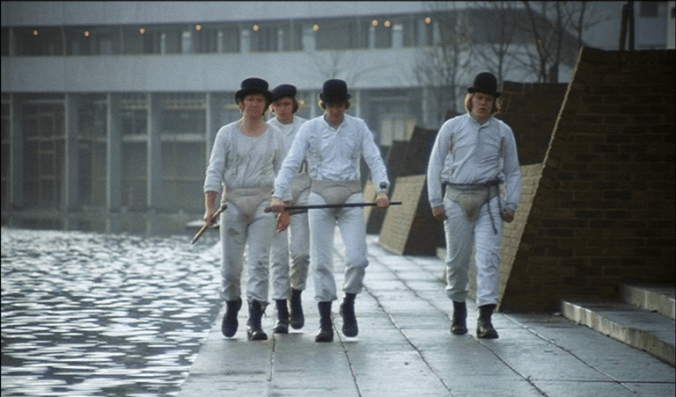
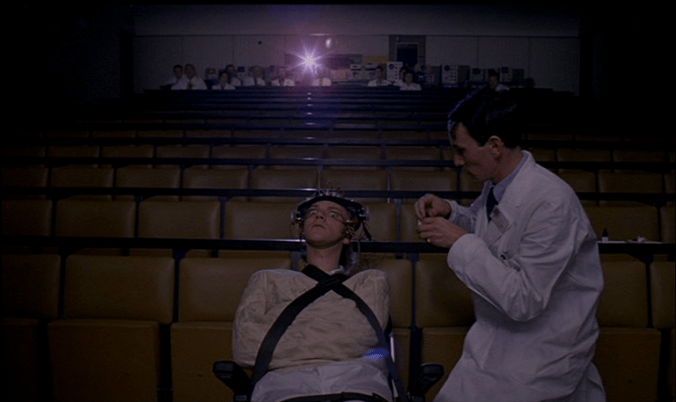
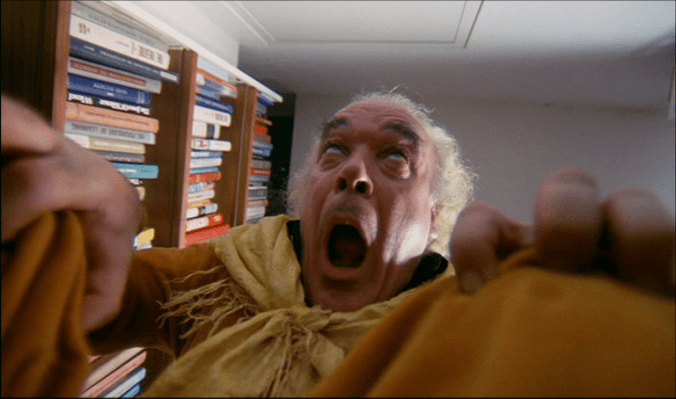
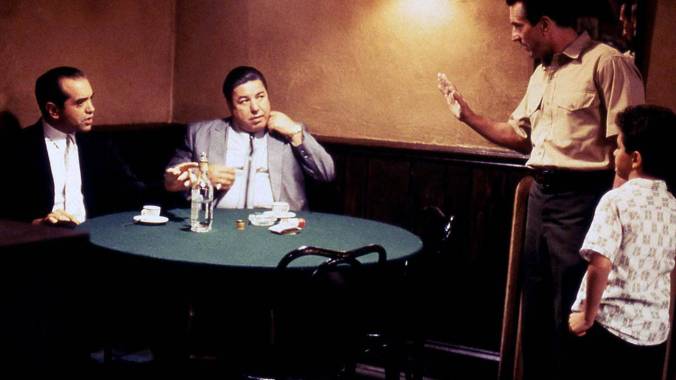
The Elephant Man

The Elephant Man (1980)

Dir. David Lynch

Written by: Christopher De Vore, Eric Bergren, David Lynch (from the medical records of Dr. Frederick Treves)

Starring: Anthony Hopkins, John Hurt, Freddie Jones


As I mentioned when I was writing about Blue Velvet last year, I have been an obsessive fan of David Lynch’s work since I was about 16 years old. That film and Mulholland Dr. were my introductions to Lynch’s cinema, and they were the only films of his that I watched regularly until I came to college. The Elephant Man was actually one of the last Lynch films that I saw, never seeking it out until it was screened in a class that I took when I was a junior in college. At the time, the movie felt decidedly out of step with the rest of Lynch’s oeuvre, with its period setting and traditionally romantic narrative sticking out like a sore thumb among Lynch’s less direct, more decidedly surreal output. However, as I’ve spent more time with the movie, and as my own opinions on Lynch’s cinema have changed and evolved over the intervening decade since my introduction to The Elephant Man, I’ve discovered that it absolutely fits into Lynch’s strange filmography and shares a distinct affinity with much of his more overtly experimental and strange output.

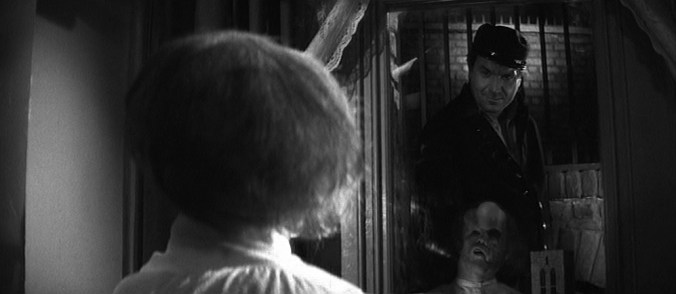
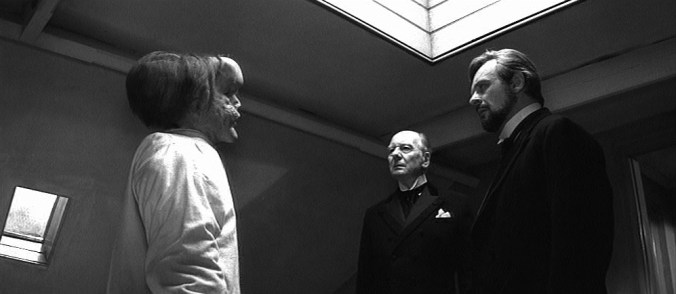
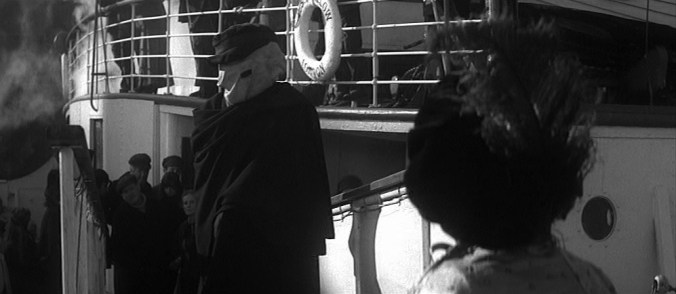
Based on the true story of Joseph Merrick (although in the film he’s called John), a medical anomaly who lived in England during the end of the 19th century, The Elephant Man focuses on the final portion of Merrick’s (Hurt) life during which he was under the care of Dr. Frederick Treves (Hopkins), and during which he gained a level of fame and notoriety in British society. The film opens with Treves attending a carnival freak show where a cruel and greedy master named Bytes (Jones) is displaying the unfortunate Merrick as an oddity that he has dubbed “The Elephant Man,” due to his unnaturally distorted and enlarged features and the preponderance of tumors that have given Merrick’s skin a hardened, scaly look. While the rest of the audience recoils in horror at the sight of Merrick, Treves recognizes him for what he is: an unfortunate human being afflicted with a debilitating and rare malady. Treves gets Bytes to agree to submit Merrick to medical testing, and Treves presents him to his colleagues at the hospital, where Merrick eventually is allowed to live as a ward. Though they initially assume that Merrick is an idiot, incapable of speech or advanced thought, the medical staff learns through Treves’s work with the patient that Merrick is, in fact, fairly intelligent and is quite capable of thought, emotion, and self-determination. Treves begins to work closely with Merrick, and as the two develop a bond, and the word of Merrick’s unique condition spreads, he becomes something of a celebrity, receiving letters from adoring fans and visits from members of the royal family. However, while he is enjoying the fame of celebrity by day, Merrick is still being subjected to brutal exploitation by night, as a porter (Michael Elphick) at the hospital has begun charging admission to sneak the curious into Merrick’s room where they can gawk at and mock the unfortunate man. Despite this daily torture, Merrick seems to take solace in his relationship to the kind Treves and maintains his quest for some small dignity up until the end.

elephant man 4

Although The Elephant Man would seem to be an outlier in Lynch’s body of work, it actually has more similarities to his other films than might be initially apparent. Though this film and its follow up, Dune, a project fraught with tension and one that Lynch would ultimately disavow, find the filmmaker operating with the least amount of authorial control in his career, decidedly Lynch-ian motifs and themes abound in The Elephant Man. The most apparent aspect of the film that could be considered Lynch-ian is the character of John Merrick, himself. Throughout his career, Lynch has exhibited a fascination with the grotesque, the macabre, and the freakish, and the tale of poor, malformed Merrick is one that the filmmaker would seem to naturally gravitate towards. That he presents Merrick as a pitiable, complex character, rather than a monstrosity is also trademark Lynch, as he has shown a career-long sympathy towards characters in crisis such as Laura Palmer in Twin Peaks or Dorothy Valens in Blue Velvet. Lynch gravitates towards dark subject matter, but he attempts to find the light and the life in the characters that people his films, and Merrick is clearly no exception. Though the film, and by extension the filmmaker, certainly relishes the monstrous reveal of Merrick’s deformed body, a revelation that doesn’t fully come until 30 minutes into the movie, it goes out of its way to emphasize Merrick’s innate humanity and civility from that point on.
elephant man 3

The film’s structure also belies Lynch’s influence. After Merrick arrives at the hospital, the day/night dichotomy that is so often present in Lynch’s work becomes the film’s operative framework. By day, Merrick is able to enjoy his time with Dr. Treves and visitors who look upon him with curiosity, sure, but of a more benign sort. Merrick’s daytime world is one in which he can aspire to some level of normality, and gain a modicum of acceptance within society. By night, however, Merrick’s life is a dark carnival led by the greedy porter, Jim, who is reminiscent of the drunkard Bytes in his exploitation and mistreatment of Merrick. All of the basic humanity that Merrick has been able to achieve through his work with Treves during the days is washed away as Jim turns him back into an inhuman monster, something to be feared and scorned, by night. When he isn’t being tortured by Jim and his band of morbid curiosity seekers, Merrick is tortured by nightmares, his restless sleep interrupted by visions of terrifyingly rampaging elephants. These dreams have a specifically surrealistic bent to them, and are reminiscent of Lynch’s early experimental shorts, particularly in their marriage of monstrous imagery to chaotic, industrial soundscapes. Though he was working from adapted material for the first time in his career, Lynch found ways in The Elephant Man to further his cinematic vision, and established patterns and artistic tendencies that would continue throughout his career.

This was the film that broke Lynch into the mainstream, as The Elephant Man was a major critical and commercial success. It’s interesting to see a filmmaker who would become known as something of an iconoclast working in a more traditional milieu, but as I mentioned, this isn’t some generic film without artistic merit and beauty. The black and white cinematography is at once sumptuous and primal, remarkably beautiful, but not in a gauzy or nostalgic way. Instead, the film’s imagery is suggestive of the dark, dingy world of turn-of-the-century London that Merrick inhabited. The film’s greys recall not just the skin of the elephants that Merrick was compared to, but the cold greyness of industrial machinery. This focus on the industrial is backed up by the film’s soundtrack, which often features a faint, impersonal thrum, as of a distant engine cranking away somewhere. Lynch uses the full array of cinematic tools at his disposal to create a rich and evocative period piece, including the famed actors who perform in the film.
elephant man 2

Though Hurt was not yet a household name in America, which is part of the reason he was chosen to portray the deformed protagonist, Hopkins certainly was established as a renowned thespian by this point in his career. The two actors form a complementary pair, with Hopkins’s mannered, urbane performance giving the film a tranquil bedrock upon which Hurt can do his work. Though it would be easy to dismiss Hurt’s performance as being solely the work of the incredible makeup job that renders him totally unrecognizable, but it requires an actor of great sensitivity and poise to humanize the monstrous Merrick. Physically, Hurt renders Merrick’s anguished movements a grace that a man of his stature and predicament should not have, but the actor’s greatest work in the film is in his voice acting. Hurt uses a strained falsetto, giving Merrick’s voice a querulous timbre, both the result of his facial deformities and his constant mistreatment at the hands of others. Merrick stammers and stutters with the hesitance of a dog that knows it will be beaten for barking. Hurt’s belabored words drip with emotionality, revealing the broken, emotionally responsive and receptive heart that beats inside of Merrick’s chest, while his coal-black eyes reflect the deep despair that Merrick must feel. Merrick is a pitiable character by his very circumstances, but it is Hurt’s sensitive, emotive performance that brings him to life and helps the film reach heights of pathos and emotionality unseen again in Lynch’s filmography. In later Lynch films, displays of raw emotion are highly stylized, rendered nearly inhuman in their dissonance, but in The Elephant Man, Lynch gives in to sentimentality and Hurt’s genuinely plaintive performance shines through. It’s an exceptional and memorable turn.
elephant man 5

Though it might feel like an early career diversion, The Elephant Man is actually an important film in the development of Lynch as an auteur, and one that marked a breakthrough into the mainstream for the director. Though his experience on his next film would likely prompt his turn away from prestige projects towards a personally-focused filmmaking, The Elephant Man proves that Lynch can helm a mainstream narrative film while also imbuing it with his unique cinematic vision. It isn’t a movie that I watch frequently; in fact I almost only bring it out when I’m going through a heavy Lynch phase in which I find myself watching through his entire corpus, but it’s a movie that deserves as much attention as his later masterpieces. The film is enjoyable enough on the merit of its beautiful cinematography and the captivating performances from its leads, but for fans of Lynch’s work, The Elephant Man holds hidden pleasures in its somewhat overshadowed affinities with the rest of his cinema. It’s a movie that I should probably watch more often, because I really enjoy picking out the instances of Lynch-ian weirdness that seep into the film at the cracks. It is probably the one Lynch film that I can unequivocally recommend to anyone, as well.
Dogville

Dogville (2003)

Dir. Lars von Trier

Written by: Lars von Trier

Starring: Nicole Kidman, Paul Bettany


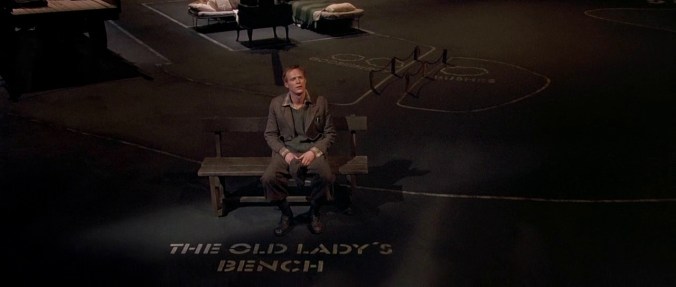
Dogville, in which a stranger named Grace (Kidman), stumbles into a remote town in the mountains of Colorado, where she is reluctantly accepted into a cloistered society and discovers that behind many acts of human kindness there lies an avaricious motive, may be Lars von Trier’s defining masterpiece. The film marries the Danish auteur’s dark thematic explorations with the most radical example of his challenging and ever-evolving visual style. It’s a film that has challenged me since I first viewed it shortly after its release, sometime during my freshman year of college. Like the other von Trier films that I’ve written about, Dogville is a difficult film to “enjoy,” due to its dark and depressing subject matter, but it stands out as a startling and immediate piece of art. The film strips away the artifices of traditional cinema, replacing them with a starkly minimalist visual aesthetic that utilizes chalk outlines on a soundstage to block out its only setting. This extreme minimalism allows von Trier to focus in on the film’s narrative and dig deep into the roots of human nature, revealing a pessimistic, challenging world view that shouldn’t be surprising to anyone who is familiar with the director’s oeuvre. Dogville is a profound film, seeking to explore aspects of the human condition rarely considered, and despite its barren aesthetic, it’s often a beautiful film. It’s an emotionally taxing, mentally exhausting experience to watch, but its host of strong performances and von Trier’s artful directorial choices make for an engaging, unforgettable film.

dogville 3

Dogville is a tale told in nine elliptical chapters and a prologue, in which we are first introduced to the residents of Dogville, Colorado, a mining town hard hit by the Great Depression. Our guide to the town is young Tom Edison (Bettany), a self-styled writer who has rarely put pen to paper, but who doesn’t shy away from trying to inflict his own morality and high-mindedness on the often resistant townsfolk of Dogville. Early in the film, Tom is walking the town’s main street at night when he comes upon a stranger, Grace, who is on the run from a gang that Tom had previously heard firing shots in the valley below the town. Tom agrees to shelter her, but he must first convince the rest of Dogville’s residents to keep Grace secreted away from harm in their village, and many of them are less than eager to put their own safety and tranquility on the line to harbor a stranger, particularly one who may be dangerous herself. However, they eventually consent to offer Grace a trial period, provided that she earn her keep in the town by doing housework and chores for each of its residents. This arrangement continues well for some time, as Grace proves herself to be an asset to the town, and nearly all of the townsfolk begin to warm to her presence, particularly Tom with whom Grace begins a tentative romance. However, the situation begins to become more tenuous and dissolve when Grace’s pursuers, as well as the local police who are in the pocket of the gang, come sniffing around town, raising the stakes for the people of Dogville. Their initial welcoming attitude begins to gradually turn to resentment and suspicion of Grace, as the townsfolk’s true nature starts to reveal itself as they inflict an escalating series of cruelties on the stranger.

dogville 1

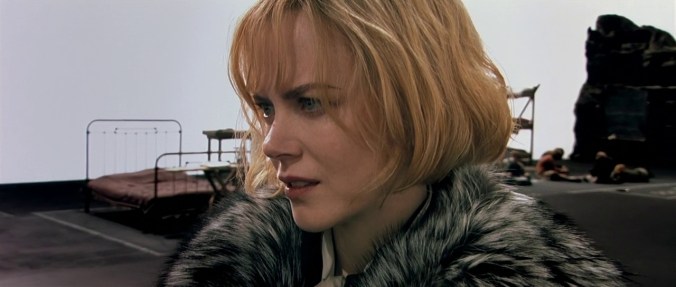
This is von Trier at his most radically experimental, as he’s fully abandoned the realist tendencies of the Dogme 95 movement that he helped to spark nearly a decade earlier, creating a fully stylized and symbolic, if completely minimalist, visual aesthetic. Von Trier has mentioned that his choice to adopt such radical and theatrical staging for his film was an attempt to strip away the distractions of setting so that audiences would focus on the characters, the narrative, and the performances. Another side effect of this chosen visual aesthetic is that it makes the film immediately engaging because it is such a radical departure from the visual presentation of any sort of traditional narrative film. Taking a page from famed theatrical provocateur Bertolt Brecht’s playbook, and staying true to his own theory that cinema should be “as a rock in your shoe,” von Trier presents the audience with a set of distancing effects that counter-intuitively work to foster audience engagement and identification. As there is little to recognize about the physical setting of the film, audiences have no choice but to deeply and personally invest themselves in the characters and their highly-charged chamber dramas. In Brechtian theory, this would then cause the audience member to internalize the performances and undergo a sort of self-reflection, unearthing heretofore unknown truths. As a highly analytical and critical filmmaker, von Trier no doubt is seeking the same sort of agitation and self-examination in his audience, and if they take the lessons and attitudes of the characters in Dogville to heart, the truths that they find reflected may be challenging, to say the least.

Perhaps this is why Dogville is such a difficult and divisive film, appearing on many best and worst films of the year lists when it was released. The suppositions that it makes about human nature, and in particular, about the American national spirit, are confrontational and challenging, if not down-right appalling. Dogville finds von Trier at perhaps his most misanthropic, sometimes giving the impression that he sees the characters (and perhaps even the actors portraying them) in this morality fable as specimens to be studied, rather than humanistic equals. The coldness that he shows towards his subjects is reflected in the coldness that is revealed to be at the core of their beings. Dogville is a film without any “good guys,” where no good deed goes unpunished, and the strong ultimately lord over the weak and powerless. The quickness with which the townsfolk turn to abusing, and taking advantage of Grace is horrifying, and the savagery to which they descend is shocking, but to von Trier, those traits are true to the selfish, rapacious nature of the human animal. We have seen before in his films that his worldview is bleak and uncompromising, but in Dogville there are no pure souls, no Selma or Bess, to point towards the existence of decency or goodness in the world. When Grace finally gains her comeuppance on the townsfolk and watches them murdered and the town burned, there’s little satisfaction in the revenge for the audience, because it is we that she is dispatching of, at the same time that it is we who are gleeful in the killing. Audiences are indicted as killers regardless of whom they choose to identify with, and are left with a preponderance of difficult questions about their own position on the nature of human kindness and charity.

dogville 4

Even in a film so bleak, however, and so coldly antihuman, there are many moments of warmth, primarily supplied by the excellent performances of the cast. Although there are several great performances in Dogville, Nicole Kidman owns this movie with her performance as Grace. Released at the same time that she was starring in prestige period films such as Cold Mountain and The Hours, for which she won an Academy Award, Kidman’s performance in Dogville seems to sometimes get overlooked. Perhaps it is the film’s overall divisiveness that led to Kidman not receiving much mainstream consideration for awards or commendations, but what vibrancy there is in the film is directly related to her performance. Kidman is radiant in the film, both in her performance and physically, as she is often shot in golden light that reflects in her red hair and seems to make her personage glow. Early in the film, her kindness is palpable and it begins to seep into the dark crevices of Dogville, inflicting itself onto the town’s hardened residents. The film also requires Kidman to demonstrate extreme range as an actor, as her character is taken on an extreme emotional journey over the course of the film, experiencing and embodying fear, happiness, humble service, love, distress, resignation, shame, and moral vengefulness, among many other complex and difficult to convey emotional states. Though the performance may not be as singularly memorable as Bjork’s in Dancer in the Dark, Kidman’s Grace is equally as impressive. The performance is less outwardly expressive and showy, more inwardly-focused and nuanced.

dogville 7

Kidman headlines an impressive assemblage of talent, with several other standouts in supporting roles. Von Trier is often able to find himself working with some of Europe and America’s finest actors, and though they don’t always find the experience of working with the famously irritable and demanding director to be a pleasant one, he usually draws great performances out of already talented actors. Dogville is no exception, with famous character actors such as Ben Gazzara and Philip Baker Hall turning in great performances as lonely, but ultimately reprehensible, older men, alongside film legend Lauren Bacall whose Ma Ginger at first seems to be a sweet, if reclusive, matriarch, but whose vitriol becomes evident by the film’s end. Of course von Trier regular, Stellan Skarsgård, makes an appearance as Chuck, a hard working father who resents Grace for what she represents as an outsider who had previously enjoyed a life of luxury. Chuck is the member of the town who harbors the most outward animosity towards Grace, and Skarsgård plays him terrifyingly well, embodying seething resentment and a physical type of malice. John Hurt’s familiar, soothing voice is used to great effect as the film’s narrator, helping to set the scene, and providing near-ironic counterpoint through his calm voiceover narration of events that are rapidly descending into cruelty. In fact, nearly all of the film’s supporting cast stand out in some way, with Kidman’s co-lead, Paul Bettany, being one of the more forgettable aspects of the film. He is fine as the naïve, moralizing Tom, but he doesn’t really add much to the film through his performance. I don’t say that to diminish Bettany’s performance, but more to point out how difficult it is to stand out among a field of such accomplished actors.

Von Trier handles the ensemble cast masterfully, though. His earlier films were often focused on highly intimate and personal narratives that centered on a dynamic female protagonist, and though Dogville certainly is that, the film sees von Trier expanding that focus to provide the sort of character depth and interiority that he previously explored on the individual level to a society. He allows the audience to get to know the citizens of Dogville gradually, affording each one enough screen time to develop their own personality, and to properly inform their motivations and behaviors. He’s brought in actors intuitive enough to make the most of small gestures or bits of terse dialogue, and the result is a town that actually feels as if it could exist. In spite of its lack of visual specificity, Dogville is clearly mapped out, quite literally, and the interactions and relationships existing between its residents feel true to life. Their petty disputes, and their over-familiarity with one another will ring true to anyone who has spent time living in a small town, and perhaps this is what makes their monstrous turn in the film’s second half all the more disturbing. The people of Dogville are people that we, the audience, know. Again, they are us. Dogville is a studied portrait of the callousness of modern human society, from the perspective of a filmmaker who often doesn’t include himself in the larger strictures of human society, and though its scope may be played out on a more violent and even Biblical scale, it hits the nail on the head at the rottenness that is often at the core of people’s petty slights and swipes at their neighbors.

dogville 2

Dogville is not a film for most people. It’s too avant-garde, too pretentious, too graphic, too nihilistic and misanthropic, to really cater to many audiences. Obviously, I am in the camp that considers it a masterpiece, which really shouldn’t be surprising given my affinity for von Trier’s other films. I don’t necessarily agree with the film’s totally bleak take on human nature and society, but I appreciate its provocative stance and von Trier’s willingness to be totally unrelenting in his vision, both aesthetically and in terms of his presented worldview. I enjoy films like this, ones that force their spectators to question aspects of their own identity or their own nature. I think that for every film that celebrates the beauty of life or of art, there should be another artfully challenging those assumptions and presenting necessary counterpoint. Life certainly isn’t all sunshine and flowers, and neither should our art be. Though I don’t recommend that anyone, myself included, watch Dogville often, I do think that it’s a film that people should at least try to engage with once in their life. It’s a stylistically audacious work of art that seeks to shake viewers out of their complacency and challenge their core beliefs. It’s a good thing to be shaken up from time to time.

Dog Day Afternoon

Dog Day Afternoon (1975)

Dir. Sidney Lumet

Written by: Frank Pierson (from the magazine article by P.F. Kluge and Thomas Moore)

Starring: Al Pacino, John Cazale, Penelope Allen, Charles Durning


Dog Day Afternoon is one of the oldest DVDs in my collection, both in terms of its place on my shelf and in terms of the actual production of the disc. I would imagine I purchased it sometime in the early 2000s, shortly after buying the Playstation 2 that my family used to play DVDs, probably on a whim based on my affinity for Al Pacino at the time. I know that I hadn’t seen the movie before owning it, and I’m fairly certain that I was only tangentially familiar with it and its subject matter. As a crime movie from the 1970s, with a highly pedigreed cast and director, Dog Day Afternoon fit squarely into my wheelhouse during my teens, and it became one of my favorite movies during that time. It’s a classic crime movie that I don’t think gets enough credit today for being as interesting and influential as it really was. Though I don’t watch Dog Day Afternoon with any regularity anymore, I think that some of its subject matter has only become more relevant in the 21st century with the advent of reality television and social media.

The film is based on the real-life robbery of a Chase Manhattan Bank branch in Brooklyn in 1972. In the film version, the robbers are Sonny (Pacino) and Sal (Cazale), who are woefully unprepared and ill-equipped to pull off the heist. The inept robbers have arrived after the bank’s deposit has already been collected for the day, so there is just over $1,000 left in cash in the bank. To make up for his miscalculation, Sonny decides to steal traveler’s checks and prevent them from being traced by burning the bank’s check register. However, the bank’s neighbors see the billowing smoke coming from the building and call the police, prompting the robbery to turn into a true hostage situation, as Sonny and Sal barricade themselves inside the bank with the employees. What follows is a tense standoff between Sonny and police Sergeant Moretti (Durning), in which Sonny attempts to negotiate a way out of the situation for he and Sal, while Moretti tries to ensure the safety of the hostages in the bank. A huge civilian crowd starts to form, as the situation devolves into a circus, with Sonny repeatedly attempting to incite the crowd and the police, clearly enjoying his brief moment of notoriety. Though he feels that he has total control of the situation, and that he will be able to extricate himself and Sal from the bank safely, it becomes clear as the hostage situation extends further and further into the night that there likely won’t be a happy ending.

dog day afternoon 6

The thing that’s immediately fascinating to me when watching Dog Day Afternoon in 2018 is how prescient and immediate the movie feels. Though perhaps not as much as Lumet’s next feature, Network, this film feels like, with very few alterations, it could have been made today. Though it’s been a feature of news media since the advent and proliferation of cable news, the type of instant celebrity embodied by Sonny in Dog Day Afternoon feels like a very modern phenomenon. Social media and the constant news cycle keep viral stories, such as the one presented in the film, in the public eye much more easily, and they allow for access to breaking news as it happens. It would be very easy to imagine a remake of the film in which the crowd doesn’t gather around the bank, but rather engages with the hostage situation via a Twitter feed, with the police not having to worry about the opinions of just New Yorkers, but of people around the world. It would be a more cynical type of film, but, were it made today, I can envision Sonny planning out the heist to further his YouTube brand. The bank robbery and subsequent circus scene that develops surrounding it have the perfect making of a viral marketing stunt, and, knowing Lumet’s other films, I have to imagine that he had at least some inkling of the watered down celebrity culture that was coming in the near future. While Warhol predicted that everyone would have 15 minutes of fame, I think that in modern culture that brief moment can be distilled down even further, and Sonny’s “Attica!” scene is a perfect example of the sort of brief video clip that has come to define viral stardom in the modern age. Lumet was often an acerbic critic of the media, and Dog Day Afternoon needs little creative interpretation to fall in line with some of his other cynical, satirical films.

dog day afternoon 5

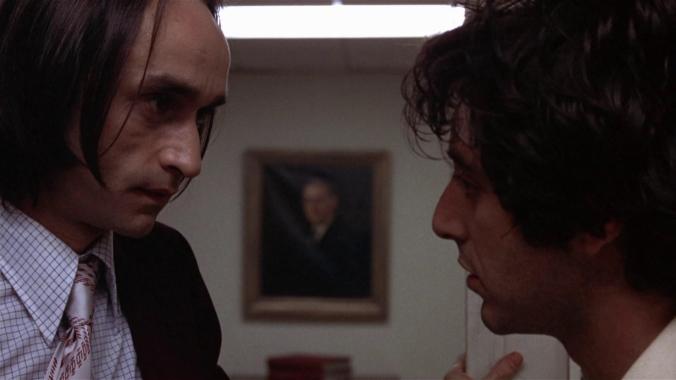
Of course the other aspect of the film that helps it to feel modern and alive is Pacino’s electric performance as Sonny. Delivered at the height of Pacino’s rise to fame, immediately after his star turn in the first two Godfather films, Sonny is my personal favorite Pacino performance of all time. The character is at the same time wired and exhausted, bursting with kinetic energy and mania, but always threatening to collapse in a heap from the stresses his life and his situation have foisted upon him. Pacino gets a (mostly) undeserved reputation for being bombastic and over the top in his performance style, but he plays Sonny to the hilt in this movie, and it absolutely works. He’s physical, he’s histrionic, he certainly gives evidence for some of the more overt tics that would emerge in his style in his later years, but he wraps it all in a believable and effective package, giving Sonny enough nuance to fill in the gaps between his outbursts. He balances his shouting, gestural performance style when hamming it up for the crowd and the police with the quieter moments that he shares with the bank tellers and with Sal, his accomplice. I had forgotten some of the truly touching interactions that Pacino and Cazale share in the film, seeming to genuinely care for one another as friends, and even more so I had forgotten about some of the great moments that Pacino shares with Penelope Allen, who plays the bank’s head teller.

Allen is great in her supporting role as a tough, no-nonsense bank teller who refuses to extricate herself from the hostage situation because she’d rather stay with “her girls,” and ensure their safety. She brings a matriarchal air to the film, but she’s also hardened in a way. She isn’t intimidated by either the robbers or the police, taking ownership of her role as pack leader among the bank’s employees. In many ways, she and Cazale’s Sal are the film’s stabilizing forces. Cazale provides an important foil to Pacino, as he did in the Godfather films. In Dog Day Afternoon, Cazale gets to show off his quiet, stoic side, much different form his better known role as Fredo Corleone. Although he doesn’t have much dialogue, allowing Pacino to do more of the verbose scenery chewing, Cazale’s reserved performance tells the audience everything they need to know about Sal. He’s maybe a bit dim, but he’s loyal and competent, and he’s able to keep a level head as the bank robbery continues to spiral out of control. Though his emotional register remains fairly neutral throughout the film, I always get a bit sad when Sal admits to being afraid to take the jet that Sonny has arranged for them to escape on as he’s never flown before. That extremely human admission, in a very small moment of the film, sells his performance for me entirely.

dog day afternoon 3

The dynamic between Sonny and Sal is an important one in the film, and their opposing demeanors are borne out thematically throughout. Most obviously, the performance styles of the two actors vary wildly, with Pacino’s Sonny more outwardly expressive, performative, and rambunctious, while Cazale plays Sal with a restrained, calm efficiency. Lumet continues this dichotomy through his treatment of the film’s two primary locations, the interior and exterior of the bank. The bank’s interior becomes a still oasis, where Sonny retreats to think and plan his moves, while the exterior becomes increasingly raucous as the crowd of onlookers and police grows throughout the film. The film’s only moments of true physical violence all occur outside of the bank, with Sonny being attacked on the sidewalk by one of the teller’s boyfriends, and of course with Sal being shot at the film’s end. Although this doesn’t take place directly outside of the bank, it still happens outdoors. The bank’s interior, however, is home to moments of emotional authenticity and vulnerability, the vault becoming an important visual reminder of security and refuge. Sal’s aforementioned fear of flying is an example of this vulnerability, as is the bank manager’s (Sully Boyer) admission to Sonny that he has two children at home whom he would like to see again. But the film’s most immediate moment of emotional vulnerability is the scene late in the film in which Sonny finally speaks to his wife, Leon (Chris Sarandon), on the phone. By now, it’s been revealed that Sonny’s motive for robbing the bank was to pay for Leon’s sex change, and though their relationship seems to be contentious at best, it’s clear that the two really love one another. During this brief scene, you can see the realization that he’ll never see his lover again wash over Sonny’s face as Pacino physically slumps, weighed down by the reality of the predicament he’s put himself and everyone he knows in. The quiet resignation in his brief conversation with Leon stands in stark contrast to the bellicosity that Sonny has shown up to that point, and indicates a further layer of the film’s operative dichotomy of wild abandon and homebound safety playing out within his own character.

In Dog Day Afternoon, Lumet hews fairly close to the reality of the event that he’s depicting, with him and screenwriter Frank Pierson knowing a juicy story when they see one ready to be ripped from the headlines. It would be hard not to make the spectacular bank robbery into a good movie, but Lumet’s wry sensibilities and eye for capturing authenticity elevate the film beyond its already intriguing subject matter. He encouraged his actors to largely improvise their dialogue, allowing them the freedom to turn in personal, memorable performances. His sense of pace and of location tighten the film’s narrative and focus. As in any very good thriller, there’s no fat to be trimmed, and the tension is ratcheted up and released at just the right moments. The film strikes a delicate balance as individual scenes are allowed to play out with their natural ebb and flow while the overall work continues its propulsive momentum towards its ultimate, inevitable finale. It’s a slow burn that’s also allowed to crackle and pop from time to time. In short, it’s one of the better thrillers of all time.

The Departed

The Departed (2006)

Dir. Martin Scorsese

Written by: William Monahan

Starring: Leonardo DiCaprio, Matt Damon, Jack Nicholson, Martin Sheen


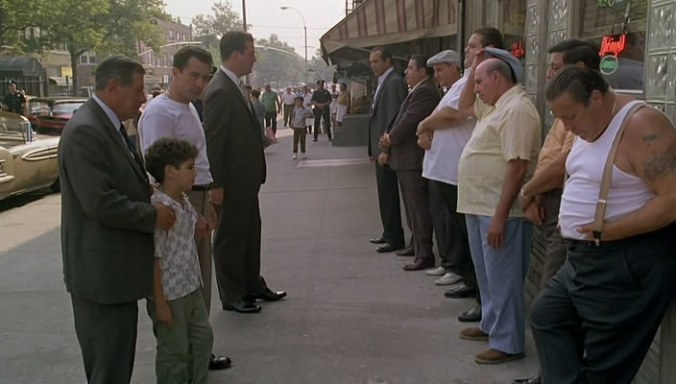
This will likely be an unpopular opinion, but The Departed is lesser Scorsese. At the time of its release, the film was seen as a return to form for the auteur, who had been working away from the crime genre for the most part, spending much of the late 1990s and early 2000s making historical epics and biopics. The film won four Academy Awards, including a Best Director award, Scorsese’s first, and a Best Picture award. At the time of its release, I was as on board as anyone else with the opinion that The Departed is, in fact, a great movie, and that it was justified in being the film that finally brought home a much coveted Oscar for the master, Scorsese. I saw the film at least twice in the theater, and purchased it on DVD as soon as it was released. In the fall of 2006 and into 2007, The Departed was my favorite film. It distilled Scorsese’s directorial trademarks into easily identifiable cues, it featured a talented and broad cast, and it certainly did feel like a return to form for the filmmaker who had been making much less intense, more personal projects. However, with over ten years to reflect back on the film, not only does The Departed feel somewhat less essential than it did back then, it doesn’t even strike me as a particularly good film. I don’t hate The Departed, but the film has a myriad of problems that keep it from being a regular in my viewing rotation, despite my initial fondness for it upon its release.

departed 4

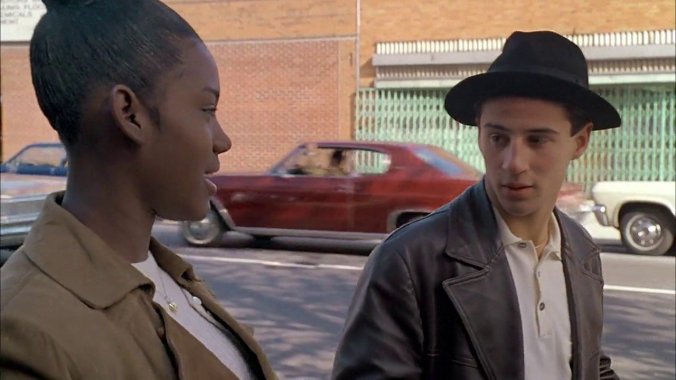
An adaptation of the Hong Kong thriller Infernal Affairs, The Departed is an elaborate game of cat and mouse, with both the police and the criminals inserting moles into each other’s organizations. The film shows us that Irish mob boss Frank Costello (Nicholson) has been grooming Colin Sullivan (Damon) since childhood to infiltrate the Massachusetts State Police as a mole. Eventually Sullivan works his way into the Special Investigations Unit, specifically tasked with bringing down Costello and his crime syndicate. At the same time, the SIU has groomed their own mole, Billy Costigan (DiCaprio), a cadet in the state police academy, to go undercover inside the Costello organization to aid in their investigation. The two men proceed down parallel paths of deceit and double cross until they eventually become aware of the existence of the other. Sullivan and Costigan attempt to find out each other’s identity, while also maintaining the tenuous balance required to protect their own cover. Eventually, the ruse begins to unravel as other members of Costello’s crew are revealed to be informants, and Costello himself admits to being an FBI informant for years. The layers of deceit are thick, and, ultimately, neither Costigan nor Sullivan is able to reconcile his duplicitous nature.

That seems like an overly simple plot summary for a film that features as many plot twists and turns as The Departed, but I feel that much of the film’s complexity is actually facile. The Departed features many of the hallmarks of Scorsese’s cinematic output, but it feels more like a paint-by-numbers than a fully fleshed out project. The film utilizes Scorsese’s trademark soundtracking, and his memorable insertion of classic rock songs into key moments in the film, but for the first time, the trick feels gimmicky. It’s all style over substance, with its flashy patina masking the fact that its narrative is actually significantly less complex than it appears. While the film that Scorsese is adapting, Infernal Affairs, is a taught, grimy crime thriller, The Departed is an overly-serious, bloated piece of work. The film lacks the panache and the humor of Scorsese’s earlier crime films such as Goodfellas, and is a worse film for it. The Departed proceeds with an air of self-importance that it never really earns, providing solid entertainment, but striving through heavy-handed symbolism at a moralism that never really feels fleshed out. The film’s denouement attempts to bring all the pieces of its sprawling narrative back together, but it does so in a way that leaves me feeling unsatisfied. The characters find their resolutions too easily and conveniently, if not often too peacefully, with the film too readily insisting on a neat conclusion in a world that’s been established to exist in moral grey areas. Rather than untying the Gordian knot that its narrative has attempted to tie, The Departed’s final act opts to hack it to pieces with the blade of coincidence and deus ex machina. Its closing shot is almost inexcusably heavy-handed, spoon feeding the audience the symbolic import of its image.

departed 3

That isn’t to say that The Departed doesn’t have its redeeming qualities. It does have some elements of genuine intrigue. The film often harkens back to Scorsese’s explosively violent work of the 1990s, with Costigan in particular showing himself to be an able vehicle of violent retribution. The scenes in which he is easing into his role as a soldier in Costello’s organization are some of the film’s most interesting, because they leave a question as to how much of the violence is Costigan playing out a role and how much of it stem from his latent destructive urges. DiCaprio plays this role well, and this seems to be one of the first indications that he would go on to become more than just a teen heartthrob. His Costigan is paranoid, conflicted, and violent, attempting to stay one step ahead of both Costello and Sullivan, while maintaining his own sanity in the face of the pressures of living a double life. DiCaprio plays his role with an appropriately desperate edge, a manic energy pervading his performance that will become familiar in his performances over the next decade. He doesn’t reach the heights of performance that he did in his earlier pairing with Scorsese, The Aviator, but DiCaprio is one of the lone bright spots in the film from a performance standpoint. Perhaps DiCaprio stands out so much because his counterpart in the film, Damon, seems to be phoning in his performance. He doesn’t seem to bring any of the psychological or emotional complexity to his role that DiCaprio does, and he relies on his Boston accent to do much of the work in his performance. Damon is solid, but he doesn’t shine.

Nicholson is a disappointment, as well. Solidly into his hammy later career, Nicholson’s Costello is a stereotype of a gangster. He seethes cruelty and anger, but rarely steps outside of this emotional register. In a film where the arch criminal is revealed to be an FBI informant, Nicholson doesn’t bring any moral ambiguity or nuance to the character. It isn’t that the performance is poor, but with a character as dynamic as Costello, Nicholson should be able to do more. Costello seems more sleazy pervert than criminal mastermind, and his decision to become a rat doesn’t seem to wear on him psychologically in any way. He’s simply acting out of self-preservation, and any larger examination of the character’s psyche is left out. This kind of psychological short-shrifting is fine for a minor or even a supporting character, but when you’re trying to make the type of prestige film that The Departed badly wants to be, a bit more probing into the personal life and mind of one of your three principles is required. I’m ok with a performance strictly being for comedic effect or shock value, and I think that Mark Wahlberg’s bombastic Sgt. Dignam is exactly that and I love it, but you have to expect more character development from one of the three main characters in a prestige drama.
departed 1

I’m not totally certain when the bloom came off of the rose for me with The Departed. As I said, it’s a movie that I wholly enjoyed and sang the praises of for a full year after its release. Maybe it was after seeing Infernal Affairs a couple years after The Departed and realizing what a tight, well made thriller the original film is. Maybe it was simply that the lengthy interim between my last viewing of The Departed and this viewing for my post had cast the film in the positive light of nostalgia for me, although I don’t think so. I think that, truly, I always knew that The Departed wasn’t the great movie that it purports itself to be, but I got carried away in the newness of it because it really is a fun movie a lot of the time. I certainly have issues with the film, but it has some enthralling moments of action that break through and grab the viewer. The overall package doesn’t warrant the sort of high praise the film often receives, but there are fleeting instances of a great crime drama within The Departed. Unfortunately, they’re so buried in the artificially complex narrative twisting and turning that the film insists upon that they rarely get the chance to connect in a meaningful way.

The Deer Hunter

The Deer Hunter (1978)

Dir. Michael Cimino

Written by: Deric Washburn

Starring: Robert De Niro, Christopher Walken, Meryl Streep, John Savage


The Deer Hunter stands as a landmark of 1970s filmmaking, winning critical and audience acclaim, and enduring throughout the years as one of the representative filmic explorations of the Viet Nam War and its effects on individuals and on American society, as a whole. The film is a thoughtfully crafted ensemble drama that goes further than many films of the time to depict the lasting horrors of war, and the mental scars that stayed with American soldiers long after they had returned home from Viet Nam. The Deer Hunter was a must see for me when I was a teen, as I was a big proponent of 1970s American films, the movement that is often referred to as the New Hollywood, and this film is often seen as one of the defining films of the movement. The movie has remained on my shelf for all these years since, going largely unwatched. However, when I sat down to watch the film again, over a decade since my last viewing, I was struck by the way that it exists in my head as a film of impressions. The Deer Hunter’s iconic scenes are instantly memorable: its Viet Nam scenes are gritty and intense, while the scenes back home in rural Pennsylvania are light and airy, with an undercurrent of sadness and nostalgia. The interstitial segments of the film were hazier, but they were ultimately the moments that made the film for me upon this viewing. The Deer Hunter’s cinematic climaxes are epic, but it’s the quieter moments that have been resonating with me over the last few days as I’ve turned the film over in my mind.

deer hunter 1

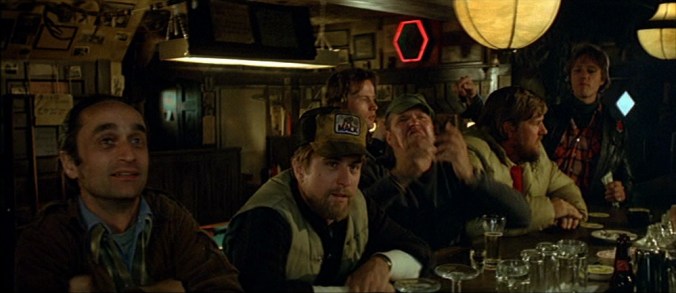
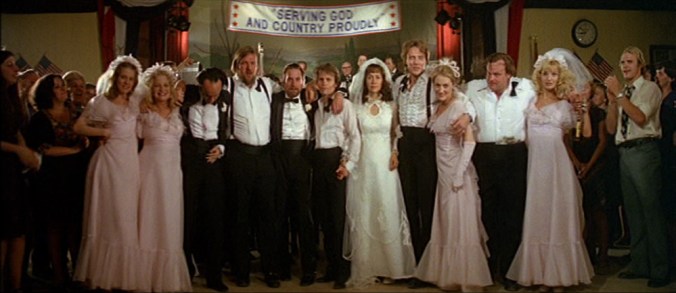
The Deer Hunter opens in the late 1960s in Clairton, Pennsylvania, a mill town just south of Pittsburgh, along the Monongahela River. The film follows three young men, Mike (De Niro), Nick (Walken), and Stevie (Savage), as they prepare to leave their home in the rust belt for deployments in Viet Nam. The film takes its time getting the principles to the war, with Cimino carefully establishing a sense of place in Clairton, and introducing the viewer to the protagonists’ friends and families, as well as their way of life in this typical working class American town. Much of the film’s first act is taken up with a beautifully shot wedding scene, in which the relationships between the friends is established, as well as their anxieties on the outset of setting off for war. Cimino uses these early scenes to establish a holy triumvirate of family, God, and country that rules the lives of his characters, informing their sense of identity. When the film finally arrives in Viet Nam, the pace and intensity are ratcheted up significantly, with all three men being captured by the Viet Cong and forced to play Russian roulette, as their sadistic captors revel in their misery. While these scenes are some of The Deer Hunter’s most memorable, the Viet Nam section of the film is actually quite brief, with Mike quickly leading a daring escape from the makeshift prison. While he and Stevie eventually return stateside, attempting to adjust to civilian life after experiencing the horrors of war, Nick is pulled further into a seedy world of underground betting, where human life is devalued and thrown away. Although Nick is the character who is most obviously lost to his experience in Viet Nam, by the film’s end, it’s clear that all of these characters, even the ones who stayed home during the war, have lost something.

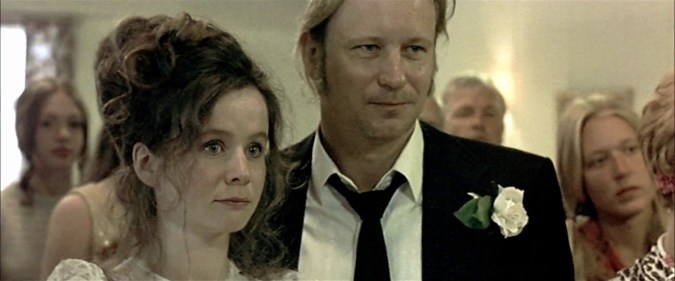
This film is an epic in every sense of the word. It is over three hours in length, and sets out to depict the ravages of war, not just on the individual, but on society as a whole. Cimino famously clashed with producers and his studio about the film’s runtime and its controversial, graphic, and intimate depictions of violence, but ultimately the film that he delivered feels important and necessary in its scope. The Deer Hunter has the impact that it does precisely because Cimino takes his time to establish a sense of place and normalcy early in the film through the scenes set in Clairton. Without the deliberate pacing of the film’s first third, the overall psychological and societal devastation that the Viet Nam war has on these characters wouldn’t be as profound. The locations, the traditions, and the people in these scenes will be familiar to anyone who has ever lived in small town America. Cimino revels in showing these working class traditions up close, dropping in on intimate moments in both churches and bars, letting his camera casually investigate the culture of this particular Southwest Pennsylvania hamlet. The lengthy wedding scene that dominates the film’s first act is a beautifully shot celebration of this type of specific small town tradition. Traditional conservative values of religious piety and family togetherness are fully on display, and traditional gender roles and machismo are reinforced throughout the scene, but cracks start to show in the façade of traditionalism through the anxieties that Stevie, Nick, and, especially, Mike, begin to subtly express regarding their impending deployment. As the wedding reception continues and the men get drunker, their reservations about leaving their familiar homes for a killing field on the other side of the globe become ever more apparent, acted out demonstratively against a backdrop of ostentatiously draped American flags. The film’s opening section lays the groundwork of normalcy that will be eroded by the toll that the Viet Nam war takes on all of the characters.

deer hunter 2

When the film abruptly shifts its focus to Viet Nam, the pace quickens and the intensity is ratcheted up, dropping the audience in country immediately before Mike, Nick, and Stevie are captured and held as POWs by the Viet Cong. While the cast does good work early in the film depicting the internal turmoil that the characters are experiencing regarding their deployment, De Niro and Walken, in particular, shine in the Viet Nam segments. De Niro plays Mike with a determination bordering on insanity, born of a promise that he made to see his friends home safe from the war. The intensity of his performance is matched and exceeded by Walken, who internalizes the trauma that his character has experienced, and who plays Nick as a shell of a man in the film’s second half. While he doesn’t play Nick with the outwardly demonstrative aggression of De Niro’s Mike or the histrionic emotional register of Savage’s Stevie, Walken’s Nick is unforgettable, hollow and haunted. His characteristically stilted line delivery benefits this performance, as well, as Nick seems to be communicating on a different emotional and cognitive level than the characters around him. All three of the actors are tasked with giving dynamic performances that require them to portray genuine celebration and happiness during the film’s beginning and slowly descending into emotional vacancy by the film’s end. They all deliver admirably, making clear the subtle shifts in personality and emotionality that the trauma of imprisonment and the constant threat of death has rendered in their characters.

The supporting cast provides solid work around the film’s stars, as well. The three protagonists leave behind them a network of friends and family in Clairton, and the film’s third act, with Mike’s return home from the war, shows the ways that the war has changed people on the home front. A very young Meryl Streep plays Linda, Nick’s, and eventually Mike’s, girlfriend. Initially, the character was poorly scripted, and Cimino encouraged Streep to flesh the character out, bringing her own ideas and feelings into the performance. Streep’s talent is obvious, as she’s able to easily convey without words the sort of pained longing that war brides must always experience. Linda has to stay strong, working her job at the Giant supermarket, and keeping up the house that she, Nick, and Mike shared, without any knowledge of if or when her lover might return. When Mike finally does return home, it’s obvious that his time away has seen Linda go from a happy, smiling young woman to a ball of frayed nerves. Streep’s performance is full of the little details that communicate more information about a character than voice over or monologue ever can. The way that she clings to Mike’s arm when he walks her to work, or the way that she perches in her chair after all the guests have left from Mike’s aborted homecoming party give a window into the quiet suffering that her character has had to endure. John Cazale is equally strong in his final performance. He plays Stan, a friend who didn’t go to war with Mike, Nick, and Steve, and who can never really understand the experiences that they’ve shared. Stan’s blustery bravado and penchant for pistol-toting provide a screen for the fact that he was too cowardly to go to war like his friends. Cazale’s cocksure performance belies the fact that his health was rapidly deteriorating from cancer. He wouldn’t live to see the film’s completion, but his final performance offers a nuanced look at the crisis of American masculinity during the 1970s. Stan is a typical working class American man of his time, attempting to paper over his personal inadequacies with a hard-drinking, hard-headed lifestyle, while at the same time, the nation as a whole was struggling to reconfigure its own identity in the face of military embarrassment abroad and societal upheaval and the beginning of the end of American industrial dominance at home.
deer hunter 5

More than just a film about war or violence, The Deer Hunter is really an elegy for a way of life that was rapidly coming to an end at the close of the 1970s. Real life towns like Clairton all over the rust belt were beginning to die out, as steel mills and factories closed, and the livelihood of the American worker was challenged. The trauma of war may have broken Nick, and driven him down a rabbit hole of destruction and nihilism in Viet Nam, but Mike’s difficulty in assimilating to civilian life shows that Nick may have never been able to come home anyway. The town that they left wasn’t the same one that Mike returns to at the film’s end, and the prospects for him finding peace and meaning in the future seem bleak. The Deer Hunter’s final scene is beautiful, as Nick’s family and friends gather together to mourn his passing, and they all join in a slow, mournful rendition of “God Bless America,” as they share a meal together. Though it’s Nick that they’re ostensibly mourning, they are also recognizing the passing of a way of life, a societal sea change. The war is the catalyst for change in the film, but it’s also symptomatic of a larger shifting of values and lifestyles both in the film, and in the society into which it was released in 1978. The final scene’s tone is nostalgic, but also cynical, as if Cimino recognized the American dream had long since died out, and the patriotism expressed by his characters as they sing “God Bless America,” is an attempt to grasp at the remaining straws of normalcy.

deer hunter 8

The Deer Hunter is a difficult movie. The strains of its production and the fights between Cimino and his studio are apparent when watching the film. I don’t mean that the end result seems flawed or complicated as a result, but that the tension and passion involved in creating this film are palpable in the final cut. Ultimately, it seems that Cimino was able to keep much of what his studio deemed objectionable in the final cut, and The Deer Hunter is a better film for it. It’s a film that attempts to depict one of the most fraught and difficult portions of American history, and its broad scope allows it to present the central problems of the period in multiple lights. The Deer Hunter is unique among war films in the amount of attention that it pays to the home front, and the parallels that it draws between war and overall societal downfall. The film is doubly difficult in that it doesn’t provide any real answers to the societal problems that it documents, instead leaving its viewer with a profound sense of sadness and cynicism. However, it is a film that is well worth watching. Viewers sitting down to enjoy a war movie might be turned off by the film’s initial hesitance to deliver on the promise of action, but to really appreciate The Deer Hunter, you have to get a sense of the entire tapestry that Cimino has woven.

Dancer in the Dark

Dancer in the Dark (2000)

Dir: Lars von Trier

Written by: Lars von Trier

Starring: Björk, Catherine Deneuve, David Morse, Peter Stormare


It isn’t exaggeration to say that Dancer in the Dark is the most impactful film that I’ve ever seen. When I first introduced myself to the movie around 2002, at the age of 16, I hadn’t yet experienced a film that could be so heart breaking, so emotionally overwhelming. I had seen brutal horror films that inspired revulsion and fear, and a handful of films that were dripping with pathos like Roberto Benini’s Life is Beautiful, but nothing that had left me feeling as hollow and tired as that first time I saw Dancer in the Dark. The film is a portrait of human suffering, but it also examines the desire of the human spirit to persevere in the face of overwhelming odds and the desire of a mother to provide a better life for her son. Even though that first viewing was an emotionally devastating experience, the film very quickly became a favorite, and a film that I have returned to over and over again through the years. From Lars von Trier’s unique vision of a musical fairytale, to Bjork’s riveting, one-of-a-kind performance, I was fascinated by the film. Its soaring moments of fantasy and its sobering examinations of cruelty drilled their way into my brain, opening my mind to new possibilities of film style and of filmic representation. I’ve since seen films that more thoroughly or accurately examine emotion through cinematic art, but you never forget your first one, and Dancer in the Dark is a film that I owe a debt of gratitude to for changing my expectations of the cinema.

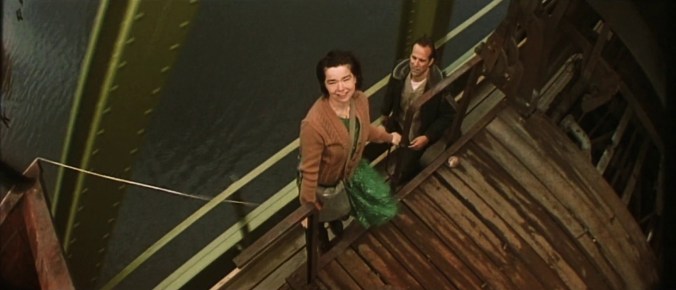
Dancer in the Dark is the final film in von Trier’s “Golden Heart” trilogy, and it operates as a fairy tale, similarly to Breaking the Waves. Another period piece, this time set in Washington State in the early 1960s, the film follows a similarly naïve protagonist, Selma (Björk), a single mother who emigrated from Czechoslovakia hoping to find better opportunities for herself and her young son, Gene (Vladica Kostic). Selma suffers from a hereditary vision condition, in which her eyesight has worsened to the point of near-blindness, and her only concern is saving up money so that her son can afford an operation that will reduce his chances of succumbing to the same dark fate. Selma’s devotion to her son is such that she is willing to work double shifts in a stamping plant and put together sets of bobby pins that she then sells for extra money, forgoing any creature comforts, simply on the hope that Gene will be able to enjoy a normal life with perfect vision when he grows up. Selma’s only pleasure in life is music and dancing, and she enjoys going to the movie theater to see classic musicals, which her friend, Kathy (Deneuve), must describe to her because her failing vision doesn’t allow her to see the screen. Selma wishes that her life were a musical, and is prone to childish flights of fantasy in which her friends and coworkers join her in elaborate musical numbers, bringing light into her dark existence. Selma’s pitiable fate is worsened when her neighbor and landlord, Bill (Morse), takes advantage of her disability and steals the money that she had been saving for Gene’s operation. Desperate, Selma is forced to go to extreme lengths to try to recover the money, and she pays the ultimate price for her devotion to her son and his future happiness.

dancer in the dark 2

Being bookends of a trilogy, it’s natural that Breaking the Waves and Dancer in the Dark should explore much of the same thematic ground. I’m not particularly interested in comparing the two films or discussing the merits of one versus the other, but watching them close in succession for this project, it’s difficult for me not to think of them together. When I wrote about Breaking the Waves, I wrote that it was a film that, although I admired it, I didn’t watch frequently because of its difficult and depressing subject matter. I have never had that problem with Dancer in the Dark. Though it could be considered a bleaker, more unforgiving, viewing experience than the earlier film, it’s one that I’ve returned to every couple of years, actually searching for the visceral emotionality that the film imparts upon me. I don’t know if it’s Björk’s performance as Selma, full of life and vivacity in the face of extreme hardship, that helps me to connect to this film in a way that I don’t with Breaking the Waves and Emily Watson’s more staid performance. Perhaps it is von Trier providing his take on a classical Hollywood musical through Selma’s fantasies that helps to break through the heaviness of the film, giving us glimpses of light throughout, while Breaking the Waves has the structure of a descent into Hell. Maybe it’s simply the fact that Breaking the Waves arrived on my radar much later in life, whereas Dancer in the Dark was a seminal film for me, and one that I discovered shortly after its initial release, allowing me to approach it in a much fresher context. Whatever the reason may be, I’ve clung to Dancer in the Dark for some 15 years, re-viewing it when I want to be broken down by art, when I want to feel deeply and painfully, when I want to be reminded that even though the world is a savage and cruel place, the love that we choose to hold inside of us is only extinguishable if we allow it to be so. It’s one of my favorite films ever made and a testament to the power of the cinema as an art form uniquely capable of depicting and inducing profound emotional and psychic experiences.

dancer in the dark 4

That being said, Dancer in the Dark is not a film for everyone. I have showed the film to friends over the years, and often I’ve been met with the same response: “Why would anyone want to watch something so unrelentingly depressing?” It’s a criticism that I can only partly understand, because I don’t really feel that Dancer in the Dark is a depressing film. It’s a heavy film. It’s packed with moments of genuine trauma, and it doesn’t shy away from depicting human suffering and cruelty of a heartbreaking magnitude, the whole time inviting the viewer to engage with it on a similarly heightened emotional level. It asks its viewers to cry and feel along with the characters, using techniques of suspense, pathos, and spectacle to produce immense waves of feeling, and I understand that that can be a difficult experience for some. Many people would rather see films that help to distract them from the pressures or troubles of their day-to-day lives, and I like to enjoy light entertainment, as well, but more frequently, I would like to engage with art that challenges me and helps me to explore facets of myself that I wouldn’t otherwise be able to engage. Art can and should be a means towards self-reflection and it should also help to build empathy. I have written often about using films as a window into life experiences and cultures that I don’t have firsthand knowledge of and I think that the same can be said for emotional experiences. While it might be difficult to watch a two hour film in which the protagonist is conned, robbed, commits a murder, and is, ultimately, executed, all while rapidly and tragically losing her eyesight, I find it to be a valuable experience as it helps me to learn about and engage with that suffering, ultimately becoming a more empathetic person. Watching the film is a traumatic experience, but I feel that having vicariously lived through Selma’s suffering, I come out of the experience as a better person.

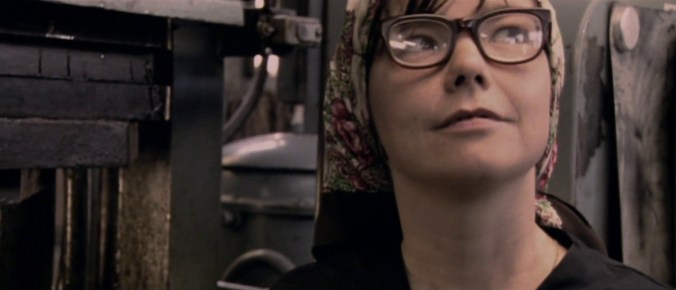
Of course, empathy is only generated if the art is true and if the artists involved are pouring a great deal of themselves into the project. If this weren’t the case for Dancer in the Dark, it truly would be a depressing slog, akin to exploitative emotional pornography, however, largely due to Björk’s powerhouse performance as Selma, the film rings true and proves emotionally relatable. I can’t imagine anyone else but Björk in this role. I know that she is a divisive persona, and that her music and public image are often hard for people to digest, but I am an unabashed fan of her work and I wish that she would do more acting because her work in Dancer in the Dark, while unconventional, is devastatingly raw and true. von Trier takes advantage of Björk’s idiosyncratic voice and performative style in the film’s musical scenes, but he also draws an unforgettable dramatic performance out of her. As a nonprofessional and largely inexperienced actor, Björk’s performance is more defined by intuition than by technical acting chops, but that allows her to fully tap into the range of emotion that she has to portray as Selma. There is no critical distance between the actor and the role, and it’s clear that Björk is pouring every bit of her emotional self into the work. It’s obvious that she is fully invested in the performance, and, in fact, she found the experience of working on the film to be so traumatic that she has largely sworn off acting since. This is truly a shame, because the range that Björk shows in Dancer in the Dark hints at a natural aptitude for this type of performance, with her obviously shining in the film’s uplifting and uproarious song and dance numbers, but also nailing scenes of intensely personal emotional distress when von Trier chooses to strip away the film’s artifice and present us with a glimpse at a character truly in crisis. Björk is equally dynamic when portraying Selma’s quiet determination and her histrionic emotional responses, whether they be of fear, joy, or sadness.

dancer in the dark 1

The rest of the film’s cast is admirable as well. Their relationships to and with Björk’s Selma help to further audience identification and further heighten the sense of emotional empathy that the film strives for. Deneuve is a natural foil to Björk, providing a stability that is critical for both Selma and for the audience. Her Kathy is matronly, strong, and determined to protect her friend at any cost. In many ways, Kathy acts as an audience surrogate, informing the way that the viewer should react to Selma’s idiosyncrasies. She recognizes and celebrates the inherent goodness in Selma, looking beyond the unusual persona that she projects onto the world, and encouraging the audience to empathize with her, as well. Peter Stormare’s Jeff is another fount of empathy towards Selma, though his romantic desires for her largely go unrequited. Jeff is stoic and dedicated, showing up to pick Selma up from work at the factory each day, despite her repeated refusals of his offers for companionship. Though Selma is never cruel to him, it’s hard not to feel badly for Jeff, as Stormare’s typical hangdog performance style grants the character a great deal of pathos. Because he and Kathy so openly show a great deal of love and care for the unusual and sometimes inscrutable Selma, the audience’s bond with all of the characters is heightened. The film creates a web of emotional relations between these characters that feels real. It isn’t falsified, romanticized, or cheapened.

Dancer in the Dark is also the film that awakened my interest in the films of Lars von Trier. I wrote briefly about my relationship to the filmmaker when I was writing about Breaking the Waves, but I don’t feel that I really did justice to the way I feel about him as an artist. von Trier is frequently referred to as an “enfant terrible,” but I don’t think that this moniker really does his work, or his persona, justice. The director often makes headlines for his films’ perceived sadism and misogyny, or for his frequent controversial statements or gaffes in interviews, but I think that often these claims overshadow the true provocation that he provides through his art. I take the accusations of misogyny by his leading women very seriously, including by Björk shortly after filming Dancer in the Dark, however, more often than not, his actresses are the first to defend the filmmaker’s passion and vision, and even Björk has since walked back her stance. The superficial controversies in which von Trier often finds himself embroiled only serve to obscure the fact that though his art is challenging and controversial, he is one of the few filmmakers who seems interested in deeply and meaningfully exploring mental health, sexual power dynamics, and female identity through his films. Whether it is his place as a man to devote his work to these themes is a valid question, but I do think that his films are true, at least to the extent that I can personally relate to them. It’s important to remember that von Trier does not depict only female suffering, even in the “Golden Heart” trilogy. In Dancer in the Dark, Selma’s rich interior world, devoted friends, and boundless love for her son all serve as reminders that her existence is not just one of suffering. In fact, Selma’s death is even more heartbreaking because she is a fully formed character whose demise is snuffing out a vast world of potential beauty and love. von Trier’s treatment of his female characters may be somewhat problematic, but I do think that his representations are almost always respectful, and I truly believe that he feels with and for his protagonists, being far from the sadist he’s sometimes portrayed as.

dancer in the dark 6

I had a conversation recently with a coworker about movies in which the topic of favorite films came up. This is always an impossible question for me to answer. I have a stock answer, which we’ll eventually get to in this project, but really picking a favorite film, for me, would be like picking a favorite child. Instead, I gave him a list of a handful of films that I would be really interested in screening and giving a lecture on. I didn’t mention Dancer in the Dark, but it was in the back of my mind. Aside from Au Hasard Balthazar, it would be my obvious choice for a class or lecture on film and emotion. The films are radically different, although there is a bit of Bresson’s minimalist tradition in von Trier’s modified Dogme aesthetic. I’d likely have to give the nod to Balthazar if I were choosing, simply because of Bresson’s ability to muster the heights of human empathy in a film about an animal, but Dancer in the Dark remains the most emotionally moving film I’ve ever seen. Even after 15 years and more than a dozen screenings, it’s shockingly frank final scene never fails to leave me utterly devastated. I think that Björk’s performance as Selma should be remembered as one of the most unique and emotionally affective performances by an actor ever put to screen. It’s my favorite musical, and despite its imperfect fit alongside the other great films of the genre, it deserves a mention whenever classic musicals are brought up. It’s a film that I know not everyone will enjoy or appreciate, but I do think that it’s an indispensable film that anyone who wishes to educate themselves in the cinema must see at least once.

Cries & Whispers

Cries & Whispers (1973)

Dir. Ingmar Bergman

Written by: Ingmar Bergman

Starring: Harriet Andersson, Kari Sylwan, Ingrid Thulin, Liv Ullmann


By and large, the works of Swedish auteur Ingmar Bergman are a pretty large cinematic blindspot for me. For whatever reason, his films were sparsely taught at the University of Pittsburgh, at least by the professors I had when I was in film school there. I saw Persona in a class my first year of college and really loved it, although I found it fairly inscrutable, and I sought out a few other films of his on my own. For the most part, however, I haven’t given this challenging filmmaker his proper attention. I briefly attempted a deep dive into his filmography around 2012, shortly after purchasing Bergman’s career-spanning autobiography Images: A Life in Film, but his filmography is so deep that I didn’t put much of a dent in it. I still haven’t completed the book, nor have I progressed much further in my exploration of Bergman’s cinema over the last half decade, but even attempting to explore his massive body of work gave me a better appreciation for this master’s art. Though his films are often extremely personal, investigating his own life, history, and relationships, at the same time, they explore universal themes of death, faith, and identity. Bergman’s is a challenging, cerebral cinema, and I think he often gets a reputation of being a cold filmmaker, but his work also plumbs the depths of human emotion, attempting to portray the full scope of human existence. Cries & Whispers bridges this gap somewhat, providing an emotionally stirring narrative that explores the nuances of human love and familial relationships while also holding its subjects at arms-length. It’s a study of the limits of human love and also the propensity of humans for cruelty, a rumination on the meaning of a life.

cries and whispers 4

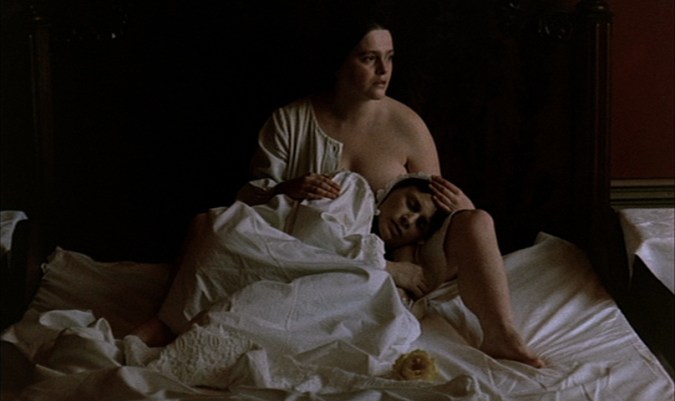
Cries & Whispers, set at the turn of the 20th century, is the story of three sisters, Agnes (Andersson), Karin (Thulin), and Maria (Ullmann), who have been brought together in their familial home because Agnes is dying. As her illness progresses, Agnes’s sisters find themselves unable to provide her with any comfort or empathy. Instead, they sulk and pout around the isolated mansion, leaving Agnes’s care to the family’s dedicated servant, Anna (Sylwan), who is Agnes’s only source of comfort in her final days. A series of flashbacks, one focusing on each woman, explore the incidents in their interconnected lives that have brought them to this place of resentment and have shaped them into the women they’ve become. Being in the family home also seems to bring these feelings of jealousy and malice to the forefront for the women as Maria and Karin begin acting increasingly hostile towards each other, and particularly towards Anna, whom they intend to fire once Agnes dies. Upon Agnes’s eventual death, Karin and Maria are forced to recognize their callousness and their failure as sisters, but they are ultimately too driven by their own selfish desires to allow for proper reflection, and they choose to return to their bourgeois lives, forever closing the door on their past.

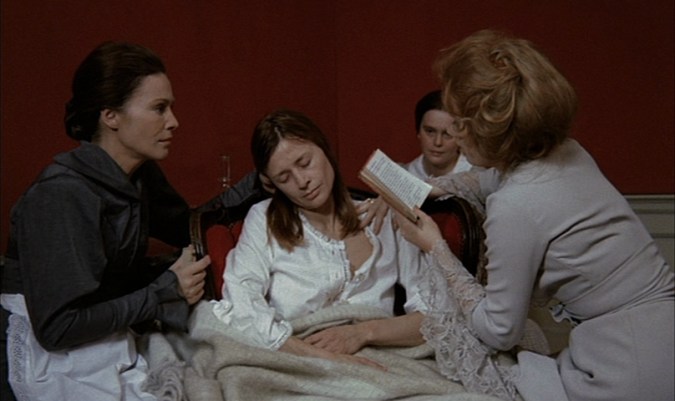
Like the other Bergman films that I’ve seen, Cries & Whispers is richly symbolic, its narrative and visual compositions both densely packed with information. Unlike other Bergman films that I’ve seen, which seem to purposefully hold both their subjects and their audience at arm’s length, Cries & Whispers is an enveloping experience. Bergman has said himself that all of his films “can be thought of in black and white, except for Cries & Whispers,” and it’s true that the film’s distinctive red color palette is its defining quality, creating, to me, a womblike atmosphere in the film that makes me feel totally ensconced in its chamber drama. This is a film of suggestion, hinting at states of heightened emotion through its rich swaths of color and Bergman’s impressionistic direction. The title is perfect, as the text communicates with the audience in sharp, startling cries through its memorable visuals, while the characters therein are able to communicate with one another only in whispers, if at all. Maria and Karin find themselves totally cut off from any emotional response, unable to connect with one another on any meaningful level, although they attempt to feign concern for their dying sister. Though it provides only sketches of backstory for its four central characters, with its flashbacks feeling purposefully elliptical, the scant details the audience is granted allow for a deep understanding of the various women’s psyches. All three sisters suffer from a deep-seeded repression, and the film’s refusal to fully unleash all of its mysteries is a perfect mirror of that denial. The film’s structure makes for a beautiful suture of form and content, as the its setting of the familial mansion forms a hermetically sealed environment made up of disparate rooms, reflecting the sisters’ detached relationships and closed-off natures. Its red walls, at the same time soothing and intimidating, are representative of the storm of emotions bubbling under these women’s calm surfaces. The white dresses that Karin and Maria wear during the early parts of the film stand in stark contrast to the overwhelming red interiors of the home and serve as visual reminders of their attempts to maintain their states of emotional detachment. Both women have reasons for retreating into themselves, each having experienced traumas in her marriage, and though the film is largely observational, refusing any ambitions towards melodrama, watching Karin’s and Maria’s emotionally stunted state is heartbreaking.

cries and whispers 6

The performances across the board are superb, with Ullmann and Thulin as Maria and Karin, respectively, bringing differing motivations to characters who have ended up in similar emotional and psychological places. Both characters are icily cold, but Ullman’s Maria is more manipulative and active, while Thulin plays Karin as defeated and reserved. Karin’s emotional repression manifests itself in a self-destructive tendency, while Maria’s is more outwardly cruel and harmful to others. Regardless, both actresses perfectly portray the agonizing reality of being unable to express the host of human emotions that are raging internally. Their resentment for each other, as well as for their dying sister, is apparent, and it is only magnified by the film’s intense color scheme. Bergman often chooses to focus closely on his actresses’ faces, leading into each character’s individual flashback with a lengthy facial close-up, lit by alternatingly naturalistic and artificial red light, and their blank expressions staring directly into the camera are memorable, but it’s the tiny tics and attempts at human connection that Ullmann and Thulin bring to their roles that stick with me after multiple viewings.

cries and whispers 7

Sylwan’s Anna is the film’s emotional core. Her obvious goodness is the natural counter to the contempt that Maria and Karin exude. Unlike the sisters, Anna is deeply in touch with her emotions and her faith, providing genuine love and care to the dying Agnes. Sylwan’s performance lends Anna the quiet dignity of the meekly pious. As a servant, her role often relegates her to the background, but she has an important role to play in the dynamics of the household. We see that Anna has suffered as much, if not more, than Maria and Karin, having lost a child. However, Anna’s faith is strengthened by her suffering, and rather than turning inwardly, she has devoted her life to loving service. Anna is the only character in the film who offers any genuine kindness to Agnes, and it is implied that through this kindness, Agnes is able to finally experience some of the beauty of life in her final days after years of being deprived of the familial love that she has craved. Anna shares a strong religious faith with Agnes, and in the end, it is their optimistic point of view that is reinforced by a coda that features Anna reading from Agnes’s diary, negating the staid, emotionally repressed viewpoint of Karin and Maria. All of the performances are naturalistic and haunting. When combined with the film’s overall visual aesthetic and tone, they create an atmosphere of mystery, with small gestures containing monumental significance and personal character history only vaguely implied but easily perceived and understood.

Cries & Whispers is a profoundly challenging film, representing, as it does, extremes of human emotion and suffering. It’s a painful watch, and the cold indifference with which the characters hurt themselves and one another, with Maria and Karin waging cruel psychological warfare, can be tough to watch. For viewers who choose to wade into the claustrophobic examination of trauma that is Cries & Whispers, though, there are rich cinematic rewards. I feel similarly about this film as I do towards Bresson’s Au Hasard Balthazar, which I have written about as one of my favorite films and one of the most important films to me. Though my personal affections for Cries & Whispers are not as strong, I feel that it is a similarly prescient look into the emotional human experience, although perhaps from a more cynical viewpoint than that of Bresson’s film. While Bresson was, admittedly, a man of strong religious conviction, Bergman was possessed of no such religious faith, opting instead to approach the questions of God and the universe through close examination of the human psyche. Bergman used the tools of the cinema to delve into the depths of human psychology, seeking to use the filmic image to create a language to express not just tangible reality but also the psyche, identity, and emotion. It is this examination that informs the masterpiece of modernist filmmaking, Persona, and this examination which Bergman expands in Cries & Whispers, visually representing emotional states and transmogrifying them into vibrant color, sound, and, importantly, silence. With its elliptical flashback structure, Cries & Whispers mimics the patterns and functions of memory, creating a textual representation of the very workings of the psyche. The film is great enough simply as a narrative film, but as a formal experiment in expanding cinematic language, it is brilliant.

cries and whispers 5

I watched the film twice closely and once distractedly in preparation for writing this post, and each time, like every other time I’ve watched Cries & Whispers before, I was struck with the desire to watch more Bergman. His filmography is daunting in its depth, with well over 50 features made, and his style is not the most accessible, even when judging by the standards of international art house cinema, but I want to make further inroads into viewing his films. The handful that I’ve seen have left me stunned by their visual beauty, their formal and narrative audacity, and their ability to tap into universal truths about the human experience. I’ve written many times that I feel great art should always give its audience cause for introspection and there is no way to come out of the experience of viewing this or any Bergman film without doing serious soul searching. Art should be used as a tool to reveal real, human truths, and Cries & Whispers insists on doing that. The film’s style is decidedly modernist, but the emotions and human truths that it speaks to are something primal. It might not be a comfortable watch for everyone, but it’s a powerful piece of art that demands thought and attention, and that rewards careful viewers with deep insights.

A Clockwork Orange

A Clockwork Orange (1972)

Dir. Stanley Kubrick

Written by: Stanley Kubrick (from the novel by Anthony Burgess)

Starring: Malcolm McDowell


Some months ago, when writing about 2001: A Space Odyssey, I indicated that Kubrick had been my favorite filmmaker throughout my teens and early twenties. Some recent reexamination and rumination on other major films from that time in my life has probably revealed that though he may have seemed to stand head and shoulders above all other filmmakers in my formative years, it’s likely truer that he was one among a handful of filmmakers that have come to make up my personal pantheon. Regardless, the influence of Stanley Kubrick on my early film viewership is undeniable. I was an instant fan of 2001, and came to hold Full Metal Jacket and The Shining in equally high regard. I became familiar with his earlier work, including masterpieces such as Dr. Strangelove and Paths of Glory, after I came to college. I was a full devotee, and I sought out all of Kubrick’s films in my first couple of years of college, learning to appreciate each one of its own merit. Some I enjoyed more than others, but overall my opinion of Kubrick as perhaps the greatest master filmmaker was more or less cemented. It is probably a bit ironic, then, that the only film of his that still resides in my collection, besides 2001, is one of the few that I truly feel ambivalently about: A Clockwork Orange.

clockwork orange 3

Set in a not-quite-dystopian future London, A Clockwork Orange is a look into a world defined by violence and nihilism, where street gangs are free to brutalize the public. Our window into that world is Alex (McDowell), teenaged leader of a gang of droogs, whose favorite pastimes include rape, murder, and listening to Ludwig van Beethoven. Alex wields his authority over the gang through physical intimidation and takes advantage of the crumbling societal structures to wreak havoc. When the droogs get sick of Alex’s mistreatment, they decide to set him up, leading him to break into the home of a wealthy woman whom he subsequently clubs to death. When he tries to make his escape, the droogs turn on him, smashing a bottle over his head and leaving him to be caught by the police. Alex is charged with murder and sentenced to prison, where he learns of an experimental psychiatric treatment that might reduce his sentence. Alex submits to the Ludovico treatment, in which his eyes are held open by a machine, and he’s forced to watch video of horrific acts of violence and warfare. The treatment leads to a physical and psychological change in Alex wherein he becomes physically ill at the thought of engaging in any of his previous behaviors. Finally deemed sufficiently neutered and reprogrammed, Alex is released back into society. The world that he had left just two years ago seems as different as Alex is after his Ludovico treatment, but have either really changed that much?

Though it is probably one of my least favorite Kubrick film, I can’t deny that A Clockwork Orange is a cinematic work of art. As is every Kubrick film, this is a beautifully rendered and thoughtful film. Its art direction might be my favorite in his whole filmography, with vibrant color splashed across the screen and set designs that are both retro and futuristic at the same time. When I picture the swinging 70s of London, it’s really the design of A Clockwork Orange that I’m envisioning. Kubrick is at the height of powers, using striking visuals to set the tone of his film and also to imply subtle narrative details about the characters and the world.  Early on, the film’s visuals evoke its mood so perfectly, the setting of the Korova Milk Bar oozing sinister dread when we first meet Alex and his gang. The bar’s stark black and white color pattern signify a world that is broken down into dualities: black and white, good and evil, peace and chaos, rule and anarchy. Alex’s worldview, too, is dominated by a duality, chiefly that of the hunter and the hunted. Of course these simplistic visual and narrative points of view belie a layered examination of power dynamics and the inherent role of violence in human nature.

clockwork orange 2

This examination is at the heart of A Clockwork Orange, as we see domination played out in three different ways: initially, individually through Alex’s physical intimidation and domination of his gang, his family, and those around him, subsequently, domination by the State after Alex is imprisoned and subjected to a mind altering experiment, and lastly, a reactionary sort of violence from the townsfolk who exact revenge on the newly humbled Alex. This is an important and continuously prescient line of inquiry for a piece of art to make, but I feel that the ideology of the film gets a bit muddled. Its attempts to be critical of violence as an institution are undercut by the fact that Alex is the film’s ostensible hero, and the fact that the audience is often led to sympathize with and even root for the murderous, rapacious Alex. Malcom McLaren has often claimed that the film was not better received upon its release because people weren’t able to understand that it was intended as a dark comedy, and I can understand where he’s coming from with that comment, because there are certainly elements of satire to the film, but I can’t say that I agree that A Clockwork Orange should be read as a comedy. The film’s gleeful sadism should be repulsive and horrifying, not amusing. I think presenting A Clockwork Orange as a comedy of any sort is a dangerous proposition. I have defended violent, bleak films in my writing before, but I find A Clockwork Orange difficult to defend, its obvious artistry notwithstanding, due to the misconstrued fandom of the film that I have observed, and to the cult of personality that has sprung up around its hero, Alex.

clockwork orange 5

I’ve noticed that most of the fandom surrounding A Clockwork Orange seems to be driven by young men who are enamored with the film’s violence. To these men, Alex has become a counterculture icon, snubbing his nose in the face of authority and daring to live out his most extreme fantasies. I personally find this fandom disturbing, and, unfortunately, I can’t separate the film from its fandom because it seems as if the film does very little to avoid glorifying Alex and the deplorable behavior that he displays throughout. I’m often able to separate art from its creator, or from its fan base, but I have always had a difficult time reconciling my love for Stanley Kubrick with this particular film. I recognize that A Clockwork Orange is an important cinematic work of art, and I appreciate its sumptuous visual palate and its attempts at social critique, but I can’t bring myself to really enjoy the film. Kubrick was never a filmmaker who seemed interested in creating relatable, sympathetic characters, but his characterization of Alex is an anomaly even in a filmography peopled by depraved, morally empty figures. Alex’s entire raison d’etre is violence. He has little depth as a character, and even as a symbol or a metaphor for youth gone wild, he falls entirely flat. Kubrick attempts to make up for this lack of character depth with an emphasis on style and superficial details, but they don’t ring true and Alex is ultimately proven to be hollow. I work for an independently owned craft brewery and we offer a seasonal beer called Milk+, which features tap handle and label artwork inspired by A Clockwork Orange, and any time I have the beer on tap I invariably have customers who order it simply based on the name and artwork because A Clockwork Orange is “their favorite movie.” Sometimes I really wonder if they’ve thought about the implications of the film’s mixed messages.

clockwork orange 7

Maybe I’m being overly sensitive, but I feel that A Clockwork Orange is a film that tries overly hard to make its audience sympathize with a totally abhorrent protagonist. More than simply asking its audience to consider the ramifications of Alex’s actions, by not wholly critiquing these actions the film tacitly approves of them. Although all forms of dominative violence seem to be viewed equally in the film, whether they be State sanctioned or individualistic, Alex is clearly presented as the film’s hero and, as a result, his actions are championed, and even justified by the severity of the trauma that is inflicted upon him during the Ludovico treatment. The film masquerades as a critique of violence and authority, but in actuality it seems to be a reactionary fantasy, with Alex’s final rapacious daydream supplying an orgasmic triumph over the film’s moralizing forces. A Clockwork Orange is a film that I wish I could enjoy more thoroughly because it contains some of my favorite moments of Kubrick’s visual genius, but I just can’t get over the hump of the film’s treatment of its subject matter. There’s a reason that the copy of the film that I currently own was still in its shrink wrap when I took it off the shelf for this post, nearly four years after picking it out of a BestBuy bargain bin: A Clockwork Orange is an impressively beautiful film, but I almost never want to watch it.

A Bronx Tale

A Bronx Tale (1993)

Dir. Robert De Niro

Written by: Chazz Palminteri (based on his play)

Starring: Chazz Palminteri, Robert De Niro, Lillo Brancato, Jr.


It surprises me somewhat that A Bronx Tale doesn’t have a bigger following among movie fans. I think that it’s probably well known among people who came of age in the early- and mid-90s, and among big fans of the gangster movie genre, but it’s not a film that I hear very many people talk about. Often as films come up on significant anniversaries, they receive a sort of critical reexamination or reevaluation, but I don’t think I’ve ever seen an article or think piece written on this film. Maybe it isn’t as remembered because it arrived at a time when there were an unusual number of Hollywood mob movies being released, or because it was sandwiched in between De Niro’s more well-known work in Goodfellas, Cape Fear, and Casino, but I think A Bronx Tale deserves a bit more credit than it seems to get. While it wouldn’t make a list of my favorite gangster movies and I definitely have some problems with the film as a whole, A Bronx Tale is worth a watch because it provides a different take on the typical gangster movie. It isn’t as good a film as the commonly accepted genre classics, but it often rings truer than some of the more touted gangster movies and the obvious care that the cast and crew, particularly Palminteri, have in bringing the story to the screen makes for an entertaining watch.

Based on his one-man show, A Bronx Tale is Palminteri’s semi-autobiographical tale of growing up in the Bronx in the 1960s. The coming of age tale uses Calogero (played early in the film by Francis Capra, and later by Brancato, Jr.) as a surrogate for Palminteri. Calogero is a bus driver’s son, and his father, Lorenzo (De Niro) tries to instill a sense of morality in him and teach him the value of an honest day’s work. However, the boy is drawn to another father figure in the neighborhood, Sonny (Palminteri), the local mafia boss. From Sonny, Calogero learns the art of the hustle, and he begins to learn the complicated code of ethics that exists on the streets, and he earns the nickname Cee. As he grows up, Cee is caught between two worlds, the straight world, peopled by working stiffs (or suckers, as Sonny calls them) like his father, or the more glamorous life of crime and luxury that Sonny represents. To further complicate matters, Cee is coming of age at a time when the Bronx is beginning to change, with racial integration beginning in earnest, so he must also learn to navigate a world that will soon be vastly different than the one that either of his father figures came up in.

bronx tale 1

The most compelling thing about the film, unsurprisingly, is Palminteri’s portrayal of Sonny. When he’s first introduced, the audience isn’t given much insight into his character. We first see Sonny as the young Calogero is introducing the neighborhood figures, and he points out Sonny holding court on the street corner, but he appears to be an average mobster. We learn early on that Sonny is capable of delivering lethal violence at the drop of a hat when Calogero witnesses him shoot a man over a dispute over a parking spot. After Calogero clams up and doesn’t identify Sonny as the shooter to the police, he begins to take the boy under his wing and other aspects of his personality begin to emerge. Initially, Cee is a sort of mascot and good luck charm for Sonny, serving drinks to Sonny and the other gangsters, and playing dice. In these scenes, Palminteri plays Sonny with a sense of humor and geniality, but he also gives the character more than a little undercurrent of manipulation, as it seems very apparent that he is grooming Cee for a life of crime despite the objections from Lorenzo. Sonny’s worldview is informed by an Old World code of ethics and respect and a quasi-capitalist dog-eat-dog view of economics where the strong survive by any means necessary and if the weak can’t do for themselves then they’re suckers. Despite this approach to life, however, he is capable of genuine emotion and in the later parts of the film Palminteri reveals Sonny to be a fully nuanced character, as he begins truly mentoring an older Cee. While their relationship is inherently complicated, Sonny’s motivations seem to become clearer towards the end of the film. He sees promise in Cee and tries to steer him in directions that will lead him to have a better, happier life than either Lorenzo or Sonny have had. Usually relegated to supporting or character roles, Palminteri shines as the lead in a role he created for himself. I can’t picture anyone else playing Sonny, and this is definitely Palminteri’s signature role.

bronx tale 5

De Niro puts in a good, if unspectacular, performance as Lorenzo, a role which was out of character for him in a period when he was still best known for playing mafia figures and psychopaths. Lorenzo is definitely a supporting role in the film, but De Niro brings a presence to his scenes, creating a worthy foil to the dynamic Sonny. Sparks fly in an early scene that pairs he and Palminteri as Lorenzo furiously returns the money that his son brought home from working at the bar for Sonny. Lorenzo tells Sonny to stay away from his son, and Sonny threatens to hit him, as the two men fight over who should have the bigger influence over the boy. Lorenzo isn’t a violent man but he can’t back down as he tries to protect his family from the influence of the mafia. De Niro plays him as poor but proud, principled and hardworking. As they leave the bar, and the money, Lorenzo explains to Calogero that the only money worth having is money earned justly through work. “It don’t take much strength to pull a trigger, but try to get up every morning, day after day, and work for a living. Let’s see him try that!” he shouts at his crying son, explaining his worldview succinctly. This is probably De Niro’s best scene in the film, rising to the occasion when paired with Palminteri, but the rest of his performance is fairly workmanlike. He’s actually very good in the film, but he doesn’t stand out, nor is he intended to. His steady performance does provide a bedrock for the film, though, and it’s also likely that his focus was diverted due to his responsibilities behind the camera as the director of his first feature.

Like most directorial debuts, A Bronx Tale is a bit hit or miss, but De Niro wasn’t a neophyte to filmmaking, having been one of the most famous and successful actors of the last 20 years. Overall the film is strong, and while it does certainly owe a debt of influence to other mafia films, it has a unique tone and approach to the genre. Visually, the film is reminiscent of early Scorsese, although the camerawork isn’t as virtuosic, but the way De Niro chooses to shoot the neighborhood and the people in it feels familiar. The Bronx, particularly the street corner that houses Sonny’s bar and Cee’s home, becomes a central character in the film. De Niro does some of his best visual storytelling tracking along with cars and up and down the avenues, capturing the essence of the neighborhood. The film also features a great soundtrack, using classics of the 1950s and 60s to establish a sense of place and period. It’s a shame that De Niro often forsakes these obvious strengths in visually and cinematically interesting storytelling for an overreliance on redundant, needlessly expository voiceover. I don’t know if this is another influence of De Niro’s mentor Scorsese or maybe just a lack of confidence in his visual storytelling ability, but the film would be better off without much of its voiceover. Overall, though, De Niro makes strong directorial choices and I’d be interested to have seen him return to this role more frequently, although he’s only directed one other film, 2006’s The Good Shepherd.

bronx tale 3

One thing that stood out to me while watching the film again for this post was its somewhat ambivalent treatment of race relations. The film’s second half introduces the topic of neighborhood integration as Cee meets and instantly falls in love with a black classmate, Jane (Taral Hicks), at the same time that his friends from the neighborhood are taking umbrage with the presence of young black men beginning to move into their neighborhood. The film’s depiction of racism is frank and, I’m sure, real for the time period, as name-calling and shouting eventually escalates to physical violence as Cee’s friends attack a group of black teens riding by on bikes. While Cee tries, halfheartedly, for fear of losing face with his friends, to intervene, his friends savagely beat the other teens and then leave them for dead when the police start to show up. Shortly thereafter, Cee is supposed to pick Jane up for a date, but when he meets her, he finds out that her brother was the one who was beaten up by his friends and has told her that Cee was involved. He pleads his case with her but she won’t believe him and leaves, but not before Cee shouts at her brother, calling him the N word. Though the film ultimately supports the interracial relationship of Jane and Cee, and Cee’s racist friends are burned alive in their car, getting comeuppance for their increasingly violent and sadistic actions, that moment where Cee shouts a racial slur is jarring and out of character for him up to that point in the film. It’s meant to be understood that it’s uttered out of frustration, and doesn’t represent Cee’s true character or beliefs, but it’s a real moment and it barely gets acknowledged with Jane’s forgiveness coming too quickly and seeming unwarranted. Overall I think that the film has a positive outlook and message on race relations, and I applaud the frank, realistic depiction of racial tensions, but the resolutions might be just a little too convenient for my taste. That scene keeps sticking out to me as unresolved, but it doesn’t detract from the quality of the film in general.

On the whole, A Bronx Tale is a mixed bag. There’s enough originality to the film to help it stand out from the glut of similar crime movies released around the same time, but the film also wears its primary influences on its sleeve. Palminteri is excellent, and although I’ve always had a problem with Brancato, Jr.’s portrayal of the older Cee, the rest of the cast is very good. There are the building blocks of a better film here, but much of the time, its theatrical roots show through too much and cause the film to feel distinctly uncinematic. When the film tries to get more serious and address social issues, it largely drops the ball, but at least A Bronx Tale doesn’t fall into the same trap of romanticizing Italian racism that I’ve felt from other gangster films, including some classics that I really do love. A Bronx Tale isn’t a forgotten classic or a must see film. It falls squarely in a category of films that I call “hangover cinema,” familiar movies that are good enough to keep one’s attention on television while nursing a hangover on the couch, but not necessarily good enough to pick out off the shelf and watch frequently. It has its flaws, but for fans of the genre, it will be satisfying enough entertainment.

Breaking the Waves

Breaking the Waves (1996)

Dir. Lars von Trier

Written by: Lars von Trier

Starring: Emily Watson, Stellan Skarsgård, Katrin Cartlidge

Breaking the Waves is one of the films in my collection that I have watched the least. I picked the film up on Bluray a few years ago during one of Barnes and Nobles’s periodic half price Criterion Collection sales. I have been following the career of Lars von Trier since seeing Dancer in the Dark shortly after it was released, but to that point I had never seen Breaking the Waves, one of his most celebrated films, so I decided to take a chance on the purchase. I watched the movie shortly after buying it, and I was very impressed by its emotionally affective morality fable, and by Emily Watson’s heartbreaking performance as Bess, a naïve young woman who sacrifices everything in an attempt to please and heal her ailing husband. Since that initial viewing, I have only watched Breaking the Waves one other time before watching it for this project, simply because, like many of von Trier’s films, it is an incredibly difficult watch. The film’s beauty and artistic merit are without question, but its subject matter and emotional brutality make for an uncomfortable viewing experience.

Set in a small village on the northern coast of Scotland in the early 1970s, Breaking the Waves begins with the wedding of Bess (Watson) and Jan (Skarsgård). The Calvinist elders of the village don’t approve of this marriage as they are distrustful of outsiders, and Jan, a Scandinavian who has come to their village to work on an oil rig, is certainly an outsider. The tall, hard-drinking Jan, and Bess, who is devoutly religious and meek, make for an odd couple, but their marriage seems genuinely happy. Bess matches her religious devotion with a new-found devotion to her husband, and begins to find herself in a new context through Jan’s introduction of a previously forbidden sexuality into her life. When their honeymoon phase comes to an end and Jan has to go back to work on the rig, Bess comforts herself in prayer, giving voice to her own wants and concerns as well as God’s responses. While at sea, Jan suffers a head injury and is returned to Bess immobilized and confined to a hospital bed. Possessing of a childlike faith, Bess believes that her prayers for Jan’s early return from the oil rig are the cause of his injury, and, feeling guilty, she seeks a way that she might be able to heal him. Bess also begins to believe that she and Jan have a metaphysical connection, through both action and prayer. Jan suggests that Bess take another lover and then describe their sexual encounters to him, telling her that if she does this, it will help him to get better. Bess secretly begins prostituting herself, hoping in vain that through her debasement, the man she loves will be healed. Though her friends and family, including her sister-in-law (Cartlidge) who is also Jan’s nurse, caution her against her actions, insisting that she is being used by Jan, Bess persists, hoping that she can bring about a miracle.

breaking the waves 5

Von Trier often groups his films into sets and trilogies, and Breaking the Waves is the first film in what he calls his “Golden Heart” trilogy. It is followed by The Idiots, which I haven’t seen, and Dancer in the Dark, which I will be writing about for this project in time. These films are all influenced by a fairytale that von Trier read as a child in which a little girl is lost in the woods and gives away everything she owns to those who are needier than she is, and they all explore themes of exploitation, martyrdom, and absolution. Though he experienced critical success throughout Europe from the beginning of his career, Breaking the Waves marks von Trier’s first crossover success, with the film receiving near-unanimous praise from critics, winning the Grand Prix at Cannes, as well as garnering an Academy Award nomination for its star. The film also marks the genesis of the criticism of von Trier for perceived misogyny and exploitation of his female leads. Though von Trier has countered these criticisms, claiming that his female protagonists are representations of his own feminine side, there is certainly an argument to be made that the female protagonists of von Trier’s films are unfairly and sadistically treated, particularly in the “Golden Heart” trilogy. I’m not sure exactly whether I think that von Trier is a sadist or a misogynist, or if he is simply interested in documenting some of the baser, crueler aspects of human relations as a reflection of his own mental anguish. Watching his films often makes me uncomfortable, which is absolutely his intention as a filmmaker. He has often stated that his intention is to create films that are a “stone in your shoe,” that are provocative in both style and subject matter, and that lead the audience to consider positions or truths that may be unsettling. Breaking the Waves is certainly successful in this respect, and as uncomfortable as it might be to watch, it is often a beautiful and profound film.

breaking the waves 3

Arriving just over a year after von Trier’s announcement of the Dogme 95 manifesto, a set of rules announcing a new experimental cinema movement that aimed to return filmmaking to a focus on core values of story, performance, and theme, Breaking the Waves shares many stylistic similarities to later Dogme films, but it is not considered a true Dogme film. One goal of Dogme filmmaking was to better connect with the audience by stripping away the artifice of special effects and slick post-production, and though he doesn’t strictly adhere to the filmmaking tenets laid out in the manifesto in Breaking the Waves, the desired effect of audience engagement and delivery of cinematic truth is achieved through von Trier’s beginning to experiment with a more minimalist and naturalistic style. The film was shot entirely with handheld cameras, with von Trier often framing his leads in extreme close ups. The audience is granted an unusual intimacy to Bess and Jan, with von Trier explicitly and frankly filming them having sex, lying in bed, dancing. The camera engages in a sort of dance, as well, with the freedom of movement provided by handheld allowing von Trier to film his subjects from unusual angles. In post-production, von Trier chose to transfer the images from film to video and back to film again, resulting in a slightly grainy, occasionally out of focus image that is reminiscent of a home movie. Although both of these unusual stylistic choices could be seen as disruptive or distracting, used for their distancing effect on the audience, I think that they enhance my own personal identification with the film and the characters, as well as lending the film a sort of cinéma-vérité quality. Sometimes devout realism can rob a film of some of its emotional impact, but in this case I think it helps to create poignancy.

breaking the waves 7.jpg

Of course the real emotional engine of the film is Watson in her performance as Bess. The film requires her to portray the full scope of human emotions, from the joy that Bess experiences when she and Jan are first married to the utter anguish that she feels when she realizes she may have been somehow at fault for his accident. Her performance ranges from performative, histrionic fits of despair to quiet moments of prayer and internal reflection. Despite her devotion to Jan, Watson plays Bess as primarily internally focused, and she incorporates subtleties into the character that hint at her mental illness and her stunted emotional development. There are several scenes that feature Bess praying, and in them she utters her prayers out loud and also vocalizes what she believes to be God’s personal responses to her. Watson’s subtle change of inflection in these scenes, a conversation of one, demonstrate the sadly rich internal world that Bess inhabits, and the extreme religious faith to which she clings. Watson’s Bess is a, literal, wide-eyed innocent, von Trier often framing her face in extreme close up and highlighting her eyes, which seem to be constantly searching. As the film progresses, we see more and more pain enter into those eyes as Bess continues to put herself through emotional and physical punishment. The performance was lauded by critics and Watson earned an Academy Award nomination for Best Actress. Astonishingly, Breaking the Waves was her debut feature but she carries the film entirely, imbuing her character with heartbreaking pathos.

Although it is a bleak film, Breaking the Waves isn’t an entirely grim affair. It does have moments of levity and some astonishingly beautiful compositions. The film’s opening scenes at Bess and Jan’s wedding begin the film on a light hearted note. There is music and dancing, and despite the misgivings of Bess’s family and the village Elders, everyone generally seems happy for her. The cultural differences between Jan’s coworkers and the chaste villagers is largely played for laughs, although there is a sinister undertone to an exchange between Jan’s friend, Terry (Jean-Marc Barr), and Bess’s grandfather (Phil McCall), in which the latter smashes a glass with his bare hand in response to the former crushing his beer can in an aggressive manner. Largely, though, the scene sets up what will be a fairly quaint setting for the beginning of the film, before Jan’s accident triggers the film’s darker portions. Von Trier’s film depicts the Scottish countryside as rugged and cold, but beautiful, and the intertitle shots that introduce the seven chapters that he has chosen to break his film up into are stunning, possessing a painterly aesthetic. These intertitles are jarring, made up of landscapes so vibrant they appear to be tinted, the static long shots are soundtracked by 1970s British rock classics, and they stand in stark contrast with the aesthetic of the rest of the film. Their beauty is almost transcendent and its radical departure from the established visual aesthetic of the film indicates that for von Trier, perhaps, there is little place for traditional beauty in the real world of his film. These intertitles could also be seen as a sort of fantasy informed by the influence of Jan on Bess’s life and mental state, as she quickly mentions music as being one of the noteworthy contributions of outsiders like Jan to life in the village when she is being interrogated by the village Elders prior to her wedding. Even when working somewhat within the framework of a restrictive code of filmic ethics such as Dogme filmmaking, von Trier can’t help but include some of the beautiful, set compositions that would become more prevalent in his post-2000 work.

breaking the waves 1

Von Trier also pulls his punches somewhat by including a quasi-happy ending to the film. While I won’t go into depth on the specifics of the film’s ending, because I think that its final shot is a thing of true beauty and needs to be seen to truly be understood, it does offer some absolution and redemption for Bess. Von Trier’s later films would abandon this sentiment, and often find their heroines left in a much more precarious or pessimistic position at film’s end, but I think that Breaking the Waves is a better film for allowing some light to permeate its darkness. Many seem to think that this film is von Trier’s finest work, but I think that I prefer Dancer in the Dark, perhaps just because I saw it so much earlier in life than I saw Breaking the Waves. Watching it this time, though, I was struck by the film in a way that I hadn’t necessarily been in my first two viewings. It’s easy to get caught up in the film’s bleakness, as its long running time compounds the experience of watching Bess’s prolonged suffering, but the moments of true beauty are certainly there in the film. It’s a more complex film than I had previously realized, and it bears many thematic resemblances to one of my favorite films, Au Hasard Balthazar. Just like that film always does, the ending of Breaking the Waves brought me to tears. Experiencing a Lars von Trier film can be an emotionally exhausting experience, and, to be honest, I don’t know that all of his films are worth the amount of trauma that they can inflict upon a viewer, but Breaking the Waves is a piece of high art. It probably isn’t the best introduction to the cinema of von Trier, but it is a film that’s not to be missed.