Eternal Sunshine of the Spotless Mind

Eternal Sunshine of the Spotless Mind (2004)

Dir. Michel Gondry

Written by: Charlie Kaufman

Starring: Jim Carrey, Kate Winslet, Mark Ruffalo, Kirsten Dunst


From its release until about five years ago, I think I would have confidently listed Eternal Sunshine of the Spotless Mind among my very favorite films. In fact, I know that there was a time when I attempted to create a concrete “top ten” list of my favorites, and Eternal Sunshine was granted a place in the bottom half, somewhere around number six, I believe. My feelings towards the film have not soured in any meaningful way; quite the contrary, I think that I might actually appreciate it more now in my thirties than I did when I was younger. It’s a great love story, presented in a unique and stylish manner, brimming with real, painful emotion, and speaking to the kind of loss and longing that only the most romantic and the most maudlin of souls can aspire to. When I was younger, I fancied myself that kind of romantic, seeing my own failed and failing romantic relationships through the prism of this film. I was taken by the overwhelming feeling of the movie, the aching way that Gondry visualizes a person trying to mentally compartmentalize their crumbling relationship. I’ve certainly gotten more cynical since then, but the film still has a magical hold on me, although for different reasons. I’m now interested in the ethical quandaries raised by the film’s memory erasure process and still incredibly impressed by the visual flair of the movie and the perfect way that Gondry expresses psychological and mental processes in a visual and spatial manner. While Eternal Sunshine doesn’t hold the vaunted position it once did in my cinematic pantheon, it is still a very good movie, and one that I was glad to revisit for the first time in several years.

Eternal Sunshine 3

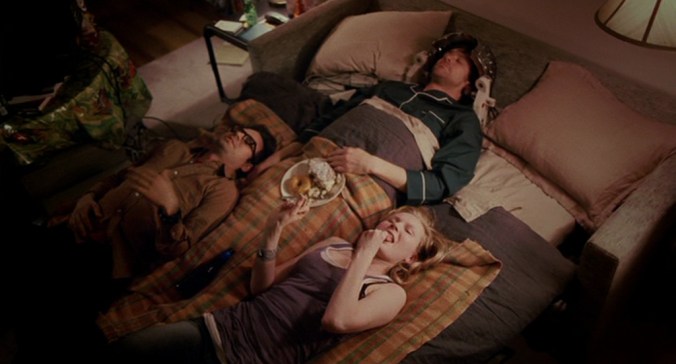
Eternal Sunshine portrays the beginning, middle, end, and rebirth of a passionate, tumultuous relationship between Joel (Carrey) and Clementine (Winslet). Their love story is primarily told through flashbacks experienced by Joel after he undergoes an experimental memory removal process to try and erase Clementine from his brain. After their breakup, Clementine impulsively had her and Joel’s relationship erased from her memory. Upon finding this out, Joel is, understandably, hurt, and vengefully decides to scrub all traces of Clementine from his consciousness. While undergoing the removal process, however, Joel becomes consciously aware of his desire to try to save the memory of Clementine, and, potentially, save their relationship. Joel’s mental avatar starts to fight back against the removal process and tries to secret Clementine away, burying her deeper and deeper in unrelated memories, in a vain attempt to stop her from being erased. However, the process is completed successfully and Joel wakes up the next morning with no recollection of his previous relationship, though he doesn’t appear much better off for it. In the end, it is revealed that Joel and Clementine may be destined for one another as they meet again and rekindle their relationship.

Like Kaufman’s earlier scripts, Eternal Sunshine is something of a maze, inviting the audience to unpeel the film’s layers and daring them to keep up with his script’s twists and turns. Eternal Sunshine retains the emotional sincerity of Kaufman’s film Adaptation. and builds upon that film’s occasional raw emotionality. Joel and Clementine are two of the most relatable protagonists that Kaufman has written because while they are both shown to be deeply flawed people, they lack many of the outward symptoms of anxiety and overarching neuroses that plague more autobiographical Kaufman protagonists. As a result, I think that Eternal Sunshine is likely the Kaufman-scripted film with the most mainstream appeal. Being John Malkovich and Adaptation. were both critically lauded and fared pretty well at the box office, but I’ve noticed that Eternal Sunshine is the Kaufman film that most people I talk to about movies seem to really latch onto. It isn’t especially difficult to find the heart within Kaufman’s more esoteric scripts, but Eternal Sunshine is a movie that wears its heart on its sleeve, and I think the open, raw emotionality that Kaufman and Gondry tap into in envisioning Joel’s and Clementine’s lives and relationship rings true with audiences.

Eternal Sunshine 1

I know that for myself, the emotional impact of Eternal Sunshine was what really attracted me to the film in the first place, and what cemented my affection for it early on. The movie came out right before I graduated from high school, and I can remember when the relationship I was in at the time began to sour that I thought the idea of erasing my significant other seemed like a very attractive proposition. My girlfriend and I were both fans of the movie, but when our relationship started falling apart due to my moving to another state and continuing to allow a fairly serious drinking problem to develop, I personally began to identify with the film more and more. I was experiencing one of my first real relationships starting to crumble and I felt like Joel as he travels through the landscape of his mind while his memories are crumbling around him. I vacillated between wanting to cling to that relationship and that person, and wanting to destroy everything that reminded me of her. It was my first really serious break up and I wasn’t emotionally or socially ready for it. Of course, as time went on, I moved on and developed some coping skills and realized that it is actually possible to bounce back from what seemed at the time to be an all-consuming, emotionally devastating turn of events. Still, though, to this day when I watch Eternal Sunshine of the Spotless Mind I can’t help but think of that girl and that relationship and the important role that she played in my life when I was transitioning into adulthood. There’s a sentimentality to the movie that I’ll probably never fully shake.
Eternal Sunshine 4

I still love the groundswell of emotion that a screening of Eternal Sunshine induces, but I’ve also come to really appreciate the movie for other reasons, as well. Chiefly, I’m always enamored with Gondry’s visual style and the unique way he envisions mental processes in a visual, tangible space throughout the film. The editing and camera movements are incredible, but still subtle. Gondry is a master at creating practical effects and manipulating images in-camera, and those skills are on full display as he creates a dynamic world within Joel’s head. Obviously, some of the film’s more memorable visual effects are the instances in which the mise-en-scene begins to become unstable and, often, literally crumbles as Joel’s memories are being eradicated, but I’m more intrigued by the smaller, more nuanced visual tricks that Gondry plays that serve to mimic the overall instability of memory as a neurological process. The film depicts the nature of memory perfectly, as within the memories that Joel traverses through, Gondry uses filters, color schemes, and trick photography to hint at the influence of nostalgia and association on our memory processes, as well as highlighting the sometimes imperfect nature of memory, and the readiness of a person to reflect back on an experience in a more perfect or sentimental manner. The film, like a relationship, is built upon a foundation of several small moments that add up to a meaningful whole, but the audience is constantly reminded that the recollection of those moments may not always be completely accurate. Eternal Sunshine is a movie about love, and it presents a complex, realistic depiction of a relationship, but it’s also very much a movie about memory, and I think the ways that it represents the process of forming and recalling past memories is even more impressive.

Eternal Sunshine 6

I’ve barely scratched the surface of what makes Eternal Sunshine of the Spotless Mind a memorable and enjoyable movie to go back to time and time again. The film’s score is beautifully melancholy, matching the mood and timbre of the film. The performances of its deep ensemble cast are all top notch. Jim Carrey stands out as Joel in what, I believe, is his best performance since Man on the Moon. Kate Winslet turns up her automatic charm and gives a reliably solid performance as Clementine. Her turns of phrase in the film always get stuck in my head for some reason. Kirsten Dunst provides depth and a spark in an important supporting role that turns the film on its head in its last few minutes. Of course Gondry’s direction of Kaufman’s superb script is unique and visionary, as I’ve mentioned. The older I get, and the more life experience I gain, the more depth I find in this film. I certainly wasn’t moved to ponder the ethical dilemmas presented by the prospect of memory erasure when I first encountered Eternal Sunshine, but now, as an adult, it’s all I can think about. While it used to release a cascade of emotional feeling in me, the film now leads me to ask heavy philosophical questions, such as “Is it ethical or even sensible to eschew formative life experiences in such a concrete way?” and “Is there an experience or a person who I value so little that I would want to completely remove that person/instance from my life history?” and even, “What right do I have to the contents of my own head?” Even though it may no longer hold a distinction in my personal top ten list of favorite movies, Eternal Sunshine is undeniably a great movie, and I think it has only gotten better with age. It’s one of the films that I was most affected by early in my foray into cinephilia, and one of the few from that time period that I still return to with some regularity, and it still never disappoints.
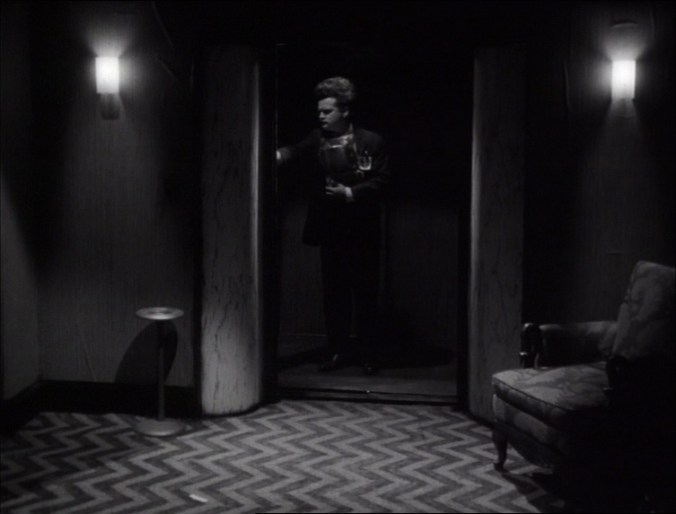
Eraserhead

Eraserhead (1977)

Dir. David Lynch

Written by: David Lynch

Starring: Jack Nance, Charlotte Stewart


Finally getting to write about Eraserhead, something that I’ve avoided ever doing despite enjoying the film for the last 15-odd years, should be a liberating experience, but it feels very daunting at the same time. It’s a film that I know well, having watched it over a dozen times since first experiencing it in my late teens via a little red Netflix envelope, but it’s a film that still vexes me in many ways. It’s the auspicious debut of my favorite filmmaker, and a dark indicator of the themes and content that would make up his ensuing output. Lynch’s filmography is celebrated, but also troubling, with his films asking audiences to bear witness to dark urges that exist buried deep within themselves. His films are designed to trigger deep-seeded anxieties and fears that rest at the core of the human experience. Eraserhead begins this trend with its look at the anxieties surrounding bringing new life into a flawed, disturbing world. Though it’s presented in an exceedingly strange package, at its core, Eraserhead is a look at the struggles of an everyman trying to get by in a world that is designed to sap him of his energy and his will to live. It took me a long time, and many, many repeated viewings to come to some sort of understanding of this film, but it was a process that was richly rewarding, and one which helped to open up my mind to new analyses of the films of my favorite director.

eraserhead 1

I wasn’t really ready for Eraserhead when I was 19 and I first saw the movie. It wasn’t that I didn’t like it, because I did enjoy the movie, and I thought that it was delightfully weird and esoteric, but I didn’t have any sort of framework with which to really understand it. I had seen visually experimental, non-narrative films in college, but those didn’t seem to apply here. Eraserhead was using some of the tools of experimental cinema in a symbolic and narrative way that I had trouble reconciling. Even in reference to the other David Lynch films that I had seen, Eraserhead was something totally foreign and new. In Blue Velvet and Mulholland Dr., I recognized the world that Lynch was depicting as somewhat similar to my own; even if I did find Mulholland Dr. narratively inscrutable, I still felt that I had some foothold into its world. Eraserhead, on the other hand, felt hermetically sealed, existing in a separate and decidedly interiorly-focused cinematic space, one that I could observe but not enter into in any meaningful way. The film’s bleak industrial-noir setting felt at first familiar, but it gave way to the unfamiliarity of tiny, misshapen chickens that ooze black inky liquid, hellish factories that turn men’s heads into pencil erasers, and, of course, one monstrous and insatiable infant. This was uncharted cinematic territory. Trying to cobble together meaning out of the film’s disparate and confusing imagery seemed impossible, but I was still drawn to the film. By the end of my first viewing of Eraserhead, I wasn’t sure exactly what I had watched, but I knew that I wanted more of it.

I’ve encountered countless films in my life that I’ve held up as seminal or formative in some way, and I encountered many of those for the first time in my late teens and early twenties, as my cinematic world was rapidly being expanded, and my understanding of the medium was growing by the day. Eraserhead found itself firmly in that group of highly meaningful films. Though I didn’t screen Eraserhead again for two years, it lingered around the periphery of my consciousness, its iconic images popping up from time to time. I expanded my viewership of Lynch’s films, but I still wasn’t able to find a direct line into the heart of Eraserhead through an auterist critical approach, which was often my preferred critical approach to films at the time. Even within this singularly weird filmography, Eraserhead stood as an outlier, defiantly experimental, refusing codification by my young brain. I read critical analyses of the film, which attempted to parse out its dense symbolism and orient it within the larger context of Lynch’s body of work, but still Eraserhead remained a mystery. Eventually, I just chalked up my lack of ability to come to complete grasps with the film to the mark of Lynch’s true artistic genius, and my own woeful shortcomings in that department.

eraserhead 3

While I’m certainly still not a genius on the level of any of the filmmakers I’ve been writing about for this project, much less on the level of a visionary like Lynch, I do think that I’ve come to a much more comfortable place of understanding with regards to Eraserhead. Clearly, Lynch is using the film to help work out some of his anxieties about his newfound status as a father, but it’s also obvious to Lynch fans that Eraserhead sets the table for all of the films and media projects that would come later. The film’s chaotic, densely-layered soundtrack points forward to Lynch’s continued sonic experimentation. He is known as a master of film sound, and that use of sound as a mood setting and narrative device is very much on display in Eraserhead. The film’s soundtrack swells with an omnipresent whooshing, intermittently interrupted by industrial banging and cranking. The way Lynch records the plaintive cries of Henry’s monstrous baby results in an unnerving caterwaul that stops far short of invoking sympathy in the audience.

Thematically, Eraserhead finds Lynch already mining the source material for his later films. Paranoia, anxiety, and voyeurism all factor heavily into Eraserhead, and Lynch will return to these ideas more explicitly in films like Blue Velvet and Lost Highway. Eraserhead is also one of Lynch’s most complete explorations of a dream space, as much of the film could be interpreted as an extended dream triggered by Henry’s fear of his impending fatherhood. Even if you eschew that reading, the film contains several notable scenes that explore Henry’s interior fantasies, including his obsession with the tiny woman who lives in the radiator, and the nightmare that gives the film its title, in which Henry’s head is stolen and sold to a factory where it is ground down to make pencil erasers. Dreams are privileged sources of symbolism and truth in Lynch’s work, and he often attempts to explore the liminal space between dreaming and the waking world, in which that truth is most accessible. We see dreamlike sequences in all of Lynch’s media, but Eraserhead is a bold film that spends nearly all of its time locked into its protagonist’s interiority.

eraserhead 4

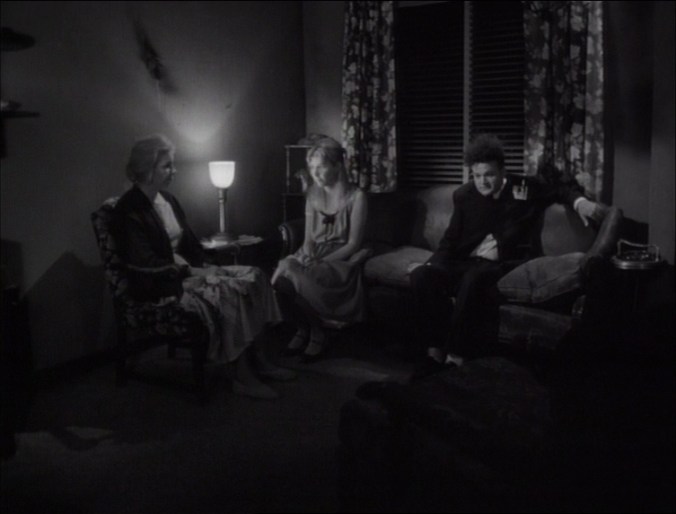
I’ve neglected the plot synopsis that I typically write for each film because Eraserhead’s narrative can be summed up in just a sentence or two. Henry (Nance) is informed by Mary (Stewart) that she has given birth to his child, though she isn’t sure that their offspring is a child at all. The couple marry and take the baby back to Henry’s one room apartment, where it is revealed to be a monstrous lizard creature, without arms or legs, that cries incessantly. Mary can’t handle the crying and she leaves Henry alone, to go insane as he tries to care for a creature that he can’t understand or relate to. The film is narratively straight forward and simple, though its surface weirdness might obfuscate this, but it is incredibly symbolically dense. Henry is trapped in a Kafkaesque nightmare and the only logic that can prevail is the logic of the dream, therefore we are presented with a stream of imagery that makes no narrative sense, but carries deep symbolic truth. Henry’s responses when faced with the responsibility of caring for his child are all in some way attempts to infantilize himself. He dreams of the lady in the radiator, which represents a womblike space, and when he finally connects with his beautiful neighbor (Judith Roberts), they have sex in, and eventually submerge themselves in, a pool of milk. Henry’s apartment is strangely symbolic itself, with mounds of dirt on his furniture, many of which are sprouting small trees or shrubs. The apartment should seem like a productive, organic, space, but instead these strange dirt piles give the room a fetid and decaying feeling. Of course the most obvious symbolic element in Eraserhead is the baby itself, which both Henry and Mary view as a monstrous Other. The baby is an unwanted imposition in their lives, and, as such, they view it in a way that allows them to disassociate themselves with their offspring. This disassociation leads to Mary’s abandonment of the child and Henry’s ultimate infanticide/mercy killing. These are just a few of the more obvious symbolic signifiers in Eraserhead, but the film is rich with impressionistic dream sequences, non-sequitur dialogue, and other-worldly imagery, which allow for a richness of unique interpretations of the film.

This fluidity of meaning is one of the things that I think initially drew me to Eraserhead, and that has kept me coming back to the film as frequently as I do. Although I’ve settled on my own interpretation of the film, I still find myself challenged by it with each subsequent screening, and I often find myself considering it in a new context, based on my own changing life experiences or on my changing relationship to the film and to related media. Watching Eraserhead in 2018 with the viewing experience of Lynch’s Twin Peaks: The Return fresh in my mind was a totally different experience than any other time I’ve seen the film. For me, the newest season of Twin Peaks functions as Lynch’s magnum opus. It contains throughlines and references to Lynch’s earlier films and serves to bring all of his disparate thematic and aesthetic concerns together in one dense, strange viewing experience. I felt several affinities between Lynch’s first feature and what I believe will be his final visual media project, and my recent screening of Eraserhead only strengthened those connections for me.

eraserhead 2

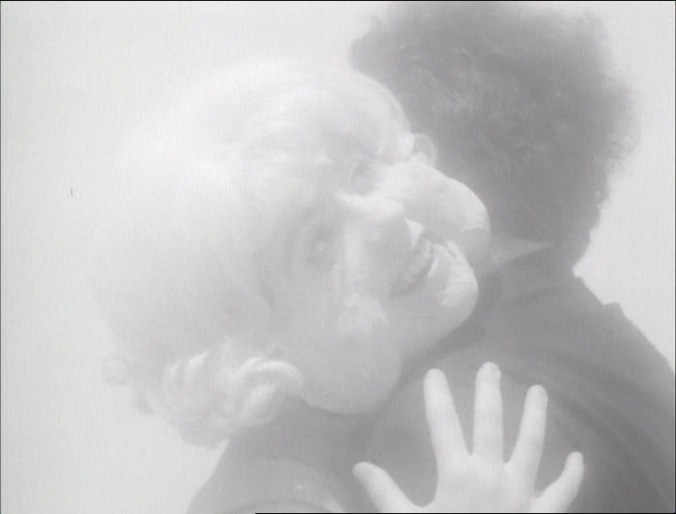
I found a thematic kinship between Henry’s abandonment by Mary and subsequent retreat from adult responsibility and Audrey Horne’s (Sherilyn Fenn) curious appearances in The Return. Though the narrative circumstances in each case are quite different, something about the dreaminess and illogical, circular dialogue used in both Eraserhead and in Audrey’s scenes with her husband Charlie felt very similar. Both characters are being neglected and emotionally abused by people close to them, though Audrey’s victimhood seems more obviously apparent, while Henry seems to be in a more mutually dysfunctional relationship where he, too, adds to Mary’s mental anguish. Both characters are infantilized, with Charlie’s gaslighting of Audrey keeping her in a subservient and dependent role, and Henry’s chosen retreat away from responsibility and into the safety of a childlike interior fantasy world. In the end, both characters are also last seen in a blindingly white space. Eraserhead has a superficially happy ending, with Henry finally uniting with the Lady in the Radiator (Laurel Near), whose earlier song reminded the audience that “in Heaven, everything is fine,” indicating that Henry has killed himself after killing the baby. This marks the furthest expression of Henry’s retreat, as his suicide can be read as a rejection of all of life’s responsibilities.

In The Return, Lynch reverses this dynamic to some extent with Audrey’s final scene, in which she reprises her iconic dance from Twin Peaks. Audrey’s dance is interrupted by a fight breaking out and she rushes towards Charlie, who is sitting at the bar, imploring him to get her out of there. There is a brief crackle of electricity, and Audrey appears in a starkly white room, staring at her face, sans makeup, in a vanity mirror. She, and the audience, are stricken by this jarring change of scenery, and it throws into question the handful of scenes in which Audrey has appeared thus far in The Return. This being Twin Peaks, the most operative reading of the scene is that there are two Audrey’s, and we are discovering that the “real” Audrey has been trapped in a Lodge all along. However, there is some indication to support a reading that Audrey’s interactions with Charlie may have been a dream or a vision that she had, before waking up, confused, in the white room, which appears not dissimilar to a mental hospital. Though there is very little of the white space around Audrey shown, she appears to be wearing a white hospital gown, and the sheer blankness of the space indicates a sterile, clinical setting. This reading, when coupled with the ending of Eraserhead, provides for a very bleak vision, indeed. Audrey dreams of a sad and dysfunctional life, from which she is ripped during her one moment of ecstasy performing her dance, while living a reality that may be even more maddening. Henry’s narrative begins with an unhappy reality from which he retreats into a dream that is by turns menacing and seductive, ultimately succumbing to the temptation to live in the dream by taking his own life and murdering his child. For these characters there isn’t any easy way out, and the few reveries they get to experience are symbolically and explicitly linked to madness and death.

eraserhead 6

Eraserhead is a landmark film, a bench mark and a step forward for modern surrealist filmmaking. While Bunuel and Jodorowsky were making films that set their aims on societal structures such as religion and class through an experimental and surrealist viewpoint, Lynch sought to examine the more personal territory of the human mind and emotion. He had trouble getting financing for the film and it took over five years to complete, as the production was plagued with complications. When Eraserhead finally arrived, it was a film that was seen as a visionary work by some and a confounding mess by many, although its stature in film history has certainly appreciated over time to the point that it is almost universally regarded as a classic. I have come to love the film for what it represents as the true foundational text in my favorite filmmaker’s body of work, as well as for the singular viewing experience that Eraserhead provides. There’s not a film that I can think of that is quite like it, and it is a film that two people can walk away from with markedly different opinions about and experiences of, and I really like that. More than many of the movies that I’ve written about, Eraserhead isn’t for everyone, but for the initiated it’s a rewarding treasure of a cinematic experience, with iconic visual imagery, rich symbolic nuance, and a terrifyingly original vision.

Enter the Dragon

Enter the Dragon (1973)

Dir. Robert Clouse

Written by: Michael Allin

Starring: Bruce Lee, John Saxon, Jim Kelly, Shih Kien


I’m not sure exactly when I first saw Enter the Dragon. It wasn’t the first movie starring Bruce Lee that I ever saw, nor was it my first foray into the kung-fu genre, but I do know that it made quite an impact on me at a fairly young age. For many people, Enter the Dragon stands as the high water mark of the classic era of kung-fu movies, and I don’t think that it’s a stretch to call it the most well-known mainstream martial arts film of all time. Lee’s star appeal was just beginning to break through in the United States, and Enter the Dragon was set to be his triumphant entryway into mainstream action filmmaking. However, Lee tragically passed away shortly before the film’s release, making Enter the Dragon the last film that he would live to complete. Though he left behind a relatively scant filmography, only starring in a handful of films, Lee has become synonymous with martial arts cinema, and is still one of the most widely recognized and celebrated martial artists to ever grace the screen. Instead of serving as a launching point into greater stardom, Enter the Dragon now serves as a reminder of Lee’s athletic ability, charisma, and viability as an action star.

enter the dragon 5

Enter the Dragon marks a diversion from traditional kung-fu narratives of the time, including significant Western influences and playing out something like a blend of a James Bond spy thriller and a traditional martial arts film. In the film, Lee (Lee) is approached by a British intelligence agency and is encouraged to enter into a martial arts tournament held on a mysterious island owned by Mr. Han (Kien), a suspected crime lord. While attending the tournament, Lee is to investigate Han’s compound and find evidence of his involvement with prostitution and drug trafficking. Lee agrees to attend the tournament after learning of his sister’s death at the hands of one of Han’s bodyguards, O’Hara (Bob Wall), and vows to avenge her death, as well as bring down Han’s crime syndicate. When he arrives on Han’s island, Lee meets Roper (Saxon), a gambling addict on the run from the mob, and Williams (Kelly), a Vietnam veteran on the run from the police. The three men are obviously the most skilled fighters in the tournament, and they quickly dispatch of their opponents, although each of them runs afoul of Han in some way for disobeying the rules of his island. By night, Lee infiltrates Han’s compound and discovers the extent of his smuggling operations, although he is captured by Han’s guards. Meanwhile, Han has tried to recruit Roper to his syndicate, but Roper refuses when he realizes that Han has murdered his friend Williams. The next day, Han orders Roper and Lee to fight each other, and when Roper again refuses to be used as Han’s pawn, a melee breaks out which leads to Lee pursuing and eventually killing Han in an epic fight. With Han defeated, Lee and Roper await the arrival of the British helicopters on their way to recover Han’s prisoners and clean up the last of his criminal operations.

enter the dragon 3

The influence of Enter the Dragon can’t be understated. The film was a box office and critical success, earning $25 million in American box office receipts alone, against a shoestring budget of less than $1 million.  As I mentioned, the film marked the real introduction of Western audiences to Hong Kong cinema and martial arts cinema, in general. Far from being just a martial artist, Lee served as a cultural ambassador and representative of Chinese philosophy for many American audiences who were unfamiliar with the tenets of martial arts. Without the success of Enter the Dragon, I really doubt that American audiences would have ever experienced the films of Jackie Chan, Jet Li, Donnie Yen, or scores of other martial artists who would emerge as key action stars both in Asia and in America in the years to come. The popularity of Enter the Dragon also kicked off a fervid interest in martial arts in America, with kids all over starting to take kung-fu and karate lessons, emulating their onscreen hero, and embracing the strength, hard work, and discipline that martial arts training instills in its adherents. Simply put, Enter the Dragon was one of the most culturally significant films of the 1970s.

As a film, Enter the Dragon is a joy to watch. Though it was shot on a limited budget and under unique constraints due to language barriers between the American and Chinese crews, as well as creative disagreements between Lee and screenwriter Michael Allin, the finished film is a thing of beauty. The setting of Han’s island is lush and vibrant, and his compound is a visually rich location that hints at the opulence that a life of crime can afford him. The film is perfectly paced, and though it is light on the exposition, it delivers on the promise of great action. Its espionage scenes are tense and exciting, underscored by a funky jazz score from one of the great film composers of the 1970s, Lalo Schifrin. The fight scenes, all of which were conceived of and choreographed by Lee, are shot impeccably, capturing the aggression and grace of the fighters perfectly. The film’s climactic showdown between Lee and Han, in which the pair eventually square off in a hall of mirrors is a stunning cinematic achievement. The precision with which the scene must have been filmed is hard to fathom, and I still don’t know how the crew managed to pull it off. It’s one of the most memorable fight scenes in the martial arts genre, and the image of hundreds of mirror images of Bruce Lee repeating into the background as he stalks Han through the mirrored room is one of the genres indelible calling cards.

enter the dragon 7

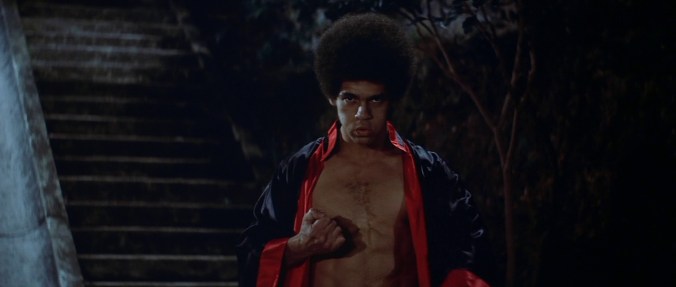
Kelly and Saxon certainly hold their own in their fight scenes, but Lee is the obvious star of the show. His lithe physicality is on display throughout the film, and his fight scenes capture the effortless way in which he cycles through movements, countering and striking with such ease and skill that he seems imbued with an innate sense of placement and momentum that the other martial artists simply don’t have. More than his obvious physical prowess, which had been on display in his other films, Enter the Dragon gave Lee the chance to introduce the philosophy behind his martial arts to the Western world. Particularly early in the film, Lee takes the opportunity to expound upon the ways in which his martial arts practice emphasizes living a balanced and harmonious lifestyle. Lee saw his martial arts as a form of self-expression, and his journey in life as one of constant self-improvement and of increasing the knowledge of self. Though much of the content relating to Lee’s philosophies and to Chinese philosophy, in general, was excised from the original American theatrical cut of the film, these scenes were reintroduced to later home video releases, and I think that the film is better off for it. If Enter the Dragon is to be seen as Lee’s magnum opus, it must contain at least some of the revolutionary thinking that he espoused and that ran as an undercurrent to his martial arts.

enter the dragon 4

Though it isn’t my absolute favorite martial arts movie, or my favorite Bruce Lee movie (that’s Way of the Dragon, which I no longer own), Enter the Dragon is a classic, and an interesting look at what might have been had Lee lived longer and continued making films in Hollywood. Lee’s impact on the action film scene of the 1970s was seismic, launching a kung-fu craze that lasted long after the release of this film and, of course, long after his untimely death. The film is often imitated, but never duplicated, and it serves as a perfect entry point for the uninitiated into classic kung-fu films. It has all the campiness and action that fans of the genre are looking for, but it’s also a film that is clearly grounded in Lee’s unique philosophical viewpoint. Lee’s star burned so brightly and his legend grew so outsize after American audiences got a taste of his prowess in Enter the Dragon that the film’s director cobbled together the film Game of Death from outtakes and partial scenes that Lee had filmed before beginning work on Enter the Dragon. Though his image and reputation have often been traded on in the decades since his death, mostly to diminishing returns, such is the quality and intensity of Lee’s small filmography that he will be forever seen as an action film legend. Lee was already a star by 1973, but when Enter the Dragon was released, he became an icon.

Duck You Sucker

Duck You Sucker (1971)

Dir. Sergio Leone

Written by: Luciano Vincenzoni, Sergio Donati, Sergio Leone

Starring: Rod Steiger, James Coburn, Romolo Valli


I can’t believe I hadn’t watched this great Western until today. I’ve been a big fan of Sergio Leone since I was a teen, but his final Western, Duck You Sucker, had eluded me until a few years ago. I fell in love with Leone when I was 17 and I saw The Good, The Bad, and The Ugly for the first time. I was taken by the grandiosity of the film, its famous, epic Ennio Morricone score, Leone’s unique approach to montage and framing, and the performances of its titular trio as three outlaws whose paths are set on a collision course. I instantly wanted more films like this one, and I sought out the rest of Leone’s “Dollars trilogy,” Leone’s first three films which all starred Clint Eastwood in one of his early signature roles. I eventually tracked down Leone’s last two films, as well, Once Upon A Time in the West and Once Upon A Time in America, with the former becoming another of my very favorite films of all time, along with The Good, The Bad, and The Ugly. Duck You Sucker, however, was a film that I didn’t even know existed until I was in my early twenties, and it was introduced to me as a somewhat “lost” Leone classic. Unlike Leone’s other films, this film was not as well received outside of his native Italy, so it didn’t gain wide distribution, and was difficult to screen until a series of remasters of Leone’s catalog in the 2000s led to its restoration and re-release on home video. I picked up a copy of the film on DVD at an FYE store that was going out of business in 2014 and it sat on my shelf, unwatched, for the next few years. When I conceived of the idea for this project, I just decided to wait until Duck You Sucker’s time came up for my initial screening. I’m glad to have finally gotten around to it, because this is a movie that I’d been anticipating for a long time, and I wish that I wouldn’t have waited so long to watch it because it is every bit as entertaining as any of Leone’s other masterful films.

Duck You Sucker 2

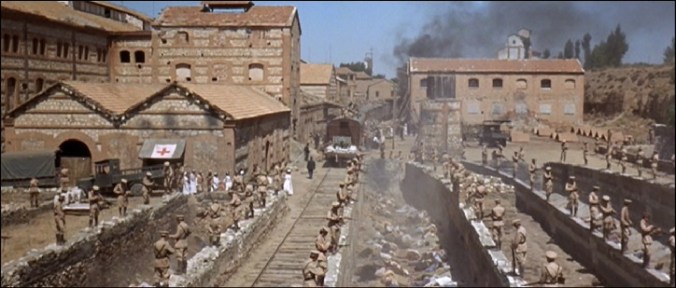
Duck You Sucker, or A Fistful of Dynamite or Once Upon A Time in the Revolution, depending on which version of the film you’ve seen and where, is set in the 1910s during the Mexican Revolution. It opens with Juan Miranda (Steiger), the head of a family of bandits, waylaying a stage coach and robbing its wealthy, Anglo occupants of their belongings and money. While the family are counting their spoils, they hear a series of explosions in a nearby canyon, and a masked rider on a motorcycle emerges from the smoke and rubble. The rider is John Mallory (Coburn), a former bomb maker for the IRA, who has fled his home country and sought refuge in Mexico. Seeing John’s proficiency with explosives and noting the similarity of their names, Juan suggests that their meeting must be destiny, and attempts to convince the Irishman to help him and his family break into the National Bank in Mesa Verde. John is committed to the revolutionary cause in Mexico, and sees an opportunity to use Juan in service to the revolution, so he allows him to believe that he is on board with the robbery. When the unlikely pair of allies arrives in Mesa Verde, they find it occupied by the army and meet with other revolutionaries, led by Dr. Villega (Valli), who is orchestrating a coordinated attack in the town. Juan and John hit the bank, along with Juan’s family, as a part of this attack, but when they start blowing open vaults, they find them stuffed with political prisoners instead of cash and jewels. Juan is incensed at being tricked, but finds himself lauded as a hero of the revolution when the attack is over for his role in freeing hundreds of prisoners. With the revolutionaries on the run after the attack, Juan and his family stay with John, although the former expresses some distaste for revolutions in general, noting that though it is academics who theorize social revolution, it is the poor who are actually called to enact it with violence and loss of life. Despite these reservations, Juan helps John to destroy an army detachment by blowing up a bridge, but while Juan is away from his family, they and dozens of other revolutionaries are slaughtered by the army. Juan is heartbroken, and strikes out on his own, though he is quickly captured and is facing a firing squad. John arrives just in time to save his friend, with a well-placed stick of dynamite, and his trademark cry of, “Duck, you sucker,” and the two escape on John’s motorcycle, recommitting themselves to the revolution, and to vengeance for Juan’s murdered family.

Duck You Sucker 1

For fans of Leone’s films, Duck You Sucker should feel familiar, as it borrows elements from his previous Westerns, and is dripping with Leone’s unmistakable directorial aesthetic. Leone’s unique vision of the American West (primarily captured through substituting Italian and Spanish locales), is evident from the first shots of the film. The sun-drenched landscape, and the sunbaked people who exist within it are similar to the ones we’ve seen in Spaghetti Westerns before. Juan and John form the same sort of unlikely duo that we’ve seen in For A Few Dollars More and The Good, The Bad, and The Ugly, teaming up to achieve a certain goal despite their differences in motive, and their initial distrust. Leone’s films are often peopled by outlaws, grifters, and malcontents, and these two feel right at home in that world. Juan is essentially a stock Leone character, one that would often by played by Eli Wallach, and John is a variation on the Man With No Name character made famous by Eastwood, although Coburn does put a unique spin on the trope. I don’t say all this to make Duck You Sucker seem derivative, because it takes these familiar elements and uses them in service of a narrative that is more nuanced and cynical than those of Leone’s earlier films, but to say that it is yet another example of a masterful filmmaker having established, and honed, his cinematic voice. Where Leone’s famous close ups and quick zooms were once mere stylistic tricks, highlighting the grimy, gritty nature of his version of the West and helping to create kinetic effects within his often still visual compositions, here they are often used in ironic counterpoint. Leone is retaining his visual style, but flipping its intended meaning on its head in service of a larger narrative argument that he’s making throughout the film.

Though he claims that he did not intend to make a political film, I don’t see any other way of reading Duck You Sucker. From the outset, the film asks its audience to consider issues of race and class, as they pertain to political revolution. Even setting aside the film’s epigraph, a quote from Mao about the necessity of violence in revolution, which was, predictably, excised from the film’s U.S. release, Duck You Sucker is still the most overtly political of all of Leone’s films. The opening stage coach scene, in which Juan is racially abused and mocked by a coach full of well-to-do Anglos, including a priest, is a perfect example of Leone using his trademark style in the service of this politically motivated criticism. The scene is shot in typical Leone fashion, utilizes a lot of quick cuts and eyeline matches, and a camera framing that is steadily bringing us closer and closer to the subjects. As the racial animus that the wealthy passengers are directing towards Juan starts to reach a head, Leone opts to cut to close ups of their mouths, gorging on food, spitting flecks of it from their lips with each invective. Leone visually links the ugliness of their attitudes and speech to their disgusting manners, undercutting the veneer of polite society that they pretend to live within. Also, in predictably Leone-ian fashion, Juan gets the better of his fellow passengers through some underhanded trickery. He allows them to hurl their insults, and plays the role of the stupid Mexican well, knowing that just around the bend, his sons are waiting to ambush the coach and turn the power dynamic on its head. After being called an animal and a brute by the racist travelers, Juan is happy to oblige their stereotypes as he callously robs, beats, and strips them, leaving them for dead in the desert.

Duck You Sucker 5

While the film, and by extension the filmmaker, doesn’t make an overt political statement, there are more than enough indications throughout as to where the audience’s sympathies are intended to lie. We are repeatedly shown the suffering of the individual and of the oppressed at the hands of the wealthy and those in positions of state-sanctioned power. Though I do believe that Juan’s rejection of revolutionary action, which convinces the intellectual revolutionary John to throw away his Bakunin, should be taken as the sentiment closest to Leone’s own feelings about war and revolution, I think that in this narrative the film is clearly favoring one side of the conflict over the other. The film has the highest body count of any Leone film, by far, and it depicts scores of both soldiers and citizens being killed, but only affords opportunities for pathos in the killings of citizens and revolutionaries. When an entire army battalion is dispatched of in the bridge explosion, they are as ants, crushed underfoot and easily forgotten about, but when Juan’s family and the rest of the rebels are murdered in their beds, the camera makes it a point to linger on their faces, humanizing the dead and evoking strong pathos and sympathy within the audience. Leone said that he didn’t intend anyone to read the film literally, and that the Mexican Revolution should be considered allegorically, but the repeated evocations of revolutionary conflicts across the globe doesn’t really allow for any reading of the film aside from a political/social one.

Duck You Sucker 8

But, even if one chooses not to consider the film’s larger arguments and political implications, it’s a masterful Western in the Italian style. Though he certainly wasn’t the first Italian filmmaker to evoke the American West, Leone firmly established the Spaghetti Western aesthetic, and the genre found its Platonic ideal in The Good, The Bad, and The Ugly. Once again, Leone perfectly captures the Spanish countryside, filming breathtaking vistas and deserts that stand in for Mexico. His images are, as usual, underscored by Ennio Morricone’s breathtaking music, providing perfect accompaniment and counterpoint to the images. Morricone has scored some of my favorite films, and the themes in Duck You Sucker rank among his finest work. And, of course, the film features some strong performances from its leads. Despite not always seeing eye-to-eye with Leone, Steiger turns in a great performance as Juan Miranda, allowing an intellectualism and cunning to shine through the character’s motivating greed and avarice. Coburn plays John Mallory as a world-weary, but not resigned, intellectual. He often seems bemused at the circumstances that have led him halfway around the world, but he rarely wanes in his principled dedication to revolutionary action. The two actors play off of one another well and make the unlikely bond between Juan and John feel not just realistic, but deep and true. By the film’s end, it’s clear that these characters have grown not just to respect one another, but to feel a close affinity and kinship with one another, despite their differences. Leone has maintained that the film is ultimately about their unlikely friendship, and that the revolution is just the setting that allows that story to take place, and if one wants to read the film that way, he or she certainly wouldn’t be disappointed, either.

Duck You Sucker 3

I really can’t say enough good things about this movie. I’m kicking myself for not watching it sooner, because I think that I would have more insightful criticism to provide if I had a couple more screenings under my belt. I’m still trying to figure out exactly where Duck You Sucker should fit in the larger context of Leone’s filmography, and of the Western genre, as a whole. It’s a film that sees a legendary director starting to expand his palette while truly refining his signature style. Once Upon A Time in the West, the film that directly precedes this one in Leone’s body of work, is truly an elegy for the American Western, and felt like it was closing a chapter on the director’s career. So what, then, is Duck You Sucker? I think that it’s an example of Leone trying to work out other artistic and narrative concerns within a familiar milieu. If the West of his earlier films represented a filter through which to understand Americanism from the perspective of an outsider, then should we read Mexico and the Revolution in Duck You Sucker as a filter through which to explore and understand human relations and power dynamics, generally? I’ll need a few more viewings to truly settle my own thoughts on this movie, and I’m sure that I’ll take that opportunity as soon as I’m able, which makes me really happy. Part of what I was hoping to do in this project was to potentially reassess my relationship and understanding of movies with which I was intimately familiar, through unfamiliar juxtapositions, or meeting a film text at a totally different point in my life. In this case, watching a new movie has helped me to reexamine my thoughts in regards to a filmmaker that I felt I was already intimately familiar with. Finally introducing myself to Duck You Sucker was a real pleasure, but the most fun thing about it was how it started the process of helping me rethink my own understanding of Leone’s cinema. It felt like putting in a final puzzle piece and completing a picture. Of course, now I have the inspiring challenge of making sense of what that overall picture means to me.

Drunken Master

Drunken Master (1978)

Dir. Yuen Woo-ping

Written by: Lung Hsiao, Ng See-yuen, Yuen Woo-ping

Starring: Jackie Chan, Yuen Siu-tien, Hwang Jang-lee


Drunken Master is one of the seminal classics of the kung fu genre. I didn’t see the movie until after I had already become enamored with Hong Kong martial arts films and decided to trace the lineage back to some of the great films of the early period of the genre, but it’s still a favorite of mine. Like many Americans getting into kung fu movies, my journey began with the films of Bruce Lee, and then jumped forward to the modern kung fu films of Jackie Chan and Jet Li, whose American films were becoming very popular around the time that I started high school. After I tired of their late 1990s and early 2000s era Americanized martial arts films, I started seeking out Chan’s earliest work, and discovered a treasure trove of classic Hong Kong cinema. Jackie Chan has become a household name, and in many ways has come to signify a certain type of martial arts cinema. The roots of his particular blend of slapstick comedy and martial arts can be found on full display in Drunken Master.

The film casts Chan as the folk hero Wong Fei-hung, a revolutionary kung fu master who lived at the turn of the 20th century, and a common figure among popular martial arts media. In the film, young Wong is a troublemaker, who is only beginning his journey towards becoming a hero and martial artist. Wong is more interested in causing mischief with his friends and in picking fights than he is in learning the disciplines of kung fu, so his father, Kei-ying (Lam Kau), recruits the feared and legendary master Su Hua-chi (Yuen Siu-tien) to mentor the boy and mold him into a kung fu master. Master Su introduces Wong Fei-hung to a rigorous training regimen, meant to strengthen the pupil’s mind and body in preparation for his learning of Master Su’s secret style of kung fu, “drunken boxing.” Though he initially bristles at the torturous training, Wong eventually falls in line after suffering an embarrassing thrashing from Thunderleg (Hwang Jang-lee), a local contract killer and bully. Wong masters drunken boxing just in time to save his father from Thunderleg, who has been hired to kill him by a business rival to whom the elder Wong will not sell his land.

drunken master 3

Drunken Master wasn’t Jackie Chan’s first hit in Hong Kong, but it, along with its predecessor Snake in the Eagle’s Shadow, also directed by Yuen Woo-ping, were Chan’s true breakthroughs. The films established the comedic style of kung fu that the actor would become synonymous with, and ushered in a sea change in the genre. The films also helped Chan to step out from Bruce Lee’s shadow, as he had been groomed as a potential successor to Lee as the next big star of Hong Kong action cinema. While Chan would go on to experience major success both at home and internationally, likely earning a place on the Mount Rushmore of modern action stars, he would do it through establishing a potent blend of comedy and action. Chan’s unique style of martial arts, acrobatic and lithe, is on full display in Drunken Master, and his comedic timing is enhanced by the film’s plot device that drunken boxing can only be optimally performed when under the influence of alcohol. Throughout the film, Chan glides through his fight scenes, displaying an oxymoronic graceful clumsiness and the sort of effortless physical timing that denotes a master. He nails his spots and his stunts, while maintaining the engagingly charismatic persona that makes him a star. Though the film doesn’t feature the daredevil stunts that would become Chan’s calling card later in his career, the seeds of his slapstick style of action comedy are clearly already on display.

drunken master 6

Chan isn’t the only engaging martial artist in the film, however. Drunken Master is full of great fight scenes that are entertaining, exciting, and funny. Yuen Woo-ping began his career with Snake in the Eagle’s Shadow and used that film and this one to cement his style, going on to further his credentials by working with several legendary martial arts actors and further the blend of comedy and martial arts. Though much of his cast in Drunken Master is not as famous or accomplished as the actors who he would make his name with, Yuen helps his performers stand out in unique ways during their fight scenes. Hwang is the perfect villain in the film as Thunderleg, and Yuen uses the actor’s physicality perfectly, crafting him as a traditionally one-dimensional, cruel and punishing villain. Though the Korean actor would continue to work in Korea and Hong Kong into the 1990s, Thunderleg is probably his signature role, and his unique fighting style in the film is memorable. Dean Shek, who had already been making films for Shaw Brothers Studios for a decade, stands out as Kai-hsien the assistant instructor at Wong Kei-ying’s school, whom Wong Fei-hung and his friends bully early in the film. He provides a lot of comic relief early on and is a good foil for Jackie Chan. Yuen Siu-tien, Woo-ping’s father and an established martial arts star, steals several scenes as Master Su. He plays the role of the drunk and the warrior equally well, snapping into action in the film’s fight scenes, while he dodders around, casually abusing Wong, during its many training montages. The many different styles of kung fu on display, and Yuen Woo-ping’s ability to excellently choreograph fight scenes that highlight those stylistic differences, make for a varied fight-fest that doesn’t get bogged down in the repetition that can befall some lesser martial arts films.

The film is, admittedly, fairly light on plot, but I don’t think that that is necessarily a bad thing. I don’t really watch kung fu movies looking for intricately plotted narratives, and Drunken Master delivers on the promise of a fun, action-packed two hours of entertainment. The film’s plot will be familiar to anyone who is familiar with the archetypal narrative of the hero’s journey, generally, and intimately familiar to anyone who is familiar with kung fu films. It uses the traditional narrative of some outside force threatening the protagonist’s village/family/martial arts school, and the protagonist having to train to defeat that outside force, and becoming a kung fu master in the process. While some of the specifics of this narrative are unique to Asian cultures, the narrative itself is universal and bears a great deal of similarity to the classic American Western. I have always felt that the Western and the Asian action genres of martial arts and samurai films have had a great deal in common and have regularly been in cinematic dialogue with one another. There are obvious examples of crossover with The Magnificent Seven being a direct adaptation of Seven Samurai, and with A Fistful of Dollars being adapted from Yojimbo, but I think that overall the genres are constantly influencing and informing one another. Specifically in Drunken Master, I think that Yuen Woo-ping shows the influence of Sergio Leone early in the film, particularly in the way he has characterized and chooses to frame Thunderleg.  The sort of primal, direct narratives that Westerns and martial arts films traffic in are cut from the same cloth, despite cultural specificity, and the focus on “men of action,” while perhaps outmoded, is certainly familiar. I guess it isn’t surprising that these two genres are among my favorites, and that I’ll generally be pretty satisfied to watch any Western or martial arts film.

drunken master 5

Drunken Master is the sort of genre cornerstone that anyone who is interested in getting into kung fu movies, or Hong Kong cinema generally, should see. It is an early career classic from some of the central players in the New Hong Kong Cinema that would emerge in the 1980s, and its influence on the modern martial arts genre should not be understated. I don’t know that I personally love the slapstick style of Jackie Chan and the extreme emphasis on comedy in his early kung fu films as much as the traditional wu xia inspired kung fu films of the Shaw Brothers, but Drunken Master is too fun not to enjoy. The film’s fight choreography stands up to modern films, even 40 years after its release, thanks to the work of Chan and Yuen Woo-ping, both legends in the world of martial arts cinema. The film’s injection of humor makes it a perfect starting point for people looking to start watching more kung fu movies, and the presence of a mega-star like Jackie Chan make it fairly easily accessible, as well. Martial arts films had already reached a high level of artistic accomplishment by the release of Drunken Master, but the film’s success helped to reinvigorate the genre after the death of Bruce Lee, and helped to keep it relevant, if somewhat disregarded as “low art,” with international audiences. The film’s innovations wouldn’t be fully realized until Chan broke through as a star in Hollywood in the early 1990s, bringing along with him a wave of Hong Kong action stars and American releases of their films, but without Drunken Master, it’s arguable that this boom period for martial arts cinema wouldn’t have happened. If you’re only going to watch one kung fu movie, this might not be the Platonic ideal to choose, but if you want to explore the genre and seek out some of the more unique entries to its canon, Drunken Master can’t be missed.

Dirty Work

Dirty Work (1998)

Dir. Bob Saget

Written by: Frank Sebastiano, Norm Macdonald, Fred Wolf

Starring: Norm Macdonald, Artie Lange, Traylor Howard, Christopher McDonald


Early on in this project while writing about Belly, I called it “probably the worst movie, objectively speaking,” that I had reviewed to that point in this project. If you go back and read the review, however, you’ll find that Belly is actually a film that I genuinely enjoy and watch often, and that in spite of some of its cinematic shortcomings, I found some interesting things throughout the film to write about. While Belly looks more like an auspicious debut that hinted at great promise never really fulfilled by its director, Hype Williams, Dirty Work could be viewed more as the hacky, sophomoric comedy that it really is. It is definitely the worst movie that I’ve written about for this project, displaying none of the artistic flair of some of the other “bad” movies that I’ve reviewed. However, Dirty Work will always have a place in my heart. It is truly one of my favorite movies, and I don’t even classify it as a guilty pleasure, because I enjoy it fully, without irony, and without shame. Dirty Work is a bad movie, but, to me, it’s endlessly quotable and rewatchable. In a way, it’s the perfect movie to close out the first year of this project on, because I’m fairly certain that I’ll be one of a very select few to have written a gushing, unabashedly positive review of this much-maligned, oft-forgotten, footnote of cinematic comedy.

MCDDIWO EC024

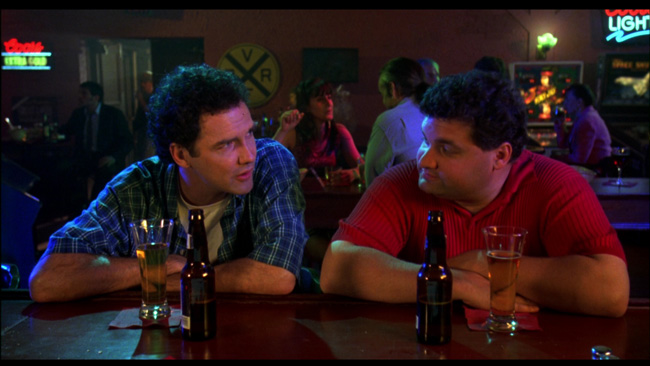
Dirty Work tells the story of Mitch (Macdonald) and Sam (Lange), two underachievers who have been friends since childhood. Growing up, the pair are taught by Sam’s father, Pops (Jack Warden), to not take crap off of anybody. Taking that lesson to heart, as children they make it their mission to serve comeuppance to anyone who wrongs them, child and adult alike. However, when they grow up, they find themselves too often on the receiving end of the comeuppance. Mitch in particular has a difficult time fitting into society, losing 14 jobs and his girlfriend in a matter of three months. Down and out, Mitch asks to move in with Sam and Pops, and shortly thereafter, Pops suffers a severe heart attack. When the two friends are faced with raising $50,000 to secure Pops a heart transplant, they first try their hands at a series of odd jobs, but soon realize that the key to raising the money to save Pops is by returning to their roots as revenge artists. They open up a revenge-for-hire business and offer to do other people’s dirty work for them, all the while saving up money to save Pops. Along the way, Mitch meets a woman whom he falls in love with, Kathy (Traylor), and ends up running afoul of the town’s most powerful citizen, Travis Cole (McDonald). Cole tries to trick Mitch and Sam into helping him condemn a build that he owns, but they eventually turn the tables on Cole and end up getting the last laugh. In the end of the film, Pops gets his heart transplant, Mitch gets the girl, and Cole is railroaded out of town after being exposed for the fraud that he is.

Dirty Work was added to my collection in the summer of 2002. That year, I spent about two weeks cooped up inside the house recovering from a bout of mononucleosis. As such, my mother picked up a few inexpensive DVDs to keep me occupied while I was homebound. One of these bargain bin finds was Dirty Work, and I probably watched the film a half dozen times in those two weeks. I had already seen it in the movie theater with some friends when I was about 13 years old, but it didn’t really stick out to me at that time. I was a latchkey kid back then, and I would often come home from elementary and middle school and watch reruns of “Saturday Night Live” on cable while I waiting for my parents to get home from work. I had gotten introduced to Norm Macdonald’s wry, dry sense of humor through these afternoon television watching sessions, and, as a result, I was a member of the small demographic that was actually interested in Dirty Work when it was released. The movie didn’t make a huge impression on me, but I can remember enjoying it a good bit. I loved the callbacks that Norm did to his Weekend Update persona, pulling out a Dictaphone and recording “notes to self,” and my friends and I were all fans of Chris Farley’s performance as Jimmy, Mitch and Sam’s bar buddy who had his nose bitten off by a Saigon whore, but overall the movie didn’t really stick with me after that initial viewing. Since receiving it on DVD, however, Dirty Work has been a staple of my viewing schedule for the past 15+ years. I don’t know if its offbeat, mocking style of humor needed some time to grow on me, or if part of the joy of the movie lies in repetition, but the older I get and the more times I watch Dirty Work, the more I want to watch and enjoy it again and again.

Dirty work 2

I think the common line of thought on Dirty Work, if the film is even thought of at all, is that it is a simple, sophomoric comedy, loosely and conveniently plotted, and filled with gross-out humor. On the surface, this is an absolutely accurate description of Dirty Work, but after nearly 100 viewings, I’ve come away with a much different reading of the film. Sure, Dirty Work is a “bad” movie, but I think that it is intentionally so. It’s a nudging, winking meta-film, poking fun at the cookie cutter studio comedies of the time, and standing as a prime example of anti-comedy, much like Saget’s and Macdonald’s other work. These are two master comedians, with a great understanding of and appreciation for the history of the medium, and the nature of humor, in general, and I simply find it hard to believe that they combined to create a movie that is crass for the sake of being crass. Though it features many alumni of the institution in cameo roles, Dirty Work is something of a send up of the morass that Saturday Night Live-inspired movies had become by the late 1990s. Similarly to an SNL film, the central conceit of a revenge-for-hire business feels like a sketch that has been pushed beyond its boundaries, but rather than relying on catch phrases or recurring oddball characters for a nostalgic sort of humor, Saget and Macdonald rely on escalating levels of absurdity, cringe-inducing anti-humor, and a defining performance from Macdonald, one of SNL’s most maligned cast members of the 90s. They combine these elements to create a chaotic comedic maelstrom that certainly isn’t for everyone, but which fully hits home with me.

dirty work 4

Of course I realize that a viewer’s enjoyment of Dirty Work is going to be directly related to their enjoyment of Norm MacDonald’s particular brand of wry, winking humor. MacDonald, something of a “comedian’s comedian” and certainly an acquired taste when it comes to mainstream comedians, is essentially playing a version of himself in the film, imbuing Mitch’s character with all of his trademark quirks and mannerisms, familiar from his stint behind the anchor desk at SNL’s Weekend Update. MacDonald does try to act in the film, although he’s best when he isn’t trying to force himself into a character and is instead allowing Mitch and the film, in general, to be a vehicle for his comedic stylings. To say that Norm MacDonald is a bad actor isn’t a hot take or a novel idea, but his brand of monotone non-acting is perfect in this film that he co-wrote for himself. The film’s humor largely stems from MacDonald’s deadpan line delivery, and his presence as a straight man in a very zany world. He also proves himself adept at physical comedy, not something that he was normally associated with, through a very funny running gag that sees Mitch being physically tossed through a series of windows. I can understand that MacDonald’s presence in the film on its own might serve as a stumbling block for the uninitiated, but I can’t picture another comedian or actor delivering some of the lines that he wrote, much less with a completely straight face. He anchors the film, not necessarily with a great performance, but with a certain comedic sensibility that is necessary for the rest of the film’s antics to revolve around.

dirty work 5

The rest of the stars orbiting MacDonald do so admirably. The film’s true supporting actors, Artie Lange as Sam and Traylor Howard as Kathy, don’t really stand out much, but Dirty Work is full of excellent cameos from some big name comedians. I mentioned him already, but Chris Farley’s role in Dirty Work is one of my favorite of his. He only has a few scenes, but he makes the most of them, and leaves a memorable impression in what would be the final film he worked on before his death. His character, Jimmy, is one note, a barfly who has sworn revenge on the Saigon whore who bit off his nose, but Farley brings his irrepressible physicality and charm to the role, playing against type as a somewhat villainous maniac. The scene, early in the film, where he confidently queues of the Rolling Stones classic, “Street Fighting Man,” on the bar jukebox before Mitch and Sam get in a brawl, only to push the wrong button and underscore the fight with Rupert Holmes’s “Pina Colada Song,” is one of my favorites in all of film comedy. Chevy Chase also shines as the degenerate gambler physician who offers to bump Pops’s transplant up on the list if Mitch and Sam can raise enough cash to help him pay off his bookies. Like Farley, Chase makes the most of his limited screen time, providing classic one-liners that feel improvised. His comedic timing is as excellent as always, and he has mastered the understated delivery that can drive a joke home before the audience even realizes it has been uttered. Don Rickles delivers some devastating insult comedy in a brief appearance that really served as my introduction to his brand of acerbic, vitriolic comedy. He debases Sam and Mitch, as well as the other employees at the movie theater where they are briefly employed, with such cutting quips. The scene leaves me laughing out loud no matter how many times I see it.

dirty work 3

I could be wrong. Dirty Work could be just an ordinary, run-of-the-mill bad movie. It certainly seems to be that way on first blush. Saget’s direction in the film would be most generously described as competent. The script is both outlandish and simplistic, often settling for lowest common denominator punchlines and toilet humor. The film’s lead actor turns in a performance that seems almost determinedly wooden. However, despite all that, I honestly feel that the film is a twisted work of comedic genius. I really think that it was a movie ahead of its time, engaging in the type of anti-comedy that would become popular a decade later, at least in underground comedy scenes. It isn’t the type of movie that could ever become a classic, even of the cult variety, but I have rarely found a person who I’ve showed the film to or reminisced about it with who doesn’t find something about it to enjoy. I don’t know if my lionizing of the film is a sort of justification, but I also don’t feel that my outright admiration for Dirty Work is something that needs to really be justified. I’ve rarely subscribed to perceived dichotomies between high and low culture, and I’ve been even more reluctant to cast my lot with existing cultural values when it comes to art. I believe that, increasingly so, great art can come from any number of sources, and that beauty is often in the eye of the beholder. Writing about 50 different movies from my own personal collection this year has reminded that there’s really no accounting for personal taste. People should like what they like, and watch what they want to watch. If a movie makes you happy or gives you some relief or distraction from life’s many problems, even for just a couple of hours, enjoy the hell out of it. Happy New Year.

Desperado

Desperado (1995)

Dir. Robert Rodriguez

Written by: Robert Rodriguez

Starring: Antonio Banderas, Selma Hayek


Desperado was one of my favorite action movies when I was a teen, and it, along with other early Robert Rodriguez films, became highly influential on my early ambitions of becoming a filmmaker. I was a certified Tarantino freak in high school, and his filmography and circle of influence became a major jumping off point for me in discovering other favorite films. It was a short jump from Tarantino to his friend and frequent collaborator Robert Rodriguez, and Desperado was my entry into the latter’s low budget, sun baked brand of cinema. I immediately recognized the meta-cool of Tarantino’s postmodern style, but while Desperado indulged some of the same impulses of Pulp Fiction or Jackie Brown, its influences were decidedly grittier. While Tarantino’s films sought to recontextualize and elevate their B-movie influences to the status of “high art,” Rodriguez’s reveled in the “low art” status of their cult and midnight movie predecessors. Rodriguez has proudly walked to the beat of his own drum throughout his career, learning the trade of filmmaking on the job, and constantly evolving as an artist. At this point, he has become a brand, the progenitor of a grindhouse resurgence that has only gained steam as new media has made it easier for aspiring filmmakers to create movies on a shoestring budget and get them released to wide audiences through alternative distribution channels like streaming or VOD, but Rodriguez’s early films represent a different type of guerilla filmmaking. In the 1990s, with films like Desperado, Rodriguez was one of a handful of filmmakers raising the flag for interesting, high production value, low budget, DIY filmmaking.

desperado 3

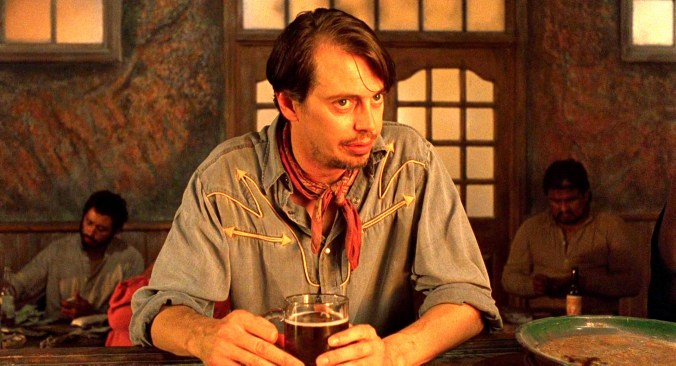
Desperado begins with a road weary, possibly deranged traveler (Steve Buscemi) stumbling into a bar in Mexico and relating the tale of a tall, shadowy figure that he saw murder a bar full of gangsters a few towns over. His story piques the interest of the bartender (Cheech Marin) and his associate (Carlos Gomez), as they obviously know the principals in the traveler’s story. It turns out that that shadowy figure is known as “El Mariachi” (Banderas), and he’s strapped with a guitar case full of guns, on a quest for vengeance against Bucho (Joaquim de Almeida), the drug lord who murdered his wife. Desperado is a straight forward revenge tale, with El Mariachi stalking Mexican towns, hunting down members of Bucho’s gang as he tries to get closer to the man himself. Along the way, he meets and falls in love with Carolina (Hayek), a book store owner who happens to be Bucho’s lover. When Bucho finds out about El Mariachi and Carolina’s affair, he sends his men to hunt down the pair, but they fight off their pursuers and eventually confront Bucho himself at his compound. After dispatching of Bucho, El Mariachi is free to ride off into the sunset with Carolina, although he hangs onto his guitar case full of guns, “just in case.”


What the film might lack in narrative complexity, it more than makes up for in fast-paced, explosive action. Rodriguez is obviously channeling the influence of the Hong Kong action films of John Woo in Desperado, but the film doesn’t feel derivative. Instead, it becomes a celebratory homage to those action landmarks, and a testament to Rodriguez’s ability to create polished, kinetic action sequences on a shoestring budget. His book, Rebel Without A Crew, details the process that Rodriguez went through to make his debut film, El Mariachi (which Desperado is a sequel to). It can serve as a primer for young filmmakers looking to chase their own movie dreams, and it was a huge influence on me in my late teens. Though the budget for Desperado was significantly larger, it was still scant by Hollywood standards, and Rodriguez still holds true to the rules of economic action filmmaking detailed in his book. His later films would see him working with bigger budgets, full FX teams, and cutting edge CGI technology, but the essence of Rodriguez’s style is perfectly on display here.

THE FILM 'DESPERADO' BY ROBERT RODRIGUEZ

The stunt work in Desperado is impeccable, with Banderas doing all of his own stunts and performing some excellent fight choreography. He combines slapstick elements with traditional fight choreography and firearms work to create an ultraviolent, combustible ballet. Bullets rain down throughout the movie and countless scores of anonymous bad guys are dispatched of. This is action at its most impersonal and most impressive: mindless, excessive, and explosive. Rodriguez, a self-proclaimed guerrilla filmmaker, squeezes every bit of value out of his film’s $7 million budget. His mastery of practical effects and ingenuity as a filmmaker allow him to turn in a film that looks every bit as polished and has just as many high action set pieces as a big budget studio film. Although the industry and movie making technology have changed significantly in the 20+ years since Desperado was released, aspiring filmmakers who want a crash course in delivering high quality films on a budget should still look to Rodriguez’s early films and his book for tips. He’s by no means the only filmmaker capable of producing films of this quality on tight deadlines and budgets, but action films are so often the result of bloated FX budgets, lengthy shooting schedules, and complicated stunt work, and they still rarely leave the lasting impact that Desperado has, which is a testament to Rodriguez’s unique skillset.

As I mentioned, for all of its visual sheen, Desperado still finds Rodriguez struggling to flesh out his narratives. The script for Desperado is bare bones, interested only in the most direct motivations for its characters, and certainly not interested in significant psychological examination or character development. I don’t know that Rodriguez has ever really learned to write a “good” script, but I also don’t think that he often makes the type of films that are so significantly character driven that this is a bad thing. He plays to his strengths in Desperado and doesn’t let extraneous character background or plot devices get in the way of the fight scenes and explosions. There are attempts in the film to provide some depth for El Mariachi’s character, such as his relationship with a young boy who is growing up watching the cartel violence in his town, or his romantic relationship with Carolina, but these are largely underdeveloped. Narrative simplicity in a film like Desperado is fine. Character motivations in films like this one are concrete and don’t need a significant amount of discussion. However, one interesting thing about Rodriguez’s approach to storytelling in Desperado is his penchant for weaving the story together through narrated flashbacks. The film opens with one such instance of this technique, with the traveler telling the story of his encounter with El Mariachi interspersed with flashbacks of the mysterious gunman shooting up the bar. Though this isn’t a unique narrative device, Rodriguez employs it skillfully enough in Desperado that it helps to break up the linear progression of the film and makes for an interesting storytelling wrinkle.

desperado 7

Though the script might not be complex or narratively innovative, it does feature several great individual moments and opportunities for characters to deliver memorable monologues in one-off scenes, particularly earlier in the film before the action really ramps up. Banderas is great as El Mariachi, which, for me, is his signature role. He plays the character with a combination of winking cool and ruthless, violent determination. There’s an elegance to the choreography that Rodriguez has designed, with Banderas performing his stunts like a dancer, performing a duet with the camera to graceful, devastating effect. Hayek has little dialogue in the film, but she proves equally capable of performing action stunts, and Rodriguez gives her enough agency in the film that she doesn’t sink to the role of eye candy, which would have been a typical choice in a Hollywood action film. Almeida is a hate-worthy villain as Bucho. His performance isn’t over the top, as he chooses to play Bucho as largely disinterested in anything going on around him. His defining characteristics are cruelty, greed, and apathy, and they’re manifested in Almeida’s nose-in-air performance and his utter disdain for the rest of his costars. In many ways, though, the film’s supporting cast are given the best moments in the film and provide the most memorable performances, aside from Banderas’s. Desperado features cameos from familiar faces such as Steve Buscemi, Cheech Marin, Quentin Tarantino, and Danny Trejo, and though most of these actors are only given a scene or two, they bring their established (or burgeoning) personae to their scenes, and individually nail them. I’ve already mentioned Buscemi’s opening scene, which sets the stage for the destruction to come, but Marin’s cynical, corrupt bartender is classic Cheech, particularly in his brief interaction with an entitled tourist. Tarantino gets a brief moment to ham it up with a memorable telling of a genuinely funny joke, while Trejo, in one of his first mainstream film appearances, makes the most of his silent performance by utilizing his imposing physicality in a role as a bounty hunter tracking El Mariachi. Top to bottom, the cast shines in a genre that often doesn’t ask much of its actors.

desperado 6

It’s probably pretty obvious that my zeal for Desperado has not lessened any with age. It isn’t a film that I watch with any regularity anymore, but it’s one that I can get caught up in just as easily today as I did when I first saw it. Most modern action movies have become so formulaic and so obviously FX driven that I rarely seek them out. Desperado still feels like a breath of fresh air. It has its obvious influences, and it is clearly existing within a fairly rigid genre template, but Rodriguez’s sensibilities and his unique storytelling voice keep the film from ever feeling derivative. The film’s set pieces still hold up even with 20 years of technological innovation, and its central performance from Banderas as El Mariachi is an action archetype. I feel like Desperado doesn’t get as much consideration now, because Rodriguez’s career has moved away from making straight action movies and more into a direction of making B-movies and children’s sci-fi, but it’s a genre classic. In the 1990s, Desperado was a weekend cable TV staple, and it is still as fun of an experience to sit down and mindlessly consume as it was then.

Dead Man

Dead Man (1995)

Dir. Jim Jarmusch

Written by: Jim Jarmusch

Starring: Johnny Depp, Gary Farmer, Lance Henrikson


I’m excited to finally write about another Western for this project, as the Western genre is one of my favorite types of film to watch and think about. One of my overarching interests in college was writing about depictions of masculinity in films, and I often found the Western genre to be rich with films that explored examples of classic machismo and also depictions of traditional masculinities in crisis. As a whole, the genre has often stood for Americana, and classical American mythmaking, but individually, Western films can serve as prisms to explore the underlying tapestry that makes up these unifying myths or as powerful critiques on the societies that produced them. My favorite Westerns to think about, like Dead Man or Blazing Saddles, are revisionist Westerns, ones that challenge and critique the accepted myths of Americana and offer up alternative narratives to the settling of the West. I love the films of John Ford and John Wayne, and we’ll get to a few of those, but I more appreciate the later films of the genre that used the existing conventions of the Western to deconstruct the genre and allow some light to seep through the cracks in the linear narrative of conquest and Manifest Destiny that the Western has come to represent. Dead Man doesn’t offer much overt criticism of the Western genre or social commentary, but it does inject mysticism, psychedelia, and some trademark Jim Jarmusch “cool” into the genre.

dead man 1

The film opens with William Blake (Depp) onboard a train from Cleveland to the frontier town of Machine, where he has been offered a job as an accountant with the Dickinson metal works. Blake is instantly set apart from the rest of the passengers on the train, as they eye him suspiciously from beneath the brims of fur hats, clutching long guns tightly. The film’s surrealism is apparent from the opening scenes, as well, as the train’s Fireman (Crispin Glover) emerges, covered in soot, to engage in a strange conversation with Blake in which he warns the newcomer against going to the frontier. All the while, the passengers are shooting buffalo from the moving train behind the two men. Undeterred, Blake arrives in Machine, and sets off to claim his job, however, when he arrives at the metal works, his job has already been filled and he is driven from the property at gunpoint by Mr. Dickinson himself (Robert Mitchum). Without the job he was promised, and having just buried his parents in Cleveland, Blake finds himself with no money for a return ticket and no prospects, but he shows some kindness to a flower girl, Thel (Mili Avital), who in turn takes him back to her room at the local hotel. Their post-coital bliss is interrupted by the arrival of Thel’s former lover, Charlie (Gabriel Byrne), who tries to shoot Blake, but instead shoots Thel when she throws himself in front of the bullet. Blake, with some difficulty, uses Thel’s gun to shoot Charlie, and then realizes that he has been shot by the bullet that passed through Thel’s chest. Wounded, he jumps out of the window and steals Charlie’s horse, riding off into the desert. When Blake comes to, he meets Nobody (Farmer), a Native American who will act as a spiritual guide for Blake as they continue into the frontier, possibly into the afterlife.

I first became aware of this film in my Sophomore or Junior year of college in a class on Westerns. I don’t believe that we screened the film in its entirety in class, but we watched a handful of clips from it, and I saw enough that I was intrigued and purchased the film on DVD. I knew Jim Jarmusch, as my Wu-Tang obsession had led me to the RZA-soundtracked Ghost Dog in high school, and Broken Flowers had been one of my favorite movies of 2004, but I hadn’t explored much into the director’s filmography beyond these and a couple of other films. Even with this cursory introduction to the director’s style and having seen some clips from the movie, Dead Man was a very weird film to me the first time I watched it. I was used to modern Westerns that called into question ideas of national identity and American exceptionalism, but Dead Man is much more inwardly focused, raising questions of personal identity, life and death, and humanity. Critics, including myself earlier in this post, have called it a psychedelic Western, and it certainly is that, but perhaps it is more accurate to think of Dead Man as an Existentialist Western. It lends itself, with its moody score and monochromatic visual presentation, to the same sorts of reflection as Existentialist philosophy. Its subject matter, a dying man (who may or may not be actually dead already) being guided to the afterlife speak to these same concerns of being and nothingness, and of Man’s place in the spiritual and mystical realms. Dead Man has little time for inquiries into political or social commentary as it sets its goals on a higher level of exploration of the human condition. It was certainly a bit of an adjustment from what I had been expecting of the film at first.

dead man 6

Of course, after consuming much, if not all, of Jarmusch’s oeuvre, these lofty thematic concerns don’t surprise me at all. His films often strike a balance between a perfect Zen koan and a late night, pot-fueled, dorm room philosophy session. They often provide deep truths about the human experience, but their presentation is a bit hazy and nebulous around the edges. From top to bottom, Dead Man makes for a great cult film. Like most of Jarmusch’s output, the film is just a little bit too strange to fully connect with the mainstream, but it has fared pretty well critically, and it has a fan base among critics and audiences. Its literary allusions, including a running gag in which Nobody believes that Blake is the deceased Romantic poet William Blake, and its philosophical context will satisfy the intellectuals in the audience, while its hazy, mystical presentation and brief moments of gore will satisfy the midnight movie crowd. The film celebrates the history of the Western genre with its casting of Robert Mitchum (in what would be his final role) as Dickinson, while also turning the typical Western narrative on its head. Like many Westerns, Dead Man depicts a great journey, but the nature of this journey is spiritual rather than physical, and it’s being led by Nobody, a Native American rather than a White cowboy. These type of inversions are typical of a revisionist Western, but Jarmusch pushes the genre to its breaking point, by merging the Western journey with a picaresque, peopled by strange, obtuse characters. The intended effect is to keep the audience off balance, unsure of whether Blake is really having these experiences or whether he’s hallucinating them, or if his journey is through some purgatorial space. What appears, initially, to be a stylish modern take on a classic genre turns out instead to be using that classic genre as a landscape upon which to project a rumination on life, death, violence, and human nature.

dead man 4

These themes are primarily explored through the character of Nobody, played expertly by Gary Farmer, whose job it is to enlighten the dying Blake, whom Nobody often refers to as a “stupid fucking White man.” Nobody’s character walks between two worlds, having been captured by English settlers as a child and toured around museums as an attraction. In this way, Nobody has closely inspected and become educated by White culture, but as a result has been unable to fully assimilate into his own Native culture. Like Blake floating between life and death, Nobody, too, is pulled between two different types of existence. Farmer provides much of the film’s comic relief, though not in the typical Western style, with Native Americans and other marginalized characters serving as the butt of cruel jokes. Nobody is smarter and more cultured than Blake, and the film’s humor often stems from Nobody’s offhanded quips about Blake and White culture. Farmer, a member of the Cayuga Nation, brings authenticity and respect to his role, as does Jarmusch’s treatment of Native American culture in the film. The film employs several Native languages throughout, and it presents Native culture as more enlightened and sophisticated than the brutal, rapacious culture of the White characters. Though he’s capable of great violence, Nobody is full of joy and life, while Blake and the film’s other White characters are morose and associated with death. In fact, Blake becomes a sort of avenging angel over the course of the film. Though he is initially unable to shoot straight, Blake develops lethal potency during his journey with Nobody, who teaches him to let his pistol speak his poetry. Depp’s performance is worthy of praise, as well. He eschews the scenery chewing that will become his trademark later in his career, employing instead a laconic, trancelike performance style. It gives the sense that Blake is some sort of conduit, channeling the energies of the Universe as the mysteries of death are revealed to him in his spiritual journey.

dead man 3

The rest of the film’s cast is excellent, as well. As is typical of a Jarmusch film, big names pop up in small roles throughout the film. Though this really is Depp’s and Farmer’s movie, several of these cameos are worth mentioning as they simply add to the overall strangeness of the film. Lance Henrikson is a standout as Cole Wilson, the deadliest of three bounty hunters that Dickinson sends to bring Blake in for the murder of Charlie, who happens to be Dickinson’s son. His performance is built around his quiet menace and the rumors that the other bounty hunters whisper about his sadism and depravity. His riding partners, Conway Twill (Michael Wincott) and The Kid (Eugene Byrd), hatch a plot to kill Wilson and split the ransom among themselves, but Wilson is too crafty for them and in a memorable scene, proves the truth in the rumors of his cannibalism. Alfred Molina has a brief but memorable cameo as a bigoted frontier missionary. Blake and Nobody come upon his outpost late in the film and the missionary feigns piety when dealing with Blake, but treats Nobody with disdain and malice. Finally, Iggy Pop and Billy Bob Thornton are fantastic as two thirds of a group of outlaws who plan to rape and kill Blake. Thornton is almost unrecognizable, covered head-to-toe in fur, but his distinctive drawl is hard to mistake, while Iggy Pop is very obviously himself, despite wearing a dress and a bonnet. Their brief scene is an interlude, and not particularly important to the film’s overall plot, but, like many of Blake’s encounters in Dead Man it deepens the sense of alienation and psychedelia that the film traffics in, and it enriches this offbeat world.

dead man 5

Dead Man is a film that exists wholly within its own space. While it certainly comments on and dialogues with the Western genre, it is not wholly of that genre. The film offers up little in the way of concrete narrative resolution, but instead leaves the audience with a profound sense of mood. The film’s visuals, its idiosyncratic performances, and its spare, improvised, Neil Young score, all enhance the strangeness of the film, and help to build this mood. Viewers looking for a traditional Western action film might be disappointed by Dead Man, although the film does have plenty of action, but anyone who wants to immerse themselves in a cinematic journey would be well advised to check out this somewhat lesser-known movie. It’s often said that a trip is less about the destination than about the journey, and Dead Man is a perfect example of this. While the film ends without much narrative clarity, its presentation of a moody, psychedelic trip is as enjoyable as it is inscrutable.


Post-script:

I missed a post last week for the first time during this project. My plan at the outset was to post once a week. The film that I had planned on writing on for my post on the 22nd of October was George Romero’s Dawn of the Dead, however when I opened up the case, the disc was missing. Rather than replacing the disc, as I had with Better Off Dead, or advancing my schedule by a week, I decided that my project would be better served by me taking a week off to catch my breath. I have a demanding and time consuming job, and I also devote a good portion of my free time to volunteering and community service, so I needed to take a brief break to get my writing back on schedule and to ensure that I could continue providing the quality of content that I have striven to maintain throughout the life of this blog. I hope to not miss any more posts going forward.

Clerks

Clerks (1994)

Dir. Kevin Smith

Written by: Kevin Smith

Starring: Brian O’Halloran, Jeff Anderson, Marilyn Ghigliotti


Mallrats might have introduced me to Kevin Smith and hooked me on his brand of humor, but Clerks literally changed my life. Not only did the film deepen my appreciation for Smith, who was one of my youthful film heroes, but it totally opened up my eyes to the possibility of a different kind of cinema. Of course I knew that there was such a thing as “independent cinema,” but it existed more as a nebulous concept than a concrete entity in my mind. I had seen a handful of movies on Independent Film Channel when I was 11 or 12, over a month when my parents’ cable offered a free preview of the channel when it became available in our area, but, for the most part, these movies just seemed like slightly less glossy versions of what I could see in the local multiplex. It wasn’t until I saw Clerks that I think independent cinema really clicked for me as something that could be radically different from the mainstream. Clerks turned me on to the idea of filmmaking existing outside of the Hollywood system, and the idea that anyone can make a movie if they really want to. At that time in my life, I really wanted to.

Even at 14 years old, I was an aspiring filmmaker of sorts. Most of my friends were getting into skateboarding and I became a de facto cameraman because my parents had recently bought a video camera, and I was also too uncoordinated to skate with any proficiency. At first, our videos mostly consisted of poorly shot and executed skateboard tricks and stunts, modeled after the MTV show Jackass, but I got more interested in learning how to edit the footage and add music. Seeing Clerks around this same time further cemented my interest in filmmaking and led to me trying some very basic narrative experiments in addition to the skate videos that I was shooting. What were once strictly stunt videos started becoming slightly more narrative with the addition of loosely scripted sketches and parodies. The “humor” contained therein was still overwhelmingly physical, but we were striving towards a more cinematic vision of our silly videos. My friend Mike introduced a distinctively performative aspect to the videos with his incessant mugging and rapping for the camera, and his various alter-egos, many of which were clearly influenced by Jason Mewes’s performance as Jay in Clerks and Mallrats. Our videos never really advanced beyond the most rudimentary experiments, and all of the tapes have been lost for over a decade, but I remember those days that we spent filming ourselves hurting each other with great fondness. I continued to dabble with filmmaking throughout high school in various forms, but it was largely something that I abandoned until I moved to Pittsburgh.

Clerks 2

Of course, while my interest in making my own films waned in high school, my interest in watching them and consuming the medium was only beginning to peak. I don’t know if I used Kevin Smith and Clerks as a jumping off point, per se, but at this time in my life, I began to more fully explore the American independent film movement of the 1990s. I truly discovered Tarantino around this time, I saw Do The Right Thing for the first time at 15, Richard Linklater started to bubble into my consciousness through his comedies. Through these filmmakers I started to branch out, discovering their influences, and laying the groundwork for my later formal education in Film Studies. Even though it was a period of great exploration and discovery for me, I always came back to Kevin Smith. As I wrote last week in my Chasing Amy post, I was obsessed with the View Askewniverse all throughout my late teens. By the end of high school, I’m not sure if I would have mentioned Smith as my favorite filmmaker above Tarantino or, perhaps, Kubrick, but that would have likely been youthful posturing. In retrospect, I was always watching more Kevin Smith than anything else. That changed somewhat after I came to college and my expanding tastes and more crowded viewing schedule put an end to the ritualistic repeat viewings of Smith’s films. That time in my life also, coincidentally, dovetailed with an artistic low period for the filmmaker, whose post-2000 output has been of varying quality, at best. Clerks, however, has been the one film in his filmography that I’ve come back to over and over again, year after year. I still revisit the other 1990s Smith films, but Clerks is the only one that has become truly indispensable for me.

Clerks has been different things for me at different points in my life, but it’s always been a film that I watch once or twice a year. I’ve definitely seen it over 50 times in my life, and maybe even close to 100 times. When I was first introduced to it, it was inspirational, challenging in its simplicity. It was a film that dared me to want to make something of my own. In college, even though I often found myself thumbing my nose at Smith’s current films, Clerks was still the high water mark that my film school friends could all agree on. When I started my bartending career after college, Clerks gained a professional relevance that I wouldn’t fully appreciate until I started managing bars in my late-20s. I don’t know how many times in the last five years I’ve found myself repeating Dante’s (O’Halloran) catchphrase from the film, “I’m not even supposed to be here today.” It’s become a mantra to get me through the long nights and weekends. The beauty of the film to me is a malleability belied by its overall simplicity. I can appreciate a different aspect of Clerks every time I watch it depending on my mood or how my week has been going, and even though I’ve seen it dozens of times, it never gets old. Smith’s ambitions as a filmmaker have certainly grown since Clerks, and his technical prowess has greatly improved, but Smith has never made a better film than Clerks, and he almost certainly never will.

Clerks 4

Famously shot on a self-financed budget of just under $30,000, Clerks follows a day in the life of register jockeys Dante Hicks, who works at the Quick Stop convenience store, and Randal Graves (Anderson), Dante’s friend and erstwhile employee of neighboring RST Video. The two clerks deal with annoying customers, drug-dealing loiterers, and Dante’s romantic foibles as he tries to decide between his current girlfriend, Veronica (Ghigliotti) and his ex, Caitlin (Lisa Spoonauer). He’s not even scheduled to work on this particular day, and Dante just wants to get through his shift and get home, but life keeps throwing obstacles in his way as he’s forced to live out his mundane, hellish existence. It’s a depiction of existential nothingness, and a perfect expression of a frustrated sense of arrested development. Clerks is the end result of a person deciding that they have a story to tell so important to them that they have to get it out there by any means necessary. Clerks is filmmaking by necessity, which makes it great.

The film is based on Smith’s actual job at the time, and was primarily shot in the convenience store that he actually worked at. It’s decidedly lo-fi, shot on 16mm black-and-white, and featuring almost exclusively non-professional actors. Rather than being hampered by the constraints placed upon him by his limited budget and lack of experience, Smith uses his technical simplicity and idiosyncratic cast to his advantage, and plays to his strengths. The film is conversational, broken up into nine vignettes (in reference to the nine circles of Hell in Dante’s Inferno) that consist primarily of lengthy passages of conversation between Dante and Randal, or between one of the two and his customers. These dialogues are shot simply, often consisting of a lengthy master shot, broken up by a bit of shot/reverse shot, with the occasional reaction shot of an eavesdropping customer thrown in. The simplicity is surely due to circumstance and to Smith’s limited filmmaking experience, but it isn’t incompetence. Instead, the lack of edits and the largely static camera work to highlight the script, forcing the audience to pay close attention to the cascade of pop-culture references and vulgarities that the two protagonists exchange throughout the film. The languid visual style also exhibits Smith’s already developing sense of comedic timing. When he does make cuts for comedic effect, they work more often than not. Smith doesn’t over extend himself as he sometimes will later in his career, and it pays off. The film also gets some of its most memorable moments from the unusual shooting requirements. Because the film could only be shot in the middle of the night, after the convenience store closed, Smith had to fabricate a reason for the store’s steel shutters to be lowered. In the film, vandals have plugged the shutters’ locks with chewing gum, forcing Dante to write a sign on a bedsheet with shoe polish that reads, “I assure you, we’re open!” It’s my favorite running gag from the entire film, and it’s the result of forced ingenuity.

Clerks 6

Clerks also manages to bring out the best in a cast made up chiefly of Smith’s friends and other non-professional actors. The performances in Clerks are not necessarily good, in fact, sometimes they’re not very good at all, but they are perfect for the film and for the script. Though it very much feels true to life, Smith’s dialogue is often somewhat off-kilter and affected, especially early in his career as a screenwriter. O’Halloran and Anderson manage to internalize those affectations and their line delivery feels completely real. I think that often when Smith employs non-professional actors, such as in Clerks or in the case of Jason Lee in Mallrats, they give more naturalistic performances and are able to translate the idiosyncrasies in Smith’s dialogue into speech patterns that read as familiarities between the characters. O’Halloran and Anderson, as Dante and Randal, speak in the language of close friends, which drives home the film’s realism. The rest of the film’s characters, who could broadly be described as the customers, with the exception of Veronica and Caitlin, provide a counterpoint to the chummy, laid back nature of Dante and Randal’s relationship. They’re shown only in glimpses but could largely be characterized as manic and reactionary, outsiders who are imposing their neuroses on the Quick Stop. As Randal says, “This job would be great if it weren’t for the customers.” This type of characterization of the retail customer and the sometimes antagonistic relationship between customer and employee will likely ring true for many who have worked in service.

I don’t know if there will come a time when I get tired of the movie Clerks. It’s certainly a film that is aimed towards people of a certain age demographic, which I am rapidly approaching the tail end of, now that I’m in my early thirties. Clerks is definitely a product of post-adolescent fury, and it speaks to concerns of youthful rebelliousness, but I think its anti-establishment, anti-authoritarian message transcends age demographics. It was a seminal movie for me at a time when I was starting to discover my own anti-authoritarian streak, and it’s adherence to DIY principles was inspiring to me. It’s stayed with me through the years as a reminder of one of my youthful obsessions, but also as a movie that has remained relevant and changed in meaning for me over time. Sometimes I sympathize more with Dante, a tired man clinging to a scrap of professionalism and optimism in a town full of savages, and sometimes I’m more of a Randal, openly antagonistic and despairing for the state of humanity. Clerks is an important movie in the history of independent cinema, and it set Kevin Smith up to be an important and influential filmmaker throughout the rest of the 1990s. For me it’s an important film because it’s a reminder of who I was when I first started getting serious about movies and filmmaking, and because it provides a symbolic throughline from the kid I was then to the adult that I’ve become.

Bruce Campbell vs. Army of Darkness

Bruce Campbell vs. Army of Darkness (1992)

Dir. Sam Raimi

Written by: Sam Raimi, Ivan Raimi

Starring: Bruce Campbell, Embeth Davidtz


As will become apparent later in this project when I review the first half of the Friday the 13th series, a few Nightmare on Elm Street films, and, eventually, Texas Chainsaw Massacre, I had a soft spot for horror movies growing up, particularly slashers and gore-fests. This obsession with the macabre goes back to my early childhood and my introduction to the classic Universal monster movies of the 1930s and 40s. I came to love Dracula and the Invisible Man, but particularly Frankenstein’s monster, and I would search the weekly television listings for classic monster movies and record them off of cable late at night. When I was a little older, I’d sneak glances at the Friday the 13th movie marathon that ran every, well, Friday the 13th on the USA Network, and my tastes in scares began to mature and get a little darker, a little gorier. It wasn’t until probably my early teens, maybe 13 or 14 years old, that I first encountered the uniquely weird horror offered up by Sam Raimi. I saw Army of Darkness on television and it was immediately intriguing to me. It satisfied the gore and gross-out component, although it wasn’t really a true horror movie, and it added a strong comedy component that I wasn’t expecting. I liked the movie a lot but I didn’t really come back to it until my later teens. During high school my friends and I would start seeking out more and more hardcore and taboo horror films, often turning to Asian cinema and the emerging torture porn genre to provide these cheap thrills. The first two Evil Dead movies, providing some legitimate scares along with their moments of campy comedy, were acceptable to my friends’ deviant tastes, but the lighter, goofier Army of Darkness was more of a stretch to some of them. Eventually, sometime in high school, I picked up the director’s cut (officially titled Bruce Campbell vs. Army of Darkness, the film’s original title), and would occasionally share it with friends, particularly around Halloween. By my early twenties, this movie, along with most of the horror movies in my collection, had gotten largely shelved. My tastes were changing rapidly and I didn’t see much value in the schlockier elements of my collection at the time. I still don’t go for horror movies too often, but I’ve enjoyed the later films from Raimi and I was happy to go back to one of his classics for this project.

Army of Darkness 4

The film picks up immediately after the events of Evil Dead II with Ash (Campbell) being transported to the year 1300 AD. After arriving in the middle ages, Ash finds himself in the midst of a conflict between Lord Arthur (Marcus Gilbert) and Duke Henry the Red (Richard Grove). He is captured by Arthur’s knights who believe him to be a spy of Henry the Red, but Arthur’s Wise Man (Ian Abercrombie), believes Ash to be a hero promised in a prophecy. After being taken prisoner, Ash is taken to Arthur’s castle where he is thrown into a pit to be executed. Ash is able to escape the pit, killing a Deadite with the help of the Wise Man who returns his chainsaw to him. When he climbs his way to the top, he regains his “boomstick,” which he uses to quickly dispatch of another Deadite that attempts to escape the pit behind him. Ash is celebrated as a hero and he garners the affections of Sheila (Davidtz), a beautiful maiden. The Wise Man agrees to help Ash return to his own time, and tells him he must seek out the Necronomicon in order to do it. Ash’s quest for the Necronomicon leads him to battle demons and Deadites, but he finally persists and makes his way to the graveyard where the evil book is stored. However, Ash has never been one for attention to detail, so he has forgotten the magic words that will allow him to open the Necronomicon, and when he attempts to open the book without reciting the words properly, Ash unleashes an army of the dead on the land. Now in order to return to his home, he must defeat the Army of Darkness to save the castle and Sheila, who has been captured by the Deadites.

If that doesn’t exactly sound like the description of a horror movie, that’s because Army of Darkness really isn’t one. Although it does contain a few unsettling or scary moments, for the most part it’s a fantasy movie that leans heavily on slapstick comedy set pieces. The first two installments of the Evil Dead trilogy have their tongues firmly inserted into their cheeks, but they still fall distinctly into the horror genre. For the third installment, Raimi wanted to go in a different direction by getting Ash out of the cabin in the woods and into the larger world. He incorporates the influence of classic fish out of water tales like A Connecticut Yankee in King Arthur’s Court and Gulliver’s Travels, and the end result is a film that is distinctly different from its predecessors while retaining the same attitude and tone. Though he’s traded in the familiar setting of the first two films, plenty of Raimi’s filmmaking tricks are still on display in Army of Darkness. He returns often to the low tracking shots and queasily fast zooms that defined the Evil Dead films, implying the presence of spirits chasing Ash through the woods. He also retains his fondness for jump scares, and the few that show up in Army of Darkness might be the only moments in the film that could induce real terror in the audience. But, of course, Raimi’s most familiar tool is the star persona of Bruce Campbell in his signature role as Ash.

Army of Darkness 2

A close friend of Raimi’s, Campbell helped him finance and create the original Evil Dead and has gone on to use his appearances as Ash to launch a career for himself as one of the most recognizable character actors currently working. As the film’s original title would suggest, in Bruce Campbell vs. Army of Darkness, as in the other Evil Dead films, Campbell is asked to essentially carry the load from an acting standpoint. He is the most heavily featured actor in the series by far, and in many of his scenes he is paired with shrieking, nearly nonverbal demons. Luckily, Campbell very easily has the chops to entertain on his own for the film’s 90-minute run time. Campbell plays Ash as a spoof of the hyper-macho action stars of the time, and he delivers his punches as readily as his punchlines, never at a loss for words as the film spawned many catchphrases among horror fans. He is the engine for both action and comedy in the film, as Campbell possesses both the bravado of a traditional leading man, and the rubber-faced, physically performative gifts of an expert slapstick comedian. Raimi knows how to perfectly capture Campbell’s expressive face to render emotions ranging from confidence, to fear, to hysteria and he uses this malleable mug to great effect throughout the film. It’s impossible to imagine the Evil Dead series without Campbell as Ash; another actor just wouldn’t feel right in the role.

Raimi is able to do a lot with a little as a filmmaker, and that economy is on display again in Army of Darkness. Though the film was made well into the beginning of the CGI boom, he chose to use practical effects throughout the movie, employing miniatures and stop-motion animation to create the army of the dead. Though the effects do look a bit dated, they don’t necessarily look bad. In fact, there is a sort of nostalgic charm to the skeletons, as they recall the groundbreaking stop-motion work of Ray Harryhausen. Raimi uses sharp, quick edits to propel the action in the film’s climactic battle between Ash, Arthur’s army, and the army of the dead, led by a reincarnated Evil Ash. These edits allow Raimi to mask the fact that he is employing a very small cast, and maintain the level of action at a fever pitch. Army of Darkness definitely feels like a throwback to a time when film genres weren’t as rigidly codified and swashbuckling heroes could coexist with supernatural demons and beautiful damsels in distress. This is decidedly a B-movie, but it’s a rather well-made one, and an entertaining one to boot. Campbell’s charisma carries over to the entire production, with even some of the animated skeletons delivering throwaway lines that are laugh-out-loud funny.

Army of Darkness 3

Army of Darkness is a very fun movie experience, and it’s one that I would probably go back to more often if it weren’t for the terrible quality of the video transfer on the DVD copy that I own. I don’t know if the image quality has degraded over the years, but it’s really difficult for me to imagine myself watching this disc as a teen. There are times when the image becomes so grainy and dark that it’s almost impossible to see what’s going on on the screen at all. This is particularly the case during the film’s final battle, which was entirely shot at night. I’ve watched Army of Darkness on streaming services and it doesn’t seem to suffer from this lack of clarity, so I’m assuming that it’s just a bad transfer on this particular Director’s Cut edition of the DVD. It’s really a shame, because I think the Director’s Cut, with the film’s alternate ending (which is something of an homage to Planet of the Apes) is the superior version of the film, but I just can’t see myself sitting down to watch this particular DVD again anytime soon. I will, however, likely be revisiting this cult classic, along with its predecessors, sometime around Halloween this year, just on a streaming platform. Although my taste for straight horror movies has somewhat diminished, I’ll always enjoy the humorous horror that Raimi offers up here and in his later films, which are equally as good at blending the genres of horror and comedy. I probably enjoy the Evil Dead films a bit more than Army of Darkness, but it’s great in its own right for taking the series in a totally new direction while still maintaining that distinctive early Raimi feeling.