Friday the 13th Pt. 2

Friday the 13th Part 2 (1981)

Dir. Steve Miner

Written by: Ron Kurz (based on characters created by Victor Miller)

Starring: Amy Steel, John Furey, Warrington Gillette/Steve Dash


The first sequel in the Friday the 13th series marks a decision on the part of the series’ creators to eschew their original plans of making an anthology horror film series and to double down on tales of psycho killer Jason Vorhees hunting lustful teens in the remote woods of New Jersey. Predating the eventual sequels to earlier slashers Halloween and Texas Chainsaw Massacre, as well as the entire run of A Nightmare on Elm Street, Friday the 13th Part 2 marks the first movie, that I know of, to introduce the trope of the immortal or invulnerable slasher. The ending of Halloween hints at Michael Meyers’s indestructability, but this sequel is the first that brings us a killer who was, ostensibly, killed off in the first film, in this case as a child, no less. Other than that minor innovation, the film otherwise sticks to the basic slasher template, and provides a handful of satisfying kills, but few real scares. It hews closely to the plot and pacing of the original, and though it’s the first film in the series to feature an adult Jason, it fails to really break any new ground or push the series forward in a meaningful way.

Friday the 13th 2-5

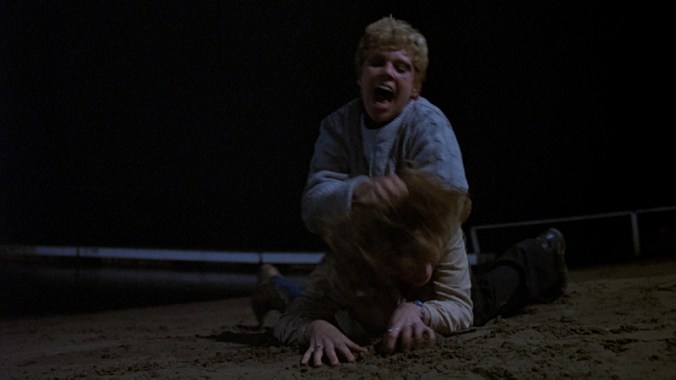
The sequel begins shortly after the original Friday the 13th left off, with that film’s heroine, Alice (Adrienne King), still haunted by nightmares of her ordeal at Camp Crystal Lake and of the undead boy, Jason, who she dreamt emerged from the lake at the film’s end to drag her to her death. It turns out that her fears are warranted, as a fully-grown Jason (Gillette/Dash) has stalked her to her home and the film’s first scene culminates with him avenging his mother’s death at the hands of Alice in Friday the 13th. From there, the film flashes forward five years and the audience is introduced to a new group of camp counselors who are attending a counselor training program led by Paul (Furey) at a camp adjacent to Camp Crystal Lake. These counselors are young, horny, and stupid, with few distinguishing character traits, much like the group of counselors in the original. As such, it isn’t particularly shocking or emotionally devastating when Jason descends upon the camp, skewering and slashing counselors right and left. Eventually, Paul’s girlfriend Ginny (Steel) emerges as a final girl, ready to do battle with Jason. She discovers a hut in the woods where Jason has apparently been hiding out for years, building a shrine to his dead mother with her severed head and articles of her clothing. Ginny uses these to imitate Mrs. Vorhees, tricking Jason into letting his guard down so that she can attack him, wounding him enough to make her escape. Ultimately, Ginny makes it out alive, but, like Alice, she is robbed of her sanity and sense of security.

Friday the 13th 2-2

Aside from the first appearance of a mature Jason as the film’s killer, Friday the 13th Part 2 doesn’t offer much variation from the template established by the original film. This sequel exists solely as a cash-in on the popularity of the original film, and it isn’t surprising that most of the creative team behind the original opted not to participate in the series moving forward. Some of the movie’s kills stand out, and the body count is escalated, but there is little innovation or evolution in this entry in the series. In fact, Part 2’s narrative so severely retcons the original’s narrative to facilitate its own existence that it has been widely lampooned by both fans and creatives involved in the series’ initial creation. If, as this sequel posits, Jason had been alive the entire time, hiding out in a hut by Crystal Lake, why didn’t he simply reunite with his mother at some point? And, short of that, how did he survive alone in the woods for nearly three decades without being spotted by some camper, hunter, or other person? I don’t always look for strong narrative continuity in slasher films, particularly in hastily thrown together sequels, but this level of narrative implausibility is really hard to look past. Not only does it not further the Friday the 13th canon, it severely disrupts it, opening up the rest of the series to an escalating chain of narrative disruptions and flimsy excuses to return the infamous Crystal Lake killer from the dead. The film gains points for being the first to introduce Jason, an iconic horror figure who has become larger that the franchise itself, but it’s hard for me not to wonder what the creative brain trust behind the original film could have done together if the series had moved in the originally intended direction and abandoned the Crystal Lake setting altogether in favor of a new tale of terror. As it stands, however, Part 2 moved the film in a direction that would see it largely recreating the same scenario over and over again with slight variations on the setting.

Friday the 13th 2-3

There isn’t much else to say about the film. Its cast of characters is largely indistinguishable, even more so than in the original, serving only as fodder for Jason’s homicidal rampage. Characters stand out for a few physical traits, perhaps, such as one counselor who is confined to a wheelchair, and another who is obviously cast as the camp clown, but they’re otherwise simply bowling pins set up to be knocked down in, admittedly, entertaining and clever ways by Jason and his array of sharp and pointy objects. The dialogue and performances in the film are laughable, as should be expected for a slasher of its type. Overall, this sequel has the feeling of being scraped together quickly to cash in on the success of its predecessor and to establish the long term viability of a franchise centered on the character of Jason Vorhees. In those respects, it’s a film that is successful. It pays some fealty to the original with its extra-long precredit sequence involving Jason returning to murder the heroine from the first film, and then splits off on a new, if nonsensical, parallel track from which the ensuing sequels would spring. For better or for worse, Friday the 13th Part 2 established the now familiar paradigm in slasher franchises that the killer can be brought back from the dead for any reason or no reason at all, as long as audiences seem willing to plunk down their hard-earned cash at the cinema box office. It certainly isn’t the worst film in the franchise, but it doesn’t hold up favorably to the original for me, simply because it hews so closely to the structure and plot of that film. It gains a few points for introducing Jason, albeit without his iconic hockey mask, but it’s largely too redundant of a movie for me to want to give it much time or attention. The original packs a similar amount of scares and has an air of novelty about it, and Jason would be given better films to terrorize later in the series, so despite its importance in changing the direction of the franchise, Part 2 feels largely extraneous to me.

Friday the 13th

Friday the 13th (1980)

Dir. Sean S. Cunningham

Written by: Victor Miller

Starring: Betsy Palmer, Adrienne King, Harry Crosby III


During the month of July, I will be writing exclusively about the Friday the 13th movie franchise. The series is a classic of the slasher genre, and during my teens, I harbored a pretty healthy obsession with all things horror, so naturally I started collecting DVDs from the series. I currently own the first five movies in the franchise, and, fortuitously, July has five Sundays, so this will be the official Friday the 13th month on my site. Some of these posts might be a little shorter than my normal review because, to be honest, these movies can get a bit repetitive as the series goes on, but I’ll try to keep it interesting and look into what makes each of these movies work (or not, as the case may be) both as a film and within the confines of their own micro-genre. There’s no better place to start than at the very beginning with the first visit to Camp Crystal Lake, and the movie that launched the most financially successful horror franchise of all time.

friday the 13th 5

The original Friday the 13th begins with the re-opening of Camp Crystal Lake, in New Jersey, after some twenty years of dormancy. The camp was shuttered after some negligent camp counselors let a young camper, Jason, drown in the lake. However, a new group of counselors arrives at the campground, ready to fix it up and reopen the camp for the summer, despite the warnings of the townsfolk about the campground, which they refer to as “Camp Blood,” being cursed. In the midst of a terrible storm, the counselors are separated as a killer stalks through the woods. In predictable fashion, the unheeded warnings prove to be warranted, and counselors start disappearing one after another as it becomes apparent that the group is not alone at Crystal Lake.

Though it was clearly inspired by earlier slashers like Halloween, Friday the 13th is largely responsible for setting the genre template for the modern slasher film. It upped the ante on blood and gore, and moved the setting from the suburbs to a remote, rural campground, heightening the sense of fear and isolation in the movie. Though all of its generic tropes have become rote by now, they must have seemed fresh and shocking when the film was released in 1980, causing audiences to flock to the movie which became a run-away box office success. The film’s popularity might be largely due to the fact that it alters the established slasher template enough to seem novel at the time, replacing the creeping dread of Last House on the Left with a more episodic, start and stop type of horror, with kills popping up at random and causing a roller coaster type of thrill effect on the audience. The film also eschews some of the more disturbing aspects of hardcore horror films that preceded it like The Texas Chainsaw Massacre, making for a more accessible and easier to digest horror movie experience. While it’s certainly gruesome, Friday the 13th feels more like escapism than a broadcast from a doomed and sickening society, which early Wes Craven and Tobe Hooper films certainly resemble. Cunningham is more intent on causing jump scares than creating a world that’s skin-crawlingly disturbing, and the end result is a horror film that feels lighter, though no less vital or important, than its contemporaries.

Friday the 13th 4

Friday the 13th is an altogether predictable movie. From the outset, the audience knows that the warnings from the townsfolk ought to be heeded by the counselors, and they also know that the entire film is predicated on the counselors not heeding those warnings and continuing to be typical sex-crazed teens. Like most slashers, Friday the 13th equates sex and death, in most cases quite explicitly, with the counselors being murdered either during, or right after performing, a sex act. I think this inherent conservatism in slashers is something that’s always interested me, the thinking that young people should be punished (with death) for being sexually explorative. I’m not sure why, as I strongly believe that people have an inherent right to freedom of sexual expression provided that they’re acting responsibly and consensually, but I’ve always been curious about the equivalence of sex and murder in horror movies. Often, the killers in these films as viewed as someone whose sexual deviance or impropriety has driven them to kill, or they’re shown as being so psychosexually repressed that they are driven to seek out victims who they feel are acting out urges that they are unwilling to claim and act upon, so they choose to pass lethal judgment on these victims. Friday the 13th carries on this tradition, established in earlier horror films, and helps it to cement its place as a hardwired genre trope.

Friday the 13th 3

The one thing that is relatively untraditional about the original Friday the 13th is that it features a female killer. The killer is never seen throughout the early parts of the film, instead her presence is implied through point-of-view shots and the film’s now iconic score. When the killer is finally revealed, it’s not the familiar hockey mask-sporting Jason, but instead his mother, played by Betsy Palmer. Mrs. Vorhees was a cook at Camp Crystal Lake, and, as she explains to Alice (King), the last surviving counselor, her son, Jason, was the young boy who drowned in the lake, prompting the camp to close. It dawns on Alice that she is in the presence of the person who murdered her friends, and she takes off, providing one final, thrilling chase scene. The usage of a female killer, though not entirely novel at the time, certainly provides for an unexpected twist at the film’s end. Up to this point, all signs had pointed to some sort of supernatural explanation for the return of the drowned Jason, but Mrs. Vorhees’s is an earthbound entity with a practical reason to want to seek her revenge. I can remember finally getting to see the original movie in the franchise and being shocked that there was no Jason. I had only seen a handful of the later sequels on television, and I just assumed that the killer would show up in his familiar hockey mask, wielding a machete, and so I was rather taken aback when there was little mention of Jason at all. This genuine surprise gives the film a bit of depth that many of its sequels lack and ups its rewatchability quotient.

The original Friday the 13th isn’t the high water mark of quality for the series, nor is it the highest grossing entry in the franchise, but it was unique and successful enough to spawn its incredible lineage. The franchise was originally conceived of as a series of anthology films, but the original’s epilogue, in which an exhausted Alice falls asleep in a canoe drifting out to middle of Camp Crystal Lake after decapitating Mrs. Vorhees, only to be roused by a pale, bloated young Jason emerging from the depths of the lake to try and drag her to her death, practically demanded that a sequel centering on the undead Jason be released. These sequels would vary wildly in quality, as I’ll discuss in the weeks to come, but they all managed to be relatively safe box-office bets until the series began to run out of steam in the early 1990s. For a while, though, Friday the 13th was a reliable and bankable commodity at the box office, and that all started with the original slasher back in 1980.