Don’t Say A Word

Don’t Say a Word (2001)

Dir. Gary Fleder

Written by: Anthony Peckham & Patrick Smith Kelley (from the novel by Andrew Klavan)

Starring: Michael Douglas, Brittany Murphy, Sean Bean


I had to write my review of Don’t Say a Word almost immediately after screening the movie, because it is a truly unremarkable and unmemorable film. The movie is the type of paint-by-numbers studio fare that I typically avoid, but somehow this disc ended up in my collection. It isn’t really my movie, having gotten mixed into my DVDs at some point when, I assume, a friend let one of my roommates borrow it sometime. The case has sat on my shelf for over a decade, mixed in among other movies that I’ve loved and watched many times over the years, and I’ve never had the impulse to take it out of the case and watch it until this morning. I have to say that my reticence to watch Don’t Say a Word was probably wise, as it provided an entertaining enough, though thoroughly uninspired couple of hours. Don’t Say a Word isn’t a terrible movie, but its familiar plot has been spun out in better, more original ways more than once.

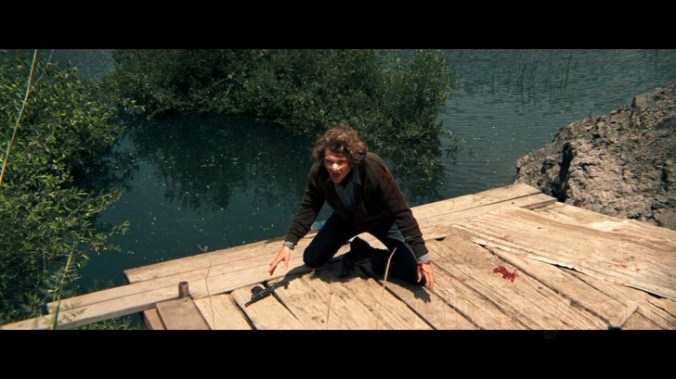
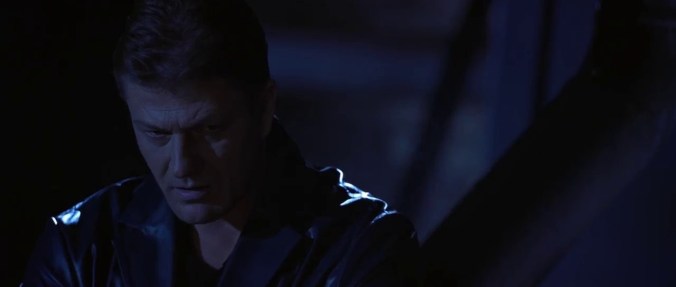
Don’t Say a Word opens in 1991, with an exciting bank robbery scene, in which a gang makes off with a rare $10 million dollar ruby. However, in the chaos of the aftermath of the robbery, two members of the gang are able to double cross their leader, Patrick (Bean), and make off with the precious jewel, leaving him holding a worthless bracelet. The film then jumps forward ten years, introducing Dr. Nathan Conrad, a child psychologist who has been asked to work with a disturbed teenage girl, Elisabeth (Murphy), who witnessed her father’s murder as a child. Meanwhile, Patrick and his gang are released from jail, and are hell bent on finding the stolen ruby. The gang set up shop in an apartment above Dr. Conrad’s apartment, and proceed to surveille him and his family, before abducting his daughter. Patrick contacts Dr. Conrad and informs him that he has little time to save his daughter’s life, and that the only way to do so is to extract a six digit number that Elisabeth has locked in her repressed memories. It is subsequently revealed that Elisabeth’s murdered father was the member of Patrick’s gang who double crossed him, and that he hid the ruby in Elisabeth’s favorite doll for safe keeping. While Dr. Conrad attempts to crack the safe that is Elisabeth’s mind, a police detective (Jennifer Esposito) is tracking Patrick in connection with a string of grisly murders. Their trails all dovetail at the film’s climax, which occurs in a pauper’s graveyard on Hart Island.
don't say a word 3

The film starts out promisingly enough. The opening heist scene is exciting, and though its rather conventionally blocked out and shot, it still provides an initial rush that propels the first quarter of the movie. However, when the film starts to downshift and introduce its psychological thriller components, it becomes a bogged down game of cat and mouse. Fleder tries to use dark settings-cemeteries, crumbling state-run mental hospitals-to give the film an eerie undercurrent, but these window dressings rarely serve to distract from the fact that what he’s presenting is largely a cookie cutter ransom film, with few points of specificity to set it aside from the rest of its ilk. The film takes very predictable courses to bringing Conrad and Patrick together for a confrontation, and hits on all the familiar tropes along the way. Even the film’s supposed twists, whether it be the fact that the kidnappers were in the apartment building all along or that Elisabeth’s murdered father was a member of Patrick’s gang, are easy to see coming a mile away. The film features a handful of action set pieces that should help to break up the monotony of its cardboard plot, but none of them are particularly memorable.

The performances are workmanlike throughout, with a pretty good cast having been assembled. No one is doing his or her best work in Don’t Say a Word, but the film doesn’t suffer from poor performances in any way. Douglas is fine as the distressed father, but his performance lacks any sort of immediacy. I felt that he was far more hell bent on getting to work in Falling Down than he ever was on rescuing his young daughter in this film. Bean is probably the star of the show, using his minimal screen time to great effect. He’s particularly effective as a chillingly calm and menacing voice over the phone, giving both Conrad and his wife, Aggie (Famke Janssen), cold instruction.

I do think that the film is to be credited for featuring several strong performances by women and giving its female characters prominent roles. Aggie is bedridden for much of the film, suffering a broken leg in a skiing accident, but when she does get the opportunity to rise and get involved in the action, Janssen delivers ably. She has one of the film’s best fight scenes, viciously dispatching of one of the kidnappers who attempts to snuff her out. Jennifer Esposito does the best that she can with the little amount of screen time and exposition afforded to her character. She plays Detective Cassidy as a tough, no-nonsense cop, and even though her character is an obvious caricature, Detective Cassidy is presented in a more positive light than her male counterparts, who are shown to ineffective, lazy, or both. Finally, Brittany Murphy shines in the movie in a role that she was likely pigeonholed into. Though she spent much of her too short career being typecast in just these sorts of roles, women with psychological issues in crisis, she never failed to deliver compelling, nuanced performances. As might be expected, much of her work in Don’t Say a Word is nonverbal, and she builds a performance on the tics and physical compulsions that drive her character. The film doesn’t have the most progressive view of mental illness, but Murphy’s performance does a lot to soften its rough edges. Her gentleness and longing help to humanize her character and give the film what emotional depth it does have.

don't say a word 1

Overall, Don’t Say a Word isn’t a bad movie. It’s serviceable in all the ways that it should be, but it lacks any real dynamism, and it’s far too predictable to stand out in a crowded field of similar thrillers. In fact, it serves as a good reminder for me of why I tend to avoid these types of mainstream thrillers. They’re often so derivative that it’s difficult to distinguish one from another. The film’s cast does what they can to elevate the material, but the talented actors just aren’t given a great deal to work with. Fleder shows some flashes of compelling action filmmaking throughout, but rarely carries these over to the film as a whole, leaving the project feeling uninspired. This is probably the first unequivocally negative review that I’ve written so far for this project, and it likely isn’t a surprise that the first film that I’m reviewing that isn’t actually “mine,” in the sense that I didn’t purchase it or choose it to be a part of my collection. I was hoping that I would be pleasantly surprised by Don’t Say a Word, but there just isn’t enough there to make me desire a second viewing. If you’re in the mood for a psychological thriller, there are plenty of better choices.

District 9

District 9 (2009)

Dir. Neill Blomkamp

Written by: Neill Blomkamp, Terri Tatchell

Starring: Sharlto Copley, Jason Cope, David James


District 9 is a film that I don’t watch particularly often, but every time I do watch it, I find myself wondering why it’s been so long since my last viewing. It’s a thoughtful, stylish exploration of social themes wrapped up in the guise of a sci-fi action film. It was an instant addition to the sci-fi canon upon its release, loved by critics and audiences alike. It was also one of the few movies that I saw in 2009, a year when I was almost completely disengaged from the cinema after having dropped out of graduate school. After some subsequent legal issues, I found myself changing jobs, fighting with severe depression, and I simply lost interest in going to the movies because they seemed so ancillary to the issues that I was dealing with in my own life. District 9 didn’t entirely reawaken my serious interest in movies, but seeing it on Christmas day that year did remind me that watching a good movie can be a soothing and restorative experience. Spending a couple of hours in this alternate version of South Africa, one which is inhabited by strange space aliens, was just what I needed at the time, and I find a similar sense of comfort every time I watch this movie.

district 9 1

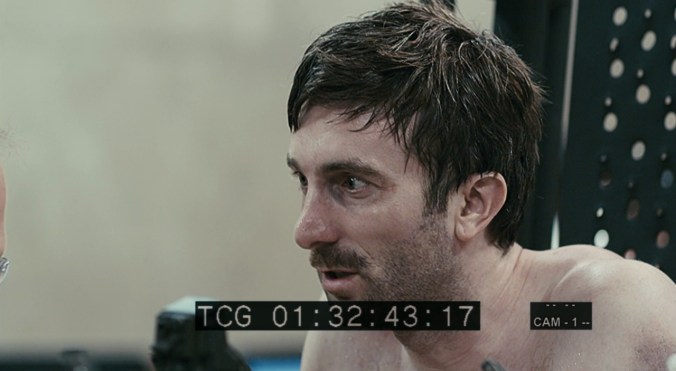
In the film, an alien spacecraft arrives on Earth in 1982, and begins hovering over the city of Johannesburg, South Africa. After some time with no successful attempts to communicate with the spaceship, and with the world’s population fervently awaiting first contact, an investigation team cracks the ship’s hull, revealing a crew of sick and dying alien lifeforms. These aliens, derisively called “prawns,” are corralled by the South African government into a slum outside of Johannesburg, referred to as District 9, where they live in an uneasy and tenuous peace with their terrestrial neighbors. After nearly 30 years of this uncomfortable arrangement, the South African government hires a private security corporation, Multinational United, to relocate the aliens to a different internment camp, further away from human civilization. Leading up the relocation effort is Wikus van de Merwe (Copley), a bumbling bureaucrat placed into a job he’s totally unsuited for by his father-in-law, who happens to be the head of MNU. During the relocation effort, Wikus meets Christopher James (Cope), an alien who, along with his young son and friend, has been stashing away alien technology for 20 years, hoping to one day repair the mothership and return to his home planet to lead a rescue mission for the rest of his kind stranded on Earth. During a search of Christopher’s home, Wikus finds a canister of fuel that Christopher and his friend have been distilling from their scavenged materials, which he confiscates. However, when trying to open the canister, Wikus accidentally sprays himself in the face with the fuel, which immediately begins to have a violent effect on his physical person. Wikus quickly realizes that his exposure to the black liquid is causing his human tissue to be replaced by alien tissue, and that he is gradually transforming into a prawn. When his condition becomes public, Wikus becomes a figure of universal scorn, while also being hunted by MNU mercenaries, who are hoping to capture him and study the only existing human/prawn hybrid. Wikus is forced to return to District 9 and seek out Christopher, hoping to find answers about his condition.

I think that my favorite thing about District 9 is Blomkamp’s choice to present his story in a pseudo-documentary style. This grounds the film’s fantasy premise in a realistic setting, giving us all the tropes of a nonfiction film, and also allows an unfettered amount of access to the few central characters in the film. By framing the narrative as a documentary, we get early moments of Wikus performing for the documentary camera crew, revealing key pieces of the character’s personality. The style makes the film feel ripped from the headlines while it’s obviously dealing with a farfetched science fiction premise. This verisimilitude is reinforced because not only is there a documentary crew filming the process of the relocation of the prawns outside of District 9, but several later developments in the film are revealed through news broadcasts, screens, and security camera footage. I’m often skeptical of films that try to bridge the gap between found footage, documentary, and narrative filmmaking, because often the narrative device is stretched beyond the point of plausibility or just used as a gimmick, but Blomkamp does a great job of walking the tight rope and meshing the film’s disparate styles together.

district 9 3

The other aspect of District 9 that keeps me wanting to watch it over and over again are the great performances by Copley and Cope as Wikus and Christopher, respectively. The movie was Copley’s feature debut, and his performance as Wikus catapulted him into international stardom. As the film’s only non-alien protagonist, and as the subject of the faux-documentary that is being shot, Wikus is in nearly every scene in the film, and Copley rises to the occasion admirably. He is at times funny, pitiful, sad, and fearsome, as he turns himself into a reluctant warrior by the film’s end. The range that he shows in the film is impressive, providing genuine humor with the early portions of the film requiring a slapstick type of performance while later scenes find Copley evoking deep pathos as he portrays Wikus’s gradual understanding of the plight of the aliens whom he had never considered before. Copley became the film’s breakout star, but I think that Cope’s performance as Christopher is equally as memorable, in a much different way. Cope did the voice work for all of the prawns in the film, and the series of clicks, whistles, and skittering noises that they produce is actually emotive, even divorced from the context of the film’s subtitles. His performance as Christopher Johnson is the film’s emotional center for me, and it’s impressive that an actor can convey that level of emotional commitment while performing as a CGI character. Christopher Johnson feels every bit as real, and deserves every bit of pathos and sympathy that Wikus does, and Cope’s mostly improvised performance is to credit for that.

I think that District 9 is one of the more emotionally resonant science fiction movies I’ve ever seen, and I imagine that that is likely due to its obvious close association with the actual political history of South Africa. The film is a clear allegory for Apartheid, the legislated, state-sanctioned brand of segregation that was law in South Africa for much of the latter half of the 20th century. The prawns are very obviously stand ins for black South Africans, who were subjugated under minority rule by white South Africans until the early 1990s. The political practice had its roots in Dutch colonial rule of South Africa, and the descendants of the colonizers simply continued enforcing this form of white supremacy through legal actions and force, when necessary. Blomkamp’s personal history growing up in the final years of Apartheid undoubtedly had an influence on District 9. Though they’re shown to be mistreated by both white and black characters alike, the othering of the prawns has a distinctly racial feel to it, and though the film’s message could be applied generally and broadly to any class or racial divisions among society, its context as the work of a South African filmmaker make its cultural allusions obvious. While it would stand out as a great modern sci-fi film based on its intriguing premise, great effects and action sequences, and memorable aliens alone, the real world resonance of District 9’s narrative with the recent history of South Africa gives the work that much more artistic integrity, and pushes it over the top into “great film” territory.

district 9 2

While Neill Blomkamp’s stock may not be as high now as it was after the release of District 9, with his proposed Alien spinoff series never coming to fruition and his subsequent films suffering both critical and commercial failure, District 9 still stands out as one of the early 21st century’s great films. Its successes have bought Blomkamp enough good will with me that I’ll consider his next film or two must see material unless they disappoint me as much as Chappie did. I’m even still holding out some hope that the sequel to District 9 that Blomkamp has teased at various times may eventually appear. But even if it doesn’t, and if Blomkamp doesn’t fulfill on the promise of his debut, nothing can diminish the initial rush that I felt on first seeing District 9. It was such a fun and original premise, presented in an action style that seemed both over the top and practical. The film’s world was engaging, both familiar and alien, but overall wholly formed. It arrived at my life at a perfect time, when I needed to remember the entertainment and distraction that a really good movie can provide, and I’m reminded of that every time I pull it off the shelf for a rewatch.

Dirty Harry

Dirty Harry (1971)

Dir. Don Siegel

Written by: Harry Julian Fink, Rita M. Fink, and Dean Riesner

Starring: Clint Eastwood, Andy Robinson, Reni Santoni


Clint Eastwood was one of my cinematic heroes when I was growing up. I came of age watching his films and modeling my impressions of cinematic masculinity on his stoic, skillful, ruthless archetypal characters. Whether he was the Man With No Name in Sergio Leone’s famous trilogy of Spaghetti Westerns, or William Munny in Unforgiven, or Inspector Harry Callahan in the Dirty Harry films, Eastwood stood out to me as an example of American cinematic machismo. Throughout his career, he embodied so many famous characters and character types that it was easy for me to pick an Eastwood film for every mood. Sometime in my early 20s, that started to change, as I became more aware of Eastwood’s personal politics, and as he began to age, publically, and ungracefully. Though Unforgiven will likely always have a spot in my personal top ten films of all time, Clint Eastwood and his films became an early lesson for me in learning to appreciate and separate an artist’s output from his or her personal politics or persona. While I found little common ground with Eastwood as his politics became publicly more and more reactionary and right wing, I still found myself appreciating of many of the films that he directed and starred in as works of art. However, I found other films of his to fall into a grey area, where their content seemed too influenced by Eastwood for me to feel totally comfortable enjoying them. Dirty Harry, unfortunately, falls somewhere in this category.

dirty harry 2

My reservations about the film aside, Dirty Harry is considered one of the definitive action films of its time, and deservedly so. The film, which would be followed up by four sequels of varying quality, introduced the world to Inspector Harry Callahan (Eastwood), a hard-boiled, no-rules San Francisco police detective who believes in bringing in his man at any cost. In Dirty Harry, Callahan is tasked with tracking down and apprehending Scorpio (Robinson), a serial killer who is threatening to murder one San Franciscan every day until the city obliges to pay him a ransom of $100,000. Callahan and his partner Chico (Santoni) track Scorpio across the city, nearly catching him several times, but the killer manages to elude apprehension over and over again. Scorpio teases the police department and mayor’s office with another threat, this time telling them that he’s buried a teenage girl alive and they have just a few hours to meet his demands before she suffocates. Callahan finally manages to track Scorpio to Kezar Stadium, where Scorpio hands out programs for the 49ers games, and confronts him on the football field. Harry shoots Scorpio, and tortures him by stepping on his wound until Scorpio gives up the location of the girl. However, when the police check the location, they find the girl already dead, and Scorpio is released from custody because Harry violated his civil rights. Scorpio continues his crime spree, hijacking a school bus and demanding a plane ticket out of California, but Harry is quick to cut him off. The two square off in an abandoned quarry, where Harry is quicker on the draw and manages to shoot Scorpio down. After killing Scorpio, Harry tosses his badge into a lake, unwilling to be a member of a police force upon which he cannot shoot first and ask questions later.

dirty harry 4

I can assume, based on my editorials in that plot synopsis, that you can gather my attitude towards some of the more political or socio-political content in Dirty Harry. Dirty Harry is the story of a rogue cop who flaunts departmental procedures and scoffs in the face of citizens’ civil rights, ruling over a city with an iron fist and a .45 Magnum, daring criminals to test his authority. Of course, on the other hand, Dirty Harry is the story of a crazed serial murderer who would hold a major city hostage were it not for the endeavors of one cop, willing to make the sacrifices that others aren’t. Where your sympathies tend to fall when watching Dirty Harry is largely dependent on your existing worldview and political stance. I certainly don’t mean that anyone watching the film would necessarily be drawn to rooting for Scorpio, but that the extent to which a viewer can sympathize and root for Harry is largely dependent on their own views on authority. Clearly, the audience is intended to root for Harry Callahan, as he’s the hero of the action movie, but I personally find it really difficult to reconcile my anti-authoritarian stance with a film that asks me to root for a renegade cop. I hate cops. Always have, always will. I do understand the need for law enforcement in a society, but the brand of highly militarized law enforcement practiced currently in America is antithetical to my worldview of treating other with dignity and respecting their rights as human beings with agency. To me, Harry is just as much a psycho killer as Scorpio, and his refusal of the badge and the moniker of official power at the film’s end isn’t something to be celebrated, because Harry’s lust for power and violence doesn’t stem from his position as an authority figure, but from some deep-seeded defect inside of the character. Harry will continue his brand of vigilante justice (in no fewer than four sequels) whether he has the backing of the badge or not.

Dirty Harry is a particularly difficult film for me to watch in 2017 in light of the ongoing revelation of widespread and heinous abuses of power by police officers across America. Institutional and individual abuses of power on the part of law enforcement are certainly nothing new, but the existence of cell phone video technology and the prevalence of social media have shed a light on what I feel is the most important news story happening in America today. Every week, a new video surfaces of a cop somewhere gunning down a citizen, who is often unarmed, and almost always hasn’t committed a capital offense. Police in America have taken to playing judge, jury, and executioner in the street and on the beat, and too often the targets of their ire are young black men. Seeing Harry Callahan pointing a massive pistol in the face of a black man who is cowering on the ground, and teasing him with the famous catchphrase, “Do you feel lucky? Well do you, punk,” is simply too disturbing to me. The actions that Dirty Harry takes throughout the film and his casually bigoted attitude towards any nonwhite characters in the film are beyond the pale. While Siegel crafts an engaging and original action film around his rogue inspector, Harry Callahan simply isn’t a character that I can stomach spending any time with. His reckless, sadistic behaviors simply hit too close to home after seeing dozens of examples of modern day cops acting out their own vigilante fantasies on grainy cell phone video. As engaging and groundbreaking as the film might have been for its time, its current relevance really sours me on it.

dirty harry 3

As I mentioned, there is an important lesson for me to learn in the films of Clint Eastwood, both those that feature him as an actor and the films that he has directed, about separating a work of art from its creator. In Dirty Harry, in particular, there’s a micro lesson that I can glean about admiring aspects of a work of art while being uncomfortable with or out of step with its overall message or presentation. I would be remiss if I didn’t mention the many positive aspects that do exist throughout the film. One of the things that jumps to my mind immediately when I think of Dirty Harry is the film’s unique score, composed by Lalo Schiffrin. The soundtrack to the film is a psychedelic jazzscape, featuring unusually syncopated rhythms and atonal melodies. The acid jazz underscores the film’s many chase scenes and heightens the tension of the images, creating a natural sense of unease in the viewer through its use of dissonance. The film is also well shot, its rapid zooms and quick cuts became genre staples throughout the 1970s. Dirty Harry stands as a massively influential film, not just in its own time period, but into the present day. Unfortunately, its influence doesn’t seem totally limited to the cinema. In the film, we have examples of a rogue cop who wantonly acts out street justice, and of a psychotic killer who would, almost certainly, be one of today’s mass shooters who have utilized easy access to high-powered, military-style weapons to enact their terroristic fantasies, killing hundreds. I’m not suggesting that the current state of police/citizen relations is in any way impacted by a 45-year-old film, but that the culture of American hyper-masculinity that lionized a vigilante cop in Dirty Harry has evolved and mutated to such a degree that our society is beset with an epidemic of gun violence and of institutionalized, state-sanctioned murder of citizenry. Dirty Harry is a well-made action movie, but because of its inherent conservatism, it isn’t any fun. The film’s current relevance saps it of any of its levity for me, and it isn’t a film that I’ll likely be watching again.

The Dirty Dozen

The Dirty Dozen (1967)

Dir. Robert Aldrich

Written by: Nunnally Johnson, Lukas Heller (from the novel by E.M. Nathanson)

Starring: Lee Marvin, Ernest Borgnine, John Cassevetes


I don’t really have a whole lot to say about The Dirty Dozen. It’s a classic war picture that’s been sitting on my shelf for probably the last 15 years. I have no idea what spurred me to pick this DVD up when I was a teen, but I remember watching and enjoying it a few times before it got shelved for good. It’s the kind of big studio blockbuster that was common during the 1960s, before a wave of more independently-minded, modernist filmmakers took American cinemas by storm. Although it feels a bit antiquated by today’s standards, The Dirty Dozen was a hit in its day, and it remains an influential film. Watching it for this post, I realized I had forgotten quite a bit about the beginning of the film, remembering only the climactic assault on the German chateau. On the whole, the film was a lot funnier and more entertaining than I had remembered, and it was a pretty pleasant rewatch.

dirty dozen 1

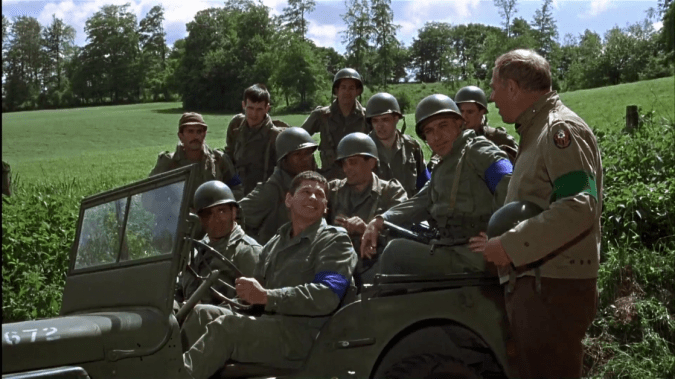
The film concerns itself with 12 convicts who are either sentenced to death or to lengthy prison terms who are selected by the Army to carry out an incredibly dangerous top secret mission behind enemy lines. In exchange for their completion of this mission, which is to infiltrate a German officers’ chateau in France and kill as many Nazis as possible, disrupting the chain of command in preparation for the D-Day invasion, the convicts will have their sentences commuted, records erased, and will be reinstated into the Army at their former ranks. The man charged with training this ragtag group of murderers and thieves is Major John Reisman (Marvin), a career military man who has grown disenchanted with the institutions that he has come to represent. The film’s first two thirds consist primarily of training montages which help to introduce the audience to the members of the Dirty Dozen and to their unique personalities. Notable here are Privates Victor Franko (Cassavetes), Archer Maggot (Telly Savalas), R.T. Jefferson (Jim Brown), and Joseph Wladislaw (Charles Bronson), all of whom are sentenced to death, and all of whom represent the scope of personality types embodied by the Dirty Dozen. Their training complete, the Dirty Dozen set off for France and their mission. The assault on the chateau is a success, and though only one member of the team survives the mission, the rest are remembered as heroes who lost their lives in the line of duty.

I love movies in which a team is assembled to perform a mission or job. These types of “professional” films, such as The Magnificent Seven, The Wild Bunch, or Ocean’s 11 often combine genres and feature broad casts of disparate actors who each bring a different focus to their role. In this respect, The Dirty Dozen doesn’t disappoint, with almost every member of the team providing a memorable moment or signature line. Cassavetes and Savalas shine as the anti-authoritarian and unpredictable members of the team, with Savalas’s Maggot nearly compromising the mission when he snaps and begins shooting everything in sight after breaking into the chateau. Bronson’s Wladislaw is the strong, silent member of the team, and is the only one to be confirmed to have escaped alive after the mission. Jim Brown puts a face to the plight of Black soldiers in the military with his performance as the oft-disrespected Jefferson. His death scene after bombing the German officers’ basement bunker, ensuring the success of the mission, is a memorable one, and a moment that brings to mind his punishing running style as one of the original stars of the NFL. Even the lesser members of the Dirty Dozen, such as Donald Sutherland’s Private Vernon Pinkley, are given their moments to shine. Pinkley’s impersonation of a General inspecting the troops of a rival Colonel is one of the film’s signature moments of comic relief. The film’s chief strength comes from balancing these various performances and making sure that each character gets his signature moment.

dirty dozen 5

Of course, even the most balanced ensemble film needs a lead, and Lee Marvin is clearly the star of The Dirty Dozen, although it nearly wasn’t so. John Wayne was the original choice to play Major Reisman, and I’m glad that he backed out of the film over concerns with the character’s morality, because I don’t think that he would have been able to convey some of the nuance that Marvin does in the film. Marvin’s performance in this film would catapult him into a higher echelon of stardom, although it would also continue his career down the path of playing similar roles. His Major Reisman is a tough, no-nonsense leader, but he is also shown to have a sensitive side through his obvious devotion to his team of castoffs. Marvin, who served in the military during World War II, along with many members of the cast, exudes authority and calm command. He cuts the sort of figure that demands respect and he’s an instantly recognizable presence in any film. A hard boiled legend, Marvin’s career was largely built on his rigid physical presence and booming voice, and he utilizes both here to great effect. Pigeonholing Marvin as a character actor, however, would be doing his career a great disservice, and in The Dirty Dozen he subtly displays the chops that earned him an Oscar just two years prior. He’s equally as effective in the scenes in which he has to display the bluster befitting of a military officer as in the quieter scenes in which he attempts to connect with the members of his team. Clearly, Reisman sees these men as misunderstood characters who have been failed by the institutions of the military and who can still be of service to the rest of the team and to their country, and Marvin expresses this care through the unusually gentle way that he guides them through their training, molding them into a capable unit. Marvin’s performance provides a grounding counterbalance to the more expressive performances from the members of the Dirty Dozen, and a stable center around which the rest of the cast can orbit.

In addition to having a strong and diverse cast, The Dirty Dozen also features some pretty shocking content and potentially progressive politics for a film of the time. Although the film’s violence seems very tame by today’s standards, it was uproarious at the time of its release. It certainly wasn’t the first film that asked its audience to sympathize with violent criminals, but The Dirty Dozen does little to normalize their criminal behavior, or to offer much redemption for the worst of its characters. The frank vileness of Savalas’s Maggot must have been a shock to audiences in the late 1960s, with the characters unrepentant racism, crudeness, and violence (both physical and sexual in nature), on full display. Maggot is a bad apple, and remains such until the end, having to be shot by Jefferson when he snaps and nearly botches the whole mission. A psychologist would likely label Maggot some sort of nihilist, and his nihilism is largely evident throughout the film. The Dirty Dozen is a film that sets itself and its characters against every institution that might stand in their way. Though it’s a war picture, I think that the film is clearly anti-military in its politics, showing the larger institutions of the military and the government to be cruel, outdated, and farcical. This is a film that, through its championing of Major Reisman and the Dirty Dozen, favors the individual over the institution. The Dirty Dozen are honor-bound to fight for one another, but there’s little indication that they feel the need to serve a larger master. This anti-authoritarian stance must have been exceedingly rare at the time, particularly in a mainstream war film.

dirty dozen 3

Through several decades-later sequels, including a short-lived television show, The Dirty Dozen has become a brand, representative of a style of late-1960s era filmmaking. It certainly isn’t the first film in which a ragtag group of misfits is assembled and turned into an elite team, but it has become one of the most recognizable and influential. I’ve been guilty myself of shortchanging the film, of assuming its generic faithfulness and its paint by numbers premise. The performances from the film’s ensemble cast are worth the price of admission, but diving a little deeper into the curiousness of the film’s politics and its attitude towards military customs and institutions reveals a film that is worth more than just a cursory glance or a nostalgic revisit. The Dirty Dozen isn’t my favorite film by any means, but watching it again revealed a depth that I hadn’t previously ascribed to it. One of the best experiences in working on this project has been the times that a film that I had perhaps undervalued takes me by surprise. It doesn’t happen too often, although my reactions to all but my very favorite and most familiar films in my collection are frequently altered by the time spent away from them and the ways that I’ve changed as a person in that interim, but when I’m truly able to see a film I thought I knew in a different light I’m reminded why I set out on this lengthy project in the first place.

Desperado

Desperado (1995)

Dir. Robert Rodriguez

Written by: Robert Rodriguez

Starring: Antonio Banderas, Selma Hayek


Desperado was one of my favorite action movies when I was a teen, and it, along with other early Robert Rodriguez films, became highly influential on my early ambitions of becoming a filmmaker. I was a certified Tarantino freak in high school, and his filmography and circle of influence became a major jumping off point for me in discovering other favorite films. It was a short jump from Tarantino to his friend and frequent collaborator Robert Rodriguez, and Desperado was my entry into the latter’s low budget, sun baked brand of cinema. I immediately recognized the meta-cool of Tarantino’s postmodern style, but while Desperado indulged some of the same impulses of Pulp Fiction or Jackie Brown, its influences were decidedly grittier. While Tarantino’s films sought to recontextualize and elevate their B-movie influences to the status of “high art,” Rodriguez’s reveled in the “low art” status of their cult and midnight movie predecessors. Rodriguez has proudly walked to the beat of his own drum throughout his career, learning the trade of filmmaking on the job, and constantly evolving as an artist. At this point, he has become a brand, the progenitor of a grindhouse resurgence that has only gained steam as new media has made it easier for aspiring filmmakers to create movies on a shoestring budget and get them released to wide audiences through alternative distribution channels like streaming or VOD, but Rodriguez’s early films represent a different type of guerilla filmmaking. In the 1990s, with films like Desperado, Rodriguez was one of a handful of filmmakers raising the flag for interesting, high production value, low budget, DIY filmmaking.

desperado 3

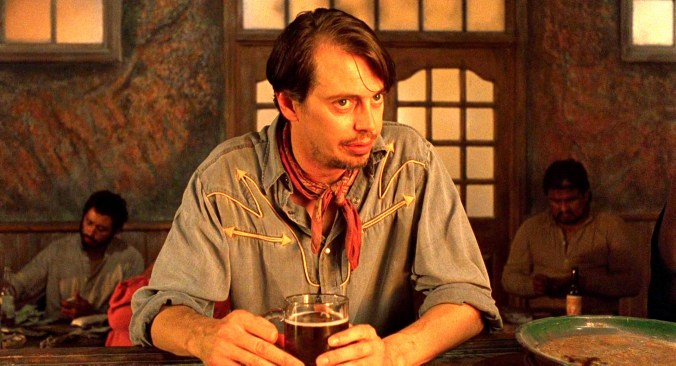
Desperado begins with a road weary, possibly deranged traveler (Steve Buscemi) stumbling into a bar in Mexico and relating the tale of a tall, shadowy figure that he saw murder a bar full of gangsters a few towns over. His story piques the interest of the bartender (Cheech Marin) and his associate (Carlos Gomez), as they obviously know the principals in the traveler’s story. It turns out that that shadowy figure is known as “El Mariachi” (Banderas), and he’s strapped with a guitar case full of guns, on a quest for vengeance against Bucho (Joaquim de Almeida), the drug lord who murdered his wife. Desperado is a straight forward revenge tale, with El Mariachi stalking Mexican towns, hunting down members of Bucho’s gang as he tries to get closer to the man himself. Along the way, he meets and falls in love with Carolina (Hayek), a book store owner who happens to be Bucho’s lover. When Bucho finds out about El Mariachi and Carolina’s affair, he sends his men to hunt down the pair, but they fight off their pursuers and eventually confront Bucho himself at his compound. After dispatching of Bucho, El Mariachi is free to ride off into the sunset with Carolina, although he hangs onto his guitar case full of guns, “just in case.”


What the film might lack in narrative complexity, it more than makes up for in fast-paced, explosive action. Rodriguez is obviously channeling the influence of the Hong Kong action films of John Woo in Desperado, but the film doesn’t feel derivative. Instead, it becomes a celebratory homage to those action landmarks, and a testament to Rodriguez’s ability to create polished, kinetic action sequences on a shoestring budget. His book, Rebel Without A Crew, details the process that Rodriguez went through to make his debut film, El Mariachi (which Desperado is a sequel to). It can serve as a primer for young filmmakers looking to chase their own movie dreams, and it was a huge influence on me in my late teens. Though the budget for Desperado was significantly larger, it was still scant by Hollywood standards, and Rodriguez still holds true to the rules of economic action filmmaking detailed in his book. His later films would see him working with bigger budgets, full FX teams, and cutting edge CGI technology, but the essence of Rodriguez’s style is perfectly on display here.

THE FILM 'DESPERADO' BY ROBERT RODRIGUEZ

The stunt work in Desperado is impeccable, with Banderas doing all of his own stunts and performing some excellent fight choreography. He combines slapstick elements with traditional fight choreography and firearms work to create an ultraviolent, combustible ballet. Bullets rain down throughout the movie and countless scores of anonymous bad guys are dispatched of. This is action at its most impersonal and most impressive: mindless, excessive, and explosive. Rodriguez, a self-proclaimed guerrilla filmmaker, squeezes every bit of value out of his film’s $7 million budget. His mastery of practical effects and ingenuity as a filmmaker allow him to turn in a film that looks every bit as polished and has just as many high action set pieces as a big budget studio film. Although the industry and movie making technology have changed significantly in the 20+ years since Desperado was released, aspiring filmmakers who want a crash course in delivering high quality films on a budget should still look to Rodriguez’s early films and his book for tips. He’s by no means the only filmmaker capable of producing films of this quality on tight deadlines and budgets, but action films are so often the result of bloated FX budgets, lengthy shooting schedules, and complicated stunt work, and they still rarely leave the lasting impact that Desperado has, which is a testament to Rodriguez’s unique skillset.

As I mentioned, for all of its visual sheen, Desperado still finds Rodriguez struggling to flesh out his narratives. The script for Desperado is bare bones, interested only in the most direct motivations for its characters, and certainly not interested in significant psychological examination or character development. I don’t know that Rodriguez has ever really learned to write a “good” script, but I also don’t think that he often makes the type of films that are so significantly character driven that this is a bad thing. He plays to his strengths in Desperado and doesn’t let extraneous character background or plot devices get in the way of the fight scenes and explosions. There are attempts in the film to provide some depth for El Mariachi’s character, such as his relationship with a young boy who is growing up watching the cartel violence in his town, or his romantic relationship with Carolina, but these are largely underdeveloped. Narrative simplicity in a film like Desperado is fine. Character motivations in films like this one are concrete and don’t need a significant amount of discussion. However, one interesting thing about Rodriguez’s approach to storytelling in Desperado is his penchant for weaving the story together through narrated flashbacks. The film opens with one such instance of this technique, with the traveler telling the story of his encounter with El Mariachi interspersed with flashbacks of the mysterious gunman shooting up the bar. Though this isn’t a unique narrative device, Rodriguez employs it skillfully enough in Desperado that it helps to break up the linear progression of the film and makes for an interesting storytelling wrinkle.

desperado 7

Though the script might not be complex or narratively innovative, it does feature several great individual moments and opportunities for characters to deliver memorable monologues in one-off scenes, particularly earlier in the film before the action really ramps up. Banderas is great as El Mariachi, which, for me, is his signature role. He plays the character with a combination of winking cool and ruthless, violent determination. There’s an elegance to the choreography that Rodriguez has designed, with Banderas performing his stunts like a dancer, performing a duet with the camera to graceful, devastating effect. Hayek has little dialogue in the film, but she proves equally capable of performing action stunts, and Rodriguez gives her enough agency in the film that she doesn’t sink to the role of eye candy, which would have been a typical choice in a Hollywood action film. Almeida is a hate-worthy villain as Bucho. His performance isn’t over the top, as he chooses to play Bucho as largely disinterested in anything going on around him. His defining characteristics are cruelty, greed, and apathy, and they’re manifested in Almeida’s nose-in-air performance and his utter disdain for the rest of his costars. In many ways, though, the film’s supporting cast are given the best moments in the film and provide the most memorable performances, aside from Banderas’s. Desperado features cameos from familiar faces such as Steve Buscemi, Cheech Marin, Quentin Tarantino, and Danny Trejo, and though most of these actors are only given a scene or two, they bring their established (or burgeoning) personae to their scenes, and individually nail them. I’ve already mentioned Buscemi’s opening scene, which sets the stage for the destruction to come, but Marin’s cynical, corrupt bartender is classic Cheech, particularly in his brief interaction with an entitled tourist. Tarantino gets a brief moment to ham it up with a memorable telling of a genuinely funny joke, while Trejo, in one of his first mainstream film appearances, makes the most of his silent performance by utilizing his imposing physicality in a role as a bounty hunter tracking El Mariachi. Top to bottom, the cast shines in a genre that often doesn’t ask much of its actors.

desperado 6

It’s probably pretty obvious that my zeal for Desperado has not lessened any with age. It isn’t a film that I watch with any regularity anymore, but it’s one that I can get caught up in just as easily today as I did when I first saw it. Most modern action movies have become so formulaic and so obviously FX driven that I rarely seek them out. Desperado still feels like a breath of fresh air. It has its obvious influences, and it is clearly existing within a fairly rigid genre template, but Rodriguez’s sensibilities and his unique storytelling voice keep the film from ever feeling derivative. The film’s set pieces still hold up even with 20 years of technological innovation, and its central performance from Banderas as El Mariachi is an action archetype. I feel like Desperado doesn’t get as much consideration now, because Rodriguez’s career has moved away from making straight action movies and more into a direction of making B-movies and children’s sci-fi, but it’s a genre classic. In the 1990s, Desperado was a weekend cable TV staple, and it is still as fun of an experience to sit down and mindlessly consume as it was then.

Big Trouble in Little China

Big Trouble in Little China (1986)

Dir. John Carpenter

Written by: Gary Goldman, David Z. Weinstein, W.D. Richter

Starring: Kurt Russell, Kim Cattrall, Dennis Dun, James Hong, Victor Wong


Action films have been a popular genre throughout the history of cinema. Some of early cinema’s most widely-known and well-loved films could fall into the action genre in some form, whether they be crime films, Westerns, or chase films. As the genre developed, however, a certain type of pure action style started to develop. Westerns began to cede popularity in the 1970s to these more modern action films, and by the 1980s, the blueprint for the action film as we now know it was largely set in stone. Classic action franchises were born in this decade, including Rambo, The Terminator, and Predator, and those films would go on to influence the next generation of action filmmakers who would continue to evolve and grow the genre. A direct line can be traced from our modern action blockbusters to the over-the-top, bombastic thrill rides featuring Arnold and Stallone that were ubiquitous in the 1980s. During that decade, however, there was an alternative style of action film being developed, one that sought to blend genres in interesting ways, that borrowed from international influences, and one that depended more on its star’s charisma than his physique (although that wasn’t so bad, either). I’m referring to the action films created by the pairing of John Carpenter and Kurt Russell. These films, including Big Trouble in Little China, provide an interesting counterpoint to the more familiar action franchises of the time.

big trouble 3

The duo teamed up for three movies in the 1980s and, though they weren’t all commercially successful on their initial release, Carpenter’s and Russell’s films have proved enduring. While their earlier films, Escape From New York and The Thing, were modest box office successes, Big Trouble in Little China had trouble connecting with audiences. Perhaps its blending of science fiction and action with traditional Chinese fantasy and folklore was too exotic for audiences in 1986. Maybe Kurt Russel’s performance, combining the lone hero of the action film with the wise-cracking leading man of the screwball comedy, was too unfamiliar. Whatever it may have been, Big Trouble in Little China had to wait to reach the level of appreciation that its director and star’s previous efforts had enjoyed. I saw all of these movies at different times in my childhood. They were staples on cable television on the weekends, edited for content and to run in the time allotted. When I was young, the gritty apocalyptic dystopia of Escape From New York was my favorite, but as an adult, I’ve become more and more fond of Big Trouble in Little China and all of its B-movie charm.

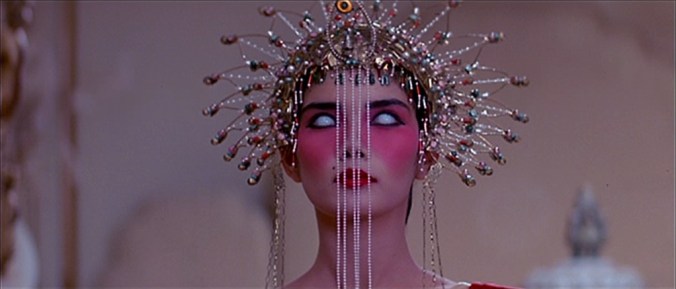
In the film, Russell plays Jack Burton, a fast-talking, fast-driving trucker, who finds himself embroiled in a gang war in San Francisco’s Chinatown. When his friend Wang’s (Dun) betrothed, Miao Yin (Suzee Pai) is kidnapped by one of the local street gangs, Jack agrees to help him rescue her. Along with the help of their friends Gracie Law (Cattrall) and Egg Shen (Wong), they set out to retrieve Miao Yin from the Lords of Death street gang. Their search takes them first to a brothel where they believe Miao Yin is being held, and Jack is successful in freeing many of the women being held there, but the rescue is interrupted by the Three Storms, three supernatural ninjas who take off with Miao Yin and take her to their master, David Lo Pan (Hong). Jack and Wang are again tasked with infiltrating a building to rescue Miao Yin, this time Lo Pan’s office front. When they get inside, they are again waylaid by the Storms and are introduced to Lo Pan’s sinister plan. Though he appears to be an old man, he is actually an incredibly powerful undead sorcerer, who is thousands of years old. He was robbed of his true physical body by the first emperor of China who placed a curse on him. In order to break the curse and regain his true form and his full power, Lo Pan must marry and then sacrifice a Chinese girl with green eyes, which Miao Yin has. From there, multiple rescue attempts must be made by everyone in the group as Jack, Wang, and Gracie all keep getting captured and escaping, all while trying to locate Miao Yin and prevent the wedding ceremony from taking place. The film’s final battle is a combination of traditional kung-fu, Wuxia, and slapstick comedy, as the heroes fight off the Storms and Lo Pan, rescuing Miao Yin. After everything settles down, Jack chooses to hitch up the Porkchop Express and return to the open road rather than staying in Chinatown with Gracie. However, just as Egg Shen says he will always have China in his heart, it seems that a piece of Chinatown is staying with Jack as the film’s final shot reveals that one of Lo Pan’s supernatural monsters has stowed away on his truck.

big trouble 6

I didn’t know it at the time, but I likely have Big Trouble in Little China to thank for some of my later filmic obsessions. It was probably the first movie I saw that heavily featured Asian influences, despite having grown up in the ninja-obsessed early 1990s. I had seen shows like Power Rangers and even some Japanese anime when I was younger, but Big Trouble in Little China was probably the film that first introduced me to kung-fu and Wuxia, two genres that I would get into more seriously in my teenage years. I remember when I saw the movie for the first time, around the age of 11 or 12, thinking that it reminded me a lot of Indiana Jones, but more authentic and more exotic. The film was set in America, but it felt more immersed in Chinese culture. It seemed like a celebration of its influences, where the Indiana Jones trilogy felt more sensationalistic and exploitative. I probably didn’t give this a whole lot of thought at the time, but I now realize that the main reason the film feels so authentic is that it has an almost entirely Asian cast. Also, rather than relegating minorities to supporting and sidekick roles to a white hero, Carpenter places Wang and Egg Shen in the more traditionally heroic roles, while portraying Jack as, at best, a fish out of a water, but more often as a bit of a boob.

That’s another thing that I really appreciate about Big Trouble in Little China. While Jack Burton is definitely the main character of the film, he is far from the film’s hero. Carpenter deftly plays with Russell’s star persona, repeatedly placing Jack in positions where the other characters in the film have to come to his rescue. Russell plays Jack Burton as a swaggering man of action, modeling his performance on vintage John Wayne, but the film’s narrative often undercuts his heroism. Though he can more than handle his own in the film’s many fight scenes, Jack is frequently on the receiving end of punches that Wang is able to easily duck under or around. He’s inventive and unorthodox in his fighting style, but he’s also often a scene’s comic relief. This only works because of Kurt Russell’s natural charisma. He’s totally believable as an action star, but he also has a roguish sense of humor that is constantly on display in this film. Jack Burton is the ultimate cool guy, tough in a fight, but also able to be self-deprecating when the tilt doesn’t go his way. The wise-cracking tough guy was certainly a genre staple by this point, but mostly in the form of witty asides or scripted catchphrases. Jack Burton’s humor is inherent in his coolness, and it’s hard to see Schwarzenegger or Stallone being able to pull off the natural charm that Russell brings to the role.

big trouble `1

Russell and the rest of the cast are aided by some great dialogue. The script went through several phases and rewrites, beginning life as a period Western, but as I mentioned earlier, the final product bears a strong resemblance to a screwball comedy with regards to its dialogue. Particularly in the interactions of Jack and Gracie, but throughout the film, the dialogue is snappy and articulate. The verbal sparring in the film is as entertaining as the fight scenes, with Russell and Cattrall displaying good on-screen chemistry. It’s one of the few action movies that is also genuinely funny throughout, without resorting to the aforementioned witty asides. Its humor isn’t nudging or winking, it’s subtly woven through the action, helping to establish these characters. Even a character like Egg Shen, whose role is almost strictly expository early in the film, gets some great lines. When discussing the hodgepodge of various mysticisms that influence Chinese spiritual belief, he says, “There’s Buddhism, Confucianism, and Taoist alchemy and sorcery…We take what we want and leave the rest, just like your salad bar.” It’s a genuinely funny line, but it’s also a window into Egg Shen as a character. He’s obviously wise and worldly, but who knew that he had been to a Sizzler? It would have been easy for Egg Shen to have been a stereotype, as many other action films of the time probably would have portrayed him, but Victor Wong plays him with a mirthful sort of mysteriousness and the script gives him several opportunities to step out of his box.

big trouble 7

I didn’t own a copy of Big Trouble in Little China until my late 20s. I grabbed it out of a bargain bin at a Best Buy one afternoon, and I’m really glad that I did. I hadn’t seen it in at least five years at that point, and I think I had forgotten just what a cool movie it really is. I think that all of the things that I really enjoy about Big Trouble in Little China are exactly the things that made it a flop upon its initial release. Mainstream American audiences just weren’t ready for an American movie that borrowed so heavily from Chinese culture. Obviously, Enter the Dragon had become a crossover hit in 1973, but martial arts pictures were still largely relegated to the grindhouse. Even the presence of emerging stars like Russell and Cattrall wasn’t enough to make the film bankable, as its deep dive into Chinese mysticism proved to be too confounding for its audiences. It wasn’t until home video really became a force in the late 1980s and 1990s that these types of films began to find an audience. Not surprisingly, Big Trouble in Little China found renewed interest in the home video market and has become one of the ultimate cult classics. It is the type of film that you can show a half-dozen different friends and each can come away enjoying something different about the film. Carpenter takes its series of disparate influences and mixes them up in a cauldron of 1980s action sensibility, churning out a wholly unique product that is more than the sum of its parts.

Belly

Belly (1998)

Dir. Hype Williams

Written by: Hype Williams

Starring: DMX, Nas, Taral Hicks, T-Boz


Belly is probably the worst movie, objectively speaking, that I have written about for this project to this point. The first and, to date, only feature film from acclaimed music video director Hype Williams is a bit of a mess, but it also serves as a showcase for Williams’s distinct visual aesthetic. Belly is a stylish crime drama that follows childhood friends Tommy (DMX) and Sincere (Nas) as they pursue fortune and street rep through drug deals and armed robbery until their lives ultimately diverge following Sincere’s decision to get away from his life of crime. The premise is simple to the point of being derivative, but the film’s kaleidoscopic visual style makes it memorable and gives the typical gangster narrative a new coat of high gloss paint. I find myself watching Belly more frequently than many other, better, movies in my collection because I enjoy its frenetic editing, moody color palette, and memorable visual style. It’s a fun movie in spite of its many glaring flaws, and for hip hop fans of a certain age, it’s a certified classic.

Starting with the good, Belly is full of visually interesting and memorable scenes. As I mentioned, Williams rose to prominence as a filmmaker by becoming one of the most prolific and acclaimed music video directors in hip hop in the 1990s. In many ways, Williams defined the visual aesthetic of hip hop during the mid- to late-1990s, a period in which the style fully crossed over into the mainstream. Over the course of his early music video career, Williams developed an eclectic but recognizable style while directing some of the most memorable videos in hip hop history. That style is fully developed and stretched out over the course of a feature film, and Belly is a natural extension of Williams’s music video work, portraying both the gritty street-level realities of its protagonists’ lives of crime and the opulence that that lifestyle has afforded them. Williams captures the drama with technical proficiency and visual flair, opting for dramatic, evocative lighting choices, and employing a restless, moving camera to reflect his characters’ mindsets.

Belly 2

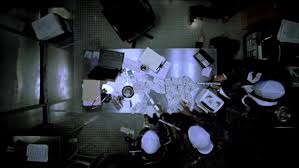
The film’s opening heist scene is a perfect example of this stylistic virtuosity. The scene, in which Tommy, Sincere, and Mark (Hassan Johnson) murder several people while robbing a strip club, sets the narrative and visual tone for the film. The men approach the club in slow motion, though the pace of the editing is quick, with the camera changing angles and distance from its subjects frequently. The quick cuts continue as the three step into the club, but the film’s color palette shifts to an eerie blue, with the black lights of the club causing a negative effect. The close up shots of Tommy and Sincere’s faces are striking and otherworldly, with their eyes glowing hot-white under the black lights. The camera’s constantly shifting perspective, the reversed color palette, and the frequent lens flare from the club’s strobe lights all combine to create a disorienting feeling and a fragmented sense of place. The action shifts upstairs to the club’s office, where the owners are counting cash. The shots lengthen and the camera moves in short, smooth pans and tilts, exploring the room and the cash within it slowly, in contrast to the choppy snapshots of the club floor. Williams continues the longer shot durations as Tommy and Sincere step into the club’s bathrooms where they’ve stashed their guns, a la The Godfather, but he also maintains the disorienting effect and creates visual tension by intensifying the strobe. As Sincere and Tommy approach and ascend the stairway to the office, the strobe is diminished, allowing for more visual clarity. Sincere nonchalantly shoots a bouncer in the chest and after he and Tommy throw him over the stairs, they and Mark charge up the stairs pulling white masks that glow in the black light over their faces. Panic breaks out in the club, and the strobes return, matched by the flashes of the robbers’ guns as they burst into the office and shoot everyone inside. One of the owners falls backwards through the wall-length window overlooking the club floor, descending in slow motion into the blue-lit depths as glittering shards of glass cascade after her like a diamond rain. As she smashes through a table, the beat to “However Do You Want Me” by Soul II Soul, the a cappella intro to which has been seething quietly under the scene up to this point, kicks in, and the film shifts back to a naturalistic color pattern as the men grab the cash and make their getaway. This scene establishes the visual and narrative themes that the film will explore in less than three minutes, and is one of my favorite credit sequences ever.

Belly 5

Belly is a film of visual contrasts. Williams associates characters with different colors throughout the film, using blue lights to establish a cold, menacing aesthetic for Tommy, reflecting his ruthlessness and predatory nature. Sincere is visually linked with warmer reds and yellows. He will eventually break with Tommy, rejecting the life of crime for Afrocentrism and attempts at self-improvement. Williams also employs contrast within the same shot by pairing slow motion with quick edits, as he does in the opening robbery scene. These are recognizable music video techniques, and it is obvious at times that Williams’s background is in music video. Often the film seems to be constructed of vignettes, moving from set piece to set piece, and often these vignettes are tied to memorable use of music. These aren’t criticisms, necessarily, as Williams’s experience matching sound to image creates some perfect scenes that almost act as music videos within the film. “However Do You Want Me” is integral to the success of the film’s opening, with the edits syncing perfectly to the music, and the music helping to inform the images. Williams is playing to his strengths in Belly, and while they don’t necessarily lend themselves perfectly to coherent narrative filmmaking, they are enough to keep the film interesting and entertaining.

I think that most of Belly’s shortcomings are a result of Williams wanting to squeeze too much into his first feature. Williams brings a laundry list of influences to the project, many of which he borrows from liberally, resulting in a film that is jumbled and incoherent. There are too many narrative threads, all of which are underdeveloped. This kitchen sink mentality makes the film’s narrative difficult to navigate, as the action shifts from New York to Omaha to Jamaica, following Tommy as he continues to involve himself deeper and deeper in the criminal underworld. Williams too often relies on voice over narration from Sincere to provide context and exposition. For a filmmaker who is so prodigiously gifted visually, Williams often opts to tell rather than show in Belly. With more focus and character development, Belly could be a very good crime film, but as it stands the film only scrapes the surface of its potential, choosing to emulate other, better gangster films and trade in clichés and heavy-handed symbolism rather than developing complex characters and original narrative arcs.

Belly 3

The film also suffers from the performances of its leads. Across the board, the acting in Belly is pretty bad. DMX and Nas aren’t asked to do dramatic heavy lifting in the film, still neither is up to the task. Belly marked the onscreen debut for both rappers, and they are essentially each extending their brands in the film, playing characters who closely resemble their on-record personae. DMX’s physicality lends Tommy’s air of menace credibility, but his line delivery is wooden and he is incapable of registering any facsimile of genuine emotion. Nas seems to be a somewhat more natural actor, but he has to contend with bad dialogue and with the film’s overreliance on his voice over. When he’s not asked to be the film’s narrator, his performance is decent. The lone bright spot in the film, performance wise, is Method Man’s turn as Shameek, a hitman who is sent to Omaha to dispatch of the local drug dealers who reported on Tommy’s drug trafficking operation. In this early role, Method Man displays the charisma and acting chops that helped him cross over into a successful film and television career. He plays Shameek as a joker whose easy charm belies his underlying penchant for violence. He has made a career playing these sorts of lovable, relatable criminals and he shines through in what is essentially an extended cameo. In fact, aside from Tommy and Sincere, the roles in the film all feel like cameos. None of the other characters are given enough screen time to develop any real motivations or character arcs. Sincere’s girlfriend Tionne (T-Boz) serves no actual narrative purpose in the film, while Keisha, Tommy’s girlfriend, is ostensibly a femme fatale, but Taral Hicks’s performance is more sultry than sinister.

Despite these legitimate criticisms of it, I will still continue to enjoy watching Belly. I’m sure it’s obvious by now but I am a big fan of the visuals of this film. Williams’s stylish direction helps to elevate what could otherwise have been a derivative and uninspired gangster film. Even when Williams is shamelessly ripping off his influences, as he does with de Palma’s Scarface for Jamaican kingpin Lennox’s (Louie Rankin) death scene, he makes the homage distinctive and memorable. The female assassin Chiquita who slits Lennox’s throat is memorable despite having less than 30 seconds of total screen time because of the way that Williams frames her visually. As I mentioned, Williams’s skillset doesn’t necessarily lend itself to crafting a complex narrative film, but they are perfect for creating intensely memorable images and translating simple bits of information through visual cues. The audience feels like they know Chiquita despite her limited screen time because her appearance, wearing a spiked collar-style necklace with dermal piercings adorning her face like war paint, conveys simple visual information so well. This is a skill that Williams has translated from music video where meaning must be conveyed simply and easily through the image, or through its relationship to the underlying song.

Belly 6

I think Belly’s reliance on music video tropes actually enhances my enjoyment of the film, because it reminds me of a time in my life when I was beginning to really immerse myself in hip hop culture, around the time that the film came out. Belly was only a modest box office success in 1998, but hip hop in general was experiencing one of its biggest boom periods. I really discovered hip hop as an early teen through Puff Daddy, Ma$e, Master P, Nelly and other popular rappers of the day. Hip hop culture was the dominant culture when I was growing up, and I have fond memories of sitting in my friend Ryan’s bedroom and listening to rap CDs on his oversized stereo. His older brother would pack their multi disc stereo with all the newest rap albums and we would soak them all in. Although I gravitated more and more towards punk rock and heavy metal music as I got older, I never lost my love for hip hop, and in particular the rappers who were popular when I was aged 12-15. This nostalgic attachment to that time period certainly helps to overlook some of the flaws in Belly. It’s a movie that is inextricably tied to that time period, and I like to pull it out when I want to turn my brain off and enjoy a well shot action movie that reminds me of one of the passions of my youth.


I apologize for the quality of the stills in this post. I couldn’t find too many great quality screen caps from the film, and the few that I did choose to use were automatically compressed to a smaller size. I’ll try to find a way to fix this and avoid the problem in the future.


Alexander

Alexander (2004)

Dir. Oliver Stone

Written by: Oliver Stone, Christopher Kyle, Laeta Kalogridis

Starring: Colin Farrell, Val Kilmer, Angelina Jolie, Jared Leto


I have owned the DVD of Oliver Stone’s Alexander director’s cut for over ten years. In that time, I have viewed it exactly once, shortly after purchasing it in the spring of 2006 at the Blockbuster on Forbes Avenue during a sale shortly before the store closed. While rewatching Alexander for this project, I was reminded of the reasons that I had never bothered to go back to it after that initial viewing. The film is simply a mess. It doesn’t work on any level. It is too dull and tedious to work as an action film, too shallow to work as a historical drama, and too conventional to work as the art film that Stone badly wants it to be. While Alexander is certainly beautiful to look at, its interminable length and poor acting make it a misery to sit through.

alexander-3

Alexander is a swords and sandals epic that traces the life of Alexander the Great (Colin Farrell) from birth to death, focusing largely on his conquest of much of the known world in his 20s and 30s. Alexander’s life is related to a scribe by an aging Ptolemy (Anthony Hopkins), and the film proceeds as a fairly typical Oliver Stone biopic. In fact, I was reminded of Stone’s Nixon at times while I was watching Alexander. The subjects of both films are men who are convinced of the greatness of their own destinies, obsessed with obtaining power, and who are ultimately consumed and brought down by their desire for power. Where Nixon succeeds and Alexander fails, however, is in making its subject a relatable and even, at times, sympathetic character. Perhaps by necessity of its setting in Greek antiquity, rather than feeling like the story of a real historical figure, Alexander feels like mythmaking. While there’s nothing wrong with mythologizing a historical figure, that mythmaking both robs Alexander of his relatability as a human character, and is at odds with Farrell’s angsty, dead-serious portrayal of Alexander the Great.

It isn’t just Farrell who turns in a lacking performance, unfortunately. Alexander must feature one of the most squandered assemblages of talent ever in a single film. Hopkins is largely reduced to the role of a voice-over narrator, appearing in only a handful of brief scenes, in which he does little besides dictate his voice-over narration to an on-screen scribe. Angelina Jolie, as Alexander’s mother Olympias, is an Oedipal seductress who is given little to do on screen besides pout and smolder. Her role as a major influencer on Alexander’s life and as a central schemer in the machinations that lead to the death of King Philip (Val Kilmer), Alexander’s father, seem unearned. Similarly, Rosario Dawson and Jared Leto are both underused, as Alexander’s wife and (not so) secret lover, respectively. In fact, the only performance in the film that stood out to me was that of Kilmer as King Philip. Kilmer gained 50 pounds for the role, and he lets his physicality do the heavy lifting for him in the performance. It stands in stark contrast to Farrell’s verbose, manic Alexander and Jolie’s subdued Olympias.

alexander-1

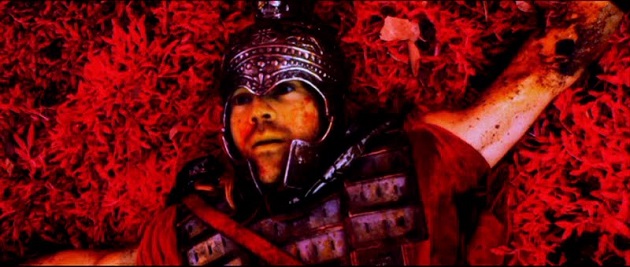
Despite its many flaws, there are some things to like about Alexander. As I mentioned, the film is often breathtakingly beautiful. If the film’s casting budget largely feels wasted, its special effects and filming budget do not. Stone’s recreation of ancient Greece and Babylon is beautiful, and it really works. The sets and costuming are detailed and beautiful to look at, and they go a long way to lending it credence as a history. The large scale battles that are featured in the film, especially Alexander’s first victory, are excellently shot, blending overhead shots of mass troop formation with close-up shots of visceral hand-to-hand combat.  The film’s real world locations are also beautifully filmed, with the final battle in India standing out in particular. The lush greens of the Indian jungle stand out richly in contrast to the film’s existing color palette which is dominated by reds and golds. It’s a shame that Stone can’t reign in some of his more experimental tendencies during that final battle, opting to color shift the film halfway through the scene, because it takes away from a set piece that is working, visually, and serves as a reminder of the self-indulgence that the whole film is suffering from.

Upon its release in late 2004, Alexander was panned critically and bombed spectacularly at the domestic box office, returning just under $35 million against a $155 million dollar budget. International box office receipts would make the film a very modest financial success, and the film would go on to have great success in the home video market, with four separate cuts of the film being released by 2013. I have only seen the 2005 director’s cut of the film, but I can only imagine that the two later cuts (the “Final Cut” and the “Ultimate Cut”) would be even more interminable than the 2005 version, as they are both nearly four hours long. Ultimately, these additional cuts of the film are indicative of the extreme self-indulgence that hamstrings Alexander in general. Stone falls in love with his own story, and too often opts to tell rather than show. As a result, its action set pieces, while enjoyable, are too few and far between, causing the film to feel like a historical reenactment. However, the film is unsuccessful in that regard as well, because even after spending nearly three hours with the subject, I didn’t feel that I came away with any larger understanding of who Alexander the Great really was as a person. The personal details that could have fleshed out Alexander, making him a well-rounded protagonist, and making for a more interesting and successful film in general, are largely glossed over or left to insinuation.

alexander-5

It’s a shame that Alexander doesn’t make for a better film, because the building blocks are there for something more entertaining and engaging. With a little more editorial oversight, Alexander could have been an effective historical action film; with better casting and a more personal (though probably less historically accurate) treatment of its subject, it could have been an interesting biopic of one of ancient history’s most important figures. Without either of those things, the end result is a bloated historical epic that is often content to meander from one life event to the next, failing to provide a more personal context for Alexander. Apparently, the “Final Cut,” released in 2007, attempts to rectify some of these shortcomings and includes a great deal of footage examining Alexander’s sexuality and his relationship with Hephaistion (Leto), as well as his relationship with both of his parents. Unfortunately, I have only seen the director’s cut, and don’t have the patience to sit through Alexander another time to find out if Stone’s attempt to have his cake and eat it too by extending the film’s runtime by nearly an hour is worth it.