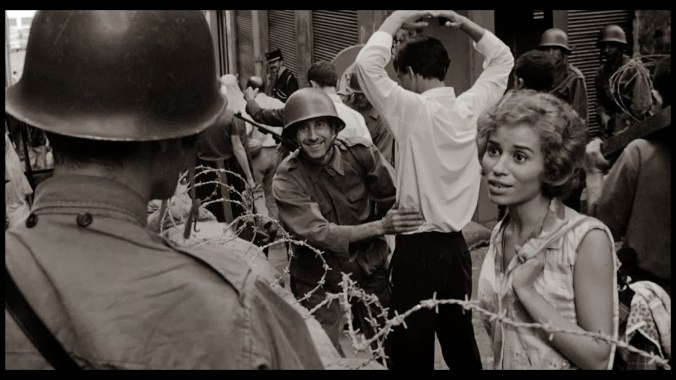
Big Trouble in Little China

Big Trouble in Little China (1986)

Dir. John Carpenter

Written by: Gary Goldman, David Z. Weinstein, W.D. Richter

Starring: Kurt Russell, Kim Cattrall, Dennis Dun, James Hong, Victor Wong


Action films have been a popular genre throughout the history of cinema. Some of early cinema’s most widely-known and well-loved films could fall into the action genre in some form, whether they be crime films, Westerns, or chase films. As the genre developed, however, a certain type of pure action style started to develop. Westerns began to cede popularity in the 1970s to these more modern action films, and by the 1980s, the blueprint for the action film as we now know it was largely set in stone. Classic action franchises were born in this decade, including Rambo, The Terminator, and Predator, and those films would go on to influence the next generation of action filmmakers who would continue to evolve and grow the genre. A direct line can be traced from our modern action blockbusters to the over-the-top, bombastic thrill rides featuring Arnold and Stallone that were ubiquitous in the 1980s. During that decade, however, there was an alternative style of action film being developed, one that sought to blend genres in interesting ways, that borrowed from international influences, and one that depended more on its star’s charisma than his physique (although that wasn’t so bad, either). I’m referring to the action films created by the pairing of John Carpenter and Kurt Russell. These films, including Big Trouble in Little China, provide an interesting counterpoint to the more familiar action franchises of the time.

big trouble 3

The duo teamed up for three movies in the 1980s and, though they weren’t all commercially successful on their initial release, Carpenter’s and Russell’s films have proved enduring. While their earlier films, Escape From New York and The Thing, were modest box office successes, Big Trouble in Little China had trouble connecting with audiences. Perhaps its blending of science fiction and action with traditional Chinese fantasy and folklore was too exotic for audiences in 1986. Maybe Kurt Russel’s performance, combining the lone hero of the action film with the wise-cracking leading man of the screwball comedy, was too unfamiliar. Whatever it may have been, Big Trouble in Little China had to wait to reach the level of appreciation that its director and star’s previous efforts had enjoyed. I saw all of these movies at different times in my childhood. They were staples on cable television on the weekends, edited for content and to run in the time allotted. When I was young, the gritty apocalyptic dystopia of Escape From New York was my favorite, but as an adult, I’ve become more and more fond of Big Trouble in Little China and all of its B-movie charm.

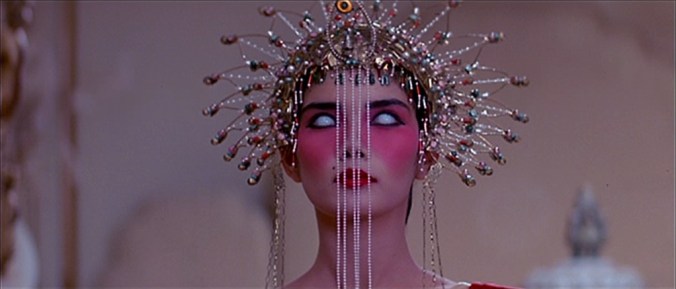
In the film, Russell plays Jack Burton, a fast-talking, fast-driving trucker, who finds himself embroiled in a gang war in San Francisco’s Chinatown. When his friend Wang’s (Dun) betrothed, Miao Yin (Suzee Pai) is kidnapped by one of the local street gangs, Jack agrees to help him rescue her. Along with the help of their friends Gracie Law (Cattrall) and Egg Shen (Wong), they set out to retrieve Miao Yin from the Lords of Death street gang. Their search takes them first to a brothel where they believe Miao Yin is being held, and Jack is successful in freeing many of the women being held there, but the rescue is interrupted by the Three Storms, three supernatural ninjas who take off with Miao Yin and take her to their master, David Lo Pan (Hong). Jack and Wang are again tasked with infiltrating a building to rescue Miao Yin, this time Lo Pan’s office front. When they get inside, they are again waylaid by the Storms and are introduced to Lo Pan’s sinister plan. Though he appears to be an old man, he is actually an incredibly powerful undead sorcerer, who is thousands of years old. He was robbed of his true physical body by the first emperor of China who placed a curse on him. In order to break the curse and regain his true form and his full power, Lo Pan must marry and then sacrifice a Chinese girl with green eyes, which Miao Yin has. From there, multiple rescue attempts must be made by everyone in the group as Jack, Wang, and Gracie all keep getting captured and escaping, all while trying to locate Miao Yin and prevent the wedding ceremony from taking place. The film’s final battle is a combination of traditional kung-fu, Wuxia, and slapstick comedy, as the heroes fight off the Storms and Lo Pan, rescuing Miao Yin. After everything settles down, Jack chooses to hitch up the Porkchop Express and return to the open road rather than staying in Chinatown with Gracie. However, just as Egg Shen says he will always have China in his heart, it seems that a piece of Chinatown is staying with Jack as the film’s final shot reveals that one of Lo Pan’s supernatural monsters has stowed away on his truck.
big trouble 6

I didn’t know it at the time, but I likely have Big Trouble in Little China to thank for some of my later filmic obsessions. It was probably the first movie I saw that heavily featured Asian influences, despite having grown up in the ninja-obsessed early 1990s. I had seen shows like Power Rangers and even some Japanese anime when I was younger, but Big Trouble in Little China was probably the film that first introduced me to kung-fu and Wuxia, two genres that I would get into more seriously in my teenage years. I remember when I saw the movie for the first time, around the age of 11 or 12, thinking that it reminded me a lot of Indiana Jones, but more authentic and more exotic. The film was set in America, but it felt more immersed in Chinese culture. It seemed like a celebration of its influences, where the Indiana Jones trilogy felt more sensationalistic and exploitative. I probably didn’t give this a whole lot of thought at the time, but I now realize that the main reason the film feels so authentic is that it has an almost entirely Asian cast. Also, rather than relegating minorities to supporting and sidekick roles to a white hero, Carpenter places Wang and Egg Shen in the more traditionally heroic roles, while portraying Jack as, at best, a fish out of a water, but more often as a bit of a boob.

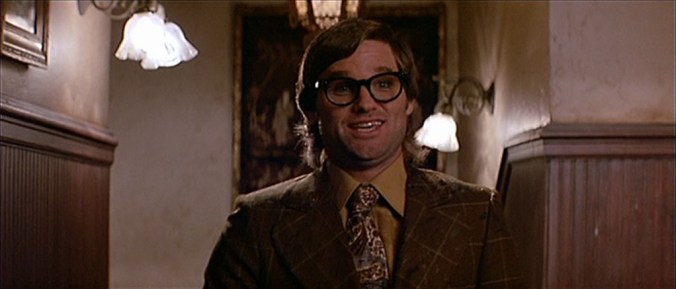
That’s another thing that I really appreciate about Big Trouble in Little China. While Jack Burton is definitely the main character of the film, he is far from the film’s hero. Carpenter deftly plays with Russell’s star persona, repeatedly placing Jack in positions where the other characters in the film have to come to his rescue. Russell plays Jack Burton as a swaggering man of action, modeling his performance on vintage John Wayne, but the film’s narrative often undercuts his heroism. Though he can more than handle his own in the film’s many fight scenes, Jack is frequently on the receiving end of punches that Wang is able to easily duck under or around. He’s inventive and unorthodox in his fighting style, but he’s also often a scene’s comic relief. This only works because of Kurt Russell’s natural charisma. He’s totally believable as an action star, but he also has a roguish sense of humor that is constantly on display in this film. Jack Burton is the ultimate cool guy, tough in a fight, but also able to be self-deprecating when the tilt doesn’t go his way. The wise-cracking tough guy was certainly a genre staple by this point, but mostly in the form of witty asides or scripted catchphrases. Jack Burton’s humor is inherent in his coolness, and it’s hard to see Schwarzenegger or Stallone being able to pull off the natural charm that Russell brings to the role.
big trouble `1

Russell and the rest of the cast are aided by some great dialogue. The script went through several phases and rewrites, beginning life as a period Western, but as I mentioned earlier, the final product bears a strong resemblance to a screwball comedy with regards to its dialogue. Particularly in the interactions of Jack and Gracie, but throughout the film, the dialogue is snappy and articulate. The verbal sparring in the film is as entertaining as the fight scenes, with Russell and Cattrall displaying good on-screen chemistry. It’s one of the few action movies that is also genuinely funny throughout, without resorting to the aforementioned witty asides. Its humor isn’t nudging or winking, it’s subtly woven through the action, helping to establish these characters. Even a character like Egg Shen, whose role is almost strictly expository early in the film, gets some great lines. When discussing the hodgepodge of various mysticisms that influence Chinese spiritual belief, he says, “There’s Buddhism, Confucianism, and Taoist alchemy and sorcery…We take what we want and leave the rest, just like your salad bar.” It’s a genuinely funny line, but it’s also a window into Egg Shen as a character. He’s obviously wise and worldly, but who knew that he had been to a Sizzler? It would have been easy for Egg Shen to have been a stereotype, as many other action films of the time probably would have portrayed him, but Victor Wong plays him with a mirthful sort of mysteriousness and the script gives him several opportunities to step out of his box.

big trouble 7

I didn’t own a copy of Big Trouble in Little China until my late 20s. I grabbed it out of a bargain bin at a Best Buy one afternoon, and I’m really glad that I did. I hadn’t seen it in at least five years at that point, and I think I had forgotten just what a cool movie it really is. I think that all of the things that I really enjoy about Big Trouble in Little China are exactly the things that made it a flop upon its initial release. Mainstream American audiences just weren’t ready for an American movie that borrowed so heavily from Chinese culture. Obviously, Enter the Dragon had become a crossover hit in 1973, but martial arts pictures were still largely relegated to the grindhouse. Even the presence of emerging stars like Russell and Cattrall wasn’t enough to make the film bankable, as its deep dive into Chinese mysticism proved to be too confounding for its audiences. It wasn’t until home video really became a force in the late 1980s and 1990s that these types of films began to find an audience. Not surprisingly, Big Trouble in Little China found renewed interest in the home video market and has become one of the ultimate cult classics. It is the type of film that you can show a half-dozen different friends and each can come away enjoying something different about the film. Carpenter takes its series of disparate influences and mixes them up in a cauldron of 1980s action sensibility, churning out a wholly unique product that is more than the sum of its parts.

The Big Lebowski

The Big Lebowski (1998)

Dir. Joel & Ethan Coen

Written by: Joel & Ethan Coen

Starring: Jeff Bridges, John Goodman, Steve Buscemi, Julianne Moore


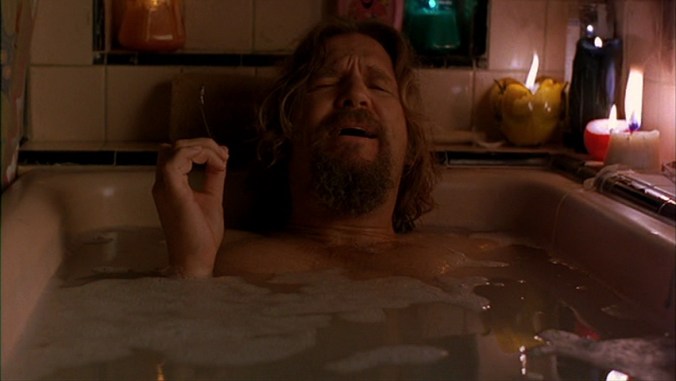
I wrote a good bit about how much I enjoy the Coen Brothers in general when I was writing about Barton Fink last month, so I’ll keep this post more limited directly to The Big Lebowski. However, I will say that the movie’s immense mainstream popularity undercuts the fact that it’s one of the brothers’ deepest dives into filmic nostalgia. Lebowski is a celebration of old Hollywood, a deconstruction of the detective genre and film noir mode of storytelling, with shout outs to classical Hollywood pictures throughout. The nuances of the film are probably overshadowed for a lot of audiences by the story of what has become one of the classic characters in all of cinema. The Big Lebowski is a film that is equally as quotable as it is esoteric, a film with many layers, and standing tall above them all is Jeff Daniels’s iconic portrayal of Jeffrey Lebowski, the Dude, an armchair philosopher and hero for the slacker generation, one of God’s own prototypes, too weird to live and too rare to die, out there taking it easy for all us sinners.

For those who may have not seen the film yet, The Big Lebowski centers on a case of mistaken identity, in which The Dude (Bridges) is mistaken for the identically-named Jeffrey Lebowski (the titular Big Lebowski, played by David Huddleston) an aging millionaire whose trophy wife, Bunny (Tara Reid), owes money all over town, including to pornographer Jackie Treehorn (Ben Gazzara) who sends two thugs to beat the money out of The Dude. When The Dude fails to produce any money, pointing out that it’s fairly obvious a millionaire would not live in his tiny one bedroom apartment, one of the thugs proceeds to pee on The Dude’s rug. The Dude seeks out The Big Lebowski hoping for recompense for the soiled rug, which really tied the room together, and this sets the events of the plot into motion. After their initial meeting, The Big Lebowski contacts The Dude, telling him that Bunny has been kidnapped, and he needs The Dude to get her back. In turn, The Dude enlists the help of his buddies Walter Sobchak (Goodman) and Donny Kerabatsos (Buscemi), who are happy to help out in between games of bowling. Along the way, The Dude encounters German nihilists, a militant feminist artist who wants him for his seed, and is forced to abide countless acts of aggression. The film takes a lot of its cues from The Big Sleep, a famously inscrutable noir, and The Big Lebowski certainly doesn’t disappoint when it comes to weaving a tangled narrative web of deceit and double cross.

lebowski 1

If that narrative seems somewhat complicated, that’s because it is. Raymond Chandler, who wrote the novel upon which The Big Sleep is based on, famously said that even he wasn’t sure who committed one of the murders in his book. The Coens take this idea and run with it in Lebowski, creating a stylized, contemporary noir in which the detective is constantly travelling through the world in a fog, unsure of which side of each uneasy alliance he finds himself at any given moment. The film is packed with subtle allusions to the films of the 1940s, containing oblique references to Double Indemnity and The Maltese Falcon, but also to 42nd Street and other Busby Berkeley musicals. As much as they are filmmakers, the Coens are also film historians, with their films often referencing favorite classic filmmakers such as Howard Hawks or Billy Wilder. All of their films dabble in this kind of pastiche, using film references as a shorthand language, but Lebowski is probably the most overt. As in Barton Fink, the Coens suture a fantastical version of Hollywood onto an actual time and place, in this case the immediate aftermath of the first Gulf War. In both films, the real life setting only serves as an anchor, and the action of the film is largely contained in its own world. The characters in the films occasionally reference actual events, but the Coens are largely free to create a universe of their own definition, and in The Big Lebowski, that universe is heavily filtered through the experience of American cinema of the 1940s.

Of course, this being a Coen Brothers film, those influences are scattered throughout The Big Lebowski, but they’re turned on their head, repurposed for a new generation and skewed in the process. The film uses many of the familiar tropes of the noir. It offers up two femmes fatales in Bunny and in The Big Lebowski’s daughter, Maude (Moore). It’s Bunny’s disappearance that kickstarts the film, but Maude is certainly the more interesting character. She appears halfway through the film, introducing herself to the dude by having her henchmen knock him out and take the rug that he had chosen to replace his originally soiled rug. She asserts that her interest is in preserving the Lebowski Foundation’s money, one million dollars of which her father has put up as ransom money for his missing wife. However, in classic femme fatale fashion, Maude’s motives are more duplicitous than they might seem on the surface. Her real interest in The Dude is procreative. While most classic femme fatales attempt to ensnare the detective using their sexuality, Maude enlists the Dude to the case before seducing him. After gaining The Dude’s trust, Maude beds him and makes known her desire to have a child with a man who will have no interest in raising it, or in being a partner to her. She’s fingered The Dude as just the deadbeat for the job, interested in him not for his bravado or his cunning, but for his biological ability to help her conceive. While I do think that a lot of classic femmes fatales could be seen as feminist characters, or at least female characters with agency in an era during which there weren’t so many such roles, I think that Maude’s overall character in Lebowski very deliberately marks her as a feminist. The shift in power dynamics marks one of the ways that the Coens are playing with the tropes of the noir mode.

lebowski 6

Another modal shift takes place in the film’s style. Though its narrative is decidedly noir-influenced, the film’s visual style rarely quotes from film noir. They had already explored the visual aesthetic of noir in their debut Blood Simple and would return to the genre with a very explicitly noir-influenced aesthetic in The Man Who Wasn’t There, but The Big Lebowski is a much brighter, color-saturated film. Its hallmark visual sequence, the dream sequence that The Dude experiences after being drugged at Jackie Treehorn’s party, is an homage to the classic Hollywood musicals of the 1930s and 40s. The sequence is choreographed just like a Busby Berkeley musical number, with The Dude descending a black-and-white checked staircase to be greeted by a dozen beautiful dancers with tiaras made of bowling pins. He shares a dance with Maude and then floats down a bowling lane through the straddled legs of the dancers. The dream devolves into a nightmare after The Dude crashes through the pins at the end of the lane and cascades into blackness where he meets the three German nihilists, who are wearing red form-fitting suits, and who chase him through the nothingness with oversized scissors, presumably hoping to “cut off his johnson.” While this sequence marks just the most striking departure from the established visual style of noir, the film’s style overall is a bit more dreamy and subjective than a typical noir. That mode established the use of evocative chiaroscuro lighting and adopted the subjectivity of the canted angle, but the Los Angeles of Lebowski is characterized by bright lights, loud noises, and a slow-moving camera that often takes in the world through a gauzy filter.

The biggest departure of the film from a traditional noir detective story, of course, is in the character of The Dude. The prototypical noir detective is personified by Humphrey Bogart: serious, square-jawed, able to take and deliver a punch. The Dude is decidedly none of these things. He is a self-described pacifist who only gets caught up in this whole mess through a case of mistaken identity and a desire to get back a rug that really tied the room together. The Dude trades in Bogart’s ever-present scotch and cigarette for a white russian and a joint. He has reached a level of Zen that Bogart’s restless men of action could never hope to achieve. He treats the whole caper involving Bunny, the nihilists, his missing rug, and his perpetually battered car, as a cosmic inconvenience rather than a case to be solved or a mission to accomplish. The Dude would rather be left alone to listen to his tapes and bowl in the next round robin. If Bogart was the masculine ideal for a post-war generation, then Bridges’s performance as The Dude served as an inspiration and a rallying point for a certain type of counter cultural slacker in the late 90s and early 2000s. He is the Coens most enduring and endearing creation.

lebowski 5

I first watched Lebowski around 1999 or 2000, a couple of years after it was released in theaters. I was instantly taken in by the characters and the dialogue. The film is simply hilarious and Bridges, Goodman, and Buscemi have unbelievable chemistry as The Dude, Walter, and Donny. Their lines are delivered lightning quick, one on top of the other, just like the conversation of real-life friends who know each other intimately. The film is endlessly quotable, with many of its turns of phrase having entered the cultural lexicon, but it is so densely written that it’s also easy to miss off-the-cuff lines on the first couple of viewings. The humor and the characters were what initially drew me into Lebowski. The interplay between Walter and Donny was so funny, and The Dude was one of the coolest characters I’d yet to encounter. Over time and additional viewings, I found new things to enjoy about The Big Lebowski and if you had asked me 15, or even ten years ago, it might have ranked up in my favorite movies of all time. It isn’t up there for me anymore, but it’s still a film that I love and probably one that I watch more frequently than some that might be in my “top ten favorite” films.

Though it started out as a cult film, the influence of Lebowski has spread far into the mainstream. As I mentioned, many of its lines have become instantly recognizable lingo, and you’d be hard pressed to find someone in 2017 who hasn’t seen the film. Bridges’s performance is now iconic, and many people would probably most readily associate Goodman with his portrayal of the bombastic, Vietnam vet Walter Sobchak. Screenings of the film have taken on a Rocky Horror Picture Show sort of tenor, with audiences often attending in costume and bringing props with them. An entire religion has sprung up centered on The Dude as a spiritual figure, with proponents of Dudeism embracing The Dude’s laissez-faire attitude and rebel shrug. Over the last 20 years, The Big Lebowski has graduated from film to full blown cultural phenomenon and while I’m happy that a great film is getting the attention and fanfare that it deserves, I would still rather appreciate it as a film text, devoid of any of the larger cultural trappings that it has come to be associated with. As a progressively-leaning, cannabis-advocating bartender who can often be found wearing a robe until mid-afternoon, and who is trying his hardest to take a “first do no harm” approach to life, I understand that the Dudeist lifestyle is probably perfectly suited to me. However, I still watch The Big Lebowski once or twice a year because it is a film that I really love, not because I hope to emulate its style or glean life wisdom from it. It never fails to make me laugh and pick up my spirits, and every time I watch it I seem to find some new little homage or hear a throwaway line that I had forgotten about. I can understand why someone might choose The Big Lebowski as the cultural artifact upon which they model their personal ethos, but even for those who choose to just enjoy it as a film, it’s an undeniable classic.

Big

Big (1988)

Dir. Penny Marshall

Written by: Gary Ross, Anne Spielberg

Starring: Tom Hanks, Elizabeth Perkins, Robert Loggia, John Heard, Jared Rushton


No pun intended, but this is a big one for me. Big is the first live-action film that I can remember ever seeing as a child. I had definitely seen cartoons up to this point, and I had probably seen some other live-action movies, but I first saw Big when I was probably six or seven years old, and it’s definitely the first live-action movie to have made an impression on my memory. If my memory serves me correctly, my parents had recorded Big on VHS at some point and it was this copy that first introduced me to the movie. I also think that my mother had reservations about letting me watch the movie due to its abbreviated sex scene, but I was ultimately allowed to see the film, and it totally enthralled me. I understood the difference between movies and reality at that point, of course. My favorite film up to that point was a cartoon called Fluppy Dogs, in which a boy adopts a magical dog who can make his master’s bed fly when he gets scratched behind the ears. I watched the movie every day for an entire year, but solely because I thought it was cute and entertaining. I understood that it was divorced from any semblance of reality. Big was the first film that I saw that showed me how movies can bridge the gap between fantasy and reality, and open up the imagination to the possibilities of magic and wonder existing in the real world.

big 5

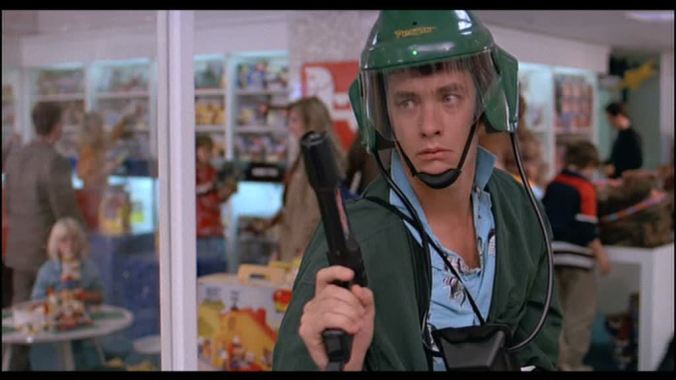
Big is probably the perfect movie to introduce children to the magic of movies because its plot about wish fulfillment and childhood magic is so relatable to children. What child hasn’t, like Josh Baskin (David Moscow/Hanks), wished to be bigger? The movie takes that premise and explores its ramifications as 13-year-old Josh makes a wish on a carnival machine that he could be bigger, and then actually wakes up the next morning in the body of a 30-year-old man. With the help of his best friend, Billy (Rushton), Josh heads to New York City in search of the magical machine that turned him into an adult, hoping that it can also reverse the process. While in New York, Josh takes a job at a toy company, and is quickly promoted due to his unique insight into toys and games. He experiences life as an adult, meets a woman whom he falls in love with, and, ultimately, must make the decision to remain an adult or make another wish and become a child, returning to his life with his family in New Jersey. It’s an urban fairy tale that’s perfect for children and adults, alike.

I watched Big a ton when I was a kid. Until I was about 10 years old, there were several movies that I watched over and over again on rotation and Big was among them, along with The Flight of the Navigator, Newsies, and Hook. I stopped watching those other movies as I got a little older, but Big continued to be a movie that I would always stop to watch if I came across it while I was scrolling through channels. Even more than its wish fulfillment fantasies, I started to become really interested in the movie’s New York City setting. When I was an early teen, I was very taken with the idea of moving to New York and leaving the sleepy, small town that I grew up in behind me. I can certainly chalk a lot of that urge up to simply getting the itchy feet that become so common to those who grow up in a small town and strive to see the bigger world, but I think that watching Big as much as I did probably fed into some of those desires as well. I can remember thinking that the loft apartment (really a warehouse) that Josh moves into after he becomes a VP at the toy company was the coolest place I’d ever seen someone live. An apartment like that couldn’t exist in my town, it was reserved for denizens of the big city. I was equally as enamored, however, with the flophouse hotel that Josh lives in when he first moves to the city. It seemed dangerous and edgy in a way that my habitations certainly were not. In fact, when I finally got to travel to New York City, I was a bit disappointed that many of its pointy edges that I had seen in movies had been smoothed over.

big 1

The other big draw for the film, of course, is Tom Hanks’s performance as Josh Baskin. Hanks is probably the most universally well-liked actor ever. He quickly became a mega-star, and by the 1990s, his presence in a film was a signature of a certain type of prestige and quality. Early in his career, however, Hanks was known mostly for his work in comedies, not big budget Oscar hopefuls. After transitioning from television and a co-starring role on Bosom Buddies, Hanks became a household name with 1984’s Splash and starred in other popular comedies throughout the mid-80s. Big is the culmination of this run, with Hanks providing both laughs and an emotional depth to his character. He slips seamlessly into the character of a 13-year-old boy, and watching Hanks react to the adult world with the enthusiasm, and also confusion, of a child is great. The party scene towards the end of the film always stuck out as one of the funniest in the movie. Josh shows up to the office holiday party dressed in a ridiculous white sequined tuxedo, which is funny in its own right, but his nibbling of baby corn on the cob and riotous reaction to trying caviar are the moments that I always lose it in the scene. It’s ridiculous, laugh out loud funny, and endearing all at the same time, and all because of Hanks’s wide-eyed, innocent portrayal of Josh. It’s also impossible to picture any other actor nailing the “chopsticks” scene at F.A.O. Schwarz the way that Hanks does. He and Robert Loggia jumping from note to note on the life-size keyboard while a crowd gathers around to watch has become an iconic scene in all of cinema.

As the film goes on, Hanks adjusts the way he portrays Josh as the character becomes more and more adjusted to his adult life. Early on, Hanks plays Josh as a naïve kid, scared, and often alone in the world. However, as he gains the acceptance of his peers and begins to spend more time with Susan (Perkins) and his other coworkers, and less time with Billy, Josh starts to act more and more like an adult himself. Hanks loses the pensive line delivery, modifies his body language, and becomes more assertive in general. The changes are subtle, but they come to a head when Billy confronts Josh late in the film after having found the Zoltar machine. After Josh is dismissive of Billy, telling him that he has work to do and he’s too busy to spend time with a child, Billy yells at him, “I’m your best friend!” and the illusion of Josh as an adult is shattered. He soon after makes the decision to go to the machine and wish to return himself to his natural state.

big 2

The Zoltar machine has been stashed on a forgotten pier, left there after a carnival has obviously closed up for the season. When Josh arrives on the pier, his transformation back into a child begins even before he approaches the machine and makes a wish. Josh runs to the boardwalk, looking for the machine, and when he sees it, his posture changes. Hanks starts to crumble in on himself, folding his hands in front of him and shifting his weight from one foot to the other, when he sees the machine. The camera zooms in on his pensive face as he weighs the decision that he’s about to make. Taking tiny steps, Josh approaches the Zoltar machine and pulls out a quarter. He unplugs the machine to recreate the exact scenario from the beginning of the film, slapping and kicking the machine until it magically comes to life. Susan arrives on the boardwalk just as Josh makes his wish and drops the quarter into Zoltar’s gaping mouth. Although she can’t comprehend his decision, and doesn’t want to believe his story about the Zoltar machine, Josh shows an emotional purity and depth of understanding that belie his years when he tells Susan that he has “a million reasons to go home, and only one reason to stay.” She’s fallen for him because he is so unlike the professional men that she usually dates, but the innocence that sets him apart is precisely the reason that they can’t be together. Susan gives Josh a ride home and, in a great sequence, watches as he transforms from a man to a boy over the span of one shot/reverse-shot. Josh turns to wave, giving Susan one last glimpse over his shoulder. She looks down to hide a tear, and when she raises her head, she’s astounded to see the child Josh Baskin walking away from her in an over-sized suit. Josh gives her a sheepish smile, which she returns, and then runs into the house to greet his worried mother, leaving his adult-sized shoes on the sidewalk as the film ends.

big 3

The ending of Big ranks up there with the ending of The Third Man and Casablanca as one of my favorites in all of film. In general, the movie is a favorite. I’ve seen it, literally, dozens of times but I still get caught up in the magic of it. Some movies I like to watch over and over again because I feel that there are nuances that I will discover with each renewed viewing. Some movies I like to watch over and over again because I know that they won’t offer me any surprises. Big is one of the latter. It’s a movie that feels like a well-worn baseball glove; it fits just right and it’s full of familiar seams and cracks. I often wonder how movies from my childhood will hold up, not just for my own personal viewing, but for new audiences estranged from the subject matter by time and distance. I really hope that there are new audiences discovering Big now, nearly 30 years after its release. As I said before, it’s a perfect fairy tale for the young and the young at heart. The universality of its themes and the performance of a young Tom Hanks coming into his full powers as a dramatic actor should keep Big fresh for the young viewers of today.

Better Off Dead

Better Off Dead (1985)

Dir. Savage Steve Holland

Written by: Savage Steve Holland

Starring: John Cusack, Diane Franklin, Amanda Wyss, Curtis Armstrong


It’s probably not surprising, as I did most of my collecting of movies as a teenager, but a good portion of my collection was, at one time, teen movies and teen romantic comedies. I was a devotee of John Hughes, even going so far as proudly displaying a Breakfast Club poster in my bedroom when I was in high school. I think it’s natural when a person is young and still trying to develop their identity to look to the teen archetypes that Hughes often traffics in and feel a kind of kinship. I also think that it’s natural that once one is a bit older they can look back at some of those characters and recognize that they’re fairly empty tropes. This isn’t to disparage Hughes’s output, as he’s made some classic films and I still enjoy watching many of them, but I don’t feel the sort of kinship to any of the young protagonists that I used to. The only Hughes-directed movie that I still own is Planes, Trains, and Automobiles, copies of The Breakfast Club and Ferris Bueller’s Day Off having been lost or left behind somewhere along the line. Better Off Dead, however, is the one teen comedy from that era that I can still relate to as an adult, and it’s one of the few of its genre that have remained in my collection. I feel that Better Off Dead is such an essential part of my collection that, upon the initiation of this project, when I discovered that the disc for the movie was missing from the case, I felt that I had to purchase it again on Bluray, just so I could watch it again and write about it.

better off dead 2

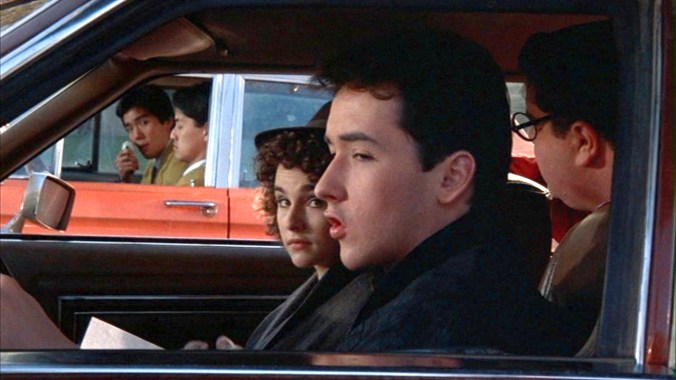
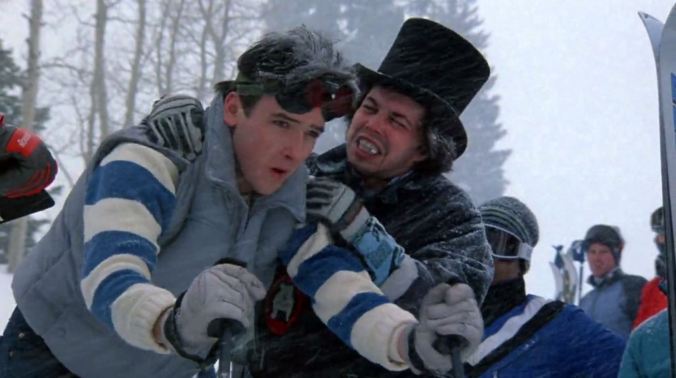
The film’s plot is fairly generic at its core, but Better Off Dead has a pitch dark and quasi-surreal sense of humor that most other teen films lack. Lane Meyer (Cusack) has two great loves in his life entering senior year of high school, downhill skiing and his girlfriend, Beth (Wyss). Lane loses out on both at the beginning of the film, as Beth cruelly dumps him for the captain of the ski team, Roy (Aaron Dozier), at the ski team tryouts. Seeing his high school social life crumbling, Lane decides that he is probably better off dead, but finds himself hilariously inept, even at suicide. Since he’s unable to off himself, and encouraged by his friend Charles (Armstrong), Lane decides to ski the K-12, a treacherous, possibly even lethal, run, in hopes of winning back Beth’s affections. Predictably, Lane fails miserably at his attempt to conquer the mountain, and his life continues to be a cycle of disappointment and adolescent frustration. That all starts to change when Lane meets Monique (Franklin), a French foreign exchange student who is living with the Meyer’s neighbors. Monique agrees to train Lane to ski the K-12 and the two develop a friendship. The film ends with a climactic race between Roy and Lane, in which Lane finally triumphs over his rival. When he crosses the finish line on one ski, Beth rushes to greet Lane, but he brushes past her, choosing Monique instead.

If you take out the failed suicide attempts, the plot to Better Off Dead reads like a fairly typical teen comedy of its time. It even slots in to a strange subgenre of the teen movie that was popular in the mid-late 1980s that featured skiing and partying as a pretext for hijinks and romance to ensue. However, Savage Steve Holland’s unique comedic sensibilities make this film stand out from others of its era. Better Off Dead was Holland’s first feature, and it is based on an actual breakup that led him to a hilariously botched suicide attempt, a la Lane Meyer. In real life, Holland was able to see the absurdity of his situation as he was sitting under a broken pipe, from which he had tried and failed to hang himself, water cascading onto his head as his mother yelled at him for damaging the pipe. He took that experience and began collecting other humorously bad ways to try to kill yourself, as the concept for Better Off Dead germinated. The end result is a film that is darkly hilarious and that feels emotionally genuine without employing the types of schmaltz that teen films sometimes resort to. The film features memorably absurd side plots and a cast of characters too whacky to truly be real, but just barely so. The film’s unique humor and the perpetually set upon Lane’s struggle to cope in the face of the insanity that surrounds him are the reasons that the film still resonates with me when others of its genre have faded off.

better off dead 1

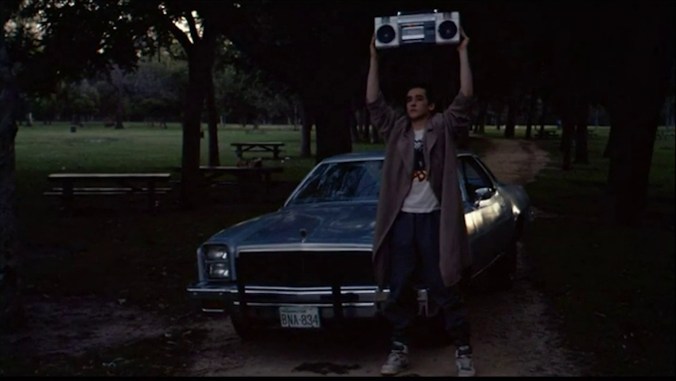
As I’ve mentioned before on this site, I was a big John Cusack fan in high school. High Fidelity and Say Anything were staples in my rotation, but I was unaware of the early Cusack film Better Off Dead until my friend Bill played it for me on VHS when we were probably about 16 years old. The film wasn’t as contemporary or as commercially successful as those others, but it’s the Cusack movie that I’ve watched the most as an adult by far. I was instantly enamored with the movie’s offbeat sense of humor. It was a totally different type of comedy than I was accustomed to at the time and I loved the unrepentant absurdity of the film. Better Off Dead is one of the few comedies that I’ve found to retain its humor despite at least a dozen repeated viewings. The film’s central comedic conceit, that Lane is so unbelievably inept that he cannot even find a way to properly end his own life, is funny, but the side plots and the supporting characters are probably the film’s most memorable comedic elements. Who can forget Lane’s younger brother Badger (Scooter Stevens), a deviant genius who constructs working lasers and rocket ships and seduces older women, despite never speaking in the film, or Lane’s mother (Kim Darby) who, throughout the film, makes creations from Better Housekeeping magazine recipes that look increasingly less and less edible? These characters, grounded as they are in recognizable reality, but spun out to the limits of plausibility, give the film its unique and memorable tone.

better off dead 5

Cusack, himself a teen when the film was shot, is solid as Lane Meyer. The charisma and chops that would help him become one of Hollywood’s most consistent and successful leading men of the last 30 years are on display here. Anyone watching the film as an adult can recognize the world-weariness that Cusack displays as Lane is humorous in its desperation, but to a teenage viewer it can feel relatable and real. Lane’s only beginning to experience life, but he feels he’s already seen its pinnacle. The maudlin, mopey performance that Cusack turns in feels like a template for many of the characters he would portray over the next decade, which isn’t really a criticism. Cusack was better at playing that sort of lovelorn sadsack than anyone else at the time, and Better Off Dead allows him to do so in a film that points a self-reflexive lens on that character and chooses to laugh. Lane may be a precursor to the more iconic Lloyd Dobler who Cusack would later portray in Say Anything, but he’s also a more interesting and realistic character.

Better Off Dead and its follow up, One Crazy Summer, would be the only features that Holland would direct. He has enjoyed a long career directing in television, mostly in children’s programming, with his animated series Eek! The Cat enjoying mainstream success in the mid-1990s. I do wonder if Holland wouldn’t have had a longer career in Hollywood had he not run afoul of John Cusack after they finished working on Better Off Dead. Reportedly, the two had a falling out after Cusack saw the final cut of the film which he felt made him look ridiculous, and the relationship has never been repaired and the film has enjoyed cult-classic status, but it has never garnered the mainstream recognition it deserves. I often find that there seems to be a generational quality to appreciating Better Off Dead. Most people my age or slightly older recognize and appreciate the film’s iconic quotes and characterizations, while I haven’t encountered many people younger than myself who seem familiar with the film. While it is almost universally fondly remembered by those who have seen it, Better Off Dead falls outside the pantheon of classic 1980s teen comedies. Despite that, it is well worth tracking down and checking out if you haven’t seen it.

better off dead 3


Addendum:

As I wrote, I felt so compelled to rewatch and write about Better Off Dead that I purchased a new copy of the movie to replace the DVD disc that had somehow gone missing from its case. That hasn’t been the case with every disc that has turned up missing in my collection. Since starting this project, I found out that my copy of American Psycho was missing. I had the case, but no disc in it. I decided that I wasn’t as interested in revisiting and writing about that movie, however, so I decided not to replace it, especially since the case that was on my shelf didn’t correspond with the original copy of the movie that I had bought on DVD in high school. Somehow, I had gotten my original copy switched up with a former roommate’s “Unrated Edition” copy. I don’t know why, but for some reason that made me much less inclined to include American Psycho as a part of this project. I loved the movie 15 years ago, and I still like it a lot. It’s an interesting satire and it features a star-making performance by Christian Bale, but it isn’t included in this project. Here are some films that I have owned in the past that I have since parted ways with that I wish I still owned so I could include them in this project. I will not be repurchasing any of these for inclusion.

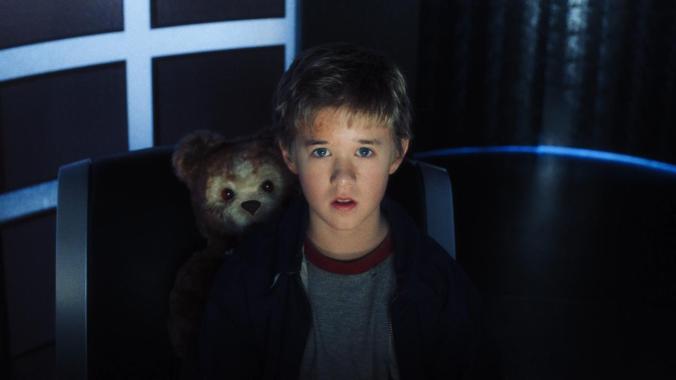
A.I.

A.I. Artificial Intelligence (2001)

I am one of the few proponents of this film that I know. I was probably just young enough to be taken in by this fairytale. Had I been any older, or had my cynicism been as fully developed as it is now, I likely would have scoffed at the film, but I saw it in the theater and loved it immediately. I bought it on DVD and I watched it a lot. A.I. is so stylish, and even if it doesn’t fulfill on all of its promise, it’s at least interesting as a historical artifact as it’s the last film that Stanley Kubrick ever worked on. He and Spielberg share directing credits on the film, and the blend of their unique visual and narrative styles is fascinating, even if Spielberg’s influence is the dominant mode. I haven’t seen this movie since probably 2005 and I wish I could reevaluate it.

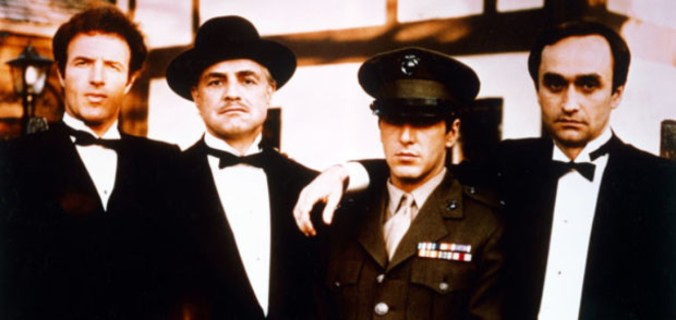
godfather

The Godfather (1972)/The Godfather II (1974)

The Godfather and its sequel are obvious classics of American cinema, and they’ll be noticeably absent from my reviews. I first saw The Godfather when I was 12-years-old on a double VHS copy that I borrowed from the library. I watched it three times in the week that I was allowed to keep it. Eventually, when I decided I wanted to more seriously pursue an education and, hopefully, a career in film, I often told people that it was the influence of The Godfather that had led me in that direction. I was obsessed with the movie as a teen to the point that I had memorized large chunks of dialogue from the film and could recite them on command as a sort of pathetic, nerdy party trick. I owned the DVD box set of all three films in high school, but I didn’t take it to college with me and it doesn’t seem to be at my parents’ house anymore. I suspect that my younger sister took over possession of it sometime after I moved out.

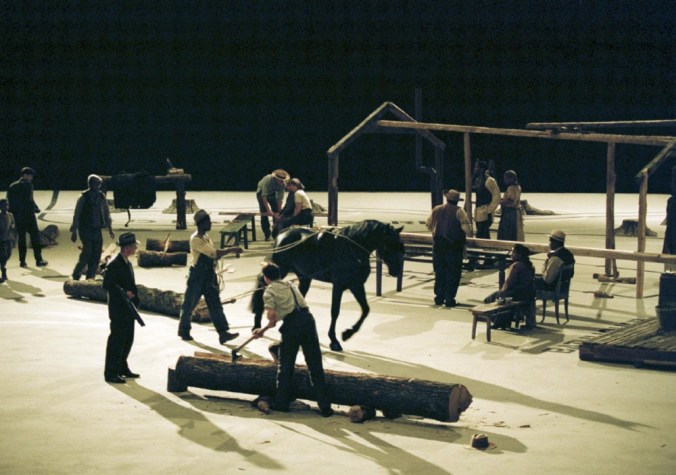
manderlay

Manderlay (2005)

The second in Lars von Trier’s still incomplete “Land of Opportunities” trilogy. Manderlay follows up Dogville, and continues with that film’s experimental, spare visual style. It also explores similar themes as the earlier film. I have a love/hate relationship with von Trier, and Manderlay was one of his more difficult films for me to wrap my head around. I first saw it with my friend, Ben, at the Regent Theater when it was released. Shortly after giving a presentation on Dogville in a class in college, I lent my copy of Manderlay to a classmate who hadn’t seen it, and I never saw it again. This is one that I’d really like to write about as I’ll be covering several von Trier films over the next few months.

say anything

Say Anything (1989)

I don’t need to watch Say Anything again to be able to remember it perfectly. I watched this movie probably two dozen times while I was in high school. It perfectly intersected my filmic interests as a teen, and would have likely ranked up in my top five or ten movies at that time. I imagine my copy ended up with some girlfriend or another at that time, and that’s ok. It would be fun to go back and watch this movie as an adult, but it isn’t necessary.

upstream color

Upstream Color (2013)

Shane Carruth is one of my favorite newer filmmakers. Both of his features, Primer and Upstream Color have been favorites of mine, particularly Primer. When I first saw that movie, I watched it three times in one day, and insisted that each of my roommates sit down to experience it with me when they got home from work. Obviously, I was eagerly awaiting Carruth’s follow-up, Upstream Color, which took several years to materialize. I saw the movie twice in the theater and purchased it on Bluray as soon as it was released. It was one of my favorite movies of 2013, and I tried several times to write a short essay about the film, but I never got it right. I still have several pages of screening notes from that time, but I let a friend borrow the movie and he lost it.

Belly

Belly (1998)

Dir. Hype Williams

Written by: Hype Williams

Starring: DMX, Nas, Taral Hicks, T-Boz


Belly is probably the worst movie, objectively speaking, that I have written about for this project to this point. The first and, to date, only feature film from acclaimed music video director Hype Williams is a bit of a mess, but it also serves as a showcase for Williams’s distinct visual aesthetic. Belly is a stylish crime drama that follows childhood friends Tommy (DMX) and Sincere (Nas) as they pursue fortune and street rep through drug deals and armed robbery until their lives ultimately diverge following Sincere’s decision to get away from his life of crime. The premise is simple to the point of being derivative, but the film’s kaleidoscopic visual style makes it memorable and gives the typical gangster narrative a new coat of high gloss paint. I find myself watching Belly more frequently than many other, better, movies in my collection because I enjoy its frenetic editing, moody color palette, and memorable visual style. It’s a fun movie in spite of its many glaring flaws, and for hip hop fans of a certain age, it’s a certified classic.

Starting with the good, Belly is full of visually interesting and memorable scenes. As I mentioned, Williams rose to prominence as a filmmaker by becoming one of the most prolific and acclaimed music video directors in hip hop in the 1990s. In many ways, Williams defined the visual aesthetic of hip hop during the mid- to late-1990s, a period in which the style fully crossed over into the mainstream. Over the course of his early music video career, Williams developed an eclectic but recognizable style while directing some of the most memorable videos in hip hop history. That style is fully developed and stretched out over the course of a feature film, and Belly is a natural extension of Williams’s music video work, portraying both the gritty street-level realities of its protagonists’ lives of crime and the opulence that that lifestyle has afforded them. Williams captures the drama with technical proficiency and visual flair, opting for dramatic, evocative lighting choices, and employing a restless, moving camera to reflect his characters’ mindsets.

Belly 2

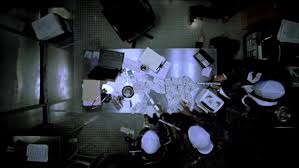
The film’s opening heist scene is a perfect example of this stylistic virtuosity. The scene, in which Tommy, Sincere, and Mark (Hassan Johnson) murder several people while robbing a strip club, sets the narrative and visual tone for the film. The men approach the club in slow motion, though the pace of the editing is quick, with the camera changing angles and distance from its subjects frequently. The quick cuts continue as the three step into the club, but the film’s color palette shifts to an eerie blue, with the black lights of the club causing a negative effect. The close up shots of Tommy and Sincere’s faces are striking and otherworldly, with their eyes glowing hot-white under the black lights. The camera’s constantly shifting perspective, the reversed color palette, and the frequent lens flare from the club’s strobe lights all combine to create a disorienting feeling and a fragmented sense of place. The action shifts upstairs to the club’s office, where the owners are counting cash. The shots lengthen and the camera moves in short, smooth pans and tilts, exploring the room and the cash within it slowly, in contrast to the choppy snapshots of the club floor. Williams continues the longer shot durations as Tommy and Sincere step into the club’s bathrooms where they’ve stashed their guns, a la The Godfather, but he also maintains the disorienting effect and creates visual tension by intensifying the strobe. As Sincere and Tommy approach and ascend the stairway to the office, the strobe is diminished, allowing for more visual clarity. Sincere nonchalantly shoots a bouncer in the chest and after he and Tommy throw him over the stairs, they and Mark charge up the stairs pulling white masks that glow in the black light over their faces. Panic breaks out in the club, and the strobes return, matched by the flashes of the robbers’ guns as they burst into the office and shoot everyone inside. One of the owners falls backwards through the wall-length window overlooking the club floor, descending in slow motion into the blue-lit depths as glittering shards of glass cascade after her like a diamond rain. As she smashes through a table, the beat to “However Do You Want Me” by Soul II Soul, the a cappella intro to which has been seething quietly under the scene up to this point, kicks in, and the film shifts back to a naturalistic color pattern as the men grab the cash and make their getaway. This scene establishes the visual and narrative themes that the film will explore in less than three minutes, and is one of my favorite credit sequences ever.

Belly 5

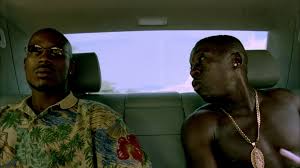
Belly is a film of visual contrasts. Williams associates characters with different colors throughout the film, using blue lights to establish a cold, menacing aesthetic for Tommy, reflecting his ruthlessness and predatory nature. Sincere is visually linked with warmer reds and yellows. He will eventually break with Tommy, rejecting the life of crime for Afrocentrism and attempts at self-improvement. Williams also employs contrast within the same shot by pairing slow motion with quick edits, as he does in the opening robbery scene. These are recognizable music video techniques, and it is obvious at times that Williams’s background is in music video. Often the film seems to be constructed of vignettes, moving from set piece to set piece, and often these vignettes are tied to memorable use of music. These aren’t criticisms, necessarily, as Williams’s experience matching sound to image creates some perfect scenes that almost act as music videos within the film. “However Do You Want Me” is integral to the success of the film’s opening, with the edits syncing perfectly to the music, and the music helping to inform the images. Williams is playing to his strengths in Belly, and while they don’t necessarily lend themselves perfectly to coherent narrative filmmaking, they are enough to keep the film interesting and entertaining.

I think that most of Belly’s shortcomings are a result of Williams wanting to squeeze too much into his first feature. Williams brings a laundry list of influences to the project, many of which he borrows from liberally, resulting in a film that is jumbled and incoherent. There are too many narrative threads, all of which are underdeveloped. This kitchen sink mentality makes the film’s narrative difficult to navigate, as the action shifts from New York to Omaha to Jamaica, following Tommy as he continues to involve himself deeper and deeper in the criminal underworld. Williams too often relies on voice over narration from Sincere to provide context and exposition. For a filmmaker who is so prodigiously gifted visually, Williams often opts to tell rather than show in Belly. With more focus and character development, Belly could be a very good crime film, but as it stands the film only scrapes the surface of its potential, choosing to emulate other, better gangster films and trade in clichés and heavy-handed symbolism rather than developing complex characters and original narrative arcs.

Belly 3

The film also suffers from the performances of its leads. Across the board, the acting in Belly is pretty bad. DMX and Nas aren’t asked to do dramatic heavy lifting in the film, still neither is up to the task. Belly marked the onscreen debut for both rappers, and they are essentially each extending their brands in the film, playing characters who closely resemble their on-record personae. DMX’s physicality lends Tommy’s air of menace credibility, but his line delivery is wooden and he is incapable of registering any facsimile of genuine emotion. Nas seems to be a somewhat more natural actor, but he has to contend with bad dialogue and with the film’s overreliance on his voice over. When he’s not asked to be the film’s narrator, his performance is decent. The lone bright spot in the film, performance wise, is Method Man’s turn as Shameek, a hitman who is sent to Omaha to dispatch of the local drug dealers who reported on Tommy’s drug trafficking operation. In this early role, Method Man displays the charisma and acting chops that helped him cross over into a successful film and television career. He plays Shameek as a joker whose easy charm belies his underlying penchant for violence. He has made a career playing these sorts of lovable, relatable criminals and he shines through in what is essentially an extended cameo. In fact, aside from Tommy and Sincere, the roles in the film all feel like cameos. None of the other characters are given enough screen time to develop any real motivations or character arcs. Sincere’s girlfriend Tionne (T-Boz) serves no actual narrative purpose in the film, while Keisha, Tommy’s girlfriend, is ostensibly a femme fatale, but Taral Hicks’s performance is more sultry than sinister.

Despite these legitimate criticisms of it, I will still continue to enjoy watching Belly. I’m sure it’s obvious by now but I am a big fan of the visuals of this film. Williams’s stylish direction helps to elevate what could otherwise have been a derivative and uninspired gangster film. Even when Williams is shamelessly ripping off his influences, as he does with de Palma’s Scarface for Jamaican kingpin Lennox’s (Louie Rankin) death scene, he makes the homage distinctive and memorable. The female assassin Chiquita who slits Lennox’s throat is memorable despite having less than 30 seconds of total screen time because of the way that Williams frames her visually. As I mentioned, Williams’s skillset doesn’t necessarily lend itself to crafting a complex narrative film, but they are perfect for creating intensely memorable images and translating simple bits of information through visual cues. The audience feels like they know Chiquita despite her limited screen time because her appearance, wearing a spiked collar-style necklace with dermal piercings adorning her face like war paint, conveys simple visual information so well. This is a skill that Williams has translated from music video where meaning must be conveyed simply and easily through the image, or through its relationship to the underlying song.

Belly 6

I think Belly’s reliance on music video tropes actually enhances my enjoyment of the film, because it reminds me of a time in my life when I was beginning to really immerse myself in hip hop culture, around the time that the film came out. Belly was only a modest box office success in 1998, but hip hop in general was experiencing one of its biggest boom periods. I really discovered hip hop as an early teen through Puff Daddy, Ma$e, Master P, Nelly and other popular rappers of the day. Hip hop culture was the dominant culture when I was growing up, and I have fond memories of sitting in my friend Ryan’s bedroom and listening to rap CDs on his oversized stereo. His older brother would pack their multi disc stereo with all the newest rap albums and we would soak them all in. Although I gravitated more and more towards punk rock and heavy metal music as I got older, I never lost my love for hip hop, and in particular the rappers who were popular when I was aged 12-15. This nostalgic attachment to that time period certainly helps to overlook some of the flaws in Belly. It’s a movie that is inextricably tied to that time period, and I like to pull it out when I want to turn my brain off and enjoy a well shot action movie that reminds me of one of the passions of my youth.


I apologize for the quality of the stills in this post. I couldn’t find too many great quality screen caps from the film, and the few that I did choose to use were automatically compressed to a smaller size. I’ll try to find a way to fix this and avoid the problem in the future.


Belle de Jour

Belle de Jour (1967)

Dir. Luis Bunuel

Written by: Luis Bunuel and Jean-Claude Carrière (from the novel by Joseph Kessel)

Starring: Catherine Deneuve, Jean Sorel, Pierre Clémenti


I was introduced to the cinema of Luis Bunuel towards the end of my academic study of film. I had seen Bunuel’s early films, Un Chien Andalou and L’Age D’Or, in high school and early college, respectively, but it wasn’t until my senior year of college that I began to familiarize myself with the rest of the prolific surrealist’s cinematic output. My final semester, I took a class on surrealism in the cinema of Bunuel and David Lynch. I was already very familiar with the work of Lynch as he was, and is, one of my favorite directors, but I knew far less about Bunuel, and it was the introduction to his work that I really treasure about having taken that course. It opened my eyes up to some wonderful films, but also to a new way to engage critically with the medium. Discovering surrealist film theory and beginning to apply it to my own criticism was a freeing experience for me, and it helped to give a framework to some of the attitudes towards cinema and some of the theories that I had been developing over the course of my formal film education.

Surrealism provided a context for a cinema that was attacking and subversive. André Breton and others theorized of the cinema as the art form most suited to disrupt the status quo, and most readily equipped to depict the imagery of the psyche. The experience of watching a film has often been likened to having ones’ dreams projected for viewing, but it was the surrealists who took this idea and ran with it, creating films that tapped into the strange and sometimes sinister workings of the unconscious mind. Bunuel was a part of the original group of surrealists, and along with his collaborator Salvador Dali, he created in Un Chien Andalou perhaps the first truly surrealist film. With that film, and with its follow up L’Age D’Or, the pair sought to create a pair of anti-narrative films that would tap into the subconscious, and bring to the surface the repressed instincts and desires of their subjects and their audience. The pair would split during the production of L’Age D’Or over increasingly differing ideologies, with Dali beginning to embrace the rising dictator, Francisco Franco, in their native Spain, while Bunuel’s political leanings remained decidedly leftist and his explicit artistic goal was to create films that undermined the institutions of the bourgeoisie and the state. With L’Age D’Or he succeeded in creating a film that did just that, expanding on the style and content of his earlier work, while tying the dreamlike aesthetic to a specific political and ideological critique, scathingly critiquing the Catholic Church and religious faith. The film was subsequently banned from public viewings for nearly 40 years.

Belle Du Jour 2

After the scandal and success of L’Age D’Or, Bunuel officially broke from the French surrealists, beginning a film career that would span nearly 50 years in which he would direct over 30 features on two continents, establishing himself as a distinctive cinematic voice, and one of the great directors of all time. Bunuel spent the bulk of the next three decades bouncing between the United States, Mexico, France, and Spain, often taking work for hire in the studio system, particularly in Mexico. Though he was often working with material not of his own choosing, Bunuel’s distinctive vision often shown through as bits of surreal imagery would surface in even the most mundane of his films. By the 1960s, the burgeoning European art film scene and its critics began to take notice of the idiosyncratic style that was on display in Bunuel’s studio work, and elevated the director to a level of prestige. This sparked a late period career resurgence, as Bunuel returned both to making European films, and to making more overtly surrealist films, and it is during this period that he received his most consistent critical and commercial success.

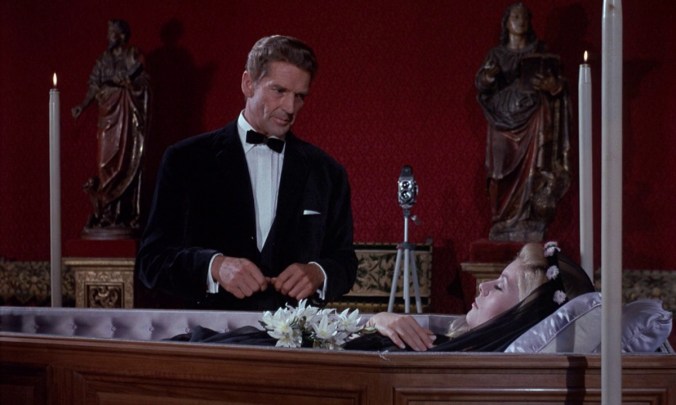
Belle de Jour arrived in 1967, during the height of this cultural reevaluation of the filmmaker. Though it was a studio project, adapted from a pulp novel that Bunuel was often openly dismissive of, the film would go on to become his most commercially successful project and one of his most critically beloved, if vexing, films. Belle de Jour follows Severine (Deneuve), a frigid Parisian housewife, as she begins to seek satisfaction outside of her marriage to an uptight surgeon, Pierre (Sorel). Though she does love Pierre, it is revealed through Severine’s dreams and sexual fantasies, that she needs more than he can offer her, sexually, to be truly satisfied in their marriage. After she hears that a friend has been prostituting herself outside of her marriage, Severine seeks out a madam and begins her transformation into Belle de Jour, the beauty of the afternoon. She is able to be sexually fulfilled through her afternoon rendezvouses with her johns, while maintaining the façade of bourgeois normality in her marriage with Pierre. Ultimately, the two worlds collide in predictably tragic fashion towards the end of the film, as Severine lets a john get too close to her, and his presence threatens to upend the stability of her life with Pierre.

Belle Du Jour 3

I have to admit that Belle de Jour has never ranked among my favorite Bunuel films. When I first watched it for the aforementioned class, I enjoyed it and certainly could see why it was one of the more commercially successful of his films, but it didn’t push the envelope far enough for me. I was more in favor of late classics such as The Milky Way, which he would direct next, or The Phantom of Liberty, Bunuel’s final film. These films fully embraced Bunuelian surrealism and satire as I understood it at the time. I felt Belle de Jour’s surrealism was too restricted, either constrained to only certain corners of the film, or if it was present the entire time, it was present as a lens through which to view the film rather than the operating mode. Over time and with a few more viewings, I’ve come to appreciate Belle de Jour more, and I think I’ve come to understand it better as a film as I’ve matured.

I added Belle de Jour and Viridiana to my collection at the same time after going to a public screening of Un Chien Andalou and L’age D’or renewed my interest in Bunuel around 2013. I went back and watched what I could find available through streaming services, including a couple of films that I hadn’t seen before, and I took advantage of a 50% off sale at Barnes & Noble to add a couple of Bunuel discs to the collection. I had hoped that I would be able to find the Criterion releases of The Milky Way or The Discreet Charm of the Bourgeoisie, but neither were available at my local store, so I settled for Belle de Jour and Viridiana, which are similar in some interesting ways, but neither of which were films which had particularly caught my interest on my first viewings for class. Over the ensuing four years, I think I’ve watched Belle de Jour three times, including for this post, and while it has grown on me, the film still doesn’t capture my attention in the same way as some of the director’s other work.

Belle Du Jour 1

As I mentioned, my initial disappointment with the film was that it did not push the envelope far enough in terms of its overt surrealism. After watching it several times, however, I think that the film does have much akin with some of Bunuel’s most surrealist works. It may not feature the sorts of absurd situations or jarring imagery that he has become known for, but its subject matter and its treatment of sexuality are certainly the type of subversion that his outwardly surrealist films seek to achieve. The film also explores its protagonist’s subconscious, giving the audience full access to Severine’s dreams and sexual fantasies. Its focus on hidden or obscured objects as important symbolic devices is also a key trait of Bunuelian surrealism.

Released in 1967, Belle de Jour’s frank depiction of Severine’s sexuality and her position as a sexual being with desire and agency certainly ran counter to the prevailing depiction of women and their sexuality in the cinema. Even in the more “progressive” art cinema of the 1960s, women were still most frequently presented as objects of male desire, as muses, or as ingénues, all vessels for male fulfillment. Severine certainly does not fall into any of those types, as she is a complex and fully formed female character, who is certainly acutely aware of her own sexual desires, even if she may not always be able to express them. By the film’s end she is capable of both seeking out her own fulfillment, and separating her need for sexual fulfillment from the romantic love that she seems to feel for Pierre. Severine and Pierre’s relationship is also atypical in this way. On the surface their marriage is representative of the sorts of bourgeois values of monogamy, strict gender roles, and capitalist patriarchy that Bunuel is critical of, and it seems obvious that Severine must look outside of this relationship for sexual fulfillment. However, as Severine’s particular sexual fantasies are contingent upon masochism and shame, the strictures of her marriage must remain in place for her to gain that satisfaction. In fact, it seems that her capacity to feel romantic love towards Pierre increases as she continues to work in the brothel, as Severine seems genuine when she insists that she is warming to the idea of being able to be intimate with Pierre every day. Though she can only be satisfied sexually outside of her marriage, Severine recognizes and acknowledges that her love for Pierre is something separate, and also necessary to her overall satisfaction. Bunuel may be critiquing marriage as an institution, but he does not seem to be indicting romantic love, in general. This is a very surrealist line of thought that puts primacy towards the irrational or the fleetingly emotional, rather than staid institutions.

Belle Du Jour 5

It could be tempting to read Severine’s masochistic fantasies as the creation of a male filmmaker who wishes to explore his own fantasies of female subjugation, but the film never presents them as such. Though her fantasy is to “give up” control, Severine is the author of her own fantasies and the beneficiary of any pleasure that is derived from them. When she articulates these fantasies in the real world in the brothel as Belle de Jour, Severine is still able to maintain control. When she is at the brothel, Severine is playing the role of Belle de Jour, which gives her a distance from her encounters with the johns, and maintains something of a veil of fantasy. She also maintains control through the professional nature of the encounters, in which she is financially empowered through the transactional nature of the sex act, and in which she can (and does) remove herself from the situation if she is uncomfortable. I’ll stop short of calling Belle de Jour a feminist film, because I do think that Deneuve is fetishized during certain portions of the film, and I think that Bunuel is really less interested in creating a film about liberating female sexuality than one that explores the themes of desire and fantasy, in general, however its depiction of a female protagonist as a knowing and active participant in the accomplishment of her own sexual fulfillment is a totally subversive idea for the time.

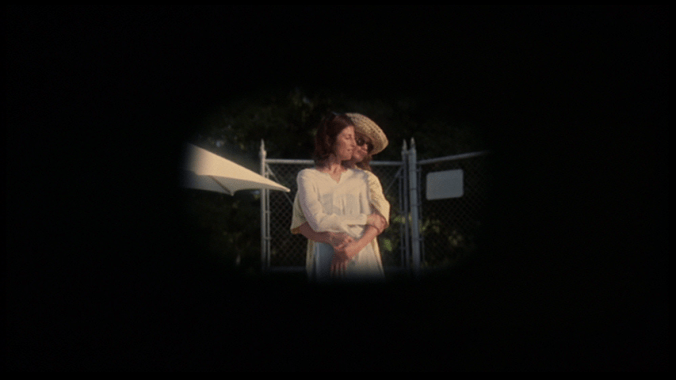
So the film is thematically subversive and surrealist, but it also has many of the trace elements of Bunuel’s style that are not as readily apparent upon just a single viewing. From the famous opening shot of Un Chien Andalou which depicts a woman’s eye being sliced open with a razor, Bunuel has had a fascination with eyes and vision, and Belle de Jour carries on this theme in an interesting way. The film is more interested in seeing and vision than in eyes, particularly. The most obvious example of this is in a scene in which Belle is instructed by Madame Anais (Geneviève Page) to watch through a peephole as one of the other prostitutes humiliates a male submissive. After Belle is rejected by the submissive for not being assertive enough, Anais takes her into an adjacent room and instructs her to watch the more seasoned prostitute, Charlotte (Francoise Fabian) as she indulges The Professor’s (Marcel Charvey) fantasy. Belle watches as The Professor is kicked and berated, but turns away in disgust when Charlotte begins to walk on his face at his request, but she returns to the peephole, guiltily, to sneak another peek. When Madame Anais asks her if she learned anything from her voyeuristic session, Belle feigns disgust and wonders how anyone can stoop so low, but her furtive second glance through the peephole and Deneuve’s pensive line delivery belie her recognition of a similar desire to her own. If eyes are the window to the soul, then the peephole acts as a window for Severine into her own subconscious and her own sexual desire.

Belle Du Jour 4

This scene is immediately followed by another that shows off another Bunuelian cinematic staple, the obscured object. There are many instances in the cinema of Bunuel where objects are hidden, either literally in boxes, or figuratively where their meaning may be distorted or undercut by a mismatch with the soundtrack and image, or an unfamiliar juxtaposition. In the scene in Belle de Jour, after failing to please The Professor, Belle is presented with an Asian john who is carrying a mysterious buzzing box. Boxes and containers are important to Bunuel for their ability to conceal, but also as a symbol. The box itself is representative of the hidden depths of the subconscious, and of the potential for self-discovery for characters willing to open the box. Tellingly, Belle is willing to accept this client and his ominous box when the other prostitutes are fearful. At first she seems startled when she looks into the box, and hears the buzzing emanating from within, but she quickly finds her confidence. After their session, the john leaves, satisfied, with his strange box under his arm, while the brothel’s housekeeper, Pallas (Muni), enters the room to find it a mess, with a bloodied sheet on the floor. Belle is lying face-down on the bed, looking exhausted and unkempt, which causes Pallas to remark, “It must be hard.” To which Belle replies, lifting her head to reveal her smile of pleasure, “What would you know, Pallas?” This scene and the one immediately preceding it with the peephole depict Severine’s recognition and acceptance of her sexual desires in a decidedly Bunuelian fashion.

There were always things that I appreciated about Belle de Jour from the first time I saw it ten years ago. I think that it’s one of Bunuel’s most visually beautiful films, shot in rich Technicolor, the reds and oranges in the film pop off the screen. Catherine Deneuve’s performance has also always stood out to me. Though she was a professional actress with several high profile roles to her name already, Deneuve was only 22 when Belle de Jour was filmed, and she turns in a performance that belies her age. She deftly manages the subtle differences in personality while bouncing between her time as Severine and Belle de Jour. Although she later complained about the shoot, claiming that the final film showed more of her body than she was initially comfortable with, her unease doesn’t show in the final cut. The mixture of vulnerability and complicity that she exhibits is perfect.

With each subsequent viewing, I find more and more to enjoy about the film. Belle de Jour has many layers, and with each viewing I feel like I’m opening another layer of a nesting doll. As a more mature viewer, I can appreciate the sexual politics at play in the film, and as I’ve become more familiar with Bunuel’s cinema, I find more similarities in the film with the rest of his work. Despite this, I still don’t see Belle de Jour climbing into the ranks of my favorite Bunuel. It isn’t cutting enough for me, and it lacks some of the sinister undertones of my favorite of his films. However, it is never not an enjoyable watch, and I always come away with a new impression of the film, or a small detail that I hadn’t noticed previously, and really that should be enough to warrant continued viewings every few years.

Being John Malkovich

Being John Malkovich (1999)

Dir. Spike Jonze

Written by: Charlie Kaufman

Starring: John Cusack, Cameron Diaz, Catherine Keener, John Malkovich


Being John Malkovich is quite a feat as a debut feature for its writer/director team of Charlie Kaufman and Spike Jonze. At the time of its release Kaufman was a relative unknown, toiling as a television writer, all of whose feature scripts had been rejected. Jonze was best known for his music video work, having directed iconic clips for artists as diverse as The Beastie Boys, Weezer, Björk, and Fatboy Slim. After the release of this film, however, both would become, if not household names, celebrities of the indie film world. Though its off-kilter premise and subtle sense of humor made the film’s release a slow build and prevented it from being a true commercial success, Being John Malkovich achieved near-universal critical acclaim, and more than made its budget back. Eventually the film would be rewarded with Academy Award nominations for both Kaufman and Jonze, as well as a nomination for Catherine Keener for Best Supporting Actress. As I alluded to in my post about Adaptation., Being John Malkovich announced its eccentric creative brain trust as major players in the film world going into the 21st century.

malkovich 7

I remember hearing about the movie when it was released, but I don’t think that I had any interest in seeing it. Being John Malkovich is a weird comedy for adults, and I was only 14 at the time. I didn’t know who John Malkovich was, and I certainly wouldn’t have appreciated or understood the film’s strange sense of humor if I had seen it when it was released. I know this because I didn’t appreciate it when I did see Being John Malkovich for the first time on cable a few years after it came out. I turned the movie on, near the beginning, on Comedy Central, and I can remember thinking to myself, “What the heck kind of weird movie is this?” I’m pretty sure I didn’t watch the whole thing, but if I did, it didn’t make an impact outside of its deep strangeness. At that time, probably 2001 or 2002, I had never been introduced to surrealism, and my tastes in comedy were certainly not geared towards something this strange and cerebral. Being John Malkovich was simply too much of a head trip for me and, to be fair, it probably was for many people on their first encounter.

The film follows Craig Schwartz (Cusack) a skillful but struggling puppeteer who is encouraged to go looking for a job by his wife, Lotte (Diaz), to bring in some income and take his mind off of his failures as an artist. He takes a job as a filing clerk for LesterCorp, which is located on the 7 ½ floor of a New York City skyscraper, home to an array of unusual characters, not least of which is Dr. Lester himself (Orson Beane). While working at LesterCorp, Craig develops a one-sided obsession with his coworker, Maxine (Keener). One day, Craig finds a small, hidden door in the filing office and opens it to reveal a dank, earthen tunnel. After crawling into the tunnel, Craig finds himself inside the consciousness of actor John Malkovich (playing himself), where he experiences the world through Malkovich’s eyes for 15 minutes before being unceremoniously dropped onto the side of the New Jersey turnpike. Craig shares this discovery with Maxine, in hopes of winning her affections by sharing this surreal and one-of-a-kind experience with her, and the two go into business together, selling the opportunity to inhabit Malkovich to sad-sack losers for $200 a trip. While a love trapezoid forms between Craig, Lotte, Maxine, and Malkovich, Craig finds a way to put his skills as a puppeteer into the service of controlling Malkovich’s body so that he can remain inside him indefinitely. And that is all before the movie starts getting really weird.

malkovich 4

I came back to Malkovich after seeing and loving Adaptation. I was a little older, and I was coming into the experience this time with a better handle on Kaufman’s unique voice. So, the pieces all fell into place for me, and I was able to appreciate the film on its own deeply strange, darkly comic terms. While I fell in love with Adaptation.’s lofty narrative ambition, I appreciated Being John Malkovich for its straightforwardness. Even though its plot is completely bananas, with each passing scene only serving to up the ante for strangeness, the film is played straight. Its humor is often deadpan, to the point of absurdity. It lacks the temporal shifts and narrative overlapping of later Kaufman films, opting instead for a linear structure. Characters don’t spend great periods of the film fretting over the metaphysical or cosmic implications of the bizarre scenario in which they’ve found themselves, as does the fictional Charlie Kaufman of Adaptation., they simply react as if finding a portal into a celebrity’s brain behind a filing cabinet is the sort of thing that could happen to any average office drone. That a film like Being John Malkovich could be described as straightforward at all is a testament to the skill of Kaufman and Jonze at crafting a believable, lived-in world, peopled with characters who feel like they could be real. Just like the 7 ½ floor, it seems like Being John Malkovich exists in a parallel world to the real one, where objects and people from the real world are easily recognizable, but the perspective is slightly skewed. The setting is familiar, but the characters’ relationship to it is somehow off.

That skewed perspective is reinforced by the choice of Cusack and Diaz as the film’s leads, as both actors are asked to play against type for their roles. Though often cast in comedies, Cusack was coming off of a run of serious dramas including Midnight in the Garden of Good & Evil and The Thin Red Line, and according to reports he discovered Malkovich after asking his agent to find him the “craziest, most un-produceable script” he could find. Craig is a typical Kaufman protagonist, an artist who can’t reconcile his own ambitions and talents with the needs of the day to day world, and Cusack perfectly embodies the depression and malaise that come along with that character. In the film, Craig’s hair is long and greasy, he’s unshaven, and he is shabbily dressed, a far cry from the typically suave, handsome on-screen persona that Cusack is typically associated with. Although he is sometimes associated with the sorts of mopey, lovelorn character that he plays in Being John Malkovich, none of Cusack’s other comedic roles (save for possibly Lane Meyer in Better Off Dead, but we’ll get to that one soon enough) skew this dark. Craig’s attempts to maintain control over his life, the people in it, and the façade that he’s built up using Malkovich as a puppet push him to extremes.

malkovich 2

If Cusack is playing against type, Diaz is asked to make a full on transformation for the role of Lotte. Diaz had burst into the mainstream the year prior playing the titular character in There’s Something About Mary. After that role, she was poised to break out as one of Hollywood’s biggest stars, and she did, but Being John Malkovich marks a definite detour into fertile territory for her. Rather than capitalize on his lead actress’s fame, Jonze opts instead to make Diaz nearly unrecognizable in the film. Her signature blonde tresses are traded in for a brown, frizzy wig, while her figure is obscured behind lumpy sweatsuits. Everything about Lotte suggests a life of quiet desperation and Diaz’s subtle performance early in the film pull that off well. Her interactions with the chimp, Elijah, who is a part of the menagerie that Lotte has acquired in place of human children, are both comfortingly maternal and heartbreaking at the same time. While she is adept at portraying a woman trapped in a loveless marriage, Diaz’s best work comes later in the film when she reveals her desire for Maxine, and her insistence of returning to Malkovich’s head to experience life as a man. After her experience, Lotte declares herself to be transgender, and she gains satisfaction and self-actualization that she could have never gotten from Craig through her relationship with Maxine. At this point, Diaz’s performance becomes more assertive, and she takes on the role of the detective in the story, trying to uncover the mystery of the portal, rather than just exploit it, as Craig and Maxine do. Though Craig is, ostensibly, the film’s main character, it’s Lotte who does the most changing throughout the film, and in whose character some of the film’s most interesting themes about identity, consciousness, and sexuality are embodied.

Watching the film in 2017, I was struck by how progressive its attitudes towards sex, relationships, and gender identity were for a film that was released in 1999. While it was far from the dark ages, with respect to representation in media, 1999 was still a much less enlightened time for the general public with respects to sexual diversity. I’m sure that watching this movie must have marked the first time I ever encountered the word “transsexual,” though it didn’t register at all then. The idea of a woman entering into a man’s body, experiencing his view of the world, but maintaining a feminine spark that can still be seen through the eyes, as Maxine asserts that Lotte’s can, suggests a gender fluidity rather than a binary relationship. While this is obviously not the way that a transgendered person in the real world exists, the experience does lead to a revelation in Lotte, and a turning point in her character, as she articulates her own chosen identity and decides to actively pursue a happier and more satisfying relationship. Maxine and Lotte’s relationship, which is eventually achieved without a physical male surrogate, is the healthiest one in the film, and their ultimate production of a child and happily-ever-after ending stands in stark contrast to the loveless marriage that Lotte and Craig were both searching for an escape from. Craig, who attempts to be domineering in his relationship with Lotte and manipulative in his relationship with Maxine, is ultimately rejected by both and ends up alone, forced to watch their happiness through the portal, as it connects to the consciousness of Maxine and Lotte’s love child (conceived through Malkovich), Emily.

malkovich 6

The other aspect of the film that interested me on this rewatch was its treatment of celebrity. In 1999, famous actors and other celebrities existed in a world that was out of reach to the common person, accessible only through tabloid newspapers and gossip shows. Now, in an age of pervasive social media, the film’s portal into John Malkovich’s brain has been actualized through celebrities’ Twitter feeds, and Instagram videos. Fans now have a window into their favorite celebrities’ private lives. Being able to actually see through the eyes of, and effectively inhabit, a famous person would still probably be a valued commodity for some, but with access to our idols’ innermost thoughts and feelings on a stream-of-consciousness Twitter feed, it seems less attractive. Want to know what life is like for John Malkovich? Follow his Twitter feed and find out his pet’s favorite Starbucks order.

malkovich 5

Despite all of that, Being John Malkovich never really feels dated. The film is nearly 20 years old, but aside from the obvious advancements in technology, it is set in such a unique world that, rather than reflecting the time in which it was made, it seems to exist just outside of time. The film’s satire of Hollywood culture and the arts scene in general still ring true, and the film’s central theme of longing to break out of one identity and into another is a universal concept. Ultimately, underneath all of its cerebral meta- trappings, Being John Malkovich is a love story, and a story about the lengths to which these characters will go to make themselves feel lovable. If the film’s strange setting is a bit alienating, its emotional core, and the performances of its cast shine through and give the viewer something to cling to. I hadn’t watched this movie in many years, and while it still doesn’t rank among my very favorite Kaufman films, I could understand why it might for others. The building blocks of his future scripts are in place here, and many of the themes that he continues to explore in his films to this day are fleshed out quite well in Being John Malkovich. I’ll probably end up going back to this movie with more frequency than I have in the past.

The Battle of Algiers

The Battle of Algiers (1966)

Dir. Gillo Pontecorvo

Written by: Franco Solinas

Starring: Brahim Hadjadj, Saadi Yassef, Jean Martin


I first saw The Battle of Algiers in the spring of 2005 when it was assigned to me for a project during my freshman year of college. I was taking a World Film History course and the major assignment was to do a short research project on a classic international film. Films were chosen at random out of a hat, and I was lucky enough to draw a film that was not only readily available to screen, but was actually experiencing a cultural and critical re-evaluation at the time. Some students drew films that were more obscure, or even lost, having to rely on secondary and tertiary sources to build up their projects, but The Battle of Algiers had actually been released on DVD through the Criterion Collection in 2004, and there was a wealth of criticism about the film, both contemporary and from the film’s initial release in 1966. It was one of the first overtly political films that I had ever seen, and I watched it several times while I was working on the research project. Exposure to The Battle of Algiers at that early time in my study of film, and to the primarily Marxist essays and criticisms I was reading about the film, changed the way I thought about movies and how to approach them analytically.

The film depicts the events of a three year period from 1954 to 1957 during the Algerian War of Independence, focusing particularly on the formation of a guerilla branch of the FLN (National Liberation Front) in the Casbah and the subsequent attempts of the French military to quell the uprising. The film opens at the end of its narrative, with Ali La Pointe (Hadjadj) and several other FLN freedom fighters trapped in a building in the Casbah, surrounded by French paratroopers, and then flashes back to 1954 to show the events that have led to this point. Ali is a petty criminal who is recruited by the FLN, and rises through the ranks, providing the audience a glimpse into how the group is organized and the tactics that the rebels employ in their fight against the French colonialists. The film doesn’t shy away from depicting the horrors of war. Over the course of the film, we see the violence in the Casbah escalate from shootings to bombings. At the same time, we are shown the French army respond to this violence with equally savage methods including torture and summary executions. While the military wins the Battle of Algiers by assassinating or neutralizing the FLN’s leadership, the film’s epilogue flashes forward to 1960, showing that the spirit of revolution is still alive in the Casbah as pro-Algerian demonstrations have broken out again. On July 2, 1962, the Algerian nation was established, and French colonization of the country and its citizens was ended after nearly 150 years.

Battle of Algiers 4

An Italian and Algerian co-production, The Battle of Algiers is part procedural, part action film, and part docu-drama, and it could be considered a very late entry into the cycle of post-war Italian neo-realist films. It is based on the field memoirs of Saadi Yassef, a military commander for the FLN who was captured during the Battle of Algiers, who also plays a fictionalized version of himself in the film, El-hadi Jaffar. Pontecorvo was no doubt influenced by the films of his peers in the school of neo-realist filmmaking, as he consciously chose to give the film the feeling of a documentary, though it is fictionalized. The Battle of Algiers is shot like a newsreel, in black and white, employing handheld camerawork and quick zooms. Its style and relationship to actual, recent, historical events help the film blur the line between fiction and documentary. The film features almost exclusively non-professional actors, furthering its realism. Pontecorvo chose his cast based on their appearances, rather than their acting ability, and he often frames his characters in close-up, capturing expressive faces that resonate emotionally and contrast with the more detached, documentary presentation of the chaos and violence of the Casbah during the war. The film ultimately doesn’t make an explicit endorsement for either side in the conflict, mainly due to pressure from its Italian producers who insisted on a neutral presentation of the conflict, but I think that Pontecorvo’s stylistic choices in the film make it clear that his sympathies are with the Algerians. Though the film depicts the suffering of Algerians and French alike, we are intended to see Ali, Jaffar, and the other FLN freedom fighters as the heroes, and the French Colonel Mathieu (Martin, the film’s only professional actor) as the villain.

BATTLE OF ALGIERS, THE / BATTAGLIA DI ALGERI, LA

Though it is presented simply, as a realist document, The Battle of Algiers certainly doesn’t lack for style. The film’s camerawork is technically impressive, with cinematographer Marcello Gatti creating a claustrophobic, oppressive tone as his camera explores the maze of alleys that make up the Casbah through masterful handheld tracking shots and zooms. As mentioned earlier, these zooms often end in close-ups of people’s faces, drawing the audience’s attention to the palpable suffering of the Algerians. The film’s grainy, black and white is evocative of newsreel footage, but it is also beautiful, allowing for both softly-lit interiors and high-contrast exterior shots of the Casbah that establish a concrete sense of place. The film’s use of sound also helps to establish place and mood. The score, by Pontecorvo and Ennio Morricone, alternates between pieces built around frantic drumming and woodwinds, underscoring the tense mood of the conflict, and pieces that feature slow, elegiac strings that heighten the emotional impact of some of the film’s more violent scenes. The film also uses diegetic sound to establish the differences between the French colonialists, who are associated with the sounds of gunfire, trucks, and cars, and the Algerians who are associated with the explosions of bombs, native drumming, and with the wailing and chanting of the citizens of the Casbah as they take to the streets to protest their treatment at the hands of their colonizers. The French are aurally associated with elements of modernity while the Algerians are associated with a more primal, tribal sound palate. The effect of this contrast isn’t pejorative, however. When coupled with the numerous shots of the thousands of Algerian extras-all actual residents of the Casbah-gathered in sorrowful prayer, the soundscape imbues the Algerian cause with a sort of religious piety.

Despite its resistance to embracing an overt political position, The Battle of Algiers has become an important film in the history of political discourse. At the time of its release, the film was praised by many critics, and won several awards at major European film festivals, but the film also had detractors and was banned in France until the early 1970s for being too sympathetic to the Algerian point of view. It was released at a time of global decolonization and worldwide struggles by oppressed peoples to assert their right to self-determination, and The Battle of Algiers was seen by many as a primer for revolutionary action. The film was also used as an example of successful counter-insurgency tactics due to its realistic depictions of urban military operations and guerilla warfare tactics. The film was famously screened at the White House in 2003 due to the similarities of the film’s subject matter to the then-new Operation Iraqi Freedom. This similarity to geopolitical realities at the beginning of the 21st century led to a renewed interest in the film, ultimately resulting in a remastering and theatrical re-release of the film in 2004. It was in this context that I first encountered The Battle of Algiers.

Battle of Algiers 3

Coming of age during the George W. Bush administration helped shape my development as a politically progressive, leftist-leaning malcontent. I spent my teens reading Howard Zinn, Noam Chomsky, and Saul Alinsky, and developing more and more disdain for the American military-industrial complex, in general, and the seemingly endless military conflict in the Middle East, in particular. The more I learned about the history of America, the more I was able to connect the Iraq war to a long chain of injustices, played out on the global scale, committed in the name of American cultural hegemony and imperialism. Seeing The Battle of Algiers helped to connect that sense of history to a larger, global context, and to the anti-imperialist struggles of oppressed peoples throughout the world. I already had a vague sense of the global history of revolution in the 20th century, but my work researching The Battle of Algiers and its context brought me into contact with writers such as Frantz Fanon, Jean-Paul Sartre, and Ernesto Freire who helped to illuminate the power relationships between the colonizer and the oppressed, and underlined the role of global capitalism in upholding these relationships. For someone of my political persuasions to discover The Battle of Algiers at that time was a revelation. It felt extremely relevant at the time, and helped to crystallize my beliefs.

If The Battle of Algiers felt prescient to me in 2005, it may be even more so after watching it again in 2017. The military conflict that I found so abhorrent then, in its infancy, has continued on for nearly 15 years, a slog that has cost hundreds of thousands of lives. Over the course of the conflict, debates over the morality of remote drone warfare and “enhanced interrogation techniques” filled the news, reminiscent of the scenes of torture in the film. American attempts at regime-building, proposed under the guise of “spreading democracy,” have continued to further destabilize the Middle East, ensuring indefinite continued military engagement in the region. The tactics of warfare have changed in the 21st century but the underpinning motive of promoting the cultural and political hegemony of the United States remains. Over the last decade, Islamophobia has become rampant in response to high profile instances of religious extremism, but I’m always conscious of the fact that one person’s terrorist is another’s freedom fighter. Terror inducing violence is unacceptable on every level, but I’m reminded by The Battle of Algiers that often acts of terrorism are direct responses by the oppressed to the injustices meted out on them by their oppressors. In many ways, Western hegemonic powers such as France and the United States laid the groundwork for the 21st century terror state through their history of colonial oppression. As Fanon pointed out, often violence is the only language that can be understood by those who would wield power violently over the disenfranchised.

Battle of Algiers 7

The scene that stuck with the most during this rewatch of The Battle of Algiers was the film’s epilogue. After Ali la Pointe, Jaffar, and the rest of the FLN’s leadership has been eliminated, the film shows us that the revolution lived on without them. After a two year period of relative piece in Algiers, the residents of the Casbah once again took to the streets in December, 1960, waving flags and asserting their desire to live free of the tyranny of colonialism. Pontecorvo somehow recreates this scene, filming hundreds of extras as they teem through the streets of the Casbah, chanting, ululating, and waving flags bearing the crescent and star. Again, the handheld camera puts the audience in the midst of a mob scene, moving through the crowd, picking up on determined faces, as a reporter gives context to the images through his voice-over description. Smoke and dust obscure the view as the crowd faces off against police and the military, who are badly outnumbered despite their martial superiority. Police beat the marchers with clubs and the army attempts to drive them away with tanks, but the crowd will not disperse. The demonstrations are shown to have gone on for nearly a month, before finally ending on December 21st, 1960, after having captured the hearts and minds of the French public and prompting many in the political class to consider “seeking a new relationship with Algeria,” as the film puts it.

In the film’s final scene, a French military officer approaches the gathered mob in the Casbah, who are obscured by smoke. “Return to your homes!” he shouts, “What do you want?” The camera slowly zooms past the officer, and from the smoke comes the response from the demonstrators, “Independence! Our pride! We want our freedom!” Slowly the smoke begins to clear, revealing the demonstrators, who are chanting defiantly in the face of authority. Two women who are dancing and waving flags stand out from the crowd immediately, and the camera again picks up on their faces. Though they are pushed back by the police, the women continue to advance, their visages alight with pride and dignity. The film’s final shot is a close up of one of the women twirling and waving her flag, a smile beaming across her face, as the voice over narration reminds the audience that though there were still two years of struggle to come, “on July 2nd, 1962, with its independence, the Algerian nation was born.”

Battle of Algiers 6

I was struck by the passion that that woman displayed. No doubt, she had experienced first-hand the oppressive nature of colonialism just a few years before being shot for The Battle of Algiers. The pride and the determination she showed was earned through her actual struggle to live in a free society. Watching those last scenes, I thought about the real-life scenes of riots and demonstrations that I had seen broadcast from Baltimore, from Ferguson, from countless other cities in America where African-American men were murdered at the hands of the police. I was reminded that the struggle for freedom isn’t limited to the past, nor is it confined to matters of national identity. If, in my country, a person cannot walk down the street without fearing for their life, then we have not moved past the injustices of a colonial system in which the ruling class seeks to exploit and dominate the underclass. The civil rights leaders of the 1960s looked to global anti-colonialist movements with an eye towards solidarity, and I think that it could be instructive for those who would fight for equal rights to make sure that they continue to explore that history. The combined forces of nationalism, capitalism, and ethnocentrism seek to divide and oppress the masses, profiting the wealthy while treading on the poor and the weak. There are historical examples of times when revolutionary action was necessary to overthrow tyrannical governments, right historical injustices, and restore power to the people. The lesson I’ve taken from watching The Battle of Algiers after seeing my country elect a quasi-fascist bigot to the highest office in the land is that revolution is a struggle, but, as I was reminded by the woman from the film’s ending, it should also be a joy.

Barton Fink

Barton Fink (1991)

Dir. Joel & Ethan Coen

Written by: Joel & Ethan Coen

Starring: John Turturro, John Goodman, Michael Lerner


The Coen brothers have made some of my very favorite films. Their filmography is notable in both its depth of quality and its stellar high-end pedigree. Even their lesser regarded films are typically enjoyable, and a cut above the standard Hollywood fare, while their best films are often regarded as classics. Barton Fink falls into this latter category, continuing a string of early offbeat classics that would set the tone for the brothers’ careers going into the 1990s. Though it may not be as widely seen as some of the Coens’ later films such as Fargo or The Big Lebowski, Barton Fink deserves consideration along with those films and others from throughout the brothers’ thirty year run of filmmaking as one of the best in their catalog. The film continued to establish the brothers as visionary talents with a knack for crafting intricate, genre-bending screenplays, as well as furthering their unique and distinctive visual storytelling style. Barton Fink is a neo-surrealist nightmare of a comedy and it often vies for the top spot in my ever-shifting list of favorite films by the Coen brothers.

Though it might get overshadowed by some of the obvious high points of the Coens’ catalog that surround it, Barton Fink is an offbeat masterpiece in its own right. The brothers wrote the screenplay while taking a break from working on their third feature, 1990’s Miller’s Crossing, and the two films could not be more different in tone. A period piece, Barton Fink is set in 1941 and follows the titular Barton Fink (Turturro), a successful New York playwright who attempts to transition his career to writing scripts in Hollywood. Barton arrives in Hollywood and takes up a room at the dilapidated Hotel Earle, where he struggles to begin work on the wrestling picture which he has been assigned by Capitol Pictures. Barton is nebbish and anxious, a typical East coast intellectual, who worries that his relocation to sunny California and the shallow material he’s asked to work with for the studio will sever his connection to the common man and hinder his quest to bring a more perfect art form to the theater. One of the reasons for Barton’s inability to work is his loud and boisterous neighbor at the Earle, Charlie (Goodman), a salt of the earth insurance salesman who is a perfect foil for the high-minded Barton. Eventually the two strike up a friendship, with Barton fetishizing Charlie’s experience as an everyday working man. The film’s final third takes a dark turn with Barton becoming embroiled in a murder investigation, while Charlie is revealed to be an at-large serial killer with a penchant for removing his victims’ heads. In the end, Barton finishes his screenplay but is ultimately blackballed by his studio, and he is relieved of the pressure of the detectives who are investigating him by the nightmarish return of Charlie (or “Madman” Mundt, as he is referred to by the detectives) who becomes evil incarnate when he torches the Hotel Earle and leaves a trail of bodies in his wake.

barton fink 5

Already known for creating films that are difficult to slot into any one particular genre or style of filmmaking, Barton Fink is probably the Coens’ most unclassifiable film to that point in their careers. While they had explored dark, anarchic comedy in Raising Arizona, that film lacks the elements of surrealism and outright horror that are present at times in Barton Fink. The film also features much more narrative ambiguity and opens itself up more to its viewers’ subjective interpretation than any of their previous films. Miller’s Crossing presents quite a tangled web of narrative interconnections and plot twists, but careful viewers can navigate the film’s twists and turns to arrive at a sense of narrative completion and truth. Barton Fink, however, doesn’t offer up a clear narrative solution, leaving its viewers instead with a series of unanswered questions and a plethora of potential clues that could explain some of the film’s stranger elements. What I love about Barton Fink is that it is so amorphous, and it’s a great film to watch again and again, refining your own personal theory to explain how it is that Barton experiences the things he does in the Hotel Earle. I’ve been doing so for the last 15 years, since first seeing the film.

My personal theory about Barton Fink is that Barton died at some point on his journey from New York to Los Angeles, and that the Hotel Earle is some sort of Purgatory, where the residents must be judged and tested to determine their ultimate fate in the afterlife. Barton’s cross country journey is elided, replaced by a brief shot of a wave crashing upon a rock that will become symbolically important later in the film, and from the outset his stay at the Hotel Earle supports the theory that there may be something more than meets the eye about the tumbledown, gloomy hotel. Upon check-in, Barton is greeted by Chet (Steve Buscemi), the hotel’s concierge, who ascends a set of stairs and emerges from a trap door to ask Barton whether he is a “trans or a res,” meaning a transient or resident guest. Barton replies that he will be staying “indefinitely.” The hotel’s lobby is dim, populated by many overstuffed arm chairs, illuminated by very few stray beams of sunlight. Barton’s room is bare, aside from a picture on the wall of a girl sunbathing on the beach, staring into the horizon as the tide comes in. The sunny image in the picture represents an oasis in the otherwise grim room. The hotel is decorated in drab greens and yellows that call to mind rot and sickness, and the wallpaper in Barton’s room peels, revealing oozing, sweaty walls. The shoes left at the door of each room for nightly shining seem to suggest a hotel full of guests, but Barton and Charlie are the only ones we actually see, giving the Earle the feeling of a haunted house. Barton’s interactions with the hotel’s staff, whether with Chet or with Pete (Harry Bugin), the hotel’s morose elevator operator, are exceedingly surreal, consisting of clipped dialogue and frequent non-sequiturs, as if Barton’s reality doesn’t quite match up with theirs.

barton fink 2

Barton’s physical appearance throughout the film also supports this theory that he may be dead. Upon arriving in Los Angeles, Barton’s physical and mental state appear to steadily deteriorate until he is able to finish his screenplay. He is plagued by ever-worsening boils, which he explains away as mosquito bites. Though it is mentioned that there are no mosquitoes in Los Angeles as they are most commonly found in swamps, there is clearly a mosquito in Barton’s room, again indicating that something is not right about the Hotel Earle. He is also plagued by not only writer’s block, but intense anxiety, bordering on paranoia, as he hears sounds through the walls at the hotel. He becomes prone to extended bouts of daydreaming as he stares at the picture on his wall, fantasizing about escaping from the gloomy confines of his room at the Earle. Even outside the hotel, Barton is often shown anxiously sitting through meetings with studio executives, his pocked face glistening with sweat, giving him the pallid look of a corpse.

After a lover is found inexplicably dead in his bed, Barton’s paranoia turns to full on mania as he asks his only friend, Charlie, to help him dispose of the body and remedy the situation. Charlie leaves town, assuring Barton that everything is taken care of with regards to the body, and asks him to safeguard a package for him which we must later presume contains the head of the woman who was killed in Barton’s bed. Barton is left weeping in his room with the package and his unfinished script. As he is battling his writer’s block, Barton opens his desk drawer and finds the ubiquitous hotel room Gideon’s Bible. Opening the Bible to a random page, Barton discovers this verse from Daniel describing the demands of a King: “…Nebuchadnezzar answered and said to the Chaldeans, I recall not my dream; if ye will not make known to me my dream, ye shall be cut in pieces…” Turning then to the book of Genesis, Barton sees the opening lines of his own screenplay as the first two verses in the Bible. This juxtaposition of Barton’s own work with the verse in the Bible indicates that finishing his screenplay is to be the test he must pass to depart from the Hotel Earle. The King’s demand to “make known to me my dreams” echoes the demand of Capitol Pictures studio head, Jack Lipnick (Lerner), that Barton turn in a crowd-pleasing, studio friendly wrestling picture, rather than the sort of high art that Barton aspires to. This revelation, coupled with Barton’s encounter with the detectives, Mastrionotti (Richard Portnow) and Deutsch (Christopher Murney), who are on the hunt for Charlie, give him the impetus needed to finish his screenplay, which he does in one bout of inspired writing.

barton fink 6

The final scenes of Barton Fink drive home the theory that Barton and Charlie are playing out a waiting game in Purgatory, while they attempt to finish out some aspect of their life’s work. After returning to the hotel from celebrating the completion of his screenplay, Barton finds the detectives in his room, rifling through his papers. They question Barton about his role in the murders, as another Capitol writer whom Barton had been acquainted with and admired has been found dead, and handcuff him to the bed, which is still soaked with blood. Before they can arrest Barton, however, the detectives leave the room to investigate smoke and heat pouring in from the hallway. They’re greeted by Charlie, who is wielding a double barrel shotgun, which he uses to quickly dispatch Mastrionotti. Charlie then charges down the hallway at Deutsch, bellowing “I will show you the life of the mind,” followed by a wall of fire. The hallway engulfed in flames around them, Charlie shoots Deutsch and then turns into Barton’s room for one last chat.

barton fink 8

Charlie settles into the chair at Barton’s desk with the world-weary air of a man who has spent one long day too many at the office. When Barton confronts Charlie about his true identity as Madman Mundt, Charlie launches into a monologue that begins, “Jesus, people can be cruel. If it’s not my build, it’s my personality,” and in which he lays out his justification for his killings. Charlie feels sorry for the people of the world, sees their day-to-day struggles, and thinks that he can best help them by giving them assistance in sloughing off their mortal coil. He laments that he has no one to have mercy on him and help him out in a similar fashion. “You think you know pain?” he says to Barton, “You think I made your life Hell? Take a look around this dump. You’re just a tourist with a typewriter. I live here, Barton. Don’t you understand that?” Charlie has never been able to leave the Hotel Earle; the best he can do is transform it through his violence. While the hotel was once a Purgatory, Charlie has unleashed Hell on Earth, and he intends to stay there. He frees Barton from his handcuffs, and then tells him that he’ll be next door if Barton needs him. As Barton leaves his room with his finished script and Charlie’s package in tow, we see Charlie step through the inferno into his hotel room, symbolically passing into the afterlife.

Though his script is ultimately rejected, and Lipnick threatens to keep him in a professional purgatory by forcing him to work out his contract for Capitol Pictures while refusing to produce any of his scripts, Barton, too, passes into the afterlife at the film’s end. After the rejection, Barton is walking along the beach, still carrying Charlie’s package. There is a shot of a wave crashing over a rock that directly mirrors the shot that is used as a transition earlier in the film when Barton journeys from New York to Los Angeles. I believe these shots symbolically represent his character entering into a new state of being, both passing from life into death and his Purgatory state at the Hotel Earle, and then passing from Purgatory into some sort of Heaven on the beach. Barton finds a place to settle on the beach, and he is approached by a beautiful woman who sits down in front of him. “You’re very beautiful,” he asks, “Are you in pictures?” To which she replies, “Don’t be silly,” as she turns from him to stare out across the waves, raising her hand to shield her eyes from the Sun, and assuming the pose of the woman in the picture in Barton’s room. The film ends with the two of them sitting on the beach, Barton having finished his journey and finally ended up in the oasis depicted in his picture.

barton fink 9

Barton Fink is so rich with symbolism and literary and textual references that one could easily come up with several other plausible theories to explain the events that take place in this unusual film. In fact, my preferred analysis is actually largely unsupported by interviews with the Coen brothers that I’ve read, and their stated desire to make a sequel to the film set in the 1960s runs directly counter to my supposition that Barton is dead. However, the beauty of a film like Barton Fink is that it is so open to interpretation and so varied in its themes that it can be exactly the type of film that any given viewer might be looking for on any given viewing. There are multiple allusions to creeping fascism and the United States’ eminent entry into World War II throughout the film if one chooses to read it in that way. There is certainly evidence that everything did, in fact, happen as it was depicted and that the world of Barton Fink is just supremely strange. My own interpretations of the film have changed with time, and could likely change again, but that’s always been a part of the fun of it for me. The film is also entertaining, funny, and populated with incredibly strong performances from its cast so that if one doesn’t care to dive deep into its narrative looking for deeper meaning and continuity, it can still be an impactful and memorable viewing experience. As I mentioned earlier, Barton Fink is somewhat lesser seen than other Coen brothers films, but it is certainly not of any lesser merit, and if you haven’t seen it yet I would suggest remedying that as soon as possible.

Au Hasard Balthazar

Au Hasard Balthazar (1966)

Dir. Robert Bresson

Written by: Robert Bresson

Starring: Anne Wiazemsky, Francois Lafarge, Jean-Claude Guilbert


This is a film that I was only introduced to within the last five years, although it has quickly captivated my interest and is on its way to becoming one of my favorite movies of all time. Sometimes there are just those films that when you see them for the first time, you know. You think, “This is something special. This one is going to be sticking with me for a long time.” Or at least, that’s the way I have felt about certain films. 2001: A Space Odyssey is one such film that I’ve written about on this blog. It wormed its way into my brain, causing me to ponder its mysteries and consider the message of its philosophy for years to come. Au Hasard Balthazar did the same thing to me, but on an emotional level, rather than a cerebral one. Since I first saw this simple fable about the life of a donkey, it’s been one of the few films to consistently move me in an emotional way every time I view it.

Au Hasard Balthazar follows the life of the titular Balthazar, a donkey, and his owner Marie (Wiazemsky) as they grow up and begin to experience life together. Set in a small French farming village, the film is a pastoral fable, exploring themes of human cruelty, suffering, and absolution. Throughout his life, Balthazar has many masters, most of whom treat him with a mixture of indifference and outright cruelty, however, he always returns to Marie, the only human who has ever shown him true love and care. Marie’s own journey in the film, growing from a girl to a woman, parallels Balthazar’s, as she also learns lessons about the capacity of human beings for abuse and cruelty from her “masters,” her father (Philippe Asselin) and the criminal, Gerard (Lafarge), with whom Marie pursues a relationship. At times, Au Hasard Balthazar can seem to be a grim and bleak look into the cruel power that the strong hold over the weak and the helpless, but its ending does hint at the possibility for the meek and the humble to obtain a reprieve from terrestrial sufferings and, ultimately, a form of redemption.

Balthazar 3

While this might sound like an over-simple description of the film, Au Hasard Balthazar is just that simple. Bresson is a highly minimalist filmmaker, and the apparent straightforward simplicity of his films often belies their symbolic depths. Underneath the mundane, realist surface of Balthazar lies a wealth of truth about human nature, and the capacity of human beings for achieving redemption and absolution in life. I think these hidden depths are what have so attracted me to the film since I first encountered it in 2013. It’s hard to believe that, presented in such a simple package, a film could contain so much of the human experience, but it’s all there in Balthazar, from birth to death. Bresson manages to capture the essence of human emotion through his animal protagonist, and provides the viewer, through Balthazar, with a blank surface upon which to project their own hopes, fears, and beliefs about life.

Bresson’s Catholicism is often mentioned when discussing his films, particularly Balthazar, as it is so overtly concerned with suffering and redemption, but I have never had much interest in the religious overtones of the film. It is impossible to completely avoid discussing the religious subtext in the film, but I am much more interested in considering the humanistic implications of its themes. Jean Luc Godard once referred to Bresson as the “Grand Inquisitor” of cinema, and by that he meant that Bresson’s films are able to get the very core and essence of the human experience. Though Bresson is largely known for his Catholicism, watching his films truly reveals him to be a Humanist. The films of Bresson, particularly Balthazar, are some of the best examples of film as a humanistic art. A great film can do many things, but one of the chief achievements of the best films is to help the viewer to understand their own humanity, or the human experience of those unlike themselves, on a deeper level. All great art helps to reveal aspects of the humanity of both its creator and its audience, but through its ability to recreate life with photorealistic integrity, the cinema is the art form with the most revelatory capacity when used correctly. With Balthazar, Bresson is at the height of his powers as an “inquisitor” of the human spirit, and in the film he exposes both evil and purity at the heart of human nature.

Balthazar 6

Balthazar was not my first experience with Bresson. I saw Lancelot du Lac (1974) in a class my freshman year of college, but it didn’t have a huge influence on me at the time. I remember thinking that the film was interesting, but it didn’t drive me to seek out more Bresson, nor did I have chance to encounter one of his films again until I sought out Balthazar nearly a decade later. I became aware of the film after seeing the most recent Sight & Sound greatest films poll in 2012. The list, published by the British Film Institute and updated every ten years, is voted on by hundreds of filmmakers, critics, archivists, programmers, and other industry professionals. I’ve enjoyed looking back at the Sight & Sound polls to chart the changing of critical tastes over the decades and also to see how the accepted “canon” of great films has shifted over the years. When I was reading through the 2012 version, I found in the 16th spot a film that I had never heard of before with a provocative French title that caught my eye and captured my imagination. I had no idea what it was about and, my French being more than a little rusty from high school, I didn’t even know what the title meant, but I decided that moment that I needed to see Au Hasard Balthazar. It was probably the best cinematic hunch that I ever acted upon.

I waited for the Criterion Collection to have one of their periodic half-price sales and I purchased Au Hasard Balthazar on DVD in the spring of 2013. In the time between discovering Balthazar and actually seeing it, I had done plenty of reading about the film. After having read critical essays about Bresson in general, and this film in particular, I went into my initial viewing with high expectations that were immediately exceeded. I fell in love with Balthazar immediately. Bresson’s shots of the donkey’s soulful eyes penetrated me on that first viewing. I felt that those eyes contained the wisdom of the ages. I felt that the film contained some key to understanding the mysteries of the Universe. I watched it three times in a week, eventually taking screening notes. A film hadn’t impacted me this much in a long time. I felt like I needed to write my way to the middle of Balthazar, as I had done before with other films that vexed me in this way, but I couldn’t find a way in to the heart of Bresson’s masterpiece.

That summer, I expanded my exploration of Bresson’s work, viewing both The Trial of Joan of Arc (1962) and Mouchette (1967) shortly after my initial experience with Balthazar. I began the process of sketching out a long format essay on the three films, which Bresson made in succession, and their formation of a triptych exploring the role of suffering in the human experience, and its necessity in the process of humans receiving ultimate absolution. My overall thesis was that the films showed an increasingly pessimistic viewpoint on the part of Bresson, depicting increasing instances of human suffering while offering fewer opportunities for salvation. At the time, I simply didn’t have the depth of understanding of Bresson’s Catholic faith to attempt to approach these films from a religious standpoint, but I felt it to be the best path towards understanding them. I ultimately scrapped the project, because I didn’t have the words to begin to adequately describe Balthazar. I still don’t. However, despite my failings to write my way to a full understanding of the film, Balthazar never left my mind. I still watch the film at least twice a year, and there is rarely a week that goes by that its images and themes don’t pop into my head.

Balthazar 2

As I said, I still don’t have the words to really describe Au Hasard Balthazar in any meaningful way. In its simple story and minimalist images, the film contains the whole of human experience. Through the eyes of the innocent, naïve Balthazar, we see the true nature of the film’s human characters. Their capacity for love and for malice is showed through their actions toward this harmless, humble beast. Balthazar entered my life at a time when I was beginning to reengage with cinema in a serious way, having started to write about film again only about a year prior to seeing it. I had hoped that my fervor for the film would spark me into writing more lengthy criticism, but instead it pushed me into discovering many other classics of the great 1960s and 70s international art house boom. Before beginning this blog, I hadn’t written anything formal about movies since my inability to work through Au Hasard Balthazar. I would occasionally take some screening notes, or maybe jot a few paragraphs down about a film that I had seen, and I made a habit of creating a top ten films of the year list that I put a lot of thought into, but I didn’t feel able to sit down and really get to the business of writing about movies. Instead, I watched hundreds of films, new and old, but I always came back to Balthazar, each time letting it entrance me the way that it had the very first time. I’ve finally been able to spill a little digital ink on the film, and in a way it’s freeing. I know that I’ll never really be able to fully express my feelings for Au Hasard Balthazar because the film is simply too big. I love too many aspects of the film to ever inventory them all, and its brilliance exists on a level that I am unable to approach. After having been introduced to thousands of films and having spent years studying the medium, it wasn’t until I saw Au Hasard Balthazar that I truly understood the dizzying heights that the cinema could achieve. To me, the film is the Platonic ideal of cinema, conveying the very essence of humanity recorded on film. I am not totally sure that Au Hasard Balthazar is my favorite film ever, though I truly think it may be, but I do know that it is the most important film in my life.