Deliverance

Deliverance (1972)

Dir. John Boorman

Written by: James Dickey (from his novel)

Starring: Burt Reynolds, Jon Voight, Ned Beatty, Ronny Cox


Deliverance is a film that needs little introduction. In the 45 years since its release, the film has gained notoriety and popularity, chiefly due to the shocking nature of one memorable scene. While the film’s rape scene might be its most memorable, and is certainly its most graphic, the rest of the film operates on a quieter, more cerebral level. It establishes a sense of dread from the opening scene, painting its four protagonists as not just fish out of water, but as prey to be hunted in an unfamiliar environment. Though it may not always be associated with the genre, to me Deliverance is very obviously a horror film. Boorman utilizes many tropes of the horror genre to build suspense and enhance a sense of impending catastrophe. I’m sure for audiences at the time, the film’s graphic depiction of sexual violence was shocking, but watching the film from a modern standpoint, I was more taken with the more subtle attempts of the film to disturb the audience. Though the film largely speaks to a set of anxieties specific to its time period, I still found it to be a tense, entertaining thriller.

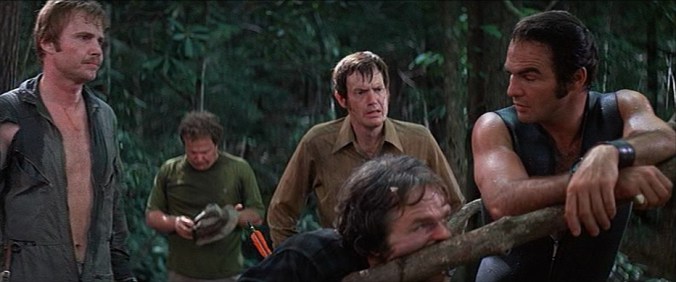
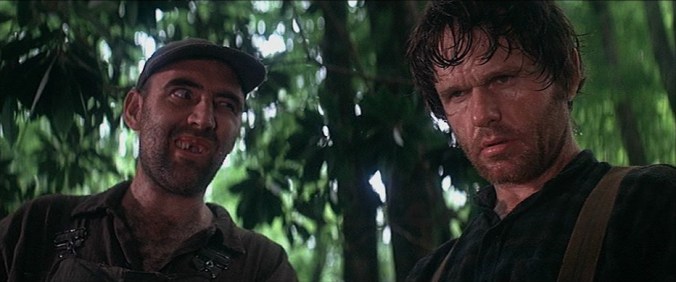
Deliverance concerns itself with a weekend canoeing trip that goes completely and horrifically wrong. Lewis (Reynolds), Ed (Voight), Bobby (Beatty), and Drew (Cox) have made the trip from Atlanta into the Georgia backwoods to canoe the Cahulawassee River before it is dammed and the entire river valley is turned into a lake. The film begins with the group finding some locals to drive their cars down river so that they can pick them up after their canoe trip. While trying to secure drivers, the group displays consistently condescending attitudes towards the hill folk that they encounter, although Drew attempts to engage with a young boy, the two performing a call and response version of “Dueling Banjos” in one of the film’s more famous scenes. Having secured drivers, the crew split up into pairs and launch their canoes into the river. After some time, they are separated, with Bobby and Ed’s canoe running aground. A pair of hunters comes upon the men and forces them into the woods at gunpoint where they tie Ed to a tree and one of the hunters humiliates and rapes Bobby, forcing him to “squeal like a piggy.” Lewis comes to their rescue, shooting one of the hunters with an arrow, while the other escapes. After some debate on what to do with the body, Lewis convinces the group that they have to hide the body, hoping that when the river is damned all evidence of their crime will be at the bottom of the lake. With the murdered hunter buried, the group continues down the river, but when Drew is shot and suddenly falls into the river, it is apparent that they are being stalked by the second hunter. The three remaining friends are caught up in some rapids, and they lose sight of Drew’s body in the chaos. With one of their canoes shattered, Lewis suffering a broken leg, and a vengeful hunter stalking them, the group is left hoping that they’ll simply survive the experience. While they do manage to make it out of the river alive, the traumatic weekend trip leaves them all scarred.
deliverance 5

The four principles do a great job of carrying the movie. Though Reynolds and Voight receive top billing, Beatty and Cox are memorable in their screen debuts, and the film really is driven by the dynamic of this central ensemble. The characters’ individual personalities all get moments to shine throughout the film. Cox gets the least amount of screentime, but the careful, worrisome Drew is an important foil for Reynolds’s cavalier Lewis. Though he’s overruled, Drew’s logical insistence that they take the murdered hunter’s body to the authorities is an important plea for civility and trust in the rule of law over a descent into savagery. Lewis, on the other hand, is the most accomplished outdoorsman of the group, and he represents a sort of adopted primitivism, a desire to master the natural world rather than exist in balance with it. The character benefits from Reynolds’s star persona at the time, with Lewis gaining a perceived ruggedness from the actor’s “man’s man” reputation. Beatty’s Bobby is the weakest member of the group, and he’s often emasculated, not just by the locals that they encounter, but by his friends in the group as well. He’s a typically effete city dweller, cowed by both the savagery of the river and the natural world, as well as the people who inhabit it. Bobby is offered up as a sacrificial lamb, given to appease the wrath of nature at the intrusion of these outsiders, particularly in the context of his being the victim of a rape. Finally, Voight’s character, Ed, is intended to be the point of audience identification. Ed has more everyman qualities than any of his friends, and by the film’s conclusion he has risen into the role of the “hero,” although he’s shown to be less inherently heroic than simply acting on survival instinct. Voight’s performance is probably the most dynamic of the film, as well. Though the film calls for all of the cast to provide memorable, emotive performances, Voight’s range is the widest, with Ed having to take on several different roles in the group throughout the course of the film.

deliverance 1

Across the board, the performances feel genuine, which is probably the result of the film’s shoestring budget. Deliverance was shot on a budget of $2 million, which necessitated the cast performing most of their own stunts, as well as the shoot proceeding without any insurance. The fear seen on the actors’ faces is real, as they were actually canoeing through swift rapids, or performing other dangerous stunts. This authenticity translates to the screen and heightens the terror of the film. As someone who is afraid of heights, I’m always on the edge of my seat during the scene when Ed scales a sheer cliff face under cover of darkness to get the jump on the hunter who has been stalking their group. With the knowledge that Voight actually made the climb, watching the scene is panic-inducing. The film’s tight budget also necessitated some directorial choices that increase its horror quotient for me. Though one of its most enduring scenes involves the song “Dueling Banjos,” there is little other music in the film. I don’t know for sure if this choice was made due to budget concerns, but there is no credit for an official film score, and the little music that there is in Deliverance is eerily sparse. Long periods of the film proceed with just natural sound effects, with non-diegetic musical cues popping up on the soundtrack only occasionally. The effect is an all-encompassing sense of dread. The river is the film’s most consistently running soundtrack, and its persistence becomes ominous and monstrous by film’s end.

Though the film’s horror stems directly from the dichotomy of city culture vs. country culture, a struggle that is most graphically played out in the rape scene, the underlying and related dichotomy of civilization vs. the natural world is very much in play throughout the film. The real monster in the film is the raging (and fictional) Cahulawassee River, which brutally and unforgivingly tosses the canoe party, representatives of modern civilization, around like rag dolls. The occasion of the canoe trip is the impending damming of the river, a very literal example of man exerting his will on the natural world. For Lewis, the damming of the river represents the loss of a river that he has enjoyed rafting upon in the past, but for the locals who the group encounters, the damming of the river represents the impending loss of their livelihoods, properties, and ways of life. This fact is touched upon in passing throughout the film, but, to me, it is one of the most interesting aspects of the film. Deliverance doesn’t see or present any of the country folk in the film as sympathetic or even relatable characters, instead using stereotypes of the unthinking, unfeeling bumpkin to paint them as the film’s human villains. Obviously the actions represented in the film are heinous, but they are also symptomatic of individuals lashing out at intruders in the face of the eradication of their homeland and culture. Lewis, Ed, Bobby, and Drew are the embodiment of encroaching “civilization,” engaging in cultural tourism while openly mocking the denizens of the culture and place that they’ve traveled to enjoy one last time. The two hunters who rape Ed are reprehensible, but the rest of the locals in the film are shown to be in pitiable circumstances and they receive nothing but mocking cruelty from the protagonists. Early in the film, we see children who are obviously malnourished, living in squalor, but the film does little to prod its audience to empathize with these characters. Sometimes it goes so far as to textually mock them, with the mute banjo playing boy’s obvious mental impairment implying that perhaps he is the product of inbreeding. I’m not suggesting that the film’s hill folk should be seen as the heroes or even the central characters of the film, but their obvious disenfranchisement is something that Deliverance isn’t interested in exploring beyond a cursory glance, which is a shame to me.
deliverance 4

Like many of the films that I’ve been writing about for this project, Deliverance isn’t a movie that I watch often at all, nor is it one that I am likely to watch again any time soon. When I mentioned to a coworker that I had watched Deliverance that morning before coming into work, his response was, “Why?” which, honestly, is probably the right response to someone telling you that they started their day by watching this film. It’s a very good movie, but it’s not one that is particularly pleasant to watch, or one that really lends itself to repeat viewings. I can’t say that I didn’t enjoy watching it again after a decade or so, but it doesn’t feel necessary. It’s an intense viewing experience every time, and the film is often very beautiful, highlighting the natural beauty of Georgia, but Deliverance also established and cemented several negative stereotypes about Appalachian people and Southerners that I don’t enjoy seeing. Maybe I’m sensitive to this depiction because I grew up in West Virginia, a place that is typically misunderstood, neglected, and forgotten, until it’s needed to be the butt of an incest or personal hygiene joke. Deliverance is a fine movie, but I cringe when I hear “Dueling Banjos” played in any other media, because I know that it will soon be followed by a crude joke featuring some toothless yokel meant to represent an entire culture. Part of working through this project and going back to so many movies that I haven’t seen in a long time has reminded me to take films where they are, try to appreciate them for what they offer, and not seeking to too much impose my own worldview into my critical evaluation of a film. Of course, that’s often an impossibility and I don’t shy away from letting my ideologies or opinions guide my writing; this is my blog after all, and I’m largely writing it to please myself. However, I strive to be objective and find something to enjoy or take interest in with every film that I write about. So, in that spirit, I’m taking Deliverance for what it is, a fine thriller with some very good performances, but not one that I’ll be inclined to watch ever again.

Bruce Campbell vs. Army of Darkness

Bruce Campbell vs. Army of Darkness (1992)

Dir. Sam Raimi

Written by: Sam Raimi, Ivan Raimi

Starring: Bruce Campbell, Embeth Davidtz


As will become apparent later in this project when I review the first half of the Friday the 13th series, a few Nightmare on Elm Street films, and, eventually, Texas Chainsaw Massacre, I had a soft spot for horror movies growing up, particularly slashers and gore-fests. This obsession with the macabre goes back to my early childhood and my introduction to the classic Universal monster movies of the 1930s and 40s. I came to love Dracula and the Invisible Man, but particularly Frankenstein’s monster, and I would search the weekly television listings for classic monster movies and record them off of cable late at night. When I was a little older, I’d sneak glances at the Friday the 13th movie marathon that ran every, well, Friday the 13th on the USA Network, and my tastes in scares began to mature and get a little darker, a little gorier. It wasn’t until probably my early teens, maybe 13 or 14 years old, that I first encountered the uniquely weird horror offered up by Sam Raimi. I saw Army of Darkness on television and it was immediately intriguing to me. It satisfied the gore and gross-out component, although it wasn’t really a true horror movie, and it added a strong comedy component that I wasn’t expecting. I liked the movie a lot but I didn’t really come back to it until my later teens. During high school my friends and I would start seeking out more and more hardcore and taboo horror films, often turning to Asian cinema and the emerging torture porn genre to provide these cheap thrills. The first two Evil Dead movies, providing some legitimate scares along with their moments of campy comedy, were acceptable to my friends’ deviant tastes, but the lighter, goofier Army of Darkness was more of a stretch to some of them. Eventually, sometime in high school, I picked up the director’s cut (officially titled Bruce Campbell vs. Army of Darkness, the film’s original title), and would occasionally share it with friends, particularly around Halloween. By my early twenties, this movie, along with most of the horror movies in my collection, had gotten largely shelved. My tastes were changing rapidly and I didn’t see much value in the schlockier elements of my collection at the time. I still don’t go for horror movies too often, but I’ve enjoyed the later films from Raimi and I was happy to go back to one of his classics for this project.

Army of Darkness 4

The film picks up immediately after the events of Evil Dead II with Ash (Campbell) being transported to the year 1300 AD. After arriving in the middle ages, Ash finds himself in the midst of a conflict between Lord Arthur (Marcus Gilbert) and Duke Henry the Red (Richard Grove). He is captured by Arthur’s knights who believe him to be a spy of Henry the Red, but Arthur’s Wise Man (Ian Abercrombie), believes Ash to be a hero promised in a prophecy. After being taken prisoner, Ash is taken to Arthur’s castle where he is thrown into a pit to be executed. Ash is able to escape the pit, killing a Deadite with the help of the Wise Man who returns his chainsaw to him. When he climbs his way to the top, he regains his “boomstick,” which he uses to quickly dispatch of another Deadite that attempts to escape the pit behind him. Ash is celebrated as a hero and he garners the affections of Sheila (Davidtz), a beautiful maiden. The Wise Man agrees to help Ash return to his own time, and tells him he must seek out the Necronomicon in order to do it. Ash’s quest for the Necronomicon leads him to battle demons and Deadites, but he finally persists and makes his way to the graveyard where the evil book is stored. However, Ash has never been one for attention to detail, so he has forgotten the magic words that will allow him to open the Necronomicon, and when he attempts to open the book without reciting the words properly, Ash unleashes an army of the dead on the land. Now in order to return to his home, he must defeat the Army of Darkness to save the castle and Sheila, who has been captured by the Deadites.

If that doesn’t exactly sound like the description of a horror movie, that’s because Army of Darkness really isn’t one. Although it does contain a few unsettling or scary moments, for the most part it’s a fantasy movie that leans heavily on slapstick comedy set pieces. The first two installments of the Evil Dead trilogy have their tongues firmly inserted into their cheeks, but they still fall distinctly into the horror genre. For the third installment, Raimi wanted to go in a different direction by getting Ash out of the cabin in the woods and into the larger world. He incorporates the influence of classic fish out of water tales like A Connecticut Yankee in King Arthur’s Court and Gulliver’s Travels, and the end result is a film that is distinctly different from its predecessors while retaining the same attitude and tone. Though he’s traded in the familiar setting of the first two films, plenty of Raimi’s filmmaking tricks are still on display in Army of Darkness. He returns often to the low tracking shots and queasily fast zooms that defined the Evil Dead films, implying the presence of spirits chasing Ash through the woods. He also retains his fondness for jump scares, and the few that show up in Army of Darkness might be the only moments in the film that could induce real terror in the audience. But, of course, Raimi’s most familiar tool is the star persona of Bruce Campbell in his signature role as Ash.

Army of Darkness 2

A close friend of Raimi’s, Campbell helped him finance and create the original Evil Dead and has gone on to use his appearances as Ash to launch a career for himself as one of the most recognizable character actors currently working. As the film’s original title would suggest, in Bruce Campbell vs. Army of Darkness, as in the other Evil Dead films, Campbell is asked to essentially carry the load from an acting standpoint. He is the most heavily featured actor in the series by far, and in many of his scenes he is paired with shrieking, nearly nonverbal demons. Luckily, Campbell very easily has the chops to entertain on his own for the film’s 90-minute run time. Campbell plays Ash as a spoof of the hyper-macho action stars of the time, and he delivers his punches as readily as his punchlines, never at a loss for words as the film spawned many catchphrases among horror fans. He is the engine for both action and comedy in the film, as Campbell possesses both the bravado of a traditional leading man, and the rubber-faced, physically performative gifts of an expert slapstick comedian. Raimi knows how to perfectly capture Campbell’s expressive face to render emotions ranging from confidence, to fear, to hysteria and he uses this malleable mug to great effect throughout the film. It’s impossible to imagine the Evil Dead series without Campbell as Ash; another actor just wouldn’t feel right in the role.

Raimi is able to do a lot with a little as a filmmaker, and that economy is on display again in Army of Darkness. Though the film was made well into the beginning of the CGI boom, he chose to use practical effects throughout the movie, employing miniatures and stop-motion animation to create the army of the dead. Though the effects do look a bit dated, they don’t necessarily look bad. In fact, there is a sort of nostalgic charm to the skeletons, as they recall the groundbreaking stop-motion work of Ray Harryhausen. Raimi uses sharp, quick edits to propel the action in the film’s climactic battle between Ash, Arthur’s army, and the army of the dead, led by a reincarnated Evil Ash. These edits allow Raimi to mask the fact that he is employing a very small cast, and maintain the level of action at a fever pitch. Army of Darkness definitely feels like a throwback to a time when film genres weren’t as rigidly codified and swashbuckling heroes could coexist with supernatural demons and beautiful damsels in distress. This is decidedly a B-movie, but it’s a rather well-made one, and an entertaining one to boot. Campbell’s charisma carries over to the entire production, with even some of the animated skeletons delivering throwaway lines that are laugh-out-loud funny.

Army of Darkness 3

Army of Darkness is a very fun movie experience, and it’s one that I would probably go back to more often if it weren’t for the terrible quality of the video transfer on the DVD copy that I own. I don’t know if the image quality has degraded over the years, but it’s really difficult for me to imagine myself watching this disc as a teen. There are times when the image becomes so grainy and dark that it’s almost impossible to see what’s going on on the screen at all. This is particularly the case during the film’s final battle, which was entirely shot at night. I’ve watched Army of Darkness on streaming services and it doesn’t seem to suffer from this lack of clarity, so I’m assuming that it’s just a bad transfer on this particular Director’s Cut edition of the DVD. It’s really a shame, because I think the Director’s Cut, with the film’s alternate ending (which is something of an homage to Planet of the Apes) is the superior version of the film, but I just can’t see myself sitting down to watch this particular DVD again anytime soon. I will, however, likely be revisiting this cult classic, along with its predecessors, sometime around Halloween this year, just on a streaming platform. Although my taste for straight horror movies has somewhat diminished, I’ll always enjoy the humorous horror that Raimi offers up here and in his later films, which are equally as good at blending the genres of horror and comedy. I probably enjoy the Evil Dead films a bit more than Army of Darkness, but it’s great in its own right for taking the series in a totally new direction while still maintaining that distinctive early Raimi feeling.

Alien

Alien (1979)

Dir. Ridley Scott

Written by: Dan O’Bannon

Starring: Sigourney Weaver, John Hurt, Ian Holm

Imagine being in one of the first audiences to experience Alien when it was released in 1979. The film’s opening credit sequence cues that this is going to be a different sort of space adventure. The only sound on the soundtrack at the opening of the film are low strings, mimicking wind howling in the vacuum of space, as the letters of the film’s title slowly begin to reveal themselves. The word “alien” not only refers to the monster that will soon be unleashed on the crew of the Nostromo, but also to the fact that this film must have been fairly alien to the sensibilities of a viewer in 1979. It isn’t that Alien is without filmic precedent. Some of its DNA can be traced back to 1951’s The Thing From Another World, and it also borrows heavily from the newly established slasher genre, particularly sharing a tonal similarity to John Carpenter’s Halloween, released just six months prior to Alien. It’s the way that Ridley Scott combines these disparate influences to create one of the first true sci-fi/horror hybrids that makes Alien such a unique experience, and a seminal classic in both genres.

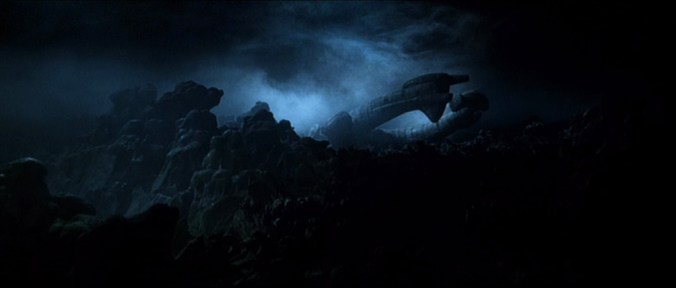
From the start, Alien takes its time, lulling the audience into a false sense of security as it spends the first half hour of its runtime detailing the fairly mundane activities of the crew of the Nostromo who have been awakened early from their hyper sleep to investigate a signal of unknown origin. Instead of forcing the pace early in the film, Scott lets the film’s set design build up a sense of foreboding in the audience, particularly after the Nostromo touches down on the alien planet and the crew begins to explore the ancient alien ship. The sheer size of the ship and its strange biomechanical construction, where the walls seem to ooze and breathe, seemingly aware of the presence of the exploring crew members, is inherently unsettling. The film’s opening half is a master work in building and releasing tension, using tone and pace to create nearly unbearable suspense that is paid off with some famously gory scenes later in the film.

alien2

One of these gory scenes, featuring the film’s famous chest-bursting alien, is the only thing I can remember from my first time ever watching Alien. I went to a friend’s birthday party in elementary school and we were going to watch monster movies all night, so his parents had rented us an assortment of classics, including Alien. I don’t actually remember watching the rest of the film, but the scene where the alien bursts out of Kane’s (John Hurt) chest was forever etched into my mind after that night. I had already seen Mel Brooks’s Spaceballs, so I knew what was coming from the parody, but I still wasn’t prepared for the visceral intensity of the scene. By today’s standards, the scene is actually fairly tame, but my ten-year-old mind was not ready for something so shocking and violent, and I imagine that I don’t remember anything else about the rest of the movie because I actually checked out shortly after seeing Kane’s ribcage explode as the infant xenomorph is born.

Since that initial introduction to the world of Alien, I have seen the original many, many times and have also seen all of its sequels and related spin offs. Up until this rewatch, I likely would have said that my favorite of the series is Aliens, the James Cameron directed sequel that expands on the original film’s mythology, introducing new characters and cementing Ripley’s (Sigourney Weaver) role as the franchise’s central hero, and as one of the most important heroines in all of film history. The sequel jettisons the original’s horror elements in favor of a faster paced, more dialogue heavy, run and gun action film. It opens up the mythology, firmly cementing the Weyland-Yutani Corporation as the real evil of the series, as it remains insistent on bringing a xenomorph to Earth for study and potential weaponization, despite Ripley’s vehement protests. Simply put, Aliens is bigger, more bombastic, and, often, more fun than its predecessor. However, after watching both films in the same afternoon for the first time in years as I prepared to write this post, I have to come down in favor of the original. Aliens is a great film, and unquestionably one of the best sequels of all time. I wouldn’t question anyone who told me that they preferred it to Alien, as I once did, but for right now, I just find the original film to be more fully realized and interesting on the whole.

I think the biggest reason for my new preference for Alien over Aliens is the former film’s deliberateness, in its construction and its pacing. The slower pace and extended introduction of Alien allows for more discovery, whether in the film’s early tracking shots that explore the Nostromo before her crew awakens in their pods, or the aforementioned highlighting of the set design on the alien planet and in the alien ship. Alien is a film that wants its construction to be noticeable and appreciated, and through highlighting that construction Scott and Giger’s effects team create a fully realized world, which raises the stakes on the terror that is unleashed in the second half of the film. The slower pace of Alien also allows the audience to get to know the characters a little better than the characters of Aliens. I care a lot more about the intergalactic truckers who crew the Nostromo than I do about the space marines who populate the sequel.

alien4

One thing that I really enjoy about both of these films, though, is their class sensibility. In both films, the heroes are simply working class people who are doing a job, particularly so in Alien. My favorite character in Alien is Parker (Yaphet Kotto) because he voices the crew’s class concerns. He has one of the first lines in the film, and he uses it to express his dislike for the inequity in the bonus structure for the crew. He and Brett (Harry Dean Stanton), the ship’s mechanics, have to split a share while the rest of the crew each gets full shares. Parker is also the one who reminds the rest of the crew that the Nostromo is not a search and rescue ship when their mission directives are changed to investigate the mysterious distress signal. Parker just wants to do his job, get back to Earth, and get paid. This class consciousness extends to the presence of Weyland-Yutani Corporation as the series’ overarching villain. The corporation’s desire to obtain a xenomorph for study trumps all other concerns, including the safety of the films’ protagonists who are often corporation employees, throughout the series. This positioning of corporate interests or meddling corporate scientists as evil is not uncommon in the sci-fi genre, but it makes for a nice subplot in the Alien films.

Whatever genre you decide to classify it in, whether sci-fi or horror, Alien is undoubtedly near the top of the pile. It launched an iconic franchise of films with variable results. Its influence extends beyond these direct sequels to dozens of sci-fi and horror films that have come since, but none have been able to top the original for innovation and sheer terror. Alien is a timeless classic for that reason. When talking about the history of films, you can’t ignore the xenomorph in the room.