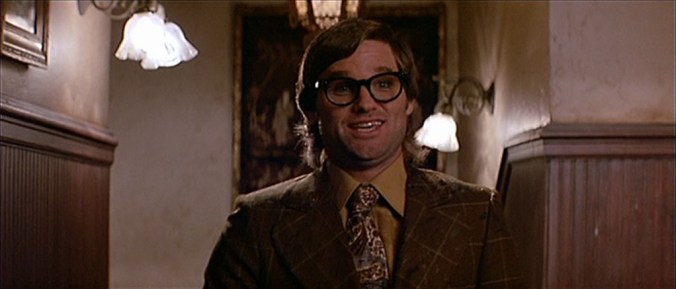
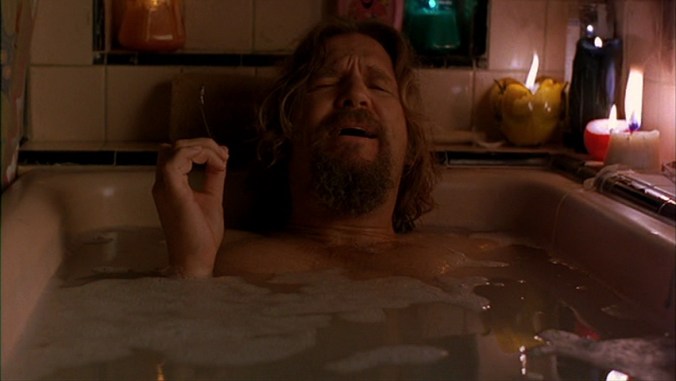
Brick

Brick (2005)

Dir. Rian Johnson

Written by: Rian Johnson

Starring: Joseph Gordon-Levitt


Around the time that Brick was released, I really wasn’t watching a whole lot of contemporary movies. In 2006, I was just starting to settle into my life in Pittsburgh, having moved here permanently that fall. I was gearing up for my final few semesters of college, and most of my movie watching was done for classes. At that time, I was watching mostly classics and genre films in school, but I still kept my Netflix account for newer movies. Although I wasn’t using it nearly as frequently as I had been in the first couple of years of college, I still made the time squeeze in movies for pleasure, watching them late at night on a laptop, often with a buzz on. This is how I first experienced Brick: receiving a disc in a little red envelope, watching it somewhat distractedly, and sending it back quickly. It didn’t make a huge impression on me that first time, but I did appreciate its transition of a classic noir narrative to the seemingly more benign setting of a high school. I thought it was a good movie, but I didn’t quite agree with the universal fawning over the film that I had read on most of the film and pop culture websites I was following at the time. However, it stuck around in the back of my head long enough that I eventually picked up a used copy of it at the Exchange a few years later. I’m glad I did because Brick is the sort of movie that rewards close watching and gets better with repeated viewings.

brick 1

Brick’s convoluted plot is a classic noir detective story, inspired by the work of Dashiell Hammett, and featuring the classic tropes of the gumshoe, the damsel in distress, the femme fatale, and the shadowy underworld figures. Johnson chooses to resituate these familiar elements in a new setting, however, placing his mystery in the sunny setting of a southern California high school. Brendan (Gordon-Levitt) is investigating the disappearance of his former girlfriend, Emily (Emilie de Ravin), who he fears has gotten mixed up in some trouble involving a local drug ring. Brendan is a loner, modeled on the classic noir detective, but he is assisted in his investigation by his friend, the Brain (Matt O’Leary), who helps Brendan track down loose threads and connect the dots in the search for Emily. Brendan is able to arrange a meeting with Emily where she tells him that he has to let her go, and to stop trying to save her, but of course he can’t. Brendan steals a note of Emily’s which leads him to a drainage ditch near the high school where he finds her dead body, and he takes it upon himself to find her murderer. Along the way, he meets Laura (Nora Zehetner), a high school socialite who was friends with Emily and who takes in interest in Brendan, though she may be playing both sides. Laura is also friendly with The Pin (Lukas Haas), a local heroin dealer who Brendan believes may have been involved in Emily’s murder. Brendan is able to infiltrate the Pin’s gang and after doing so he’s able to unravel the mystery of Emily’s murder, but the film forms a tightly wound knot that he must unwind to do so. Brick ends like so many classic noir films, with its detective standing alone, having tracked down the answers he wanted, only to be confronted with whole new questions and problems.

One of the most memorable and immediately conspicuous elements of Brick is its script. The film’s dialogue is anachronistically hard boiled, with its teenaged protagonists spouting rapid-fire line after line of tough talk. At first, the wordiness and odd phrasing of the dialogue can be a little tough to adjust to, but it quickly develops into beautiful, florid prose. Johnson wrote the script (originally conceived of as a novella) as a tribute to the work of Hammett, and he captures that authorial voice perfectly. Inserting period dialogue into a modern setting could have come off as a gimmick or a crutch, but the performances of the young cast sell it as authentic. In fact, the dialogue helps to define and create a unique sense of place in the film, creating a sort of fantasy world that these characters are inhabiting. Although it is very clearly set in the real world and its tone and subject matter are dark, Brick also has the feeling of a teenage fantasy, where the adults have vacated and left the children to their own devices. The dialogue enhances this sense of fantasy, giving the impression that Brendan is playing detective, mimicking his favorite films and pulp novels.
brick 2

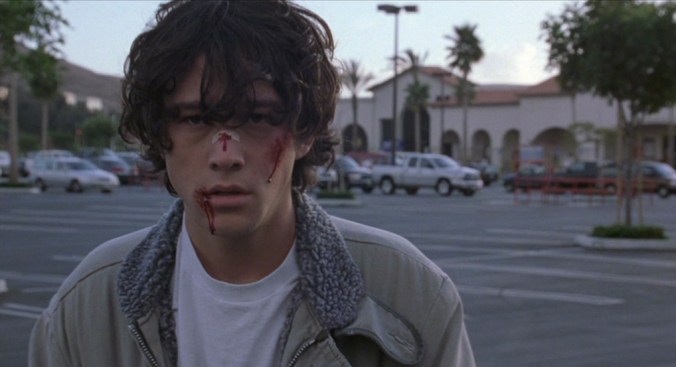
The other thing that helps make Johnson’s unusual dialogue choices work is Gordon-Levitt’s strong performance as Brendan. He appears in every scene of the movie, and he carries the movie admirably in a breakthrough performance. Aside from just embracing the period dialogue, Gordon-Levitt embodies the noir detective in other ways. He does a good job of portraying Brendan’s mental processes in a physical, observable way. The viewer can see the wheels turning in his head as he and the Brain meet up behind the school to discuss the details of their case. Although Brick uses a flashback structure, the audience is asked to unravel much of the mystery at the same time as Brendan, and watching Gordon-Levitt portray that discovery is part of the film’s appeal. Gordon-Levitt plays Brendan as doggedly persistent, hell-bent in his pursuit of the truth about Emily’s murder. His performance is equal parts verbal, playing the role of both the conman and the wise guy, and physical, though he isn’t necessarily a man of action. His physicality comes more in his ability to portray a kid who can take a beating. As the movie goes on, Gordon-Levitt often adopts a hobbled gait as Brendan’s frequent encounters with school bullies and lowlifes leaves him on the wrong end of a lot of punishment. Johnson often chooses to focus on his feet as he creates a sort of shambolic ballet, seemingly out of control but all the while possessing a dancer’s grace.

Focusing on characters’ feet is just one of the bold stylistic choices that Johnson makes throughout the film. If the film’s script is totally indebted to hardboiled fiction, its visual aesthetic is something far afield from the typical noir aesthetic. For the most part, Johnson trades in the chiaroscuro and cramped interiors of the classic noir for sunny, wide open exteriors. He frequently chooses to frame his subjects in cutaways, focusing on shoes or eyes, but he returns often to long master shots that dwarf the characters against their environment, be it a parking lot, a drainage ditch, or the startlingly empty high school. If the typical noir used its visual aesthetic to present a world closing in on its protagonists, Brick presents us with a world that is wide open, but rather than representing a freeing experience for the film’s characters, that wide open space seems like a challenge too daunting to overcome. Overall, the film has a kinetic visual style, often employing smash cuts and quick zooms and pans to imply violence or narrative action. The decision to tie narrative point-of-view so directly to Brendan also helps to drive tension, as the audience is left in the dark and has to take the ride along with him. There are several zigs and zags along the way to the discovery of Emily’s killer, and many of the film’s revelations are truly shocking, including its pseudo-twist ending.
brick 6

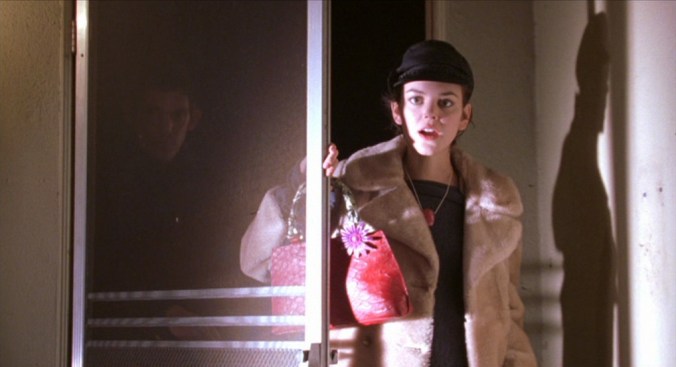
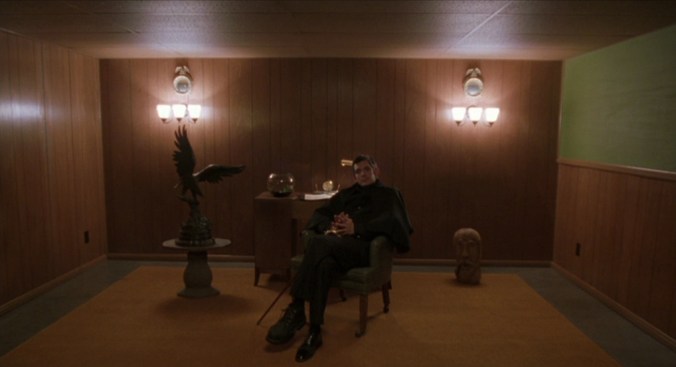
If I had any complaint with Brick, it would probably be that, aside from Gordon-Levitt, the rest of the cast isn’t given enough to work with. Obviously, the film is highly tied to Brendan’s point-of-view and his experience of the world, but that is at the detriment of fleshing out the supporting cast. Haas does give a somewhat interesting performance as the Pin, playing the character with a quiet intensity. However, costuming decisions with the character (he wears a cape and has one leg that is significantly shorter than the other) may be more subtly interesting than anything Haas does with the performance. Emilie de Ravin just isn’t in the film very much. She has an early scene with Brendan where she tries to convince him to forget about her, but otherwise she mostly appears in dream sequences as a silent, reanimated corpse. She was doing good work on LOST as a damsel in distress type of character around the same time that Brick was made, but she simply doesn’t get the opportunities in the film to fully flesh out the role. Nora Zehetner’s Laura should be the most interesting supporting character, as she is ostensibly the film’s femme fatale, and her motives are possibly duplicitous from the start, but she is often reduced to pretty screen filler. She helps Brendan with his investigation and hints that she may be doing so because she’s always had her eye on him, but she rarely rises above the trope of the popular girl who wants to manipulate the class oddball. Ultimately, that’s the biggest weakness of the film. Johnson has created a complicated, nuanced character in Brendan, and that character is brought to life by Gordon-Levitt, but the rest of the cast rarely rise above the standard teen movie tropes of the popular girl, the burnout, the jock, etc. It’s a shame because the film offers up a wholly original take on both the teen movie and the noir, only to be largely peopled with cardboard cutouts.
brick 3

Overall, though, Brick is a winner. It’s a movie about teens that doesn’t dumb itself down to its audience, instead offering a glimpse into high school life that is artful and fantastical. If you remove the murder from the film, it becomes about a young man trying to come to terms with his girlfriend dumping him and his inability to move on. That’s a relatable subtext for any young person, and it serves as the film’s emotional heart. The bones around that heart are the complex murder mystery that Johnson weaves, and then dresses in the trappings of the film noir. There are a lot of constituent components to Brick, but they ultimately combine to form a film that embraces and elevates its influences. It’s full of subtle allusions to classic films, but it is never derivative thanks to Johnson’s kinetic visual style. The director’s continued stylistic evolution, genre experiments, and knack for storytelling and world building has now landed him a spot helming the next film in the Star Wars saga, but his debut is still probably my favorite film of his. Despite its small budget and relatively unknown cast, Brick had all the indications that its director and star would be on to bigger things very soon.

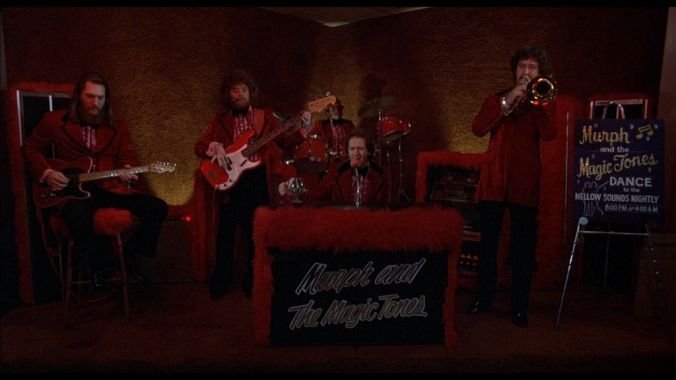
Boogie Nights

Boogie Nights (1997)

Dir. Paul Thomas Anderson

Written by: Paul Thomas Anderson

Starring: Mark Wahlberg, Burt Reynolds, Julianne Moore, John C. Reilly


It didn’t take long for Paul Thomas Anderson to gain recognition as one of America’s most promising young filmmakers. To date, he’s released seven features, and the opening of a new Paul Thomas Anderson film has become one of the biggest events in contemporary cinema. Later films such as There Will Be Blood and The Master have cemented his spot in the pantheon of great 21st century filmmakers, but I find a lot of pleasure in watching his first few features, as well. It’s interesting to watch a great talent struggle to find himself and develop a unique style and voice. Anderson’s 90s films are marked by his perfect mimicry of the style of some of his great influences, but there are also some early indicators of the distinctive visual and narrative style that he would begin to develop after the turn of the century. I’ll be writing about all of Anderson’s films in depth for this project, minus his most recent release, Inherent Vice, which I never picked up despite enjoying a lot. I think it’s fitting, though, to start off with Boogie Nights, even though it isn’t his debut feature, nor was it my first experience with the director. I think it’s fitting to start here, because Boogie Nights is the first, if not best, example of the director’s blend of artful homage and innovative storytelling that would eventually develop into his own directorial signature. I think that it is also Anderson’s most accessible and easy to enjoy film.

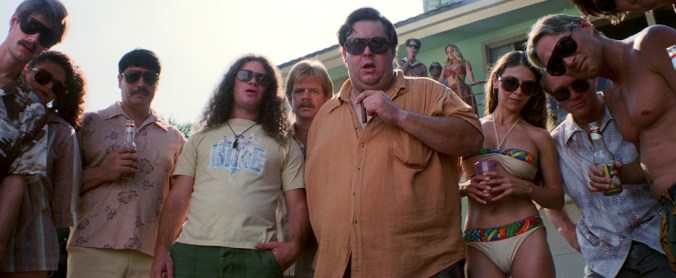
Boogie Nights charts the rise and fall of both Dirk Diggler (Wahlberg) and the adult film industry through the late 1970s and into the 80s. Loosely based on real-life porn actor John Holmes, Dirk is discovered by Jack Horner (Reynolds), an auteur of pornography, who aims to bring a touch of class and storytelling to the medium. Dirk is added to Horner’s stable of actors, but it doesn’t take long for him to separate himself from the pack and become one of the industry’s shining stars. Horner’s crew forms a sort of surrogate family, with Dirk in the middle as the golden child, around whom all the other performers are orbiting. The crew lets the good times roll throughout the 1970s, with the film reveling in its depictions of bacchanalia, giving the audience an inside look at the seedy, yet somehow still glamorous world of high-end pornography. However, as the calendar turns and as public tastes prove fickle, no one is prepared for the realities that begin to set in in the 1980s. Too much cocaine and too much hubris precipitate Dirk’s ejection from Horner’s troupe, and the rise of video sees the porn industry, in general, facing great changes. Fame is a roller coaster ride, and the dizzying heights must be matched by plummeting depths, and the film’s third act sees all parties finding rock bottom before they can hope to experience any redemption.

boogie nights 5

Growing up in a show biz household, surrounded by films, Anderson began experimenting with filmmaking at an early age. By his teens, he was shooting videos and editing them on a VCR, and, in fact, the inspiration for Boogie Nights comes from an early short from this period. When he was 18, Anderson shot a 30-minute mockumentary called The Dirk Diggler Story, which would go on to become Boogie Nights a decade later, with some of the scenes being recreated nearly verbatim, and the mockumentary itself being referenced in an abridged version as the film that Amber Waves (Moore) shoots about Dirk halfway through Boogie Nights. After a decade of development, the final cut of Boogie Nights bears little similarity to its earlier, truncated counterpart. Anderson’s directorial choices reveal a devotion to the New Wave of American Cinema, particularly to the style of Robert Altman and Martin Scorsese. Anderson leans on these pillars of American filmmaking throughout Boogie Nights, evoking their unique filming styles, as well as some of the thematic concerns on display in their filmographies, particularly Altman’s. Though the film wears its influences on its sleeve, to me it doesn’t feel plagiaristic as much as celebratory. Anderson announces his intentions immediately with the film’s opening shot, a three-minute tracking shot that follows Jack and Amber through Maurice’s (Luis Guzman) nightclub. The shot is showy and virtuosic, calling to mind the opening shot of The Player or, perhaps even more immediately due to the nightclub setting, Goodfellas. The camera winds through the club, tilting, spinning, and panning, pausing to light on the faces of the film’s main characters as they catch Jack’s watchful eye. It finally settles on Dirk, then known as Eddie, a busboy at the club who takes the bus in from Torrance just to be close to the action. More than just introducing the principal cast, this opening shot also introduces the world of the film as highly stylized and glamorous, but still slightly seedy. The costumes and sets feel authentic and they pop off the screen, matched by the stylish, attention grabbing camera work of Anderson and cinematographer Robert Elswit. The film is full of these types of long takes and carefully plotted out tracking shots, and though it may be somewhat derivative, Anderson has clearly set his artistic bar very high as a young filmmaker, and there are few other filmmakers who would be able to deliver this level of homage to acknowledged masters of the medium like Altman and Scorsese.

boogie nights 3

Of course there is much more to Boogie Nights than simply period authenticity and fan service to some great American filmmakers. The film marks the first major indication that Anderson is a great director of actors, and a great crafter of nuanced, lived-in characters. The performances in his debut, Hard Eight, are stellar top to bottom, but the scope of what he attempts and manages to pull off in Boogie Nights is on a completely different level. The film has over two dozen speaking roles, and the primary supporting cast around Wahlberg numbers around a dozen, and is made up of veteran character actors and up-and-coming stars. All of the film’s secondary and tertiary characters feel authentic and fleshed out, their side plots unraveling alongside and intertwined with the tale of Dirk’s rise and fall. Anderson’s Academy-Award-nominated screenplay gives these characters detailed backstories that are revealed subtly through overheard pieces of conversation or carefully observed actions, but much of the life is breathed into the characters through the cast’s overall great performances. The film’s supporting cast is deep and diverse, and they are all asked to shed light on different aspects of the tapestry that makes up the world of Boogie Nights through their performances.

Heather Graham delivers a star making turn as the memorable Rollergirl, one of Horner’s actresses. Her performance balances the bubbly, vivacious personality presented by her porn persona with the tragic reality of the girl who had to drop out of high school when her peers found out she was making pornographic films. She shares a scene with Julianne Moore, when she asks Moore’s Amber Waves to be her mother that cuts to the bone, and reveals the shattered little girl that Rollergirl obviously still is, despite her existence in this very adult world. John C. Reilly adds his goofily likable charm to the character of Reed Rothschild, Dirk’s friend and sidekick, while providing much of the film’s humor, along with Guzman. He’s a reassuringly normal oasis in this world of hurt, twisted people. Philip Baker Hall and Robert Ridgely appear as porn producers, and lend a suitable level of sleaze to the otherwise light, glamorous proceedings. Philip Seymour Hoffman turns in a powerful early performance as Scotty J., Horner’s in-house boom operator, who is closeted and in love with Dirk. Hoffman makes Scotty’s shame palpable in the awkward scene where he tries to kiss Dirk, only to be rebuffed, left alone with the car that he bought to impress Dirk. These types of performances would become the norm for Hoffman, and he would go on to bigger and better things, both with and without Anderson, but his sad performance as Scotty has always stood out as one of his best to me. Ditto for Don Cheadle’s performance as Buck Swope, Horner’s token black porn star. Buck spends most of the film caught between worlds, unable to rectify his own perception of himself with the world’s expectations of him as a man. Buck’s dream is to open up a stereo shop, aided by the fame he has garnered through his career in porn, but his ambitions are thwarted at every turn. There is a scene midway through the film where Buck is alone at a party wearing a Rick James-style dreadlock wig, and Cheadle’s still, quietly pained expression tells volumes about Buck’s experience of the world. The wig is patently absurd and humorous, but that humor is covering up a well of pain. All of the characters in Boogie Nights are either running from something or desperately trying to get to something.

boogie nights 1

No one in the film personifies this as much as Amber Waves. Moore plays Amber as a matronly figure to the entire production crew, but particularly to Dirk. It’s revealed early in the film that she has lost custody of and contact with her own son, so she uses Dirk as a surrogate. Throughout the film, Moore is asked to portray cocaine-induced mania alongside gut wrenching despair, sometimes even blending the two in the same scene, and she delivers with aplomb. Wahlberg might be the central axis on which the film swings, but Moore’s performance gives it both its heart and its backbone. Anderson offers more direct glimpses into Amber’s backstory than most of the other characters’, but even without the custody hearing scene, the steeliness of Moore’s performance as Amber would be enough to hint at the pain that she has been working for years to heal, or at least numb. Julianne Moore has long been one of my favorite actresses, and her performance in Boogie Nights earned her her first Academy Award nomination, for Best Supporting Actress. She has turned in many powerful performances since, but her work in this film still stand out to me as some of her best.

Though the film’s industry setting and expansive ensemble cast recall classic Altman and Anderson’s storytelling structure and shooting style are reminiscent of Scorsese, Boogie Nights has elements of a unique style beginning to bubble up at moments in the film. These impulses wouldn’t crystallize immediately, but there are glimpses here of the voice that would emerge in There Will Be Blood. The most impactful example of Anderson experimenting and developing is in one of the film’s most memorable scenes, in which Dirk, Reed, and Todd (Thomas Jane) attempt to rob Rahad (Alfred Molina), an unpredictable, violent cocaine dealer. The scene comes near the very end of the film, long after Dirk has descended into a spiral of addiction and desperation that has alienated him from Jack and the rest of the crew. He spends his time exclusively with Reed and Todd, who comes up with a scheme to help them score plenty of coke and the cash they need to support their habits. Anderson masterfully orchestrates the scene, combining masterful shot and framing choices, his actors’ performances, and a perfect soundtrack of 80s classics into a palpably tense, unforgettable moment. While the scene isn’t wholly original, its eccentricity and audacity set it apart from any of Scorsese’s memorable musical sequences. It’s a slow burn of a scene, with the trio of Dirk, Reed, and Todd becoming increasingly more agitated as they realize they’re in over their heads at the sight of Rahad’s bodyguard’s gun, the tension ratcheting higher and higher as Rahad gets increasingly more manic, and Night Rider’s “Sister Christian” builds to a crescendo in the background. There is a persistent weirdness to the scene, with a young Asian man in Rick Springfield T-shirt wordlessly lighting firecrackers and tossing them around the room. Everyone but Rahad flinches at each tiny explosion, while Rahad, dressed in a silk robe and briefs, rants and raves, smoking crack, showing off his gun, and pontificating on his mixtape skills, seemingly unfazed by the incessant pops. The tension in the scene builds to a head when Rahad’s mixing skills are shown to falter and “Sister Christian” cuts off mid-chorus, leaving Rahad stunned and angry. The silence is quickly broken by an exploding firecracker, and Rahad seems to snap out of his temporary, wordless rage, taking another hit off of his crack pipe as the opening riff of Rick Springfield’s “Jessie’s Girl” fills the soundtrack and side two of the mixtape starts up.

boogie nights 7

Other filmmakers might use this opportunity to cut straight to the action, but Anderson is content to let the tension continue to build, as he films Molina dancing and singing along to the song. He reverses the shot to a close-up of Dirk’s face, wearing a blank expression as the gravity of the situation washes over him and over the audience. He holds that static close-up for nearly a full minute, an unusually long and uncomfortable shot duration, with Wahlberg’s expression remaining largely unchanged. It’s a microcosm of the scene as a whole, a slow build that is allowed to play out at its own pace and celebrate its own weirdness. When the bullets finally do start flying, the counterpoint of the bright, familiar guitar riff of Springfield’s biggest hit ramp up in the background on the soundtrack, a pairing of music and image that is more ironic than anything Anderson could have borrowed from Scorsese’s catalog. This scene is one of the first times that I think Anderson really starts to emerge as a filmmaker who is in dialogue with his influences, appropriating bits of their style and reimagining them in new and original ways. There would still be refinements and additions that would lead to Anderson becoming one of America’s most original and artistically successful filmmakers, but the evidence is all there in this bold scene.

I don’t watch Boogie Nights all that often. In fact, I’ve probably seen it a half a dozen times or less in my life, despite being a big fan of it as a movie. This is likely due, at least in part, to the fact that in spite of what a good film it really is, Boogie Nights pales in comparison to the quality of Anderson’s later output. It’s probably also due to the fact that the film is so instantly memorable. Its characters and set pieces are big and bold, and its stylish camera work comes to mind easily. It may not quite rank up among Anderson’s very best work, but Boogie Nights is an accomplishment in any right, and may be Anderson’s most fun film. It’s a big film that is easy to get immersed in, and its world is genuinely enticing, with even the film’s darker third act containing moments of levity and humor. Initially, the film sees its director trying on the clothes of his greatest influences and finding that they are, in fact, a good fit for him, but by the end, it proves to be a crucial link in the chain of Anderson’s development as an auteur. It isn’t quite original enough to earn the masterpiece title that will be bestowed on some of his other films, but it is a perfectly fun and engaging film, enjoyable on several different levels, and a good indication of big things to come.

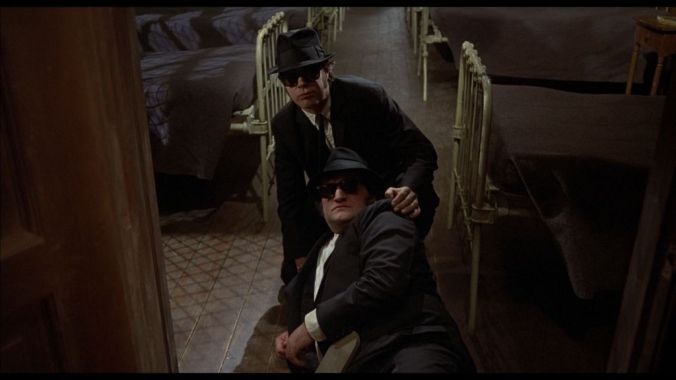
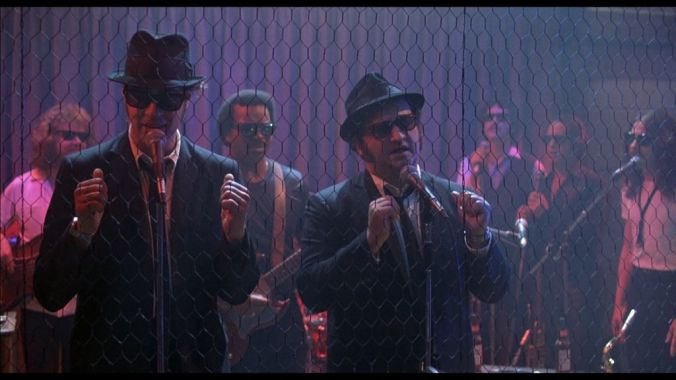
The Blues Brothers

The Blues Brothers (1980)

Dir. John Landis

Written by: John Landis and Dan Akroyd

Starring: John Belushi, Dan Aykroyd, Carrie Fisher, Cab Calloway


When I was very young, I often felt like I was out of step with my peers. My interests didn’t line up with theirs and I rarely participated in the fashions and trends that the other kids at my elementary school were obsessed with. My mother made most of my clothes and she cut my hair in a Lennon-esque shaggy bowl cut until I was about 10 or 11 years old. When other kids my age were getting into sports, I was reading tomes about the history of the Civil War and writing my own short stories on my family’s ancient word processor. This isn’t to say that I didn’t have plenty of commonalities with my classmates; I was as into Cool Runnings and The Mighty Ducks as any American kid was in 1993, and I was an avid video gamer, cherishing the Super Nintendo that my sister and I received as a Christmas gift in 1992, even though we originally played it on a black-and-white television. I did have friends, and good ones, at that, but even amongst friends, I felt that some of my interests were outside of the norm. While my friends started getting into contemporary pop culture, borrowing rap albums from older siblings or sneaking into the room to watch the ending of a scary movie, my tastes stayed decidedly retro. Until the time her turntable broke in 1993 or 1994, my main source of music came from my mother’s record collection. My sister and I had kids’ tapes that we’d listen to in the car, but we weren’t allowed to watch MTV until a little later, so our only source of “adult music” was from these three dozen or so records kept on a shelf, collected from the late 1960s into the 80s. We listened to Rubber Soul and Dylan’s Greatest Hits, but it was the copy of Briefcase Full of Blues, the debut album by The Blues Brothers that most intrigued me.

blues brothers 5

I don’t remember the exact first time I put that record on the turntable, and dropped the needle to hear the walking bassline of “I Can’t Turn You Loose” played by Donald Duck Dunne and the tight but raucous horn stabs from “Blue” Lou Marini and “Bones” Malone, but I do remember the impact that the record had on me. This was something far afield from the folk music I was most familiar with from her collection. This was party music. It was loud and celebratory, but it also had an edge that made it feel dangerous. There was something mysterious to me about the image of the Blues Brothers on the cover; their black hats and suits, and matching dark Ray Bans were the epitome of cool to nine-year-old me. I knew that the group was something of a novelty act, music being performed by comedians, but it didn’t matter. I knew Aykroyd well from having seen Ghostbusters roughly 100 times to that point, and I was aware that there was a movie called The Blues Brothers, but I was introduced to the group first through the music. To me, the Blues Brothers were a band, not characters from a sketch or a film, and they were the coolest people in the world. Seeing the movie around the time I was 12, long after the turntable was kaput and I was no longer able to hear the music, did nothing to diminish that image in my mind. On the contrary, it cemented their status as cool guy role models for a young kid who was still a couple years away from discovering punk rock.

The Blues Brothers expanded on the sense of raucous fun I got from listening to the record, and it gave the titular group a back story and an insane world in which to live. For the uninitiated, the plot is very simple. The film opens with “Joliet” Jake Blues (Belushi) being released from prison. His brother, Elwood (Aykroyd), picks him up in a decommissioned police cruiser that he bought after trading in the “Bluesmobile” for a microphone. Soon after, they visit the Catholic orphanage in which they were raised and find out that the orphanage owes $5,000 for a tax assessment or it will be closed. The Blues Brothers take it as their “mission from God” to raise the $5,000 and save the orphanage. They have to figure out a legitimate way to raise the money, so they decide to reassemble their backing band for a big performance that will help them raise the money. They meet some initial resistance, but they ultimately get everyone to agree to the gig, however, there are other roadblocks in their way as they are being pursued by Jake’s jilted ex-lover (Fisher), the Illinois Nazi party, a rival country band, and a cadre of law enforcement, up to and including the United States Army. The Blues Brothers is the rare musical comedy that succeeds in providing both great musical set pieces and genuinely funny scenes. It enlists a who’s who of Blues and R&B legends to join with The Blues Brothers for unforgettable musical cameos, as well as cameos by established and up-and-coming comedic actors. The Blues Brothers is a big, exciting blockbuster of a comedy and it ranks up as one of my favorites in the genre and potentially my very favorite musical.

blues brothers 1

Much of the movie’s comedic success comes from the natural chemistry between Aykroyd and Belushi, and their combined charisma as performers. After years of performing together on SNL and after having taken their Blues Brothers act on the road, the two had honed their onstage personae to a razor sharp point. Their characters are perfect foils for one another. Belushi’s Jake is the larger than life, bellicose frontman of the band, while Aykroyd’s Elwood is the more stoically reserved sidekick. Their interplay is perfect and they bounce off of one another with aplomb, each one filling in the gaps of the other’s personality. Elwood doesn’t have a tremendous amount of dialogue in the film, but Aykroyd’s line delivery never fails to crack me up. He has a clipped, Joe Friday delivery that implies a level of simplicity belied by the mechanical ingenuity that Elwood often shows throughout the film. Aykroyd embodies Elwood with a sense of natural cool. He doesn’t say much because he doesn’t have to; he lets his persona do the talking for him. However, as good as Aykroyd’s performance is, it can’t match the scene-stealing force that is John Belushi as “Joliet” Jake Blues.

The Blues Brothers is Belushi at his unhinged best, dancing, jiving, and shouting his way through the film with no shame. If he gained mega-stardom through his portrayal of the dumb brute Bluto in Animal House, he showed off his full range in The Blues Brothers, using his physicality in both predictable and surprising ways. Belushi is a force of nature in the film, staggering and swaggering, but also unexpectedly lithe and graceful, showing off a great deal of athleticism as he dances and cartwheels his way through the performance scenes. Unlike Bluto, Jake is the brains of the operation, and as such, Belushi is given a great deal more dialogue to work with. Jake is lecherous and scheming, but he’s also good-hearted and devoted to his brother and their surrogate father from the orphanage, Clarence (Calloway). Belushi’s passionate performance in The Blues Brothers makes me wonder what he would have gone on to do had he lived just a little bit longer and made a few more films. This film was his first big opportunity to showcase his range as a performer, and, sadly, he would be dead less than two years after its release.

blues brothers 2

While the stars of the film do a good bit of the heavy comedic lifting, their task is lessened by the hilarious odd ball world that Aykroyd and Landis’s script envisions for them to inhabit. The Blues Brothers is absolutely a celebration of the city of Chicago, but its version of Chicago is viewed through a fun house mirror. Like a handful of the other comedies that I’ve written about here, The Blues Brothers feels like it’s taking place in a world that is just adjacent to our own. This probably shouldn’t be surprising as more than most other genres, musicals require audiences to totally suspend their disbelief to accept a world in which the characters will break out in song in public at the drop of a hat, giving even the most “realistic” musicals a sense of artificiality. The world of The Blues Brothers is madcap and wacky, involving high speed car chases that employ impossible physics in their cinematic ballet of destruction, vengeful white supremacists and country groups, and a bazooka wielding ex. Jake and Elwood are repeatedly wrecked, blown up, and shot at in the film, and manage to take it all in stride and come out on the other side with nary a scratch. But beyond its larger scale weirdness, The Blues Brothers is simply packed with small, memorable moments that are patently absurd that form its distinctive comedic tone. From the brothers’ standard lunch order (four whole friend chickens and a Coke for Jake, dry white toast for Elwood), to the repeated impetus of their quest (“We’re on a mission from God”), Jake and Elwood have a magical, charmed quality about them that informs the whole film with a sense of lightheartedness. The weird, goofiness of the world of the movie underscores the absurdity of its stone-faced protagonists.

Fleshing out this strange world are a cast of characters comprised of some of the period’s best rising comedic stars. Carrie Fisher’s role as Jake’s unnamed jilted bride, who is hell bent on hunting he and Elwood down and killing them, leveling whole buildings in the process, is the only other role that I ever picture her in besides Princess Leia. She is a mysterious figure until near the film’s end, but her largely unexplained back story is hinted at by the glimpses that we get into her life. John Candy shows up as one of the detectives hunting down the Blues Brothers, and his ad-libbed “Orange whip” bit is one of my favorite lines from the whole film. Frank Oz has a brief cameo as the prison guard who returns Jake’s possessions to him when he is released from prison at the beginning of the film. But of course, the supporting roles that steal the show are the musicians who make cameos throughout the film. James Brown, Aretha Franklin, Ray Charles, and John Lee Hooker all make appearances, alongside other famous blues and R&B musicians of the 1950s and 60s. Aretha’s performance of “Think” in the soul food restaurant is my favorite in the film, but the scene featuring James Brown’s portrayal of Rev. Cleophus James never fails to illicit a smile with its over-the-top choreography. Ray Charles’s performance of “Shake a Tail Feather” along with the Blues Brothers Band is the film’s central showpiece. The film’s final performance is great, but it doesn’t match the energy of the band really getting into a great dance number, alongside one of the greatest pianists of all time, with hundreds of extras dancing in the Chicago streets.

blues brothers 3

Obviously, I have little but kind words for The Blues Brothers, but it does have a few technical shortcomings, some of which are glaring, such as “Blue” Lou’s saxophone solo during “Think.” The moment that Lou struts down the counter of the soul food restaurant during his solo should be his shining moment in the film, but unfortunately, he is framed from the neck down with his face not appearing in the shot. Landis isn’t the most visually innovative filmmaker, and I can forgive some of his more minor technical mistakes, simply because most of the film is shot very well. The car chase scenes are big and exciting, and, at the time, the film set a record for most automobiles destroyed during filming (a record that would later be broken by its sequel). Landis is able to balance these bigger scenes of spectacle with the smaller moments that provide the film its humor, and he successfully creates the rare musical comedy that nails both the performative, spectacular elements of the musical and the subtlety of perfect comedy. At the time of its filming, The Blues Brothers was one of the most expensive comedies ever filmed, and the pressure was on Landis and the film’s stars to deliver a hit. The film was a box office success, more than recouping its budget and actually grossing slightly higher box office in foreign markets than in the U.S., which was a rarity at the time. Although it wasn’t a smash hit, the film would go on to grow long legs in the emerging home video and cable television markets, earning itself new fans into perpetuity.

blues brothers 6

I’ve seen The Blues Brothers so many times over the years that I can anticipate the jokes before they arrive, and I watch it with a permanent smile across my face, ready to break into a full laugh when the punch line hits. I think Belushi’s death shortly after the film’s release paints it in a slightly different light, but even if he had gone on to lead a long life and enjoy a storied career, I think that Jake Blues would still be remembered as his iconic performance. I do wonder how younger audiences respond to The Blues Brothers, without a more direct connection to its inspirations and its featured performers. Of its principal cast, only Aykroyd is still alive, and Aretha Franklin is the only living featured performer left. The film’s iconic Chicago setting is somewhat unfamiliar after 35 years of urban development. However, I think that the things that made me connect to the film and the music early on in life are universal. There’s inherent humor and cool in the line, “It’s 106 miles to Chicago, we’ve got a full tank of gas, half a pack of cigarettes, it’s dark, and we’re wearing sunglasses. Hit it.” The joy and beauty expressed in the film’s musical scenes ring true to any audience, and tap into a primal desire to dance, sing, and enjoy life. I think I love The Blues Brothers so much because it’s a celebration of so many of the things that I have come to love about life: humor, music, goofy black suits, stupid dance moves. It might look a little bit retro now, but for me, The Blues Brothers has never gone out of style, just like a black suit.

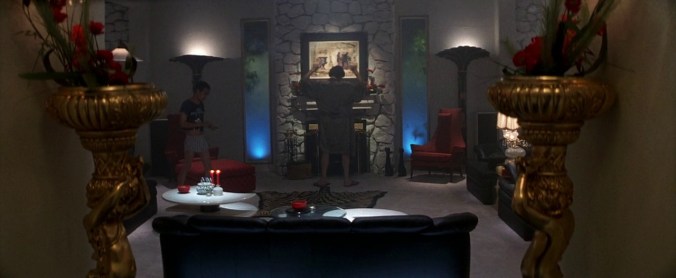
Blue Velvet

Blue Velvet (1986)

Dir. David Lynch

Written by: David Lynch

Starring: Kyle MacLachlan, Laura Dern, Isabella Rossellini, Dennis Hopper


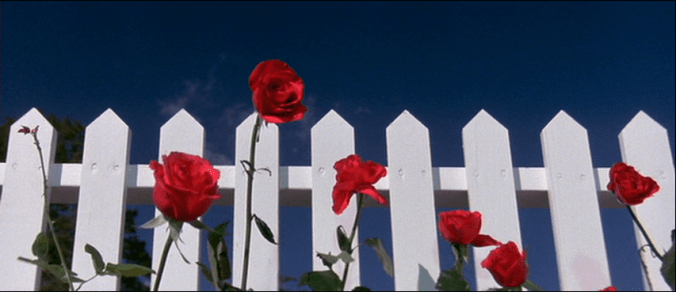
The camera descends from a cloudless, blue sky, settling on vibrant, red roses highlighted against a white picket fence. A shot of a firetruck slowly crossfades in, a firefighter riding alongside, casually waving at the camera. Children cross a street with the aid of a crossing guard. An unidentified man in a hat is watering his lawn, struggling with a kink in the hose. As an ominous hum fades in on the soundtrack, the man drops to his knees and then falls, grabbing his neck, the hose remains in his grip as he writhes painfully, spraying water into the air. A dog comes along barking and nipping at the water as it sprays from the hose wildly, and the film briefly shifts into slow motion, focusing on the snapping jaws of the little dog, giving his playful nips a sinister undertone. The camera cuts to the lawn and begins a slow zoom, turning the blades of grass into a topiary, under which a teeming nest of beetles writhes, crawling over one another. We are then greeted by a bright sign, featuring a beautiful woman waving and welcoming us to Lumberton. We are in suburbia, but something seems slightly off about this glimpse into the heart of Americana. No time is wasted in showing the audience the rotten core underlying the myth of small town tranquility. The opening sequence of Blue Velvet is seared onto my brain, representing something primal, seminal, and profound. It was my first brush with the perfect oddity of the cinema of David Lynch, who would go on to become my favorite filmmaker.

blue velvet 6

I’m really not sure how or why I decided to pick up Blue Velvet. As I mentioned, it was my first experience with David Lynch and I do remember purchasing the DVD without having seen the movie before. I must have seen something about it online, on a list of movies, or maybe I had heard about David Lynch in the commentary of some other movie I’d seen, although I don’t know what that would have been. Regardless, for some reason I picked up a copy of Blue Velvet at my local Circuit City, likely sometime in 2003. When I watched the movie for the first time, I really wasn’t sure what to make of a film like this. Though it doesn’t traffic in the same overt surrealism and narrative disjointedness that have become Lynchian calling cards, Blue Velvet is a perfect introductory film for those looking to get into David Lynch. Leaving The Straight Story aside, Blue Velvet is one of Lynch’s most straightforward and least narratively complex films, but there is plenty of weirdness and mystery creeping around the edges. Like its opening montage, the film seeks to take a look behind the idyllic white picket fences of Middle America and reveal the rot and decay hiding therein.

blue velvet 1

The film stars Kyle MacLachlan as Jeffrey Beaumont, who is returning to Lumberton from his first year of college after his father collapsed while watering the lawn. While returning home from visiting his father in the hospital, Jeffrey finds a severed human ear in an abandoned lot. He inspects the ear, which appears to have mold on it, and takes it to a detective who he knows from the neighborhood. Det. Williams (George Dickerson) thanks Jeffrey for providing him with the piece of evidence and suggests that he not concern himself in the investigation any further. However, after a chance meeting with Williams’s daughter, Sandy (Dern), Jeffrey’s curiosity is once again stoked, and the two decide to continue looking into the mysterious ear themselves. Information gleaned from Sandy eavesdropping on her father’s phone calls leads the junior detectives to the apartment of lounge singer Dorothy Vallens (Rossellini), who has recently been under police surveillance and who may have something to do with the ear. Sandy agrees to help Jeffrey break into Dorothy’s apartment, against her better judgment. Using a key that he had stolen earlier, Jeffrey sneaks into the apartment one night while Dorothy is performing. He’s nearly caught when she returns, but is able to hide in a closet where he spies on Dorothy taking a phone call from a man named Frank (Hopper), who has kidnapped her husband and child, and who is using them to blackmail and coerce her. Dorothy discovers Jeffrey and forces him out of the closet, making him strip off his clothes at knifepoint. Her initial desire is to humiliate Jeffrey, who she takes for a peeping Tom, but then she begins to kiss him. They’re interrupted when there’s a knock at the door, and Frank arrives at the apartment. Jeffrey is again forced to watch from the closet as the sadistic Frank shouts at and assaults Dorothy. All the while, he’s huffing amyl nitrate and practically foaming at the mouth with rage and desire. After Frank leaves, Jeffrey tries to comfort Dorothy. They end up having sex and she asks him to hit her, which he initially refuses, though he will eventually, reluctantly, do it. After their encounter, Jeffrey seems disturbed by what he’s seen and experienced, but also feels a responsibility to help Dorothy, so he continues his investigation into Frank and his crime syndicate, despite Sandy’s protestations. Jeffrey becomes caught between two worlds: one bright and promising, represented by the blonde, youthful Sandy, the other dark and sinister, represented by the seductive Dorothy. He risks getting in too deep with Frank and his dangerous friends, but by the time he realizes just how dangerous they may be, it’s too late. The sickness and malice that Frank represents have begun to infect Jeffrey’s formerly benign day-to-day life in the small town paradise of Lumberton.

blue velvet 5

I mentioned being somewhat perplexed by the film after my first viewing, and that certainly isn’t due to any lack of narrative clarity. I had understood the film fine, but I was left unsettled. I don’t remember if I watched it again in quick succession, or if I let myself stew on the film for a while, but the weirdness of Blue Velvet was lingering around in my head for days. Bugs crawling out of the ear, Isabella Rossellini singing “Blue Velvet” bathed in an ocean of blue light, the savagery of a dog’s jaws opening and closing in slow motion. The images from the film were persistent and strange, and they suggested a certain sort of world view that was maybe a bit skewed. I watched Blue Velvet again and again, becoming more comfortable with its tone and appreciating more and more Lynch’s cynical, surreal take on small town Americana. Growing up in a small town myself, although one that was more urban and was certainly a bit more populous than Lumberton, I had first-hand knowledge that the mythos of the pristine, Middle American, small town experience was often belied by what happened after dark when the shades were drawn.

Blue Velvet launched my obsession with the work of David Lynch. Even though his feature output isn’t necessarily as large as some other filmmakers, Lynch is undoubtedly an auteur, having developed an unmistakable style, sonically, visually, thematically, and in his choices of subject matter. I went next to Mulholland Dr., at the time Lynch’s most recent film, and I was shocked and often terrified by the strange film. If Blue Velvet had left me vexed, then Mulholland Dr. had me flat-out stupefied. I couldn’t put the film together coherently in a narrative or thematic sense, and I really had no idea how to process what I’d just seen. I wanted more, but I couldn’t find copies of Eraserhead or The Elephant Man or anything else Lynch, so I just watched Blue Velvet and Mulholland Dr. repeatedly over the last two years of high school. After I came to college, I had access to so many more movies, and I would start to work my way through Lynch’s filmography. I remember well a bus trip to the Regent Theater to see INLAND EMPIRE, Lynch’s most recent film, in 2006. When I had the opportunity to take a class on the films of both Lynch and Luis Bunuel (which I mentioned when writing about Belle de Jour), I jumped at the opportunity and my fandom was cemented. I filled in most of the gaps in the Lynch filmography through this class and I relished the opportunity to write at length about Mulholland Dr. which had become my favorite of his films, and try to work out some of the questions that I still had about the film. After college, I had less and less time to watch films as I’ve mentioned many times before, but I always came back to Lynch. Every five years or so, I take another deep dive into his work. In 2012, it was sparked by a rewatch of Twin Peaks on Netflix with a roommate. In 2017, it was another rewatch of Twin Peaks in anticipation of the release of the currently airing Twin Peaks: The Return. Lynch has been on my mind quite a bit lately, and rewatching Blue Velvet reminds me of where it all started.

blue velvet 3

Lynch’s original cut of the film was rumored to have run nearly four hours before he cut the runtime in half. Nearly an hour of that excised footage has been recovered and was included on the Bluray rerelease of the film. I don’t have that edition and I haven’t seen the footage, but from what I’ve read, it hints that Lynch’s original version of Blue Velvet was to be a much darker and stranger film, more in line with his later style. Though I would be interested to see some of these deleted scenes, I think that Blue Velvet works best just the way it is. Keeping the Lynchian surrealism to a minimum makes the film’s dark undertones seem all the more sinister. Unlike the later fictional town of Twin Peaks, Lumberton feels like a real place that could exist, indicating that the evil contained there is linked to the evil that exists in our own world. The final cut includes a (seemingly) happy ending that sees Frank defeated, Jeffrey and Sandy united as a couple, and order seemingly restored to Lumberton. The film’s final shot is of a robin crunching on one of the beetles from the film’s beginning, a callback to an earlier line by Sandy where she describes a dream in which there was no love in the world, only darkness, until thousands of robins were released, symbolizing the return of love to the world. However, I think that this happy ending is somewhat facile, because even though the robin eating the beetle might signify the return of natural order and the triumph of love and goodness over evil, it just serves to remind me that there can never be enough robins to do away with all the beetles. Digging deep into the soil of any town will turn up a nest of vile creatures. Lynch films tend to want to expose the teeming underbelly of their worlds, forcing the viewer to confront ugly truths, although often in a distorted, surreal manner.

Even after excising some of the film’s stranger elements, Blue Velvet retains many of the key elements that would come to define Lynch’s cinema over the years. Not only does the film explore themes of hidden darkness and the depths of depravity, it also engages in a light/dark dichotomy that becomes central to Lynch’s symbolism. Lynch loves doubling and doppelgangers and in Blue Velvet, the light/dark dichotomy is very literal, pairing Sandy and Dorothy, whose contrasting hair colors are symbolically representative of their moral standing. The symbolic use of night and day in this film and throughout the Lynch filmography is another example of this light/dark dichotomy. The film additionally features many actors who have come to make up something of a stock cast for Lynch, appearing in multiple films, often playing roles that share some similarities from film to film. Kyle MacLachlan has worked with Lynch frequently, most notably here and in Twin Peaks, while Laura Dern would go on to star in Lynch’s follow up to Blue VelvetWild At Heart. Jack Nance, who plays Paul, a member of Frank’s gang, was a close friend of Lynch’s and the star of his debut feature, EraserheadBlue Velvet also features many of Lynch’s iconic visual motifs, such as lounge singers and night clubs, highly staged and stylized interiors, and overtly performative acting style. The scene where Ben (Dean Stockwell), an associate of Frank’s, lip syncs to “Candy Colored Clown”  is the best example of this type of performative style, and is a decidedly Lynchian set piece. Though the film doesn’t go over the top with its strangeness, its core is rooted in Lynch’s avant-garde, surrealist style.

I think there is a temptation, particularly among those who are maybe not as acquainted with the entire corpus of Lynch’s work but I have even seen it in academic writing, to lump discussion of Blue Velvet in with its obvious influence of Lynch’s television series, Twin Peaks. There are many similarities between the two, and Lynch has even admitted that the idea for Twin Peaks began germinating while he was directing MacLachlan in Blue Velvet, but I think it’s important to point out a major difference between the two texts. There is no hint of supernatural or metaphysical forces at play in Blue Velvet. While both works explore the duality of human nature and the darkness that can be revealed when the veneer of polite society is stripped away, Twin Peaks attributes the evil in its universe to malevolent beings who live in an interdimensional space called the Black Lodge, the entrance to which happens to be in the woods near the town of Twin Peaks. In Blue Velvet, the evil infesting Lumberton is inherently a part of the town. It is represented by a figure of pure destruction in Frank Booth, one who is not being controlled by any forces other than his own desire to hurt others. Frank is an unrestrained id, manifestly evil, but he is real, and represents the terrifying reality that anyone could potentially break bad like this. That realization fuels Jeffrey’s nightmare and anguish the morning after he hits Dorothy during sex. He doesn’t know why or how Frank’s psychosexual fury developed, but he fears that he may have taken the first steps down that same path. I think this insistence on reality makes Blue Velvet a more successful and compelling work of art than the later television show. I love Twin Peaks, but one of my only criticisms of the show is that its insistence on an intentional artificiality makes its darker themes seem less serious, particularly in its troubled second season. I think that Lynch took steps to resolve that in the harrowing prequel film Fire Walk With Me, which he released after the show was canceled, and which marks one of Lynch’s most overt forays into out-and-out horror filmmaking.

blue velvet 7

When I do go back and watch Lynch films, all of which I’ve seen more than a few times now, excepting The Straight Story, I sometimes pass over Blue Velvet. Probably because I’ve seen it so many other times earlier in life, I’ve felt like my time is better spent familiarizing myself with Lynch’s 90’s works, Wild at Heart and Lost Highway, both of which are incredibly interesting, but neither of which work nearly as well as a film as Blue Velvet. I’ve barely scratched the surface of what there is to love about Blue Velvet in this post, from Angelo Badalementi’s gauzy score, to the actors’ strange, exciting performances, to Lynch’s subtle attempts to drop surrealist tropes into a more straightforward narrative. Blue Velvet is packed with information and symbolism; Freudian critics can have a field day with this film, and with the dreamscapes that Lynch creates, in general. While I don’t subscribe to that line of critical thinking, I do find myself finding new ways to arrange the tapestry of signs that make up Blue Velvet, even after 15 years and more than 15 viewings. The film still feels fresh and transgressive after all this time, and I think that makes it the perfect introduction to the cinema of David Lynch. It provides a strong enough narrative foothold to give viewers a sense of security while still introducing the darker elements of Lynch’s visual style and his thematic obsessions. Form and content match up well in the film with its traditional mystery narrative masking Lynch’s more subversive content, which mirrors the idea in the film that there are hidden evils coursing just below the surface of Lumberton. If you’ve been wanting to get on the Lynch bandwagon after hearing about the Twin Peaks revival but don’t know where to start, this would be the perfect place.

Blood Simple

Blood Simple (1984)

Dir. Joel Coen

Written by: Joel & Ethan Coen

Starring: Frances McDormand, John Getz, Dan Hedaya, Samm-Art Williams, M. Emmet Walsh


I’ve written before about the breadth and depth of Coen Brothers’ filmography. Blood Simple is a perfect example of that depth. Their debut film, it serves as an artistic statement that would define the scope of their career. It finds the brothers arriving on the cinematic scene, nearly fully formed. Though later works would achieve more popularity or prestige, Blood Simple stands out as one of the great debuts in all of film, resembling more the work of an established filmmaker at the height of his or her powers than the first offering from a couple of neophytes. It establishes their interest in genre filmmaking, and many of their trademark cinematic devices appear in the film, at least in rudimentary forms. Far from serving as a still-developing sketch, or an indicator of potential artistry, Blood Simple is a fully formed near-masterpiece in its own right. It’s a dark tale of murder, adultery, and deception set against the backdrop of the Texas desert that winds itself up to a frenzy by the third act and maintains a breakneck pace towards disaster. An unyielding thriller that can keep an audience on the edge of their seat for the duration, the film stands up among the best work that the Coen Brothers have done in their long and fruitful career, despite still being somewhat underseen when compared to their more popular works.

The film opens with Ray (Getz) and Abby (McDormand) driving down a Texas highway at night. Their conversation concerns Abby’s failing marriage to Marty (Hedaya), who also happens to own the bar that Ray works at. Though their stated destination is Houston, the two pull into a motel and spend the night. Marty, suspecting their affair, has hired a private investigator, Loren Visser, (Walsh) to follow them, and he snaps a few photos of them in their hotel room as proof of the affair. When he provides this proof to Marty, the detective implies that for the right price he’d be willing to eliminate Marty’s problem, though Marty initially turns him down. Eventually, though, Marty seeks out Visser, hiring him to kill both Ray and Abby for $10,000. Rather than go through with the hit, Visser breaks into Ray’s home and steals Abby’s gun, then takes photos of them sleeping again. He returns to Marty with doctored photos, depicting the sleeping couple as corpses riddled with bullet holes, and after receiving his payment he double-crosses Marty, shooting him in the chest with Abby’s gun and leaving him to bleed out. Later, Ray returns to the bar to find an unresponsive Marty and Abby’s gun. Thinking that she has killed Marty, he decides to cover up the murder. The ensuing cover up leads to miscommunications between Ray and Abby, with each thinking that the other is responsible for the killing of Marty, while Visser engages in a deadly pursuit of the couple, hoping to erase any link to his crime.

blood simple 3

Blood Simple is a master class in economical storytelling. At its core, it’s a straightforward revenge story, and even as its narrative gets more complex with the added double-crosses and misunderstandings, it doesn’t lose any focus or narrative momentum. The film essentially has only five characters, the previously mentioned four, plus Meurice (Williams), the other bartender at Marty’s bar, who finds himself tangentially caught up in the murder plot. Largely though, the film revolves around the principals in the love triangle and the murderous Visser, as they play out a savage game of cat and mouse in the Texas back country. With a few notable exceptions, the Coens eschew narrative ambiguity or overarching mystery as drivers of tension in the film, instead letting the audience in on all of the details of the story. Watching the characters make questionable decisions and wrong assumptions about one another heightens the tension for the audience, as the spectators are able to see the Greek tragedy unfolding in front of them, even as the characters are blind to their surroundings. In fact, the title comes from a turn of phrase in which someone is said to be “blood simple” after being rendered incapable of higher thought or decision making in the face of violent surroundings. The film makes the viewer want to reach through the screen and shake Ray and Abby, warning them of the impending doom that’s closing in.

The Coens also heighten narrative tension through the film’s masterful appropriation of classical noir visual style. The Coens have transported their crime drama from its usual urban setting to the middle of nowhere in the Texas desert, but they otherwise retain many of the stylistic cues of the genre. Aside from a few sunbaked exteriors, the film is dark, scenes often employing contrasting chiaroscuro lighting. Shadows are extreme, with characters’ faces often partially or totally obscured by darkness as they issue straightforward, hardboiled dialogue. There is more than enough visual information in the frame to make up for the paucity of verbal context. The shadows reflect both the dubious nature of the characters’ morality, and their duality. In this film, there are no true heroes; everyone is kissed by darkness in some way. Borrowing a trick from Sergio Leone, the Coens frame their characters in claustrophobic close-up, highlighting every pore and bead of sweat. At times, lazy flies are allowed to buzz in and out of the frame, crawling along Visser’s brow while he meets with Marty to discuss their dirty deals. To say the film is atmospheric would be an understatement, as its mise-en-scene does more than suggest the seediness of its environs, it insists upon the palpability of the griminess of this universe. At times, the desperation practically leaps from the screen.

blood simple 2

In addition to successfully adapting the tropes of the noir film, the Coens begin to establish their own unique visual and narrative style in Blood Simple. The slow burning tension of later films like Fargo and No Country For Old Men is on display here, with the brothers already proving to be masters of pace and timing. The film’s first two acts are languorously paced. Scenes of dialogue are allowed to play out slowly, either unexpectedly erupting into acts of violence, or, rather, expected violence is denied. The Coens punctuate their shot/reverse shot with stylish tracking shots and rapid zooms that force the viewer to take notice. The final third of the film boils over with tension as Visser closes in on Abby and Ray, stalking them through her apartment. The characters have all gotten on a runaway train, and they’re forced to pursue the ride to its logical end. The violence in the film, as in most of the brothers’ later films, is matter-of-fact, an unfortunate consequence of the corrupted world in which these characters live. It seems that the Coens enjoy spinning yarns about everyday people who find themselves embroiled in larger schemes, and the roots of that narrative preoccupation are in Blood Simple.

blood simple 5

The performances in the film are all top notch, with the Coens already showing a deft hand at directing actors. In what was her first ever film role, McDormand is perfect as Abby. Her performance gives the character just enough subtle edge to keep her true nature in the dark until the film’s end. It’s hinted that Abby might be some sort of femme fatale, but her actual level of duplicity is hard to pin down. She’s a woman torn between a man she loves and one she fears, but McDormand never plays her as a dependent. She has steely resolve, and agency, that grows to a lethal capacity in the film’s final showdown with Visser. She’s able to balance manic outbursts of emotion and quietly determined acts of violence, and remain convincing in both circumstances. Neither Getz nor Hedaya are given much dialogue to work with, but they embody both of their roles with a lived-in physicality. Hedaya’s Marty haunts most of the film as a dead or dying presence, his body often visible on the edges of the frame as a reminder of the murder that has embroiled all of these characters. Getz plays Ray as a working stiff who’s simply in over his head, but his workmanlike approach belies a darker side to the character. When it comes time to dispose of Marty’s body, Ray drives him out to the desert where he finds out that Marty is mortally wounded, but not dead yet. He proceeds to bury him alive in a harrowing, slowly-paced scene that escalates the stakes and the tension in the film. There is no dialogue, but both actors give memorable performances, with Hedaya struggling mightily to stay alive while Getz slowly, steadily shovels dirt into his face.

It’s Walsh, however, who steals the film with his unhinged portrayal of the sleazy detective, Visser. Unlike the other characters in the film, there is little duality to Visser. Walsh plays him as purely evil, and in fact, he seems to enjoy and revel in his impurity. He breathes malice and corruption into his words, and his physical performance is palpably slimy. Visser seems to ooze into locked apartments, snapping his covert photographs and stealing bits of evidence, his stealth belied by the actor’s large stature. When it is time for him to pursue his quarry in earnest, Walsh plays Visser as a ruthless, efficient hunter, stalking Abby through her apartment until she is finally able to get the drop on him. Walsh’s performance is similar to John Goodman’s performance as Charlie Mundt in Barton Fink. Both characters come to symbolize evil incarnate in their filmic worlds, but unlike Mundt, Visser is rotten to the core. Where Goodman’s good-natured charm shines through some of Mundt’s cracks, Walsh never allows any light to permeate Visser’s dark patina. Even his humor is black as the Texas asphalt over which he tracks Ray and Abby.

blood simple 6

In lesser hands, a movie like Blood Simple might add up to just another paint-by-numbers pot boiler. The familiar elements are all present here: a spurned lover spurred to murderous rage, cases of double-cross and mistaken identity, a Chekhov’s gun which fulfills its narrative promise. However, the Coens routinely elevate basic subject matter and genre filmmaking to the level of complex, high art, and that streak is begun with their debut. They take a very straightforward story in Blood Simple and filter it through excellently realized character work and impeccable visual style to produce an end result that is engaging and visionary. Most of their films are genre experiments, but rarely are they as pure as Blood Simple. The film sets out to deliver a compelling tale of murder and do it in a suspenseful manner, despite removing narrative ambiguity, and it succeeds entirely. Like the characters in the film, once things start to break bad, the audience is simply along for the ride, hoping to survive to the end. When that end arrives, the audience has been taken on a sickening ride that explores the depths of moral depravity and human capacity for malice. Many of the Coen Brothers’ narrative and stylistic obsessions are on display here, so it is a must watch for any fan of their corpus, as well as any fan of well-realized suspense and crime films.

Big Trouble in Little China

Big Trouble in Little China (1986)

Dir. John Carpenter

Written by: Gary Goldman, David Z. Weinstein, W.D. Richter

Starring: Kurt Russell, Kim Cattrall, Dennis Dun, James Hong, Victor Wong


Action films have been a popular genre throughout the history of cinema. Some of early cinema’s most widely-known and well-loved films could fall into the action genre in some form, whether they be crime films, Westerns, or chase films. As the genre developed, however, a certain type of pure action style started to develop. Westerns began to cede popularity in the 1970s to these more modern action films, and by the 1980s, the blueprint for the action film as we now know it was largely set in stone. Classic action franchises were born in this decade, including Rambo, The Terminator, and Predator, and those films would go on to influence the next generation of action filmmakers who would continue to evolve and grow the genre. A direct line can be traced from our modern action blockbusters to the over-the-top, bombastic thrill rides featuring Arnold and Stallone that were ubiquitous in the 1980s. During that decade, however, there was an alternative style of action film being developed, one that sought to blend genres in interesting ways, that borrowed from international influences, and one that depended more on its star’s charisma than his physique (although that wasn’t so bad, either). I’m referring to the action films created by the pairing of John Carpenter and Kurt Russell. These films, including Big Trouble in Little China, provide an interesting counterpoint to the more familiar action franchises of the time.

big trouble 3

The duo teamed up for three movies in the 1980s and, though they weren’t all commercially successful on their initial release, Carpenter’s and Russell’s films have proved enduring. While their earlier films, Escape From New York and The Thing, were modest box office successes, Big Trouble in Little China had trouble connecting with audiences. Perhaps its blending of science fiction and action with traditional Chinese fantasy and folklore was too exotic for audiences in 1986. Maybe Kurt Russel’s performance, combining the lone hero of the action film with the wise-cracking leading man of the screwball comedy, was too unfamiliar. Whatever it may have been, Big Trouble in Little China had to wait to reach the level of appreciation that its director and star’s previous efforts had enjoyed. I saw all of these movies at different times in my childhood. They were staples on cable television on the weekends, edited for content and to run in the time allotted. When I was young, the gritty apocalyptic dystopia of Escape From New York was my favorite, but as an adult, I’ve become more and more fond of Big Trouble in Little China and all of its B-movie charm.

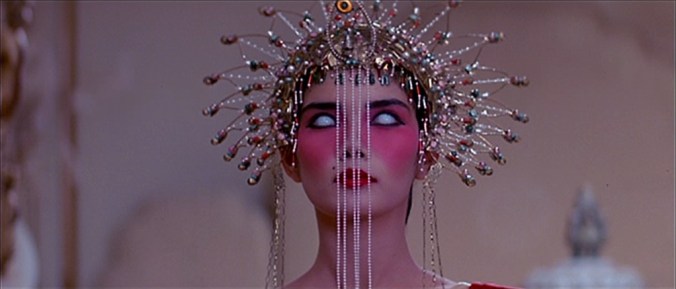
In the film, Russell plays Jack Burton, a fast-talking, fast-driving trucker, who finds himself embroiled in a gang war in San Francisco’s Chinatown. When his friend Wang’s (Dun) betrothed, Miao Yin (Suzee Pai) is kidnapped by one of the local street gangs, Jack agrees to help him rescue her. Along with the help of their friends Gracie Law (Cattrall) and Egg Shen (Wong), they set out to retrieve Miao Yin from the Lords of Death street gang. Their search takes them first to a brothel where they believe Miao Yin is being held, and Jack is successful in freeing many of the women being held there, but the rescue is interrupted by the Three Storms, three supernatural ninjas who take off with Miao Yin and take her to their master, David Lo Pan (Hong). Jack and Wang are again tasked with infiltrating a building to rescue Miao Yin, this time Lo Pan’s office front. When they get inside, they are again waylaid by the Storms and are introduced to Lo Pan’s sinister plan. Though he appears to be an old man, he is actually an incredibly powerful undead sorcerer, who is thousands of years old. He was robbed of his true physical body by the first emperor of China who placed a curse on him. In order to break the curse and regain his true form and his full power, Lo Pan must marry and then sacrifice a Chinese girl with green eyes, which Miao Yin has. From there, multiple rescue attempts must be made by everyone in the group as Jack, Wang, and Gracie all keep getting captured and escaping, all while trying to locate Miao Yin and prevent the wedding ceremony from taking place. The film’s final battle is a combination of traditional kung-fu, Wuxia, and slapstick comedy, as the heroes fight off the Storms and Lo Pan, rescuing Miao Yin. After everything settles down, Jack chooses to hitch up the Porkchop Express and return to the open road rather than staying in Chinatown with Gracie. However, just as Egg Shen says he will always have China in his heart, it seems that a piece of Chinatown is staying with Jack as the film’s final shot reveals that one of Lo Pan’s supernatural monsters has stowed away on his truck.

big trouble 6

I didn’t know it at the time, but I likely have Big Trouble in Little China to thank for some of my later filmic obsessions. It was probably the first movie I saw that heavily featured Asian influences, despite having grown up in the ninja-obsessed early 1990s. I had seen shows like Power Rangers and even some Japanese anime when I was younger, but Big Trouble in Little China was probably the film that first introduced me to kung-fu and Wuxia, two genres that I would get into more seriously in my teenage years. I remember when I saw the movie for the first time, around the age of 11 or 12, thinking that it reminded me a lot of Indiana Jones, but more authentic and more exotic. The film was set in America, but it felt more immersed in Chinese culture. It seemed like a celebration of its influences, where the Indiana Jones trilogy felt more sensationalistic and exploitative. I probably didn’t give this a whole lot of thought at the time, but I now realize that the main reason the film feels so authentic is that it has an almost entirely Asian cast. Also, rather than relegating minorities to supporting and sidekick roles to a white hero, Carpenter places Wang and Egg Shen in the more traditionally heroic roles, while portraying Jack as, at best, a fish out of a water, but more often as a bit of a boob.

That’s another thing that I really appreciate about Big Trouble in Little China. While Jack Burton is definitely the main character of the film, he is far from the film’s hero. Carpenter deftly plays with Russell’s star persona, repeatedly placing Jack in positions where the other characters in the film have to come to his rescue. Russell plays Jack Burton as a swaggering man of action, modeling his performance on vintage John Wayne, but the film’s narrative often undercuts his heroism. Though he can more than handle his own in the film’s many fight scenes, Jack is frequently on the receiving end of punches that Wang is able to easily duck under or around. He’s inventive and unorthodox in his fighting style, but he’s also often a scene’s comic relief. This only works because of Kurt Russell’s natural charisma. He’s totally believable as an action star, but he also has a roguish sense of humor that is constantly on display in this film. Jack Burton is the ultimate cool guy, tough in a fight, but also able to be self-deprecating when the tilt doesn’t go his way. The wise-cracking tough guy was certainly a genre staple by this point, but mostly in the form of witty asides or scripted catchphrases. Jack Burton’s humor is inherent in his coolness, and it’s hard to see Schwarzenegger or Stallone being able to pull off the natural charm that Russell brings to the role.

big trouble `1

Russell and the rest of the cast are aided by some great dialogue. The script went through several phases and rewrites, beginning life as a period Western, but as I mentioned earlier, the final product bears a strong resemblance to a screwball comedy with regards to its dialogue. Particularly in the interactions of Jack and Gracie, but throughout the film, the dialogue is snappy and articulate. The verbal sparring in the film is as entertaining as the fight scenes, with Russell and Cattrall displaying good on-screen chemistry. It’s one of the few action movies that is also genuinely funny throughout, without resorting to the aforementioned witty asides. Its humor isn’t nudging or winking, it’s subtly woven through the action, helping to establish these characters. Even a character like Egg Shen, whose role is almost strictly expository early in the film, gets some great lines. When discussing the hodgepodge of various mysticisms that influence Chinese spiritual belief, he says, “There’s Buddhism, Confucianism, and Taoist alchemy and sorcery…We take what we want and leave the rest, just like your salad bar.” It’s a genuinely funny line, but it’s also a window into Egg Shen as a character. He’s obviously wise and worldly, but who knew that he had been to a Sizzler? It would have been easy for Egg Shen to have been a stereotype, as many other action films of the time probably would have portrayed him, but Victor Wong plays him with a mirthful sort of mysteriousness and the script gives him several opportunities to step out of his box.

big trouble 7

I didn’t own a copy of Big Trouble in Little China until my late 20s. I grabbed it out of a bargain bin at a Best Buy one afternoon, and I’m really glad that I did. I hadn’t seen it in at least five years at that point, and I think I had forgotten just what a cool movie it really is. I think that all of the things that I really enjoy about Big Trouble in Little China are exactly the things that made it a flop upon its initial release. Mainstream American audiences just weren’t ready for an American movie that borrowed so heavily from Chinese culture. Obviously, Enter the Dragon had become a crossover hit in 1973, but martial arts pictures were still largely relegated to the grindhouse. Even the presence of emerging stars like Russell and Cattrall wasn’t enough to make the film bankable, as its deep dive into Chinese mysticism proved to be too confounding for its audiences. It wasn’t until home video really became a force in the late 1980s and 1990s that these types of films began to find an audience. Not surprisingly, Big Trouble in Little China found renewed interest in the home video market and has become one of the ultimate cult classics. It is the type of film that you can show a half-dozen different friends and each can come away enjoying something different about the film. Carpenter takes its series of disparate influences and mixes them up in a cauldron of 1980s action sensibility, churning out a wholly unique product that is more than the sum of its parts.

The Big Lebowski

The Big Lebowski (1998)

Dir. Joel & Ethan Coen

Written by: Joel & Ethan Coen

Starring: Jeff Bridges, John Goodman, Steve Buscemi, Julianne Moore


I wrote a good bit about how much I enjoy the Coen Brothers in general when I was writing about Barton Fink last month, so I’ll keep this post more limited directly to The Big Lebowski. However, I will say that the movie’s immense mainstream popularity undercuts the fact that it’s one of the brothers’ deepest dives into filmic nostalgia. Lebowski is a celebration of old Hollywood, a deconstruction of the detective genre and film noir mode of storytelling, with shout outs to classical Hollywood pictures throughout. The nuances of the film are probably overshadowed for a lot of audiences by the story of what has become one of the classic characters in all of cinema. The Big Lebowski is a film that is equally as quotable as it is esoteric, a film with many layers, and standing tall above them all is Jeff Daniels’s iconic portrayal of Jeffrey Lebowski, the Dude, an armchair philosopher and hero for the slacker generation, one of God’s own prototypes, too weird to live and too rare to die, out there taking it easy for all us sinners.

For those who may have not seen the film yet, The Big Lebowski centers on a case of mistaken identity, in which The Dude (Bridges) is mistaken for the identically-named Jeffrey Lebowski (the titular Big Lebowski, played by David Huddleston) an aging millionaire whose trophy wife, Bunny (Tara Reid), owes money all over town, including to pornographer Jackie Treehorn (Ben Gazzara) who sends two thugs to beat the money out of The Dude. When The Dude fails to produce any money, pointing out that it’s fairly obvious a millionaire would not live in his tiny one bedroom apartment, one of the thugs proceeds to pee on The Dude’s rug. The Dude seeks out The Big Lebowski hoping for recompense for the soiled rug, which really tied the room together, and this sets the events of the plot into motion. After their initial meeting, The Big Lebowski contacts The Dude, telling him that Bunny has been kidnapped, and he needs The Dude to get her back. In turn, The Dude enlists the help of his buddies Walter Sobchak (Goodman) and Donny Kerabatsos (Buscemi), who are happy to help out in between games of bowling. Along the way, The Dude encounters German nihilists, a militant feminist artist who wants him for his seed, and is forced to abide countless acts of aggression. The film takes a lot of its cues from The Big Sleep, a famously inscrutable noir, and The Big Lebowski certainly doesn’t disappoint when it comes to weaving a tangled narrative web of deceit and double cross.

lebowski 1

If that narrative seems somewhat complicated, that’s because it is. Raymond Chandler, who wrote the novel upon which The Big Sleep is based on, famously said that even he wasn’t sure who committed one of the murders in his book. The Coens take this idea and run with it in Lebowski, creating a stylized, contemporary noir in which the detective is constantly travelling through the world in a fog, unsure of which side of each uneasy alliance he finds himself at any given moment. The film is packed with subtle allusions to the films of the 1940s, containing oblique references to Double Indemnity and The Maltese Falcon, but also to 42nd Street and other Busby Berkeley musicals. As much as they are filmmakers, the Coens are also film historians, with their films often referencing favorite classic filmmakers such as Howard Hawks or Billy Wilder. All of their films dabble in this kind of pastiche, using film references as a shorthand language, but Lebowski is probably the most overt. As in Barton Fink, the Coens suture a fantastical version of Hollywood onto an actual time and place, in this case the immediate aftermath of the first Gulf War. In both films, the real life setting only serves as an anchor, and the action of the film is largely contained in its own world. The characters in the films occasionally reference actual events, but the Coens are largely free to create a universe of their own definition, and in The Big Lebowski, that universe is heavily filtered through the experience of American cinema of the 1940s.

Of course, this being a Coen Brothers film, those influences are scattered throughout The Big Lebowski, but they’re turned on their head, repurposed for a new generation and skewed in the process. The film uses many of the familiar tropes of the noir. It offers up two femmes fatales in Bunny and in The Big Lebowski’s daughter, Maude (Moore). It’s Bunny’s disappearance that kickstarts the film, but Maude is certainly the more interesting character. She appears halfway through the film, introducing herself to the dude by having her henchmen knock him out and take the rug that he had chosen to replace his originally soiled rug. She asserts that her interest is in preserving the Lebowski Foundation’s money, one million dollars of which her father has put up as ransom money for his missing wife. However, in classic femme fatale fashion, Maude’s motives are more duplicitous than they might seem on the surface. Her real interest in The Dude is procreative. While most classic femme fatales attempt to ensnare the detective using their sexuality, Maude enlists the Dude to the case before seducing him. After gaining The Dude’s trust, Maude beds him and makes known her desire to have a child with a man who will have no interest in raising it, or in being a partner to her. She’s fingered The Dude as just the deadbeat for the job, interested in him not for his bravado or his cunning, but for his biological ability to help her conceive. While I do think that a lot of classic femmes fatales could be seen as feminist characters, or at least female characters with agency in an era during which there weren’t so many such roles, I think that Maude’s overall character in Lebowski very deliberately marks her as a feminist. The shift in power dynamics marks one of the ways that the Coens are playing with the tropes of the noir mode.

lebowski 6

Another modal shift takes place in the film’s style. Though its narrative is decidedly noir-influenced, the film’s visual style rarely quotes from film noir. They had already explored the visual aesthetic of noir in their debut Blood Simple and would return to the genre with a very explicitly noir-influenced aesthetic in The Man Who Wasn’t There, but The Big Lebowski is a much brighter, color-saturated film. Its hallmark visual sequence, the dream sequence that The Dude experiences after being drugged at Jackie Treehorn’s party, is an homage to the classic Hollywood musicals of the 1930s and 40s. The sequence is choreographed just like a Busby Berkeley musical number, with The Dude descending a black-and-white checked staircase to be greeted by a dozen beautiful dancers with tiaras made of bowling pins. He shares a dance with Maude and then floats down a bowling lane through the straddled legs of the dancers. The dream devolves into a nightmare after The Dude crashes through the pins at the end of the lane and cascades into blackness where he meets the three German nihilists, who are wearing red form-fitting suits, and who chase him through the nothingness with oversized scissors, presumably hoping to “cut off his johnson.” While this sequence marks just the most striking departure from the established visual style of noir, the film’s style overall is a bit more dreamy and subjective than a typical noir. That mode established the use of evocative chiaroscuro lighting and adopted the subjectivity of the canted angle, but the Los Angeles of Lebowski is characterized by bright lights, loud noises, and a slow-moving camera that often takes in the world through a gauzy filter.

The biggest departure of the film from a traditional noir detective story, of course, is in the character of The Dude. The prototypical noir detective is personified by Humphrey Bogart: serious, square-jawed, able to take and deliver a punch. The Dude is decidedly none of these things. He is a self-described pacifist who only gets caught up in this whole mess through a case of mistaken identity and a desire to get back a rug that really tied the room together. The Dude trades in Bogart’s ever-present scotch and cigarette for a white russian and a joint. He has reached a level of Zen that Bogart’s restless men of action could never hope to achieve. He treats the whole caper involving Bunny, the nihilists, his missing rug, and his perpetually battered car, as a cosmic inconvenience rather than a case to be solved or a mission to accomplish. The Dude would rather be left alone to listen to his tapes and bowl in the next round robin. If Bogart was the masculine ideal for a post-war generation, then Bridges’s performance as The Dude served as an inspiration and a rallying point for a certain type of counter cultural slacker in the late 90s and early 2000s. He is the Coens most enduring and endearing creation.

lebowski 5

I first watched Lebowski around 1999 or 2000, a couple of years after it was released in theaters. I was instantly taken in by the characters and the dialogue. The film is simply hilarious and Bridges, Goodman, and Buscemi have unbelievable chemistry as The Dude, Walter, and Donny. Their lines are delivered lightning quick, one on top of the other, just like the conversation of real-life friends who know each other intimately. The film is endlessly quotable, with many of its turns of phrase having entered the cultural lexicon, but it is so densely written that it’s also easy to miss off-the-cuff lines on the first couple of viewings. The humor and the characters were what initially drew me into Lebowski. The interplay between Walter and Donny was so funny, and The Dude was one of the coolest characters I’d yet to encounter. Over time and additional viewings, I found new things to enjoy about The Big Lebowski and if you had asked me 15, or even ten years ago, it might have ranked up in my favorite movies of all time. It isn’t up there for me anymore, but it’s still a film that I love and probably one that I watch more frequently than some that might be in my “top ten favorite” films.

Though it started out as a cult film, the influence of Lebowski has spread far into the mainstream. As I mentioned, many of its lines have become instantly recognizable lingo, and you’d be hard pressed to find someone in 2017 who hasn’t seen the film. Bridges’s performance is now iconic, and many people would probably most readily associate Goodman with his portrayal of the bombastic, Vietnam vet Walter Sobchak. Screenings of the film have taken on a Rocky Horror Picture Show sort of tenor, with audiences often attending in costume and bringing props with them. An entire religion has sprung up centered on The Dude as a spiritual figure, with proponents of Dudeism embracing The Dude’s laissez-faire attitude and rebel shrug. Over the last 20 years, The Big Lebowski has graduated from film to full blown cultural phenomenon and while I’m happy that a great film is getting the attention and fanfare that it deserves, I would still rather appreciate it as a film text, devoid of any of the larger cultural trappings that it has come to be associated with. As a progressively-leaning, cannabis-advocating bartender who can often be found wearing a robe until mid-afternoon, and who is trying his hardest to take a “first do no harm” approach to life, I understand that the Dudeist lifestyle is probably perfectly suited to me. However, I still watch The Big Lebowski once or twice a year because it is a film that I really love, not because I hope to emulate its style or glean life wisdom from it. It never fails to make me laugh and pick up my spirits, and every time I watch it I seem to find some new little homage or hear a throwaway line that I had forgotten about. I can understand why someone might choose The Big Lebowski as the cultural artifact upon which they model their personal ethos, but even for those who choose to just enjoy it as a film, it’s an undeniable classic.