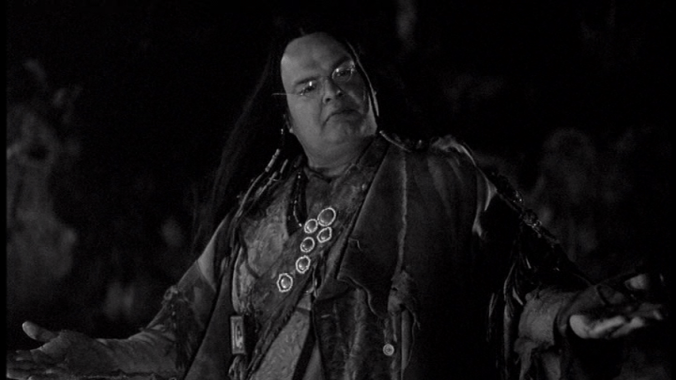
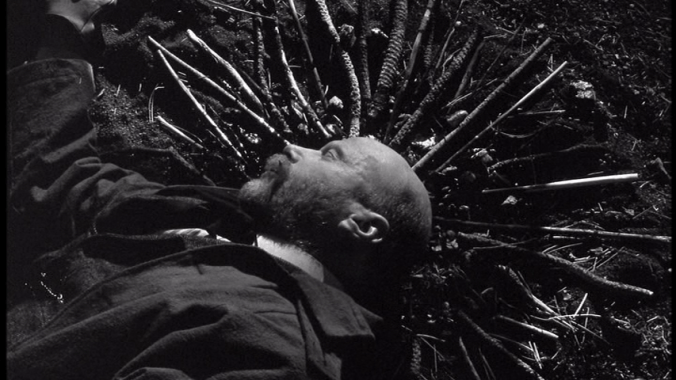
Dirty Work

Dirty Work (1998)

Dir. Bob Saget

Written by: Frank Sebastiano, Norm Macdonald, Fred Wolf

Starring: Norm Macdonald, Artie Lange, Traylor Howard, Christopher McDonald


Early on in this project while writing about Belly, I called it “probably the worst movie, objectively speaking,” that I had reviewed to that point in this project. If you go back and read the review, however, you’ll find that Belly is actually a film that I genuinely enjoy and watch often, and that in spite of some of its cinematic shortcomings, I found some interesting things throughout the film to write about. While Belly looks more like an auspicious debut that hinted at great promise never really fulfilled by its director, Hype Williams, Dirty Work could be viewed more as the hacky, sophomoric comedy that it really is. It is definitely the worst movie that I’ve written about for this project, displaying none of the artistic flair of some of the other “bad” movies that I’ve reviewed. However, Dirty Work will always have a place in my heart. It is truly one of my favorite movies, and I don’t even classify it as a guilty pleasure, because I enjoy it fully, without irony, and without shame. Dirty Work is a bad movie, but, to me, it’s endlessly quotable and rewatchable. In a way, it’s the perfect movie to close out the first year of this project on, because I’m fairly certain that I’ll be one of a very select few to have written a gushing, unabashedly positive review of this much-maligned, oft-forgotten, footnote of cinematic comedy.

MCDDIWO EC024

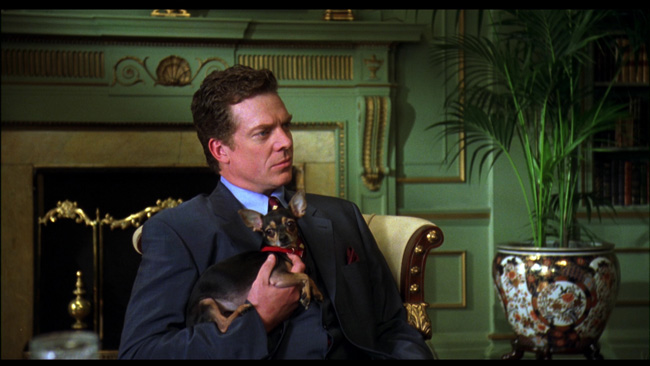
Dirty Work tells the story of Mitch (Macdonald) and Sam (Lange), two underachievers who have been friends since childhood. Growing up, the pair are taught by Sam’s father, Pops (Jack Warden), to not take crap off of anybody. Taking that lesson to heart, as children they make it their mission to serve comeuppance to anyone who wrongs them, child and adult alike. However, when they grow up, they find themselves too often on the receiving end of the comeuppance. Mitch in particular has a difficult time fitting into society, losing 14 jobs and his girlfriend in a matter of three months. Down and out, Mitch asks to move in with Sam and Pops, and shortly thereafter, Pops suffers a severe heart attack. When the two friends are faced with raising $50,000 to secure Pops a heart transplant, they first try their hands at a series of odd jobs, but soon realize that the key to raising the money to save Pops is by returning to their roots as revenge artists. They open up a revenge-for-hire business and offer to do other people’s dirty work for them, all the while saving up money to save Pops. Along the way, Mitch meets a woman whom he falls in love with, Kathy (Traylor), and ends up running afoul of the town’s most powerful citizen, Travis Cole (McDonald). Cole tries to trick Mitch and Sam into helping him condemn a build that he owns, but they eventually turn the tables on Cole and end up getting the last laugh. In the end of the film, Pops gets his heart transplant, Mitch gets the girl, and Cole is railroaded out of town after being exposed for the fraud that he is.

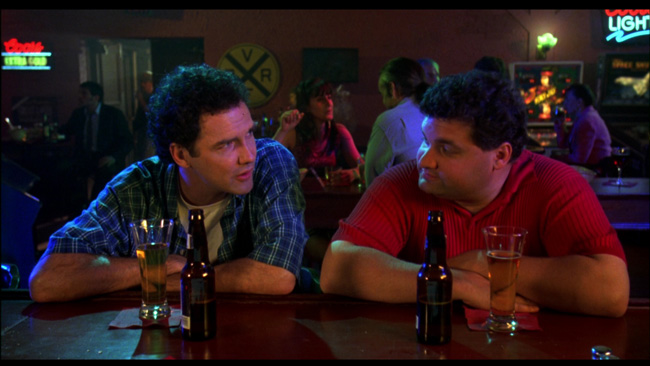
Dirty Work was added to my collection in the summer of 2002. That year, I spent about two weeks cooped up inside the house recovering from a bout of mononucleosis. As such, my mother picked up a few inexpensive DVDs to keep me occupied while I was homebound. One of these bargain bin finds was Dirty Work, and I probably watched the film a half dozen times in those two weeks. I had already seen it in the movie theater with some friends when I was about 13 years old, but it didn’t really stick out to me at that time. I was a latchkey kid back then, and I would often come home from elementary and middle school and watch reruns of “Saturday Night Live” on cable while I waiting for my parents to get home from work. I had gotten introduced to Norm Macdonald’s wry, dry sense of humor through these afternoon television watching sessions, and, as a result, I was a member of the small demographic that was actually interested in Dirty Work when it was released. The movie didn’t make a huge impression on me, but I can remember enjoying it a good bit. I loved the callbacks that Norm did to his Weekend Update persona, pulling out a Dictaphone and recording “notes to self,” and my friends and I were all fans of Chris Farley’s performance as Jimmy, Mitch and Sam’s bar buddy who had his nose bitten off by a Saigon whore, but overall the movie didn’t really stick with me after that initial viewing. Since receiving it on DVD, however, Dirty Work has been a staple of my viewing schedule for the past 15+ years. I don’t know if its offbeat, mocking style of humor needed some time to grow on me, or if part of the joy of the movie lies in repetition, but the older I get and the more times I watch Dirty Work, the more I want to watch and enjoy it again and again.
Dirty work 2

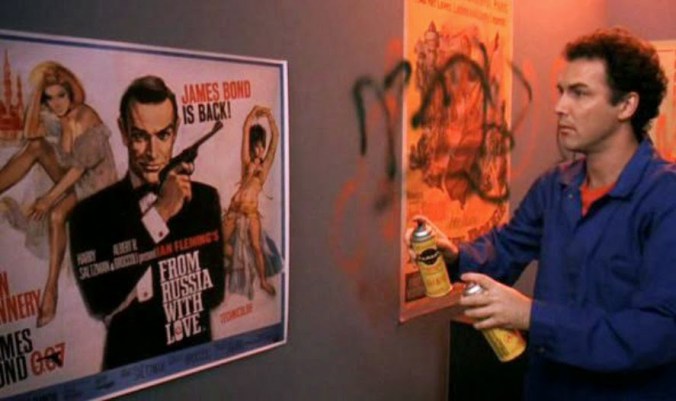
I think the common line of thought on Dirty Work, if the film is even thought of at all, is that it is a simple, sophomoric comedy, loosely and conveniently plotted, and filled with gross-out humor. On the surface, this is an absolutely accurate description of Dirty Work, but after nearly 100 viewings, I’ve come away with a much different reading of the film. Sure, Dirty Work is a “bad” movie, but I think that it is intentionally so. It’s a nudging, winking meta-film, poking fun at the cookie cutter studio comedies of the time, and standing as a prime example of anti-comedy, much like Saget’s and Macdonald’s other work. These are two master comedians, with a great understanding of and appreciation for the history of the medium, and the nature of humor, in general, and I simply find it hard to believe that they combined to create a movie that is crass for the sake of being crass. Though it features many alumni of the institution in cameo roles, Dirty Work is something of a send up of the morass that Saturday Night Live-inspired movies had become by the late 1990s. Similarly to an SNL film, the central conceit of a revenge-for-hire business feels like a sketch that has been pushed beyond its boundaries, but rather than relying on catch phrases or recurring oddball characters for a nostalgic sort of humor, Saget and Macdonald rely on escalating levels of absurdity, cringe-inducing anti-humor, and a defining performance from Macdonald, one of SNL’s most maligned cast members of the 90s. They combine these elements to create a chaotic comedic maelstrom that certainly isn’t for everyone, but which fully hits home with me.
dirty work 4

Of course I realize that a viewer’s enjoyment of Dirty Work is going to be directly related to their enjoyment of Norm MacDonald’s particular brand of wry, winking humor. MacDonald, something of a “comedian’s comedian” and certainly an acquired taste when it comes to mainstream comedians, is essentially playing a version of himself in the film, imbuing Mitch’s character with all of his trademark quirks and mannerisms, familiar from his stint behind the anchor desk at SNL’s Weekend Update. MacDonald does try to act in the film, although he’s best when he isn’t trying to force himself into a character and is instead allowing Mitch and the film, in general, to be a vehicle for his comedic stylings. To say that Norm MacDonald is a bad actor isn’t a hot take or a novel idea, but his brand of monotone non-acting is perfect in this film that he co-wrote for himself. The film’s humor largely stems from MacDonald’s deadpan line delivery, and his presence as a straight man in a very zany world. He also proves himself adept at physical comedy, not something that he was normally associated with, through a very funny running gag that sees Mitch being physically tossed through a series of windows. I can understand that MacDonald’s presence in the film on its own might serve as a stumbling block for the uninitiated, but I can’t picture another comedian or actor delivering some of the lines that he wrote, much less with a completely straight face. He anchors the film, not necessarily with a great performance, but with a certain comedic sensibility that is necessary for the rest of the film’s antics to revolve around.
dirty work 5

The rest of the stars orbiting MacDonald do so admirably. The film’s true supporting actors, Artie Lange as Sam and Traylor Howard as Kathy, don’t really stand out much, but Dirty Work is full of excellent cameos from some big name comedians. I mentioned him already, but Chris Farley’s role in Dirty Work is one of my favorite of his. He only has a few scenes, but he makes the most of them, and leaves a memorable impression in what would be the final film he worked on before his death. His character, Jimmy, is one note, a barfly who has sworn revenge on the Saigon whore who bit off his nose, but Farley brings his irrepressible physicality and charm to the role, playing against type as a somewhat villainous maniac. The scene, early in the film, where he confidently queues of the Rolling Stones classic, “Street Fighting Man,” on the bar jukebox before Mitch and Sam get in a brawl, only to push the wrong button and underscore the fight with Rupert Holmes’s “Pina Colada Song,” is one of my favorites in all of film comedy. Chevy Chase also shines as the degenerate gambler physician who offers to bump Pops’s transplant up on the list if Mitch and Sam can raise enough cash to help him pay off his bookies. Like Farley, Chase makes the most of his limited screen time, providing classic one-liners that feel improvised. His comedic timing is as excellent as always, and he has mastered the understated delivery that can drive a joke home before the audience even realizes it has been uttered. Don Rickles delivers some devastating insult comedy in a brief appearance that really served as my introduction to his brand of acerbic, vitriolic comedy. He debases Sam and Mitch, as well as the other employees at the movie theater where they are briefly employed, with such cutting quips. The scene leaves me laughing out loud no matter how many times I see it.

dirty work 3

I could be wrong. Dirty Work could be just an ordinary, run-of-the-mill bad movie. It certainly seems to be that way on first blush. Saget’s direction in the film would be most generously described as competent. The script is both outlandish and simplistic, often settling for lowest common denominator punchlines and toilet humor. The film’s lead actor turns in a performance that seems almost determinedly wooden. However, despite all that, I honestly feel that the film is a twisted work of comedic genius. I really think that it was a movie ahead of its time, engaging in the type of anti-comedy that would become popular a decade later, at least in underground comedy scenes. It isn’t the type of movie that could ever become a classic, even of the cult variety, but I have rarely found a person who I’ve showed the film to or reminisced about it with who doesn’t find something about it to enjoy. I don’t know if my lionizing of the film is a sort of justification, but I also don’t feel that my outright admiration for Dirty Work is something that needs to really be justified. I’ve rarely subscribed to perceived dichotomies between high and low culture, and I’ve been even more reluctant to cast my lot with existing cultural values when it comes to art. I believe that, increasingly so, great art can come from any number of sources, and that beauty is often in the eye of the beholder. Writing about 50 different movies from my own personal collection this year has reminded that there’s really no accounting for personal taste. People should like what they like, and watch what they want to watch. If a movie makes you happy or gives you some relief or distraction from life’s many problems, even for just a couple of hours, enjoy the hell out of it. Happy New Year.

Dirty Harry

Dirty Harry (1971)

Dir. Don Siegel

Written by: Harry Julian Fink, Rita M. Fink, and Dean Riesner

Starring: Clint Eastwood, Andy Robinson, Reni Santoni


Clint Eastwood was one of my cinematic heroes when I was growing up. I came of age watching his films and modeling my impressions of cinematic masculinity on his stoic, skillful, ruthless archetypal characters. Whether he was the Man With No Name in Sergio Leone’s famous trilogy of Spaghetti Westerns, or William Munny in Unforgiven, or Inspector Harry Callahan in the Dirty Harry films, Eastwood stood out to me as an example of American cinematic machismo. Throughout his career, he embodied so many famous characters and character types that it was easy for me to pick an Eastwood film for every mood. Sometime in my early 20s, that started to change, as I became more aware of Eastwood’s personal politics, and as he began to age, publically, and ungracefully. Though Unforgiven will likely always have a spot in my personal top ten films of all time, Clint Eastwood and his films became an early lesson for me in learning to appreciate and separate an artist’s output from his or her personal politics or persona. While I found little common ground with Eastwood as his politics became publicly more and more reactionary and right wing, I still found myself appreciating of many of the films that he directed and starred in as works of art. However, I found other films of his to fall into a grey area, where their content seemed too influenced by Eastwood for me to feel totally comfortable enjoying them. Dirty Harry, unfortunately, falls somewhere in this category.

dirty harry 2

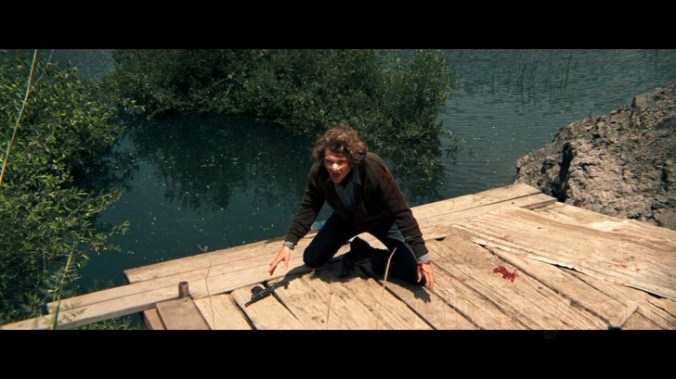
My reservations about the film aside, Dirty Harry is considered one of the definitive action films of its time, and deservedly so. The film, which would be followed up by four sequels of varying quality, introduced the world to Inspector Harry Callahan (Eastwood), a hard-boiled, no-rules San Francisco police detective who believes in bringing in his man at any cost. In Dirty Harry, Callahan is tasked with tracking down and apprehending Scorpio (Robinson), a serial killer who is threatening to murder one San Franciscan every day until the city obliges to pay him a ransom of $100,000. Callahan and his partner Chico (Santoni) track Scorpio across the city, nearly catching him several times, but the killer manages to elude apprehension over and over again. Scorpio teases the police department and mayor’s office with another threat, this time telling them that he’s buried a teenage girl alive and they have just a few hours to meet his demands before she suffocates. Callahan finally manages to track Scorpio to Kezar Stadium, where Scorpio hands out programs for the 49ers games, and confronts him on the football field. Harry shoots Scorpio, and tortures him by stepping on his wound until Scorpio gives up the location of the girl. However, when the police check the location, they find the girl already dead, and Scorpio is released from custody because Harry violated his civil rights. Scorpio continues his crime spree, hijacking a school bus and demanding a plane ticket out of California, but Harry is quick to cut him off. The two square off in an abandoned quarry, where Harry is quicker on the draw and manages to shoot Scorpio down. After killing Scorpio, Harry tosses his badge into a lake, unwilling to be a member of a police force upon which he cannot shoot first and ask questions later.

dirty harry 4

I can assume, based on my editorials in that plot synopsis, that you can gather my attitude towards some of the more political or socio-political content in Dirty Harry. Dirty Harry is the story of a rogue cop who flaunts departmental procedures and scoffs in the face of citizens’ civil rights, ruling over a city with an iron fist and a .45 Magnum, daring criminals to test his authority. Of course, on the other hand, Dirty Harry is the story of a crazed serial murderer who would hold a major city hostage were it not for the endeavors of one cop, willing to make the sacrifices that others aren’t. Where your sympathies tend to fall when watching Dirty Harry is largely dependent on your existing worldview and political stance. I certainly don’t mean that anyone watching the film would necessarily be drawn to rooting for Scorpio, but that the extent to which a viewer can sympathize and root for Harry is largely dependent on their own views on authority. Clearly, the audience is intended to root for Harry Callahan, as he’s the hero of the action movie, but I personally find it really difficult to reconcile my anti-authoritarian stance with a film that asks me to root for a renegade cop. I hate cops. Always have, always will. I do understand the need for law enforcement in a society, but the brand of highly militarized law enforcement practiced currently in America is antithetical to my worldview of treating other with dignity and respecting their rights as human beings with agency. To me, Harry is just as much a psycho killer as Scorpio, and his refusal of the badge and the moniker of official power at the film’s end isn’t something to be celebrated, because Harry’s lust for power and violence doesn’t stem from his position as an authority figure, but from some deep-seeded defect inside of the character. Harry will continue his brand of vigilante justice (in no fewer than four sequels) whether he has the backing of the badge or not.

Dirty Harry is a particularly difficult film for me to watch in 2017 in light of the ongoing revelation of widespread and heinous abuses of power by police officers across America. Institutional and individual abuses of power on the part of law enforcement are certainly nothing new, but the existence of cell phone video technology and the prevalence of social media have shed a light on what I feel is the most important news story happening in America today. Every week, a new video surfaces of a cop somewhere gunning down a citizen, who is often unarmed, and almost always hasn’t committed a capital offense. Police in America have taken to playing judge, jury, and executioner in the street and on the beat, and too often the targets of their ire are young black men. Seeing Harry Callahan pointing a massive pistol in the face of a black man who is cowering on the ground, and teasing him with the famous catchphrase, “Do you feel lucky? Well do you, punk,” is simply too disturbing to me. The actions that Dirty Harry takes throughout the film and his casually bigoted attitude towards any nonwhite characters in the film are beyond the pale. While Siegel crafts an engaging and original action film around his rogue inspector, Harry Callahan simply isn’t a character that I can stomach spending any time with. His reckless, sadistic behaviors simply hit too close to home after seeing dozens of examples of modern day cops acting out their own vigilante fantasies on grainy cell phone video. As engaging and groundbreaking as the film might have been for its time, its current relevance really sours me on it.

dirty harry 3

As I mentioned, there is an important lesson for me to learn in the films of Clint Eastwood, both those that feature him as an actor and the films that he has directed, about separating a work of art from its creator. In Dirty Harry, in particular, there’s a micro lesson that I can glean about admiring aspects of a work of art while being uncomfortable with or out of step with its overall message or presentation. I would be remiss if I didn’t mention the many positive aspects that do exist throughout the film. One of the things that jumps to my mind immediately when I think of Dirty Harry is the film’s unique score, composed by Lalo Schiffrin. The soundtrack to the film is a psychedelic jazzscape, featuring unusually syncopated rhythms and atonal melodies. The acid jazz underscores the film’s many chase scenes and heightens the tension of the images, creating a natural sense of unease in the viewer through its use of dissonance. The film is also well shot, its rapid zooms and quick cuts became genre staples throughout the 1970s. Dirty Harry stands as a massively influential film, not just in its own time period, but into the present day. Unfortunately, its influence doesn’t seem totally limited to the cinema. In the film, we have examples of a rogue cop who wantonly acts out street justice, and of a psychotic killer who would, almost certainly, be one of today’s mass shooters who have utilized easy access to high-powered, military-style weapons to enact their terroristic fantasies, killing hundreds. I’m not suggesting that the current state of police/citizen relations is in any way impacted by a 45-year-old film, but that the culture of American hyper-masculinity that lionized a vigilante cop in Dirty Harry has evolved and mutated to such a degree that our society is beset with an epidemic of gun violence and of institutionalized, state-sanctioned murder of citizenry. Dirty Harry is a well-made action movie, but because of its inherent conservatism, it isn’t any fun. The film’s current relevance saps it of any of its levity for me, and it isn’t a film that I’ll likely be watching again.

The Dirty Dozen

The Dirty Dozen (1967)

Dir. Robert Aldrich

Written by: Nunnally Johnson, Lukas Heller (from the novel by E.M. Nathanson)

Starring: Lee Marvin, Ernest Borgnine, John Cassevetes


I don’t really have a whole lot to say about The Dirty Dozen. It’s a classic war picture that’s been sitting on my shelf for probably the last 15 years. I have no idea what spurred me to pick this DVD up when I was a teen, but I remember watching and enjoying it a few times before it got shelved for good. It’s the kind of big studio blockbuster that was common during the 1960s, before a wave of more independently-minded, modernist filmmakers took American cinemas by storm. Although it feels a bit antiquated by today’s standards, The Dirty Dozen was a hit in its day, and it remains an influential film. Watching it for this post, I realized I had forgotten quite a bit about the beginning of the film, remembering only the climactic assault on the German chateau. On the whole, the film was a lot funnier and more entertaining than I had remembered, and it was a pretty pleasant rewatch.

dirty dozen 1

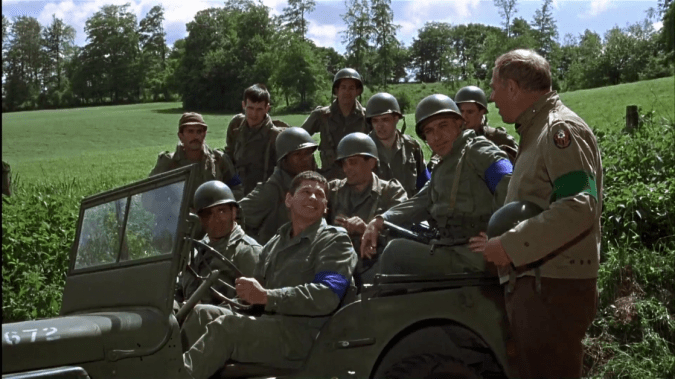
The film concerns itself with 12 convicts who are either sentenced to death or to lengthy prison terms who are selected by the Army to carry out an incredibly dangerous top secret mission behind enemy lines. In exchange for their completion of this mission, which is to infiltrate a German officers’ chateau in France and kill as many Nazis as possible, disrupting the chain of command in preparation for the D-Day invasion, the convicts will have their sentences commuted, records erased, and will be reinstated into the Army at their former ranks. The man charged with training this ragtag group of murderers and thieves is Major John Reisman (Marvin), a career military man who has grown disenchanted with the institutions that he has come to represent. The film’s first two thirds consist primarily of training montages which help to introduce the audience to the members of the Dirty Dozen and to their unique personalities. Notable here are Privates Victor Franko (Cassavetes), Archer Maggot (Telly Savalas), R.T. Jefferson (Jim Brown), and Joseph Wladislaw (Charles Bronson), all of whom are sentenced to death, and all of whom represent the scope of personality types embodied by the Dirty Dozen. Their training complete, the Dirty Dozen set off for France and their mission. The assault on the chateau is a success, and though only one member of the team survives the mission, the rest are remembered as heroes who lost their lives in the line of duty.

I love movies in which a team is assembled to perform a mission or job. These types of “professional” films, such as The Magnificent Seven, The Wild Bunch, or Ocean’s 11 often combine genres and feature broad casts of disparate actors who each bring a different focus to their role. In this respect, The Dirty Dozen doesn’t disappoint, with almost every member of the team providing a memorable moment or signature line. Cassavetes and Savalas shine as the anti-authoritarian and unpredictable members of the team, with Savalas’s Maggot nearly compromising the mission when he snaps and begins shooting everything in sight after breaking into the chateau. Bronson’s Wladislaw is the strong, silent member of the team, and is the only one to be confirmed to have escaped alive after the mission. Jim Brown puts a face to the plight of Black soldiers in the military with his performance as the oft-disrespected Jefferson. His death scene after bombing the German officers’ basement bunker, ensuring the success of the mission, is a memorable one, and a moment that brings to mind his punishing running style as one of the original stars of the NFL. Even the lesser members of the Dirty Dozen, such as Donald Sutherland’s Private Vernon Pinkley, are given their moments to shine. Pinkley’s impersonation of a General inspecting the troops of a rival Colonel is one of the film’s signature moments of comic relief. The film’s chief strength comes from balancing these various performances and making sure that each character gets his signature moment.

dirty dozen 5

Of course, even the most balanced ensemble film needs a lead, and Lee Marvin is clearly the star of The Dirty Dozen, although it nearly wasn’t so. John Wayne was the original choice to play Major Reisman, and I’m glad that he backed out of the film over concerns with the character’s morality, because I don’t think that he would have been able to convey some of the nuance that Marvin does in the film. Marvin’s performance in this film would catapult him into a higher echelon of stardom, although it would also continue his career down the path of playing similar roles. His Major Reisman is a tough, no-nonsense leader, but he is also shown to have a sensitive side through his obvious devotion to his team of castoffs. Marvin, who served in the military during World War II, along with many members of the cast, exudes authority and calm command. He cuts the sort of figure that demands respect and he’s an instantly recognizable presence in any film. A hard boiled legend, Marvin’s career was largely built on his rigid physical presence and booming voice, and he utilizes both here to great effect. Pigeonholing Marvin as a character actor, however, would be doing his career a great disservice, and in The Dirty Dozen he subtly displays the chops that earned him an Oscar just two years prior. He’s equally as effective in the scenes in which he has to display the bluster befitting of a military officer as in the quieter scenes in which he attempts to connect with the members of his team. Clearly, Reisman sees these men as misunderstood characters who have been failed by the institutions of the military and who can still be of service to the rest of the team and to their country, and Marvin expresses this care through the unusually gentle way that he guides them through their training, molding them into a capable unit. Marvin’s performance provides a grounding counterbalance to the more expressive performances from the members of the Dirty Dozen, and a stable center around which the rest of the cast can orbit.

In addition to having a strong and diverse cast, The Dirty Dozen also features some pretty shocking content and potentially progressive politics for a film of the time. Although the film’s violence seems very tame by today’s standards, it was uproarious at the time of its release. It certainly wasn’t the first film that asked its audience to sympathize with violent criminals, but The Dirty Dozen does little to normalize their criminal behavior, or to offer much redemption for the worst of its characters. The frank vileness of Savalas’s Maggot must have been a shock to audiences in the late 1960s, with the characters unrepentant racism, crudeness, and violence (both physical and sexual in nature), on full display. Maggot is a bad apple, and remains such until the end, having to be shot by Jefferson when he snaps and nearly botches the whole mission. A psychologist would likely label Maggot some sort of nihilist, and his nihilism is largely evident throughout the film. The Dirty Dozen is a film that sets itself and its characters against every institution that might stand in their way. Though it’s a war picture, I think that the film is clearly anti-military in its politics, showing the larger institutions of the military and the government to be cruel, outdated, and farcical. This is a film that, through its championing of Major Reisman and the Dirty Dozen, favors the individual over the institution. The Dirty Dozen are honor-bound to fight for one another, but there’s little indication that they feel the need to serve a larger master. This anti-authoritarian stance must have been exceedingly rare at the time, particularly in a mainstream war film.

dirty dozen 3

Through several decades-later sequels, including a short-lived television show, The Dirty Dozen has become a brand, representative of a style of late-1960s era filmmaking. It certainly isn’t the first film in which a ragtag group of misfits is assembled and turned into an elite team, but it has become one of the most recognizable and influential. I’ve been guilty myself of shortchanging the film, of assuming its generic faithfulness and its paint by numbers premise. The performances from the film’s ensemble cast are worth the price of admission, but diving a little deeper into the curiousness of the film’s politics and its attitude towards military customs and institutions reveals a film that is worth more than just a cursory glance or a nostalgic revisit. The Dirty Dozen isn’t my favorite film by any means, but watching it again revealed a depth that I hadn’t previously ascribed to it. One of the best experiences in working on this project has been the times that a film that I had perhaps undervalued takes me by surprise. It doesn’t happen too often, although my reactions to all but my very favorite and most familiar films in my collection are frequently altered by the time spent away from them and the ways that I’ve changed as a person in that interim, but when I’m truly able to see a film I thought I knew in a different light I’m reminded why I set out on this lengthy project in the first place.

The Devil’s Backbone

The Devil’s Backbone (2001)

Dir. Guillermo del Toro

Written by: Guillermo del Toro, Antonio Trashorras, David Muñoz

Starring: Fernando Tielve, Federico Luppi, Eduardo Noriega, Marisa Paredes, Iñigo Garcés


I spent a long, long time thinking about The Devil’s Backbone after the first time I saw it when I was in college. That was probably 2006, shortly after director Guillermo del Toro had really broken through to the mainstream with the release of the acclaimed fantasy Pan’s Labyrinth. I was taken with that picture, and its fantastical, allegorical approach to presenting the horrors of the Spanish Civil War, and I was eager to seek out other work from del Toro. I had already seen Hellboy (although I didn’t realize until years later that it had been directed by del Toro), but The Devil’s Backbone was the first Spanish language film of his that I discovered. I was instantly taken by this sad ghost story, and instantly recognized it as a companion film to the later Pan’s Labyrinth. The film takes a similar approach to exploring the Spanish Civil War, utilizing elements of fantasy and horror to allegorically depict the horrors of life under the threat of Fascism for both children and adults, alike. The film’s beautiful images and sorrowful story stuck with me for years, until I finally decided to purchase it in 2013 during a half price Criterion Collection sale at Barnes & Noble. It isn’t a film that I watch often, but it’s one that I’m very glad to have decided to add to my collection.

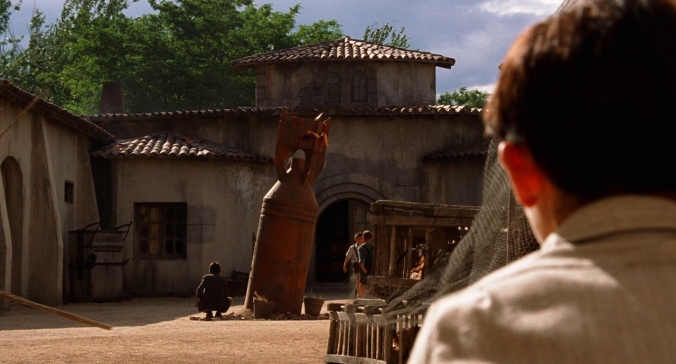
Set in the dying days of the Spanish Civil War, with Franco’s forces on the verge of defeating the left-wing Republican forces, The Devil’s Backbone begins with young Carlos (Tielve), a war orphan, being delivered to a secluded orphanage run by Carmen (Paredes) and Dr. Casares (Luppi), who are sympathetic to the Republican cause. Carmen and Casares are hiding a cache of gold, which they are using to help fund the Republican war effort, and, as such, they have gained the attention of the Fascist forces, with the orphanage becoming a target for bombings. An undetonated bomb stands upright in the middle of the orphanage’s courtyard, a stark reminder of the everyday reality of war within which these children are coming of age. Upon his arrival at the orphanage, Carlos is bullied, particularly by Jaime (Garcés), and he is told rumors by the other children of a ghost that haunts the orphanage, whom they call “the one who sighs.” When Carlos proves his bravery by venturing out of the communal sleeping quarters at night, he gains the acceptance of the other boys, but he also witnesses firsthand the existence of the ghost, and the attempts of the orphanage’s groundskeeper, Jacinta (Noriega), to break into a safe and steal the gold cache. Carlos, Jaime, and the other boys realize that the threat to their home is not from the ghost or from the war raging outside their doors, but from the ruthless Jacinta who will stop at nothing to steal the gold, even if it means destroying the orphanage and killing the wards who live there.

devil's backbone 1

Del Toro has publically professed to The Devil’s Backbone and Pan’s Labyrinth being his favorites among the films that he has directed. Although I haven’t seen all of his output, I would have to agree. Both films are rich visually and symbolically, weaving thoughtful allegories that feature excellent performances from young actors and established stars alike. While Pan’s Labyrinth may get more attention, as it truly served as del Toro’s breakout, and is widely regarded as one of the best films of the early 21st century, I think I may prefer its sparser, more haunting predecessor. There is just something about the austere, remote setting of the miserable orphanage and its wards, both living and dead, that stays with me for days and weeks after seeing the film. The film sets its tone immediately. It’s both claustrophobic, as much of the action takes place within the walls of the orphanage, and liberatingly imaginative, as the fantasies of the young boys who live within are allowed to play out in the face of their dire surroundings. The Devil’s Backbone walks this balance between darkness and light throughout, leaving its audience to try to piece together which of the characters are good and which are evil. Initial assumptions about character motivations are often undermined by new information presented later in the film, and several characters are not what they seem. By the film’s final act, when the horrors of violence and death finally invade the orphanage fully in the personage of Jacinta, clear lines are drawn between good and evil, and the true nature of all of the characters is revealed. In a powerful final scene, del Toro presents a symbolically dense critique of evil, in the forms of greed, lust for power, and cruelty, that doubles as a critique on the savagery of war and the brutality of Fascism. Just as in Pan’s Labyrinth, in The Devil’s Backbone it is the human characters who are revealed to be the true monsters, and the human impulses to kill and destroy that are the true evil unleashed on the world.

devil's backbone 5

The Devil’s Backbone is a ghost story, and it’s certainly a horror film, but it is rarely scary. Instead, the film is deeply unsettling and haunting. Del Toro resists the urge to present his ghost, Santi, as a menacing figure, even when he is first introduced. Santi is an orphan who disappeared the night that the bomb fell at the orphanage, and who the adults in the film believe simply ran off, frightened by the bomb. The children all seem to believe that Santi is “the one who sighs,” and though they are frightened of the ghost, he is almost never presented as a true threat. Santi can be seen from the earliest scenes in the film, sadly haunting corners of the frame, watching his former friends at play. He does stalk Carlos, who may be the only boy to actually see the ghost, but he’s hoping to make a connection and reveal the truth of his death. Santi is presented throughout the film as a pitiable figure, in need of help from the film’s living characters to truly be at rest, but there is another ghost that is present within The Devil’s Backbone that is more insidious.

The film’s opening voiceover, spoken by Dr. Casares references ghosts: “What is a ghost? A tragedy condemned to repeat itself time and again? An instant of pain, perhaps? Something dead which still seems to be alive. An emotion suspended in time, like a blurred photograph, like an insect trapped in amber.” This quote can be applied to all of the film’s ghosts, including Santi who is condemned to haunt the place of his death, reliving his tragedy and having his trauma frozen in time forever like an insect in amber. But I think that the quote most directly applies to a ghost that exists in the film only textually. The traumatic history of the Spanish Civil War is a ghost that is haunting The Devil’s Backbone, a film which sees del Toro resorting to fantasy to explore and interpret a real historical event. In the film, del Toro is commenting on the Spanish Civil War explicitly, but he is indicting all wars. He depicts the traumatic experience of life during wartime as a ghost which haunts the wards of the orphanage. One young boy has gained the nickname Owl (Javier González Sánchez) because he has become so traumatized he never speaks, only staring with his wide, haunted eyes. The undetonated bomb in the courtyard serves as a ghostly reminder of the war raging outside, but del Toro’s symbolic representations of war throughout the film are more powerful. War is the tragedy that society has doomed itself to repeat time and again. It’s an instant of pain, compounded one million times, and spread throughout the world like a vapor. Those affected by its ravages become ghosts themselves, set adrift in the world, their lifelike appearances belying the death they carry with them.

devil's backbone 4


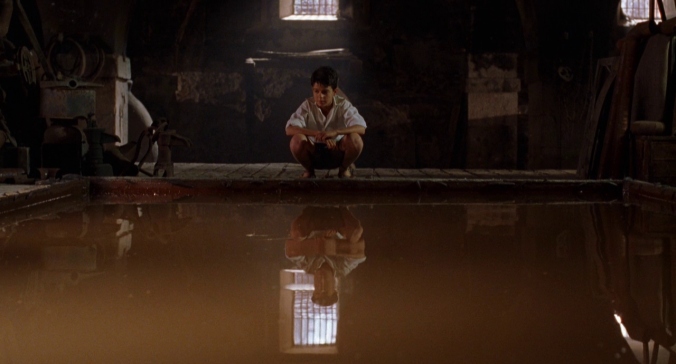
Political subtext aside, The Devil’s Backbone is a masterful film in all respects. It’s visually stunning, with a vibrant color palette of reds and oranges. The camerawork is subtly complex, with complicated but unassuming tracking shots giving the impression that the camera is following behind and spying on its subjects, always ready to duck behind the nearest corner. I love it when a film manages to mesh form and content so seamlessly. The film’s narrative progresses at a perfect pace, allowing scenes to breathe just before ratcheting up the tension, and the script is complex and twisty without being cliché. Though The Devil’s Backbone does turn on a significant plot twist in its final act, the reveal feels earned. Like the best twists, this one leave the viewer wanting to go back and rewatch, looking for clues, and repeat viewers will certainly be rewarded, as the film is deep with foreshadowing and callbacks. The film’s ending, while not elliptical, is just open enough that a crack of mystery remains. It’s a wonderful puzzle of a film, and it begs to be watched closely and intimately.


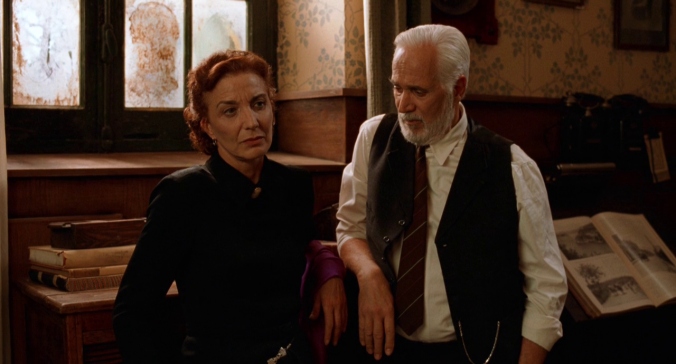
The film’s performances are all top notch, which is commendable with so much of the cast being comprised of young, inexperienced actors. Tielve delivers a soulful performance as the young Carlos. His wide eyes speak volumes to the sensitivity that he has to the world around him, but they also mask the determination that he brings to the role in the later scenes in which Carlos has to act decisively to save his friends. Garcés plays Jaime as a typical bully early in the film, pushing Carlos around and trying to maintain a façade of toughness, but by the film’s end he softens his performance to reveal the true Jaime as a frightened young boy burdened with carrying an unspeakable secret. The film’s adult actors all match the caliber of their young costars. Paredes plays Carmen as a steely, determined matriarch. She is the backbone behind Luppi’s softer, gentler patriarch, Casares. The two form a parental binary to the children, both nurturing and disciplinarian, but behind closed doors they enact private passions and acute anxieties. Their characters forge an unsteady partnership throughout the film, but their dedication to the cause of Republicanism and to their charges is unwavering. The two veteran actors imbue their characters with life through gestures and slight expressions, never needing to overact. Across the board, the actors employ a simplistic, naturalistic approach to their roles, and the realism that it brings to a work of fantasy is grounding and makes the film that much more significant.

devil's backbone 3

The more I’ve thought about The Devil’s Backbone over the past few days, the more I’ve come to admire about the film. It’s one that always manages to penetrate and stick with me for a while after a viewing. It’s powerful to see a film that can deftly wrap a political statement inside such a sensitive and truly effective dramatic narrative, and del Toro manages that easily with this film. He uses the film’s sad narrative to evoke emotions as disparate as joy, dread, and empathy, while encouraging his audience to read the film on a cerebral level, as well. It’s a beautiful film brought to life by spirited performances from its cast. The film’s visual storytelling and subtle allusions make for a richly rewarding and deep cinematic experience. If I were to rank the 50 or so films that I’ve written about thus far for this project, The Devil’s Backbone would almost certainly have a place within the top 10. It’s a film that many might overlook in favor of del Toro’s later, more celebrated films, but it is a classic in its own right, and not to be missed.

Desperado

Desperado (1995)

Dir. Robert Rodriguez

Written by: Robert Rodriguez

Starring: Antonio Banderas, Selma Hayek


Desperado was one of my favorite action movies when I was a teen, and it, along with other early Robert Rodriguez films, became highly influential on my early ambitions of becoming a filmmaker. I was a certified Tarantino freak in high school, and his filmography and circle of influence became a major jumping off point for me in discovering other favorite films. It was a short jump from Tarantino to his friend and frequent collaborator Robert Rodriguez, and Desperado was my entry into the latter’s low budget, sun baked brand of cinema. I immediately recognized the meta-cool of Tarantino’s postmodern style, but while Desperado indulged some of the same impulses of Pulp Fiction or Jackie Brown, its influences were decidedly grittier. While Tarantino’s films sought to recontextualize and elevate their B-movie influences to the status of “high art,” Rodriguez’s reveled in the “low art” status of their cult and midnight movie predecessors. Rodriguez has proudly walked to the beat of his own drum throughout his career, learning the trade of filmmaking on the job, and constantly evolving as an artist. At this point, he has become a brand, the progenitor of a grindhouse resurgence that has only gained steam as new media has made it easier for aspiring filmmakers to create movies on a shoestring budget and get them released to wide audiences through alternative distribution channels like streaming or VOD, but Rodriguez’s early films represent a different type of guerilla filmmaking. In the 1990s, with films like Desperado, Rodriguez was one of a handful of filmmakers raising the flag for interesting, high production value, low budget, DIY filmmaking.

desperado 3

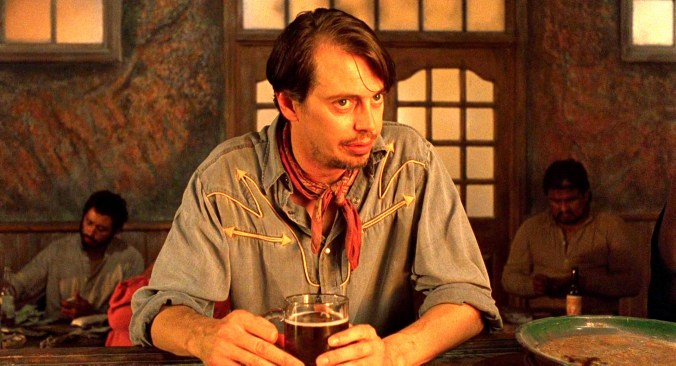
Desperado begins with a road weary, possibly deranged traveler (Steve Buscemi) stumbling into a bar in Mexico and relating the tale of a tall, shadowy figure that he saw murder a bar full of gangsters a few towns over. His story piques the interest of the bartender (Cheech Marin) and his associate (Carlos Gomez), as they obviously know the principals in the traveler’s story. It turns out that that shadowy figure is known as “El Mariachi” (Banderas), and he’s strapped with a guitar case full of guns, on a quest for vengeance against Bucho (Joaquim de Almeida), the drug lord who murdered his wife. Desperado is a straight forward revenge tale, with El Mariachi stalking Mexican towns, hunting down members of Bucho’s gang as he tries to get closer to the man himself. Along the way, he meets and falls in love with Carolina (Hayek), a book store owner who happens to be Bucho’s lover. When Bucho finds out about El Mariachi and Carolina’s affair, he sends his men to hunt down the pair, but they fight off their pursuers and eventually confront Bucho himself at his compound. After dispatching of Bucho, El Mariachi is free to ride off into the sunset with Carolina, although he hangs onto his guitar case full of guns, “just in case.”


What the film might lack in narrative complexity, it more than makes up for in fast-paced, explosive action. Rodriguez is obviously channeling the influence of the Hong Kong action films of John Woo in Desperado, but the film doesn’t feel derivative. Instead, it becomes a celebratory homage to those action landmarks, and a testament to Rodriguez’s ability to create polished, kinetic action sequences on a shoestring budget. His book, Rebel Without A Crew, details the process that Rodriguez went through to make his debut film, El Mariachi (which Desperado is a sequel to). It can serve as a primer for young filmmakers looking to chase their own movie dreams, and it was a huge influence on me in my late teens. Though the budget for Desperado was significantly larger, it was still scant by Hollywood standards, and Rodriguez still holds true to the rules of economic action filmmaking detailed in his book. His later films would see him working with bigger budgets, full FX teams, and cutting edge CGI technology, but the essence of Rodriguez’s style is perfectly on display here.

THE FILM 'DESPERADO' BY ROBERT RODRIGUEZ

The stunt work in Desperado is impeccable, with Banderas doing all of his own stunts and performing some excellent fight choreography. He combines slapstick elements with traditional fight choreography and firearms work to create an ultraviolent, combustible ballet. Bullets rain down throughout the movie and countless scores of anonymous bad guys are dispatched of. This is action at its most impersonal and most impressive: mindless, excessive, and explosive. Rodriguez, a self-proclaimed guerrilla filmmaker, squeezes every bit of value out of his film’s $7 million budget. His mastery of practical effects and ingenuity as a filmmaker allow him to turn in a film that looks every bit as polished and has just as many high action set pieces as a big budget studio film. Although the industry and movie making technology have changed significantly in the 20+ years since Desperado was released, aspiring filmmakers who want a crash course in delivering high quality films on a budget should still look to Rodriguez’s early films and his book for tips. He’s by no means the only filmmaker capable of producing films of this quality on tight deadlines and budgets, but action films are so often the result of bloated FX budgets, lengthy shooting schedules, and complicated stunt work, and they still rarely leave the lasting impact that Desperado has, which is a testament to Rodriguez’s unique skillset.

As I mentioned, for all of its visual sheen, Desperado still finds Rodriguez struggling to flesh out his narratives. The script for Desperado is bare bones, interested only in the most direct motivations for its characters, and certainly not interested in significant psychological examination or character development. I don’t know that Rodriguez has ever really learned to write a “good” script, but I also don’t think that he often makes the type of films that are so significantly character driven that this is a bad thing. He plays to his strengths in Desperado and doesn’t let extraneous character background or plot devices get in the way of the fight scenes and explosions. There are attempts in the film to provide some depth for El Mariachi’s character, such as his relationship with a young boy who is growing up watching the cartel violence in his town, or his romantic relationship with Carolina, but these are largely underdeveloped. Narrative simplicity in a film like Desperado is fine. Character motivations in films like this one are concrete and don’t need a significant amount of discussion. However, one interesting thing about Rodriguez’s approach to storytelling in Desperado is his penchant for weaving the story together through narrated flashbacks. The film opens with one such instance of this technique, with the traveler telling the story of his encounter with El Mariachi interspersed with flashbacks of the mysterious gunman shooting up the bar. Though this isn’t a unique narrative device, Rodriguez employs it skillfully enough in Desperado that it helps to break up the linear progression of the film and makes for an interesting storytelling wrinkle.

desperado 7

Though the script might not be complex or narratively innovative, it does feature several great individual moments and opportunities for characters to deliver memorable monologues in one-off scenes, particularly earlier in the film before the action really ramps up. Banderas is great as El Mariachi, which, for me, is his signature role. He plays the character with a combination of winking cool and ruthless, violent determination. There’s an elegance to the choreography that Rodriguez has designed, with Banderas performing his stunts like a dancer, performing a duet with the camera to graceful, devastating effect. Hayek has little dialogue in the film, but she proves equally capable of performing action stunts, and Rodriguez gives her enough agency in the film that she doesn’t sink to the role of eye candy, which would have been a typical choice in a Hollywood action film. Almeida is a hate-worthy villain as Bucho. His performance isn’t over the top, as he chooses to play Bucho as largely disinterested in anything going on around him. His defining characteristics are cruelty, greed, and apathy, and they’re manifested in Almeida’s nose-in-air performance and his utter disdain for the rest of his costars. In many ways, though, the film’s supporting cast are given the best moments in the film and provide the most memorable performances, aside from Banderas’s. Desperado features cameos from familiar faces such as Steve Buscemi, Cheech Marin, Quentin Tarantino, and Danny Trejo, and though most of these actors are only given a scene or two, they bring their established (or burgeoning) personae to their scenes, and individually nail them. I’ve already mentioned Buscemi’s opening scene, which sets the stage for the destruction to come, but Marin’s cynical, corrupt bartender is classic Cheech, particularly in his brief interaction with an entitled tourist. Tarantino gets a brief moment to ham it up with a memorable telling of a genuinely funny joke, while Trejo, in one of his first mainstream film appearances, makes the most of his silent performance by utilizing his imposing physicality in a role as a bounty hunter tracking El Mariachi. Top to bottom, the cast shines in a genre that often doesn’t ask much of its actors.

desperado 6

It’s probably pretty obvious that my zeal for Desperado has not lessened any with age. It isn’t a film that I watch with any regularity anymore, but it’s one that I can get caught up in just as easily today as I did when I first saw it. Most modern action movies have become so formulaic and so obviously FX driven that I rarely seek them out. Desperado still feels like a breath of fresh air. It has its obvious influences, and it is clearly existing within a fairly rigid genre template, but Rodriguez’s sensibilities and his unique storytelling voice keep the film from ever feeling derivative. The film’s set pieces still hold up even with 20 years of technological innovation, and its central performance from Banderas as El Mariachi is an action archetype. I feel like Desperado doesn’t get as much consideration now, because Rodriguez’s career has moved away from making straight action movies and more into a direction of making B-movies and children’s sci-fi, but it’s a genre classic. In the 1990s, Desperado was a weekend cable TV staple, and it is still as fun of an experience to sit down and mindlessly consume as it was then.

The Departed

The Departed (2006)

Dir. Martin Scorsese

Written by: William Monahan

Starring: Leonardo DiCaprio, Matt Damon, Jack Nicholson, Martin Sheen


This will likely be an unpopular opinion, but The Departed is lesser Scorsese. At the time of its release, the film was seen as a return to form for the auteur, who had been working away from the crime genre for the most part, spending much of the late 1990s and early 2000s making historical epics and biopics. The film won four Academy Awards, including a Best Director award, Scorsese’s first, and a Best Picture award. At the time of its release, I was as on board as anyone else with the opinion that The Departed is, in fact, a great movie, and that it was justified in being the film that finally brought home a much coveted Oscar for the master, Scorsese. I saw the film at least twice in the theater, and purchased it on DVD as soon as it was released. In the fall of 2006 and into 2007, The Departed was my favorite film. It distilled Scorsese’s directorial trademarks into easily identifiable cues, it featured a talented and broad cast, and it certainly did feel like a return to form for the filmmaker who had been making much less intense, more personal projects. However, with over ten years to reflect back on the film, not only does The Departed feel somewhat less essential than it did back then, it doesn’t even strike me as a particularly good film. I don’t hate The Departed, but the film has a myriad of problems that keep it from being a regular in my viewing rotation, despite my initial fondness for it upon its release.

departed 4

An adaptation of the Hong Kong thriller Infernal Affairs, The Departed is an elaborate game of cat and mouse, with both the police and the criminals inserting moles into each other’s organizations. The film shows us that Irish mob boss Frank Costello (Nicholson) has been grooming Colin Sullivan (Damon) since childhood to infiltrate the Massachusetts State Police as a mole. Eventually Sullivan works his way into the Special Investigations Unit, specifically tasked with bringing down Costello and his crime syndicate. At the same time, the SIU has groomed their own mole, Billy Costigan (DiCaprio), a cadet in the state police academy, to go undercover inside the Costello organization to aid in their investigation. The two men proceed down parallel paths of deceit and double cross until they eventually become aware of the existence of the other. Sullivan and Costigan attempt to find out each other’s identity, while also maintaining the tenuous balance required to protect their own cover. Eventually, the ruse begins to unravel as other members of Costello’s crew are revealed to be informants, and Costello himself admits to being an FBI informant for years. The layers of deceit are thick, and, ultimately, neither Costigan nor Sullivan is able to reconcile his duplicitous nature.

That seems like an overly simple plot summary for a film that features as many plot twists and turns as The Departed, but I feel that much of the film’s complexity is actually facile. The Departed features many of the hallmarks of Scorsese’s cinematic output, but it feels more like a paint-by-numbers than a fully fleshed out project. The film utilizes Scorsese’s trademark soundtracking, and his memorable insertion of classic rock songs into key moments in the film, but for the first time, the trick feels gimmicky. It’s all style over substance, with its flashy patina masking the fact that its narrative is actually significantly less complex than it appears. While the film that Scorsese is adapting, Infernal Affairs, is a taught, grimy crime thriller, The Departed is an overly-serious, bloated piece of work. The film lacks the panache and the humor of Scorsese’s earlier crime films such as Goodfellas, and is a worse film for it. The Departed proceeds with an air of self-importance that it never really earns, providing solid entertainment, but striving through heavy-handed symbolism at a moralism that never really feels fleshed out. The film’s denouement attempts to bring all the pieces of its sprawling narrative back together, but it does so in a way that leaves me feeling unsatisfied. The characters find their resolutions too easily and conveniently, if not often too peacefully, with the film too readily insisting on a neat conclusion in a world that’s been established to exist in moral grey areas. Rather than untying the Gordian knot that its narrative has attempted to tie, The Departed’s final act opts to hack it to pieces with the blade of coincidence and deus ex machina. Its closing shot is almost inexcusably heavy-handed, spoon feeding the audience the symbolic import of its image.

departed 3

That isn’t to say that The Departed doesn’t have its redeeming qualities. It does have some elements of genuine intrigue. The film often harkens back to Scorsese’s explosively violent work of the 1990s, with Costigan in particular showing himself to be an able vehicle of violent retribution. The scenes in which he is easing into his role as a soldier in Costello’s organization are some of the film’s most interesting, because they leave a question as to how much of the violence is Costigan playing out a role and how much of it stem from his latent destructive urges. DiCaprio plays this role well, and this seems to be one of the first indications that he would go on to become more than just a teen heartthrob. His Costigan is paranoid, conflicted, and violent, attempting to stay one step ahead of both Costello and Sullivan, while maintaining his own sanity in the face of the pressures of living a double life. DiCaprio plays his role with an appropriately desperate edge, a manic energy pervading his performance that will become familiar in his performances over the next decade. He doesn’t reach the heights of performance that he did in his earlier pairing with Scorsese, The Aviator, but DiCaprio is one of the lone bright spots in the film from a performance standpoint. Perhaps DiCaprio stands out so much because his counterpart in the film, Damon, seems to be phoning in his performance. He doesn’t seem to bring any of the psychological or emotional complexity to his role that DiCaprio does, and he relies on his Boston accent to do much of the work in his performance. Damon is solid, but he doesn’t shine.

Nicholson is a disappointment, as well. Solidly into his hammy later career, Nicholson’s Costello is a stereotype of a gangster. He seethes cruelty and anger, but rarely steps outside of this emotional register. In a film where the arch criminal is revealed to be an FBI informant, Nicholson doesn’t bring any moral ambiguity or nuance to the character. It isn’t that the performance is poor, but with a character as dynamic as Costello, Nicholson should be able to do more. Costello seems more sleazy pervert than criminal mastermind, and his decision to become a rat doesn’t seem to wear on him psychologically in any way. He’s simply acting out of self-preservation, and any larger examination of the character’s psyche is left out. This kind of psychological short-shrifting is fine for a minor or even a supporting character, but when you’re trying to make the type of prestige film that The Departed badly wants to be, a bit more probing into the personal life and mind of one of your three principles is required. I’m ok with a performance strictly being for comedic effect or shock value, and I think that Mark Wahlberg’s bombastic Sgt. Dignam is exactly that and I love it, but you have to expect more character development from one of the three main characters in a prestige drama.

departed 1

I’m not totally certain when the bloom came off of the rose for me with The Departed. As I said, it’s a movie that I wholly enjoyed and sang the praises of for a full year after its release. Maybe it was after seeing Infernal Affairs a couple years after The Departed and realizing what a tight, well made thriller the original film is. Maybe it was simply that the lengthy interim between my last viewing of The Departed and this viewing for my post had cast the film in the positive light of nostalgia for me, although I don’t think so. I think that, truly, I always knew that The Departed wasn’t the great movie that it purports itself to be, but I got carried away in the newness of it because it really is a fun movie a lot of the time. I certainly have issues with the film, but it has some enthralling moments of action that break through and grab the viewer. The overall package doesn’t warrant the sort of high praise the film often receives, but there are fleeting instances of a great crime drama within The Departed. Unfortunately, they’re so buried in the artificially complex narrative twisting and turning that the film insists upon that they rarely get the chance to connect in a meaningful way.

Deliverance

Deliverance (1972)

Dir. John Boorman

Written by: James Dickey (from his novel)

Starring: Burt Reynolds, Jon Voight, Ned Beatty, Ronny Cox


Deliverance is a film that needs little introduction. In the 45 years since its release, the film has gained notoriety and popularity, chiefly due to the shocking nature of one memorable scene. While the film’s rape scene might be its most memorable, and is certainly its most graphic, the rest of the film operates on a quieter, more cerebral level. It establishes a sense of dread from the opening scene, painting its four protagonists as not just fish out of water, but as prey to be hunted in an unfamiliar environment. Though it may not always be associated with the genre, to me Deliverance is very obviously a horror film. Boorman utilizes many tropes of the horror genre to build suspense and enhance a sense of impending catastrophe. I’m sure for audiences at the time, the film’s graphic depiction of sexual violence was shocking, but watching the film from a modern standpoint, I was more taken with the more subtle attempts of the film to disturb the audience. Though the film largely speaks to a set of anxieties specific to its time period, I still found it to be a tense, entertaining thriller.

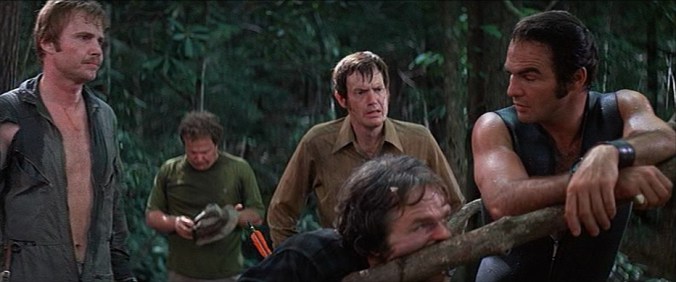
Deliverance concerns itself with a weekend canoeing trip that goes completely and horrifically wrong. Lewis (Reynolds), Ed (Voight), Bobby (Beatty), and Drew (Cox) have made the trip from Atlanta into the Georgia backwoods to canoe the Cahulawassee River before it is dammed and the entire river valley is turned into a lake. The film begins with the group finding some locals to drive their cars down river so that they can pick them up after their canoe trip. While trying to secure drivers, the group displays consistently condescending attitudes towards the hill folk that they encounter, although Drew attempts to engage with a young boy, the two performing a call and response version of “Dueling Banjos” in one of the film’s more famous scenes. Having secured drivers, the crew split up into pairs and launch their canoes into the river. After some time, they are separated, with Bobby and Ed’s canoe running aground. A pair of hunters comes upon the men and forces them into the woods at gunpoint where they tie Ed to a tree and one of the hunters humiliates and rapes Bobby, forcing him to “squeal like a piggy.” Lewis comes to their rescue, shooting one of the hunters with an arrow, while the other escapes. After some debate on what to do with the body, Lewis convinces the group that they have to hide the body, hoping that when the river is damned all evidence of their crime will be at the bottom of the lake. With the murdered hunter buried, the group continues down the river, but when Drew is shot and suddenly falls into the river, it is apparent that they are being stalked by the second hunter. The three remaining friends are caught up in some rapids, and they lose sight of Drew’s body in the chaos. With one of their canoes shattered, Lewis suffering a broken leg, and a vengeful hunter stalking them, the group is left hoping that they’ll simply survive the experience. While they do manage to make it out of the river alive, the traumatic weekend trip leaves them all scarred.

deliverance 5

The four principles do a great job of carrying the movie. Though Reynolds and Voight receive top billing, Beatty and Cox are memorable in their screen debuts, and the film really is driven by the dynamic of this central ensemble. The characters’ individual personalities all get moments to shine throughout the film. Cox gets the least amount of screentime, but the careful, worrisome Drew is an important foil for Reynolds’s cavalier Lewis. Though he’s overruled, Drew’s logical insistence that they take the murdered hunter’s body to the authorities is an important plea for civility and trust in the rule of law over a descent into savagery. Lewis, on the other hand, is the most accomplished outdoorsman of the group, and he represents a sort of adopted primitivism, a desire to master the natural world rather than exist in balance with it. The character benefits from Reynolds’s star persona at the time, with Lewis gaining a perceived ruggedness from the actor’s “man’s man” reputation. Beatty’s Bobby is the weakest member of the group, and he’s often emasculated, not just by the locals that they encounter, but by his friends in the group as well. He’s a typically effete city dweller, cowed by both the savagery of the river and the natural world, as well as the people who inhabit it. Bobby is offered up as a sacrificial lamb, given to appease the wrath of nature at the intrusion of these outsiders, particularly in the context of his being the victim of a rape. Finally, Voight’s character, Ed, is intended to be the point of audience identification. Ed has more everyman qualities than any of his friends, and by the film’s conclusion he has risen into the role of the “hero,” although he’s shown to be less inherently heroic than simply acting on survival instinct. Voight’s performance is probably the most dynamic of the film, as well. Though the film calls for all of the cast to provide memorable, emotive performances, Voight’s range is the widest, with Ed having to take on several different roles in the group throughout the course of the film.

deliverance 1

Across the board, the performances feel genuine, which is probably the result of the film’s shoestring budget. Deliverance was shot on a budget of $2 million, which necessitated the cast performing most of their own stunts, as well as the shoot proceeding without any insurance. The fear seen on the actors’ faces is real, as they were actually canoeing through swift rapids, or performing other dangerous stunts. This authenticity translates to the screen and heightens the terror of the film. As someone who is afraid of heights, I’m always on the edge of my seat during the scene when Ed scales a sheer cliff face under cover of darkness to get the jump on the hunter who has been stalking their group. With the knowledge that Voight actually made the climb, watching the scene is panic-inducing. The film’s tight budget also necessitated some directorial choices that increase its horror quotient for me. Though one of its most enduring scenes involves the song “Dueling Banjos,” there is little other music in the film. I don’t know for sure if this choice was made due to budget concerns, but there is no credit for an official film score, and the little music that there is in Deliverance is eerily sparse. Long periods of the film proceed with just natural sound effects, with non-diegetic musical cues popping up on the soundtrack only occasionally. The effect is an all-encompassing sense of dread. The river is the film’s most consistently running soundtrack, and its persistence becomes ominous and monstrous by film’s end.

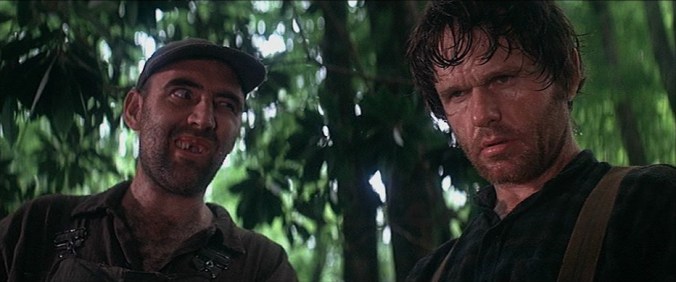
Though the film’s horror stems directly from the dichotomy of city culture vs. country culture, a struggle that is most graphically played out in the rape scene, the underlying and related dichotomy of civilization vs. the natural world is very much in play throughout the film. The real monster in the film is the raging (and fictional) Cahulawassee River, which brutally and unforgivingly tosses the canoe party, representatives of modern civilization, around like rag dolls. The occasion of the canoe trip is the impending damming of the river, a very literal example of man exerting his will on the natural world. For Lewis, the damming of the river represents the loss of a river that he has enjoyed rafting upon in the past, but for the locals who the group encounters, the damming of the river represents the impending loss of their livelihoods, properties, and ways of life. This fact is touched upon in passing throughout the film, but, to me, it is one of the most interesting aspects of the film. Deliverance doesn’t see or present any of the country folk in the film as sympathetic or even relatable characters, instead using stereotypes of the unthinking, unfeeling bumpkin to paint them as the film’s human villains. Obviously the actions represented in the film are heinous, but they are also symptomatic of individuals lashing out at intruders in the face of the eradication of their homeland and culture. Lewis, Ed, Bobby, and Drew are the embodiment of encroaching “civilization,” engaging in cultural tourism while openly mocking the denizens of the culture and place that they’ve traveled to enjoy one last time. The two hunters who rape Ed are reprehensible, but the rest of the locals in the film are shown to be in pitiable circumstances and they receive nothing but mocking cruelty from the protagonists. Early in the film, we see children who are obviously malnourished, living in squalor, but the film does little to prod its audience to empathize with these characters. Sometimes it goes so far as to textually mock them, with the mute banjo playing boy’s obvious mental impairment implying that perhaps he is the product of inbreeding. I’m not suggesting that the film’s hill folk should be seen as the heroes or even the central characters of the film, but their obvious disenfranchisement is something that Deliverance isn’t interested in exploring beyond a cursory glance, which is a shame to me.

deliverance 4

Like many of the films that I’ve been writing about for this project, Deliverance isn’t a movie that I watch often at all, nor is it one that I am likely to watch again any time soon. When I mentioned to a coworker that I had watched Deliverance that morning before coming into work, his response was, “Why?” which, honestly, is probably the right response to someone telling you that they started their day by watching this film. It’s a very good movie, but it’s not one that is particularly pleasant to watch, or one that really lends itself to repeat viewings. I can’t say that I didn’t enjoy watching it again after a decade or so, but it doesn’t feel necessary. It’s an intense viewing experience every time, and the film is often very beautiful, highlighting the natural beauty of Georgia, but Deliverance also established and cemented several negative stereotypes about Appalachian people and Southerners that I don’t enjoy seeing. Maybe I’m sensitive to this depiction because I grew up in West Virginia, a place that is typically misunderstood, neglected, and forgotten, until it’s needed to be the butt of an incest or personal hygiene joke. Deliverance is a fine movie, but I cringe when I hear “Dueling Banjos” played in any other media, because I know that it will soon be followed by a crude joke featuring some toothless yokel meant to represent an entire culture. Part of working through this project and going back to so many movies that I haven’t seen in a long time has reminded me to take films where they are, try to appreciate them for what they offer, and not seeking to too much impose my own worldview into my critical evaluation of a film. Of course, that’s often an impossibility and I don’t shy away from letting my ideologies or opinions guide my writing; this is my blog after all, and I’m largely writing it to please myself. However, I strive to be objective and find something to enjoy or take interest in with every film that I write about. So, in that spirit, I’m taking Deliverance for what it is, a fine thriller with some very good performances, but not one that I’ll be inclined to watch ever again.

The Deer Hunter

The Deer Hunter (1978)

Dir. Michael Cimino

Written by: Deric Washburn

Starring: Robert De Niro, Christopher Walken, Meryl Streep, John Savage


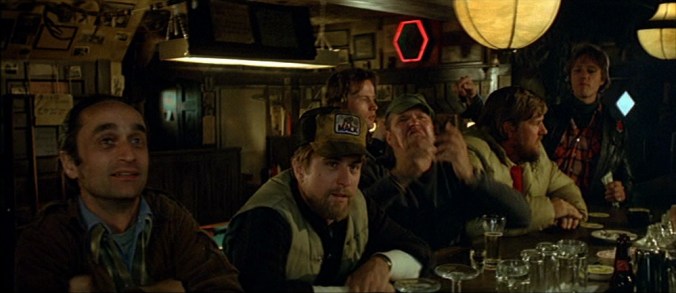
The Deer Hunter stands as a landmark of 1970s filmmaking, winning critical and audience acclaim, and enduring throughout the years as one of the representative filmic explorations of the Viet Nam War and its effects on individuals and on American society, as a whole. The film is a thoughtfully crafted ensemble drama that goes further than many films of the time to depict the lasting horrors of war, and the mental scars that stayed with American soldiers long after they had returned home from Viet Nam. The Deer Hunter was a must see for me when I was a teen, as I was a big proponent of 1970s American films, the movement that is often referred to as the New Hollywood, and this film is often seen as one of the defining films of the movement. The movie has remained on my shelf for all these years since, going largely unwatched. However, when I sat down to watch the film again, over a decade since my last viewing, I was struck by the way that it exists in my head as a film of impressions. The Deer Hunter’s iconic scenes are instantly memorable: its Viet Nam scenes are gritty and intense, while the scenes back home in rural Pennsylvania are light and airy, with an undercurrent of sadness and nostalgia. The interstitial segments of the film were hazier, but they were ultimately the moments that made the film for me upon this viewing. The Deer Hunter’s cinematic climaxes are epic, but it’s the quieter moments that have been resonating with me over the last few days as I’ve turned the film over in my mind.

deer hunter 1

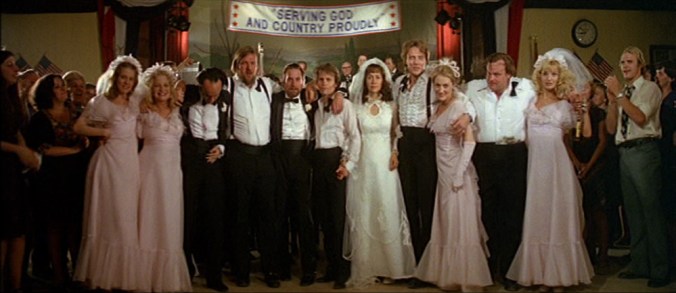
The Deer Hunter opens in the late 1960s in Clairton, Pennsylvania, a mill town just south of Pittsburgh, along the Monongahela River. The film follows three young men, Mike (De Niro), Nick (Walken), and Stevie (Savage), as they prepare to leave their home in the rust belt for deployments in Viet Nam. The film takes its time getting the principles to the war, with Cimino carefully establishing a sense of place in Clairton, and introducing the viewer to the protagonists’ friends and families, as well as their way of life in this typical working class American town. Much of the film’s first act is taken up with a beautifully shot wedding scene, in which the relationships between the friends is established, as well as their anxieties on the outset of setting off for war. Cimino uses these early scenes to establish a holy triumvirate of family, God, and country that rules the lives of his characters, informing their sense of identity. When the film finally arrives in Viet Nam, the pace and intensity are ratcheted up significantly, with all three men being captured by the Viet Cong and forced to play Russian roulette, as their sadistic captors revel in their misery. While these scenes are some of The Deer Hunter’s most memorable, the Viet Nam section of the film is actually quite brief, with Mike quickly leading a daring escape from the makeshift prison. While he and Stevie eventually return stateside, attempting to adjust to civilian life after experiencing the horrors of war, Nick is pulled further into a seedy world of underground betting, where human life is devalued and thrown away. Although Nick is the character who is most obviously lost to his experience in Viet Nam, by the film’s end, it’s clear that all of these characters, even the ones who stayed home during the war, have lost something.

This film is an epic in every sense of the word. It is over three hours in length, and sets out to depict the ravages of war, not just on the individual, but on society as a whole. Cimino famously clashed with producers and his studio about the film’s runtime and its controversial, graphic, and intimate depictions of violence, but ultimately the film that he delivered feels important and necessary in its scope. The Deer Hunter has the impact that it does precisely because Cimino takes his time to establish a sense of place and normalcy early in the film through the scenes set in Clairton. Without the deliberate pacing of the film’s first third, the overall psychological and societal devastation that the Viet Nam war has on these characters wouldn’t be as profound. The locations, the traditions, and the people in these scenes will be familiar to anyone who has ever lived in small town America. Cimino revels in showing these working class traditions up close, dropping in on intimate moments in both churches and bars, letting his camera casually investigate the culture of this particular Southwest Pennsylvania hamlet. The lengthy wedding scene that dominates the film’s first act is a beautifully shot celebration of this type of specific small town tradition. Traditional conservative values of religious piety and family togetherness are fully on display, and traditional gender roles and machismo are reinforced throughout the scene, but cracks start to show in the façade of traditionalism through the anxieties that Stevie, Nick, and, especially, Mike, begin to subtly express regarding their impending deployment. As the wedding reception continues and the men get drunker, their reservations about leaving their familiar homes for a killing field on the other side of the globe become ever more apparent, acted out demonstratively against a backdrop of ostentatiously draped American flags. The film’s opening section lays the groundwork of normalcy that will be eroded by the toll that the Viet Nam war takes on all of the characters.

deer hunter 2

When the film abruptly shifts its focus to Viet Nam, the pace quickens and the intensity is ratcheted up, dropping the audience in country immediately before Mike, Nick, and Stevie are captured and held as POWs by the Viet Cong. While the cast does good work early in the film depicting the internal turmoil that the characters are experiencing regarding their deployment, De Niro and Walken, in particular, shine in the Viet Nam segments. De Niro plays Mike with a determination bordering on insanity, born of a promise that he made to see his friends home safe from the war. The intensity of his performance is matched and exceeded by Walken, who internalizes the trauma that his character has experienced, and who plays Nick as a shell of a man in the film’s second half. While he doesn’t play Nick with the outwardly demonstrative aggression of De Niro’s Mike or the histrionic emotional register of Savage’s Stevie, Walken’s Nick is unforgettable, hollow and haunted. His characteristically stilted line delivery benefits this performance, as well, as Nick seems to be communicating on a different emotional and cognitive level than the characters around him. All three of the actors are tasked with giving dynamic performances that require them to portray genuine celebration and happiness during the film’s beginning and slowly descending into emotional vacancy by the film’s end. They all deliver admirably, making clear the subtle shifts in personality and emotionality that the trauma of imprisonment and the constant threat of death has rendered in their characters.

The supporting cast provides solid work around the film’s stars, as well. The three protagonists leave behind them a network of friends and family in Clairton, and the film’s third act, with Mike’s return home from the war, shows the ways that the war has changed people on the home front. A very young Meryl Streep plays Linda, Nick’s, and eventually Mike’s, girlfriend. Initially, the character was poorly scripted, and Cimino encouraged Streep to flesh the character out, bringing her own ideas and feelings into the performance. Streep’s talent is obvious, as she’s able to easily convey without words the sort of pained longing that war brides must always experience. Linda has to stay strong, working her job at the Giant supermarket, and keeping up the house that she, Nick, and Mike shared, without any knowledge of if or when her lover might return. When Mike finally does return home, it’s obvious that his time away has seen Linda go from a happy, smiling young woman to a ball of frayed nerves. Streep’s performance is full of the little details that communicate more information about a character than voice over or monologue ever can. The way that she clings to Mike’s arm when he walks her to work, or the way that she perches in her chair after all the guests have left from Mike’s aborted homecoming party give a window into the quiet suffering that her character has had to endure. John Cazale is equally strong in his final performance. He plays Stan, a friend who didn’t go to war with Mike, Nick, and Steve, and who can never really understand the experiences that they’ve shared. Stan’s blustery bravado and penchant for pistol-toting provide a screen for the fact that he was too cowardly to go to war like his friends. Cazale’s cocksure performance belies the fact that his health was rapidly deteriorating from cancer. He wouldn’t live to see the film’s completion, but his final performance offers a nuanced look at the crisis of American masculinity during the 1970s. Stan is a typical working class American man of his time, attempting to paper over his personal inadequacies with a hard-drinking, hard-headed lifestyle, while at the same time, the nation as a whole was struggling to reconfigure its own identity in the face of military embarrassment abroad and societal upheaval and the beginning of the end of American industrial dominance at home.

deer hunter 5

More than just a film about war or violence, The Deer Hunter is really an elegy for a way of life that was rapidly coming to an end at the close of the 1970s. Real life towns like Clairton all over the rust belt were beginning to die out, as steel mills and factories closed, and the livelihood of the American worker was challenged. The trauma of war may have broken Nick, and driven him down a rabbit hole of destruction and nihilism in Viet Nam, but Mike’s difficulty in assimilating to civilian life shows that Nick may have never been able to come home anyway. The town that they left wasn’t the same one that Mike returns to at the film’s end, and the prospects for him finding peace and meaning in the future seem bleak. The Deer Hunter’s final scene is beautiful, as Nick’s family and friends gather together to mourn his passing, and they all join in a slow, mournful rendition of “God Bless America,” as they share a meal together. Though it’s Nick that they’re ostensibly mourning, they are also recognizing the passing of a way of life, a societal sea change. The war is the catalyst for change in the film, but it’s also symptomatic of a larger shifting of values and lifestyles both in the film, and in the society into which it was released in 1978. The final scene’s tone is nostalgic, but also cynical, as if Cimino recognized the American dream had long since died out, and the patriotism expressed by his characters as they sing “God Bless America,” is an attempt to grasp at the remaining straws of normalcy.

deer hunter 8

The Deer Hunter is a difficult movie. The strains of its production and the fights between Cimino and his studio are apparent when watching the film. I don’t mean that the end result seems flawed or complicated as a result, but that the tension and passion involved in creating this film are palpable in the final cut. Ultimately, it seems that Cimino was able to keep much of what his studio deemed objectionable in the final cut, and The Deer Hunter is a better film for it. It’s a film that attempts to depict one of the most fraught and difficult portions of American history, and its broad scope allows it to present the central problems of the period in multiple lights. The Deer Hunter is unique among war films in the amount of attention that it pays to the home front, and the parallels that it draws between war and overall societal downfall. The film is doubly difficult in that it doesn’t provide any real answers to the societal problems that it documents, instead leaving its viewer with a profound sense of sadness and cynicism. However, it is a film that is well worth watching. Viewers sitting down to enjoy a war movie might be turned off by the film’s initial hesitance to deliver on the promise of action, but to really appreciate The Deer Hunter, you have to get a sense of the entire tapestry that Cimino has woven.

The Decline of Western Civilization

The Decline of Western Civilization (1980)

Dir. Penelope Spheeris


Punk rock changed my life when I was about 13 years old. I was in junior high school, and because I was in the band at my school, I was able to opt out of taking a traditional music elective. I was able to spend that period of the day practicing the saxophone, but I also had to write a research paper on a topic of my choice by the end of the semester. Being a rock and roll obsessed preteen, I decided that I would write my research paper on “Punk Rock,” a style of music that I was only aware of as a concept. I didn’t really know what punk music was supposed to be, but something about the phrase was alluring to me, and I decided I would seek out its origin. Like any good academic, my research began at the library, where I found Legs McNeil’s oral history of the birth of punk, Please Kill Me, and devoured it. The book turned me on what it meant to be a punk, and to the forefathers of the punk scene in New York City: Richard Hell, The Dead Boys, Blondie, but most importantly, it introduced me to the Ramones. I’d been playing guitar for a couple of years at this point, having formed a band with some friends the year before. I was into classic rock at the time, mostly listening to bands like Cream, The Jimi Hendrix Experience, or Kiss, but when I first encountered the Ramones, my musical life was altered forever. Their buzzsaw guitars, breakneck pace, and Joey Ramone’s garbled vocal delivery were the only thing that mattered to me after that. It was perfect music, perfect in its simplicity and its relatability, perfect in its attitude and its outsiderness. The Ramones kicked down the door to so many other bands and ideas, and punk rock became my life. It changed the way I wanted to play music and it helped introduce me to ideas that would create the core of my identity during those formative teen years.

decline 3

As I’ve gotten older, my musical tastes have expanded again. I sometimes even go entire days without listening to Minor Threat, although almost never more than a couple in a row. While it might not be as outwardly obvious from my dress or demeanor, I’ve never lost my affinity for punk rock and its core ideals and values. The devotion of the music to authenticity, fierce independence, and anti-authoritarianism still endears it to my inner punk, and still keeps me striving to maintain those ideals in my everyday life. For me living your life punk has less to do with fashion, or even music, and more to do with action. It means living your life with integrity, maintaining your independence and dignity, and not bowing to forces of larger oppression. But of course, the history of the music and the culture is important, too, and it was with that in mind that I purchased Penelope Spheeris’s seminal punk rock documentary, The Decline of Western Civilization, when it was rereleased on Blu-Ray, along with its sequels, a few years back.

Spheeris’s three Decline films explore the punk and metal scenes in Los Angeles during the late 1970s, 1980s, and early 1990s. The first film in the trilogy, released in 1980, combines concert footage with candid interviews from members of the bands and the scene, providing a window into the burgeoning Los Angeles hardcore punk scene of the late 1970s. Many of the bands featured here, including Black Flag, Circle Jerks, Fear, and X, are considered the architects of a particular brand of hardcore music. West coast punk and hardcore had emerged as a snarling, visceral answer to the artier, more bohemian punk scene of New York City that had been influenced by the Warhol Factory scene. The music was faster, darker, more aggressive. The attitude was even more nihilistic and violent, with the punk scene providing a layer of crust and grime hidden away beneath the glamor of Hollywood. Long out of print, the film is now available for the first time on home video, and it’s a good thing because The Decline of Western Civilization is a fantastic document of early punk history. The film is alive with the energy of punk and Spheeris is able to perfectly capture the essence of the music and the scene in her film.

decline 2

The concert footage in the film is a maelstrom, with Spheeris and her cameramen inserting themselves into the midst of surging crowds of punks. The handheld camera is jostled and tilted, capturing close ups of sneering faces and flailing arms and legs, clad in leather and spikes. The camera also shares the stage with the bands, who are equally as expressive and unpredictable. Like the music scene it’s documenting, the film feels dangerous; violence can, and does, break out at any time. Punks fight with other punks, bouncers fight with punks, punks fight with the bands, and the whole time the cameras continue to roll, picking up ambient sound amid the chaos. The film manages to perfectly simulate the experience of being at a punk rock show, and it’s the perfect introduction to many of these classic bands. The concert footage is rare in its intimacy and its quality. Despite being shot in such an inhospitable environment, the film looks fantastic. Before seeing The Decline of Western Civilization, I hadn’t seen such early live footage of some of my favorite bands in such high definition. You can get a feel for west coast hardcore by listening to Circle Jerks’ debut album Group Sex, but there’s something magical about watching a young Keith Morris running off the stage to fight a punk who had charged the stage, making a circle around the club, and then jump back on stage and grab the microphone in time to deliver a final chorus of “Back Against the Wall.” It’s a perfect experience of the chaotic, violent energy that existed in the early Los Angeles punk scene.

decline 1

Though she doesn’t include interviews with all of the bands featured in the documentary, Spheeris’s interview segments with Black Flag, X, and Darby Crash of Germs are all well done and help to illustrate the diversity of the bands within the scene. Her interview style is guided but not invasive. She lets each band or individual tell their own story in their own words, while maintaining enough of a focus to draw out a coherent narrative of punk rock in Los Angeles at the end of the 1970s. The bands’ communal lifestyles are highlighted in the interviews, as Spheeris asks Ron Reyes and Robo from Black Flag to give her a tour of the small two room squat that they share inside an old church, which also doubles as the band’s rehearsal space. While it seems that Black Flag and Germs are living hand to mouth, not getting paid for gigs, and largely shacking up wherever they can manage to find a place to rest their heads, other bands featured on the documentary are obviously having more success. X is shown to be a band that is in high demand and is actually courted by the local clubs for shows, while bands such as Germs or Fear are banned from clubs regularly due to the violence and chaos that regularly breaks out at their shows. Seeing a cross section of the lifestyles of many different groups helps to illustrate the striation and variation among these bands. Although they all seem to be somewhat friendly with one another, often name dropping members of various other bands in their interviews, there is an obvious hierarchy and a fairly wide variation among their lifestyles and musical styles. Crash is shown as a tortured genius, unable to extricate himself from his patterns of substance abuse and speeding towards his own demise, while Exene and John Doe of X both seem more mature and more able to handle the pressures of being a top band in a scene that is starting to emerge. For the most part, these bands and their members would go on to international fame, but this glimpse into their everyday lives is an insightful look into the day-to-day struggles that would shape their version of punk rock.

decline 4

In her follow up films, Spheeris would delve deeper into the heavy music scene of Los Angeles. Decline II focuses on the glam and heavy metal scene popping up in the 1980s around the clubs of the Sunset Strip, while Decline III, which was never released until the Blu-Ray reissue of the trilogy, depicts the lives of the scores of runaway and homeless punk youths who arrived in Los Angeles in the early 1990s. Both films are worth checking out, with each having its own merits and standing apart from the original documentary by shifting the focus slightly. The final film in the trilogy is perhaps the most moving and heartbreaking of the three, as it depicts the fun energy of punk that was present in the first film being twisted up into an empty nihilism. While the punks of The Decline of Western Civilization may not have had much hope or much optimism, they seemed to genuinely be enjoying their lifestyle, while Spheeris’s final look in on the scene finds it devoid of any shred of positivity. Although I have roughly defined what being a punk means to me, the spirit of punk rock is a nebulous thing. Depending on when and why a person found themselves drawn to the music, they’ll form their own opinions of what punk is and how it can best serve their life. For me, discovering punk rock as a small town kid in the late 1990s was a new path to channel my aggression and frustration with the institutions in my life. I was a young malcontent, staunchly anti-authoritarian, and punk rock gave me a framework within which to lash out. I’ve really only gone into any detail on the first film in her Decline trilogy, but the fact that Spheeris could make three films that all look at the punk rock ethos in a different decade speaks to the amorphous, constantly evolving nature of the scene. Born of a certain set of circumstances and frustrations, punk rock has changed through the years to reflect the anxieties of each passing generation. In its most pure form, punk should be opposed to strict rigidity and therefore will always be accessible, ready to be discovered and recontextualized, shaped into the vessel that it’s needed to be. Punk rock arrived in my life at the perfect time, and I hope that through the preservation of documents of its early history, like The Decline of Western Civilization, it will do that for generations of angry kids to come.

Dead Man

Dead Man (1995)

Dir. Jim Jarmusch

Written by: Jim Jarmusch

Starring: Johnny Depp, Gary Farmer, Lance Henrikson


I’m excited to finally write about another Western for this project, as the Western genre is one of my favorite types of film to watch and think about. One of my overarching interests in college was writing about depictions of masculinity in films, and I often found the Western genre to be rich with films that explored examples of classic machismo and also depictions of traditional masculinities in crisis. As a whole, the genre has often stood for Americana, and classical American mythmaking, but individually, Western films can serve as prisms to explore the underlying tapestry that makes up these unifying myths or as powerful critiques on the societies that produced them. My favorite Westerns to think about, like Dead Man or Blazing Saddles, are revisionist Westerns, ones that challenge and critique the accepted myths of Americana and offer up alternative narratives to the settling of the West. I love the films of John Ford and John Wayne, and we’ll get to a few of those, but I more appreciate the later films of the genre that used the existing conventions of the Western to deconstruct the genre and allow some light to seep through the cracks in the linear narrative of conquest and Manifest Destiny that the Western has come to represent. Dead Man doesn’t offer much overt criticism of the Western genre or social commentary, but it does inject mysticism, psychedelia, and some trademark Jim Jarmusch “cool” into the genre.

dead man 1

The film opens with William Blake (Depp) onboard a train from Cleveland to the frontier town of Machine, where he has been offered a job as an accountant with the Dickinson metal works. Blake is instantly set apart from the rest of the passengers on the train, as they eye him suspiciously from beneath the brims of fur hats, clutching long guns tightly. The film’s surrealism is apparent from the opening scenes, as well, as the train’s Fireman (Crispin Glover) emerges, covered in soot, to engage in a strange conversation with Blake in which he warns the newcomer against going to the frontier. All the while, the passengers are shooting buffalo from the moving train behind the two men. Undeterred, Blake arrives in Machine, and sets off to claim his job, however, when he arrives at the metal works, his job has already been filled and he is driven from the property at gunpoint by Mr. Dickinson himself (Robert Mitchum). Without the job he was promised, and having just buried his parents in Cleveland, Blake finds himself with no money for a return ticket and no prospects, but he shows some kindness to a flower girl, Thel (Mili Avital), who in turn takes him back to her room at the local hotel. Their post-coital bliss is interrupted by the arrival of Thel’s former lover, Charlie (Gabriel Byrne), who tries to shoot Blake, but instead shoots Thel when she throws himself in front of the bullet. Blake, with some difficulty, uses Thel’s gun to shoot Charlie, and then realizes that he has been shot by the bullet that passed through Thel’s chest. Wounded, he jumps out of the window and steals Charlie’s horse, riding off into the desert. When Blake comes to, he meets Nobody (Farmer), a Native American who will act as a spiritual guide for Blake as they continue into the frontier, possibly into the afterlife.

I first became aware of this film in my Sophomore or Junior year of college in a class on Westerns. I don’t believe that we screened the film in its entirety in class, but we watched a handful of clips from it, and I saw enough that I was intrigued and purchased the film on DVD. I knew Jim Jarmusch, as my Wu-Tang obsession had led me to the RZA-soundtracked Ghost Dog in high school, and Broken Flowers had been one of my favorite movies of 2004, but I hadn’t explored much into the director’s filmography beyond these and a couple of other films. Even with this cursory introduction to the director’s style and having seen some clips from the movie, Dead Man was a very weird film to me the first time I watched it. I was used to modern Westerns that called into question ideas of national identity and American exceptionalism, but Dead Man is much more inwardly focused, raising questions of personal identity, life and death, and humanity. Critics, including myself earlier in this post, have called it a psychedelic Western, and it certainly is that, but perhaps it is more accurate to think of Dead Man as an Existentialist Western. It lends itself, with its moody score and monochromatic visual presentation, to the same sorts of reflection as Existentialist philosophy. Its subject matter, a dying man (who may or may not be actually dead already) being guided to the afterlife speak to these same concerns of being and nothingness, and of Man’s place in the spiritual and mystical realms. Dead Man has little time for inquiries into political or social commentary as it sets its goals on a higher level of exploration of the human condition. It was certainly a bit of an adjustment from what I had been expecting of the film at first.

dead man 6

Of course, after consuming much, if not all, of Jarmusch’s oeuvre, these lofty thematic concerns don’t surprise me at all. His films often strike a balance between a perfect Zen koan and a late night, pot-fueled, dorm room philosophy session. They often provide deep truths about the human experience, but their presentation is a bit hazy and nebulous around the edges. From top to bottom, Dead Man makes for a great cult film. Like most of Jarmusch’s output, the film is just a little bit too strange to fully connect with the mainstream, but it has fared pretty well critically, and it has a fan base among critics and audiences. Its literary allusions, including a running gag in which Nobody believes that Blake is the deceased Romantic poet William Blake, and its philosophical context will satisfy the intellectuals in the audience, while its hazy, mystical presentation and brief moments of gore will satisfy the midnight movie crowd. The film celebrates the history of the Western genre with its casting of Robert Mitchum (in what would be his final role) as Dickinson, while also turning the typical Western narrative on its head. Like many Westerns, Dead Man depicts a great journey, but the nature of this journey is spiritual rather than physical, and it’s being led by Nobody, a Native American rather than a White cowboy. These type of inversions are typical of a revisionist Western, but Jarmusch pushes the genre to its breaking point, by merging the Western journey with a picaresque, peopled by strange, obtuse characters. The intended effect is to keep the audience off balance, unsure of whether Blake is really having these experiences or whether he’s hallucinating them, or if his journey is through some purgatorial space. What appears, initially, to be a stylish modern take on a classic genre turns out instead to be using that classic genre as a landscape upon which to project a rumination on life, death, violence, and human nature.

dead man 4

These themes are primarily explored through the character of Nobody, played expertly by Gary Farmer, whose job it is to enlighten the dying Blake, whom Nobody often refers to as a “stupid fucking White man.” Nobody’s character walks between two worlds, having been captured by English settlers as a child and toured around museums as an attraction. In this way, Nobody has closely inspected and become educated by White culture, but as a result has been unable to fully assimilate into his own Native culture. Like Blake floating between life and death, Nobody, too, is pulled between two different types of existence. Farmer provides much of the film’s comic relief, though not in the typical Western style, with Native Americans and other marginalized characters serving as the butt of cruel jokes. Nobody is smarter and more cultured than Blake, and the film’s humor often stems from Nobody’s offhanded quips about Blake and White culture. Farmer, a member of the Cayuga Nation, brings authenticity and respect to his role, as does Jarmusch’s treatment of Native American culture in the film. The film employs several Native languages throughout, and it presents Native culture as more enlightened and sophisticated than the brutal, rapacious culture of the White characters. Though he’s capable of great violence, Nobody is full of joy and life, while Blake and the film’s other White characters are morose and associated with death. In fact, Blake becomes a sort of avenging angel over the course of the film. Though he is initially unable to shoot straight, Blake develops lethal potency during his journey with Nobody, who teaches him to let his pistol speak his poetry. Depp’s performance is worthy of praise, as well. He eschews the scenery chewing that will become his trademark later in his career, employing instead a laconic, trancelike performance style. It gives the sense that Blake is some sort of conduit, channeling the energies of the Universe as the mysteries of death are revealed to him in his spiritual journey.

dead man 3

The rest of the film’s cast is excellent, as well. As is typical of a Jarmusch film, big names pop up in small roles throughout the film. Though this really is Depp’s and Farmer’s movie, several of these cameos are worth mentioning as they simply add to the overall strangeness of the film. Lance Henrikson is a standout as Cole Wilson, the deadliest of three bounty hunters that Dickinson sends to bring Blake in for the murder of Charlie, who happens to be Dickinson’s son. His performance is built around his quiet menace and the rumors that the other bounty hunters whisper about his sadism and depravity. His riding partners, Conway Twill (Michael Wincott) and The Kid (Eugene Byrd), hatch a plot to kill Wilson and split the ransom among themselves, but Wilson is too crafty for them and in a memorable scene, proves the truth in the rumors of his cannibalism. Alfred Molina has a brief but memorable cameo as a bigoted frontier missionary. Blake and Nobody come upon his outpost late in the film and the missionary feigns piety when dealing with Blake, but treats Nobody with disdain and malice. Finally, Iggy Pop and Billy Bob Thornton are fantastic as two thirds of a group of outlaws who plan to rape and kill Blake. Thornton is almost unrecognizable, covered head-to-toe in fur, but his distinctive drawl is hard to mistake, while Iggy Pop is very obviously himself, despite wearing a dress and a bonnet. Their brief scene is an interlude, and not particularly important to the film’s overall plot, but, like many of Blake’s encounters in Dead Man it deepens the sense of alienation and psychedelia that the film traffics in, and it enriches this offbeat world.

dead man 5

Dead Man is a film that exists wholly within its own space. While it certainly comments on and dialogues with the Western genre, it is not wholly of that genre. The film offers up little in the way of concrete narrative resolution, but instead leaves the audience with a profound sense of mood. The film’s visuals, its idiosyncratic performances, and its spare, improvised, Neil Young score, all enhance the strangeness of the film, and help to build this mood. Viewers looking for a traditional Western action film might be disappointed by Dead Man, although the film does have plenty of action, but anyone who wants to immerse themselves in a cinematic journey would be well advised to check out this somewhat lesser-known movie. It’s often said that a trip is less about the destination than about the journey, and Dead Man is a perfect example of this. While the film ends without much narrative clarity, its presentation of a moody, psychedelic trip is as enjoyable as it is inscrutable.


Post-script:

I missed a post last week for the first time during this project. My plan at the outset was to post once a week. The film that I had planned on writing on for my post on the 22nd of October was George Romero’s Dawn of the Dead, however when I opened up the case, the disc was missing. Rather than replacing the disc, as I had with Better Off Dead, or advancing my schedule by a week, I decided that my project would be better served by me taking a week off to catch my breath. I have a demanding and time consuming job, and I also devote a good portion of my free time to volunteering and community service, so I needed to take a brief break to get my writing back on schedule and to ensure that I could continue providing the quality of content that I have striven to maintain throughout the life of this blog. I hope to not miss any more posts going forward.