Ghostbusters

Ghostbusters (1984)

Dir. Ivan Reitman

Written by: Dan Aykroyd & Harold Ramis

Starring: Bill Murray, Dan Aykroyd, Sigourney Weaver, Harold Ramis, Ernie Hudson


This is a big one for me. Ghostbusters has been a strong cinematic constant in my life. It’s definitely in my top ten favorite movies of all time, and, depending on the day, it vies for a spot as my personal favorite movie ever. Born in 1985, I emerged into a world in which Ghostbusters was already a phenomenon, with the movie becoming a big box office success, inspiring a cartoon spinoff, a line of toys and action figures, and a fervent fandom among young children and adults alike. I was all-in on Ghostbusters from the moment I first saw the cartoon, and soon after, the movie. I collected the toys, I had Ghostbusters clothing, and I obsessively quoted the movie to my family. Some of my earliest memories are Ghostbusters related, such as a Halloween when I was only three and I went trick-or-treating as Ray Stantz, complete with a homemade jumpsuit and a borrowed proton pack. It’s really the first, and probably only, piece of nostalgic fandom that I engage in, and I still can’t get enough of it, watching the movie at least a couple of times a year. For me, Ghostbusters represents a perfect intersection of actual cinematic quality and nostalgia. I can’t pretend that the way that I love Ghostbusters and its resultant media properties isn’t painted heavily in coats of nostalgia, but there’s also no denying that it represents a high-water mark for its brand of studio comedy in the mid-1980s. It’s a classic of American cinema and a cult of fandom wouldn’t have sprung up around it so readily were it not, simply put, an all-time great comedy.
ghostbusters 2

I’ll provide a brief plot synopsis for anyone who might, for some unknown reason, be unfamiliar with Ghostbusters, but if you fall into the category I’d urge you to just go watch the movie and then come back to reading this. The titular Ghostbusters are Peter Venkman (Murray), Ray Stantz (Aykroyd), and Egon Spengler (Ramis), three out of work college professors with a special interest in paranormal phenomena. After they’ve lost their university jobs, the scientists decide to enter into the private sector, opening up an agency that specializes in the removal of supernatural and paranormal pests. Though business is initially slow, once the Ghostbusters break their first cases, they become a phenomenon themselves, and they’re joined by Winston Zeddmore (Hudson) to help them take on more cases. One of their notable early cases is for Dana Barrett (Weaver), who returns to her apartment one day to find a portal to another dimension opening up in her refrigerator, and whom Dr. Venkman falls head over heels for. As they pursue Dana’s case, the Ghostbusters discover that the portal is intended to welcome Gozer the Gozerian, an ancient God who travels through space and time destroying worlds, onto Earth. The Ghostbusters prepare to face off against Gozer and a host of otherworldly entities to save their city and the world.

There’s not a lot that I will write here that would do anything to affirm or deny the greatness of Ghostbusters. It’s an iconic movie, one that has earned its spot in the pantheon of great movies that will likely never be awarded by an Academy or earn a spot in the curriculum at a film school, but a movie that is widely acknowledged, nonetheless, as one of the best examples of brilliant, consumable, pop-culture entertainment. To me it’s every bit as important or meaningful as Citizen Kane or The Godfather. Though it doesn’t exist in a prestige genre, Ghostbusters stood for many as a gold standard for quality comedy in an era when competition was unbelievably stiff in that particular genre. I’m sure this is a biased opinion because of my age and having grown up watching all of these movies on cable television constantly, but the 1980s were the golden era for studio comedies as so many great and iconic film comedians started to emerge and find their voices, as well as finding writing and directing partners who understood how to harness their comedic energy. While Murray and Aykroyd were emerging as leading men, along with Eddie Murphy and Martin Short, as well as the prolonged great run of genius Steve Martin into the 1980s, directors such as Ivan Reitman and screenwriters such as Ramis were pushing the boundaries of the studio comedy in broad, unexplored directions. There’s a buzz surrounding classic comedies of this era that I just don’t feel in modern comedies. I think that it’s the slapdash feeling that comedies like Ghostbusters give me that I don’t feel in modern comedies, the knowledge that at least 50% of what made the final cut was improvised on the spot by gifted comedians so comfortable with riffing off of one another. There are plenty of comedies that have great chemistry, great scripted lines, and great adlibs, but Ghostbusters will always take the cake for me for the best and strongest comedic ensemble ever assembled.

ghostbusters 1

The focus of that ensemble, of course, is Bill Murray’s Peter Venkman. Though the film features a balanced ensemble of co-leads, and a supporting cast that receives nearly equal billing and several memorable moments, it’s always Murray who stands out to me in Ghostbusters. Venkman was never my favorite Ghostbuster when I was a child, but even though I related more to Ray Stantz, I could easily recognize that Murray was the movie’s star. He displays the timing, wit, and charm that turned him into a bona fide superstar in the 1980s and a comedy legend ever since. Venkman’s character is equal parts sleaze, cynicism, and off-the-cuff observational wit, and that characterization has largely followed Murray around ever since. Of course Murray has expanded his range and his choice of roles throughout his career, and there are no shortage of wonderful roles and performances for any fan to latch onto, but when I think of Bill Murray it’s Peter Venkman who I picture. His performance in Ghostbusters encapsulates everything that Murray has come to represent in his career and in the public imagination. I’m not particularly a Murray fanboy, but there’s no denying that he deserves a place on the film comedy Mt. Rushmore and that his likeness should include a proton pack.

ghostbusters 4

Of course, a single performance doesn’t an all-time comedy make, and Murray is backed up by a supporting cast that knocks it out of the park at every turn. Ramis is suitably understated as Egon, the straight man of the team, while Aykroyd brings a hand-wringing, mealy-mouthed character to Ray, the most put-upon Ghostbuster. He’s a great foil for Murray’s outsize confidence, and the dynamic between the two actors feels real, with Venkman taking every opportunity to belittle Stantz. Sigourney Weaver more than holds her own in her scenes with Murray, engaging in quick verbal sparring worthy of the best screwball comedies. She also does a great job creating two different characters when Dana is possessed late in the film and her entire demeanor changes. By far, though, my favorite supporting performance in Ghostbusters is Rick Moranis’s nerdy neighbor, Louis. Moranis is perfectly cast as the nebbish, love-struck Louis, whose only desire is to get his neighbor, Dana, to notice him and come to his party. Like Murray, Moranis proves himself to be a master improviser, and he’s adept at both verbal and physical comedy. After probably 100 viewings, Ghostbusters doesn’t always get as many belly laughs out of me as it used to, but Moranis’s party scene in which he rattles off the market prices of the food that he purchased and introduces his guests based on their jobs, salaries, and the remaining balance of their mortgages, never fails to leave me in stitches.

ghostbusters 3

That’s the thing about Ghostbusters, for me. Sure I have an obviously strong nostalgic attachment to the movie and its related ephemera, but watching it today it still elicits genuine laughs from me every time. I know the movie inside and out, and I’ve been able to quote it, chapter and verse, basically since I learned to talk, but it never loses its humor for me. The simple brilliance of many of its punchlines, and the joy of watching master comedians riffing off of one another, never ceases to leave me in stitches. The day that I watched Ghostbusters to prepare to write this post, I was having a supremely bad start to the day, with my work encroaching onto the one day a week that I am supposed to get to myself, but as soon as I popped in the DVD and the film’s iconic opening shot of the lion statues in front of the New York Public Library filled my television screen, my concerns were all forgotten. Every time I watch Ghostbusters, I am able to fully submit myself to 105 minutes of pure, unadulterated comedy pleasure, and that’s why I still watch it two to three times a year. It’s a movie that can instantly change my mood, taking me back to a place in my life before jobs and social responsibilities and constant stress. Even though I know every punchline, I find myself laughing at a different joke every time. Ghostbusters provides me with a guaranteed respite and a trip down memory lane like no other movie I’ve ever encountered. I’ve had lots of favorite movies over the course of my life, but few, if any, have had the persistence of Ghostbusters. It’s always exactly what I need when I pull it off the shelf.

Ghostbusters is a perfect movie for this project, and it’s one that I’ve been eagerly anticipating getting to write about since I started doing this work in late 2016. I’ve written about tons of movies that I have various nostalgic attachments to for one reason or another so far, but I don’t think any encapsulate the idea of going back and digging through physical media that I’ve collected so perfectly as Ghostbusters. Last year, writing about Apocalypse Now, I briefly touched on the fact that Ghostbusters was the first movie I ever saw on DVD, and I think that’s interesting because my relationship with the movie has always been related to physical artifacts as much as the film itself. In the 1980s and early 1990s, I was an avid collector of the action figures associated with the animated series The Real Ghostbusters, and my early fandom of the movie was strongly associated with those toys. At that point, for me, Ghostbusters was as much about its ancillary properties as it was the original movie, and I think that the nostalgic bond that I have to the entire franchise extends as much from the toys that I played with, and the good memories that I associated with engaging in the fan discourse of the movie through play and dress up at Halloween, as it does to my early experience of watching the movie itself. I guess it’s fitting that a movie about ghosts would be so associated to me with memory and repetition, now for thirty years playing the movie over and over, engaging with it in so many different contexts and through so many different lenses at various points in my life. It’s a pleasant sort of haunting that I’ll probably never really grow out of.

The Blues Brothers

The Blues Brothers (1980)

Dir. John Landis

Written by: John Landis and Dan Akroyd

Starring: John Belushi, Dan Aykroyd, Carrie Fisher, Cab Calloway


When I was very young, I often felt like I was out of step with my peers. My interests didn’t line up with theirs and I rarely participated in the fashions and trends that the other kids at my elementary school were obsessed with. My mother made most of my clothes and she cut my hair in a Lennon-esque shaggy bowl cut until I was about 10 or 11 years old. When other kids my age were getting into sports, I was reading tomes about the history of the Civil War and writing my own short stories on my family’s ancient word processor. This isn’t to say that I didn’t have plenty of commonalities with my classmates; I was as into Cool Runnings and The Mighty Ducks as any American kid was in 1993, and I was an avid video gamer, cherishing the Super Nintendo that my sister and I received as a Christmas gift in 1992, even though we originally played it on a black-and-white television. I did have friends, and good ones, at that, but even amongst friends, I felt that some of my interests were outside of the norm. While my friends started getting into contemporary pop culture, borrowing rap albums from older siblings or sneaking into the room to watch the ending of a scary movie, my tastes stayed decidedly retro. Until the time her turntable broke in 1993 or 1994, my main source of music came from my mother’s record collection. My sister and I had kids’ tapes that we’d listen to in the car, but we weren’t allowed to watch MTV until a little later, so our only source of “adult music” was from these three dozen or so records kept on a shelf, collected from the late 1960s into the 80s. We listened to Rubber Soul and Dylan’s Greatest Hits, but it was the copy of Briefcase Full of Blues, the debut album by The Blues Brothers that most intrigued me.

blues brothers 5

I don’t remember the exact first time I put that record on the turntable, and dropped the needle to hear the walking bassline of “I Can’t Turn You Loose” played by Donald Duck Dunne and the tight but raucous horn stabs from “Blue” Lou Marini and “Bones” Malone, but I do remember the impact that the record had on me. This was something far afield from the folk music I was most familiar with from her collection. This was party music. It was loud and celebratory, but it also had an edge that made it feel dangerous. There was something mysterious to me about the image of the Blues Brothers on the cover; their black hats and suits, and matching dark Ray Bans were the epitome of cool to nine-year-old me. I knew that the group was something of a novelty act, music being performed by comedians, but it didn’t matter. I knew Aykroyd well from having seen Ghostbusters roughly 100 times to that point, and I was aware that there was a movie called The Blues Brothers, but I was introduced to the group first through the music. To me, the Blues Brothers were a band, not characters from a sketch or a film, and they were the coolest people in the world. Seeing the movie around the time I was 12, long after the turntable was kaput and I was no longer able to hear the music, did nothing to diminish that image in my mind. On the contrary, it cemented their status as cool guy role models for a young kid who was still a couple years away from discovering punk rock.

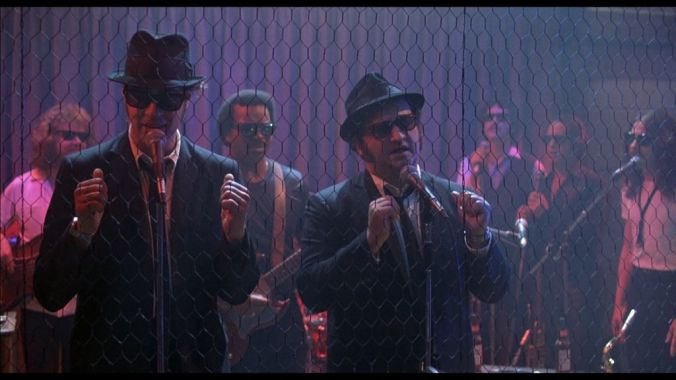
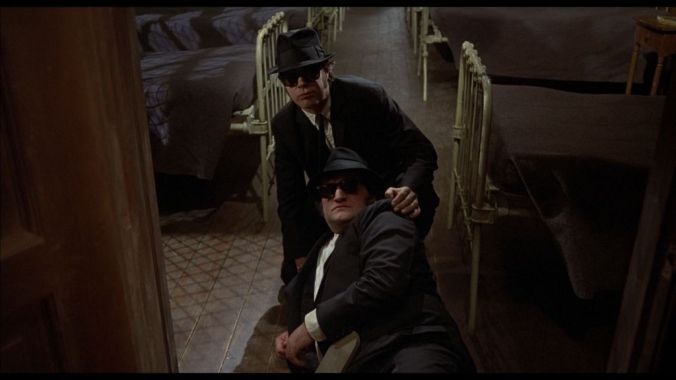
The Blues Brothers expanded on the sense of raucous fun I got from listening to the record, and it gave the titular group a back story and an insane world in which to live. For the uninitiated, the plot is very simple. The film opens with “Joliet” Jake Blues (Belushi) being released from prison. His brother, Elwood (Aykroyd), picks him up in a decommissioned police cruiser that he bought after trading in the “Bluesmobile” for a microphone. Soon after, they visit the Catholic orphanage in which they were raised and find out that the orphanage owes $5,000 for a tax assessment or it will be closed. The Blues Brothers take it as their “mission from God” to raise the $5,000 and save the orphanage. They have to figure out a legitimate way to raise the money, so they decide to reassemble their backing band for a big performance that will help them raise the money. They meet some initial resistance, but they ultimately get everyone to agree to the gig, however, there are other roadblocks in their way as they are being pursued by Jake’s jilted ex-lover (Fisher), the Illinois Nazi party, a rival country band, and a cadre of law enforcement, up to and including the United States Army. The Blues Brothers is the rare musical comedy that succeeds in providing both great musical set pieces and genuinely funny scenes. It enlists a who’s who of Blues and R&B legends to join with The Blues Brothers for unforgettable musical cameos, as well as cameos by established and up-and-coming comedic actors. The Blues Brothers is a big, exciting blockbuster of a comedy and it ranks up as one of my favorites in the genre and potentially my very favorite musical.

blues brothers 1

Much of the movie’s comedic success comes from the natural chemistry between Aykroyd and Belushi, and their combined charisma as performers. After years of performing together on SNL and after having taken their Blues Brothers act on the road, the two had honed their onstage personae to a razor sharp point. Their characters are perfect foils for one another. Belushi’s Jake is the larger than life, bellicose frontman of the band, while Aykroyd’s Elwood is the more stoically reserved sidekick. Their interplay is perfect and they bounce off of one another with aplomb, each one filling in the gaps of the other’s personality. Elwood doesn’t have a tremendous amount of dialogue in the film, but Aykroyd’s line delivery never fails to crack me up. He has a clipped, Joe Friday delivery that implies a level of simplicity belied by the mechanical ingenuity that Elwood often shows throughout the film. Aykroyd embodies Elwood with a sense of natural cool. He doesn’t say much because he doesn’t have to; he lets his persona do the talking for him. However, as good as Aykroyd’s performance is, it can’t match the scene-stealing force that is John Belushi as “Joliet” Jake Blues.

The Blues Brothers is Belushi at his unhinged best, dancing, jiving, and shouting his way through the film with no shame. If he gained mega-stardom through his portrayal of the dumb brute Bluto in Animal House, he showed off his full range in The Blues Brothers, using his physicality in both predictable and surprising ways. Belushi is a force of nature in the film, staggering and swaggering, but also unexpectedly lithe and graceful, showing off a great deal of athleticism as he dances and cartwheels his way through the performance scenes. Unlike Bluto, Jake is the brains of the operation, and as such, Belushi is given a great deal more dialogue to work with. Jake is lecherous and scheming, but he’s also good-hearted and devoted to his brother and their surrogate father from the orphanage, Clarence (Calloway). Belushi’s passionate performance in The Blues Brothers makes me wonder what he would have gone on to do had he lived just a little bit longer and made a few more films. This film was his first big opportunity to showcase his range as a performer, and, sadly, he would be dead less than two years after its release.

blues brothers 2

While the stars of the film do a good bit of the heavy comedic lifting, their task is lessened by the hilarious odd ball world that Aykroyd and Landis’s script envisions for them to inhabit. The Blues Brothers is absolutely a celebration of the city of Chicago, but its version of Chicago is viewed through a fun house mirror. Like a handful of the other comedies that I’ve written about here, The Blues Brothers feels like it’s taking place in a world that is just adjacent to our own. This probably shouldn’t be surprising as more than most other genres, musicals require audiences to totally suspend their disbelief to accept a world in which the characters will break out in song in public at the drop of a hat, giving even the most “realistic” musicals a sense of artificiality. The world of The Blues Brothers is madcap and wacky, involving high speed car chases that employ impossible physics in their cinematic ballet of destruction, vengeful white supremacists and country groups, and a bazooka wielding ex. Jake and Elwood are repeatedly wrecked, blown up, and shot at in the film, and manage to take it all in stride and come out on the other side with nary a scratch. But beyond its larger scale weirdness, The Blues Brothers is simply packed with small, memorable moments that are patently absurd that form its distinctive comedic tone. From the brothers’ standard lunch order (four whole friend chickens and a Coke for Jake, dry white toast for Elwood), to the repeated impetus of their quest (“We’re on a mission from God”), Jake and Elwood have a magical, charmed quality about them that informs the whole film with a sense of lightheartedness. The weird, goofiness of the world of the movie underscores the absurdity of its stone-faced protagonists.

Fleshing out this strange world are a cast of characters comprised of some of the period’s best rising comedic stars. Carrie Fisher’s role as Jake’s unnamed jilted bride, who is hell bent on hunting he and Elwood down and killing them, leveling whole buildings in the process, is the only other role that I ever picture her in besides Princess Leia. She is a mysterious figure until near the film’s end, but her largely unexplained back story is hinted at by the glimpses that we get into her life. John Candy shows up as one of the detectives hunting down the Blues Brothers, and his ad-libbed “Orange whip” bit is one of my favorite lines from the whole film. Frank Oz has a brief cameo as the prison guard who returns Jake’s possessions to him when he is released from prison at the beginning of the film. But of course, the supporting roles that steal the show are the musicians who make cameos throughout the film. James Brown, Aretha Franklin, Ray Charles, and John Lee Hooker all make appearances, alongside other famous blues and R&B musicians of the 1950s and 60s. Aretha’s performance of “Think” in the soul food restaurant is my favorite in the film, but the scene featuring James Brown’s portrayal of Rev. Cleophus James never fails to illicit a smile with its over-the-top choreography. Ray Charles’s performance of “Shake a Tail Feather” along with the Blues Brothers Band is the film’s central showpiece. The film’s final performance is great, but it doesn’t match the energy of the band really getting into a great dance number, alongside one of the greatest pianists of all time, with hundreds of extras dancing in the Chicago streets.

blues brothers 3

Obviously, I have little but kind words for The Blues Brothers, but it does have a few technical shortcomings, some of which are glaring, such as “Blue” Lou’s saxophone solo during “Think.” The moment that Lou struts down the counter of the soul food restaurant during his solo should be his shining moment in the film, but unfortunately, he is framed from the neck down with his face not appearing in the shot. Landis isn’t the most visually innovative filmmaker, and I can forgive some of his more minor technical mistakes, simply because most of the film is shot very well. The car chase scenes are big and exciting, and, at the time, the film set a record for most automobiles destroyed during filming (a record that would later be broken by its sequel). Landis is able to balance these bigger scenes of spectacle with the smaller moments that provide the film its humor, and he successfully creates the rare musical comedy that nails both the performative, spectacular elements of the musical and the subtlety of perfect comedy. At the time of its filming, The Blues Brothers was one of the most expensive comedies ever filmed, and the pressure was on Landis and the film’s stars to deliver a hit. The film was a box office success, more than recouping its budget and actually grossing slightly higher box office in foreign markets than in the U.S., which was a rarity at the time. Although it wasn’t a smash hit, the film would go on to grow long legs in the emerging home video and cable television markets, earning itself new fans into perpetuity.

blues brothers 6

I’ve seen The Blues Brothers so many times over the years that I can anticipate the jokes before they arrive, and I watch it with a permanent smile across my face, ready to break into a full laugh when the punch line hits. I think Belushi’s death shortly after the film’s release paints it in a slightly different light, but even if he had gone on to lead a long life and enjoy a storied career, I think that Jake Blues would still be remembered as his iconic performance. I do wonder how younger audiences respond to The Blues Brothers, without a more direct connection to its inspirations and its featured performers. Of its principal cast, only Aykroyd is still alive, and Aretha Franklin is the only living featured performer left. The film’s iconic Chicago setting is somewhat unfamiliar after 35 years of urban development. However, I think that the things that made me connect to the film and the music early on in life are universal. There’s inherent humor and cool in the line, “It’s 106 miles to Chicago, we’ve got a full tank of gas, half a pack of cigarettes, it’s dark, and we’re wearing sunglasses. Hit it.” The joy and beauty expressed in the film’s musical scenes ring true to any audience, and tap into a primal desire to dance, sing, and enjoy life. I think I love The Blues Brothers so much because it’s a celebration of so many of the things that I have come to love about life: humor, music, goofy black suits, stupid dance moves. It might look a little bit retro now, but for me, The Blues Brothers has never gone out of style, just like a black suit.