12 Monkeys

12 Monkeys (1995)

Dir. Terry Gilliam

Written by: Chris Marker (inspired by La Jetee), David Peoples, Janet Peoples

Starring: Bruce Willis, Madeleine Stowe, Brad Pitt

This particular movie is a great one to start off with, because it is likely to be fairly emblematic of the nature of this project. Many of the films that I’ll be writing about in this series are ones that I haven’t viewed in years, however they always remain on the periphery of my film viewing consciousness. The physical presence of the cases on the shelf a reminder of half a life of serious film viewership and a latent urge towards criticism. Many of the films that will come are not essential or classic, but they helped to shape my journey into the world of cinema. In the age of streaming where there are countless films available at the press of a button, and it’s possible to spend as much time surfing through titles trying to choose a film to watch as you actually spend watching the film, it’s easy to get swept up in searching for new, unfamiliar titles. That access has been wonderful, if sometimes daunting, but it has also led me to ignore some of the formative films that I had regarded as important or valuable earlier in my life.
12-monkeys-5


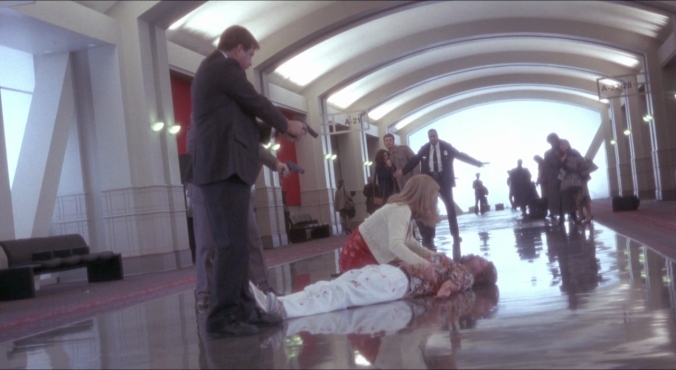
12 Monkeys is a time travel thriller alternating between a dystopian future where the last remaining humans on Earth have been forced underground and a present on the brink of an extinction level event. James Cole (Willis), a prisoner who has been volunteered to go back in time on a fact finding mission, is our entry point into this world. Initially sent to the year 1990, Cole is admitted to a mental hospital, where he meets psychiatrist Dr. Kathryn Railly (Stowe), as well as fellow patient Jeffrey Goines (Pitt), who is later revealed to be the leader of radical environmental activist group the Army of the 12 Monkeys. Cole eventually escapes the mental hospital and is returned to his present before being sent back through time to track Goines and the Army of the 12 Monkeys, who are believed to be behind the virus that will eventually nearly wipe out humanity. Back in 1996, Cole finds and kidnaps Dr. Railly, enlists her help in locating Goines and preventing the release of the virus, and eventually convinces her of the truth of his story. All the while, Cole is plagued by vivid, recurring dreams of a boy witnessing a foot chase and a shooting in an airport.
12-monkeys-4

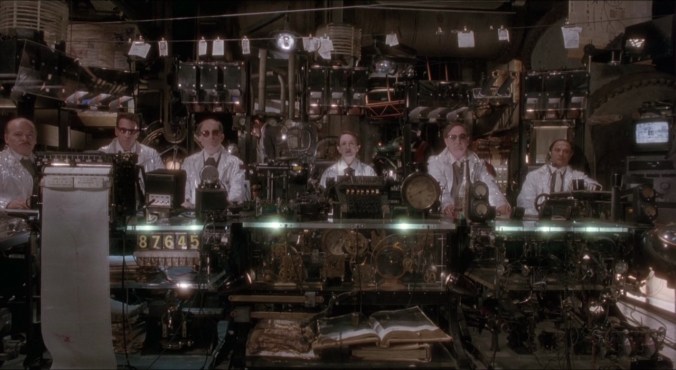
I picked up this movie sometime around 2003 I would imagine, when I was a junior in high school. I had seen the movie on cable, and I would imagine I probably picked it up because I liked Bruce Willis and Brad Pitt as the leads, and maybe to a lesser extent because of Terry Gilliam. At that point I was probably most familiar with Gilliam as a member of Monty Python, and for directing Fear and Loathing in Las Vegas, which is still a favorite but not in my collection anymore, apparently. I still like Willis’s performance in this and most of his movies, Brad Pitt less so. I feel like his performances from the 90s haven’t always aged well. Although I haven’t gone back to it in probably seven or eight years, 12 Monkeys is still a very enjoyable sci-fi movie. The steam/cyber-punk aesthetic seems a bit dated, but Gilliam’s trademark imagery and directorial style are on full display, and he steers the complex narrative through its temporal slips with relative ease. The film’s twist ending is still poignant, even if it is a bit predictable.

12-monkeys-3

The biggest difference in watching 12 Monkeys for me now, is that I can now watch it with the experience of having seen Chris Marker’s 1962 experimental short La Jetee, which inspired the film. 12 Monkeys borrows liberally from the earlier film, lifting its concept of a prisoner who is enlisted to return to the past in order to prevent a future apocalypse. Cole’s dreams of the shooting in the airport are also directly inspired by La Jetee. Marker’s film is great in its simplicity, as it is presented as a series of still photos with voice over narration explaining the story of the time traveler. Gilliam’s film is to be commended for taking as its source material something that is decidedly anti-cinematic and ballooning it into a richly visual cinematic world. While the world of La Jetee is purposefully obscure, allowing the story to exist outside of both time and place, 12 Monkeys is very clearly rooted in both a time and a place. Gilliam takes the philosophical core of La Jetee and fleshes out the narrative, providing a context and specificity not present in the original. Because of these adaptations, 12 Monkeys stands on its own as an engaging thriller. Familiarity with the film’s source material helps to add a bit of symbolic weight that Gilliam doesn’t fully explore when depicting Cole’s dreams of the airport, but 12 Monkeys is a wholly original film built on Gilliam’s memorable visual style and a strong lead performance by Willis. I feel that La Jetee is certainly an interesting film, but 12 Monkeys is ultimately the more entertaining and satisfying movie experience.

Introduction

Webster’s dictionary defines a cinephile as “a devotee of motion pictures.” I first learned this portmanteau when I was 19 years old, in college, beginning my serious study of film. At that time, it made sense to me that I must be a young cinephile; I was in love with movies and had a voracious appetite for consuming them. I had long been a devotee, and I had spent much of my free time and money in high school going to the movies, collecting DVDs, and viewing films with friends late into the night. Like many passions of youth, my love for motion pictures burned hot, and my entry into a formal academic setting where the viewing and study of films was considered very serious business only served to stoke those flames even further. Now watching three films a day was not only not frowned upon, it was encouraged as research.

My desire to study films, and to make films of my own, led me to Pittsburgh, PA, but it was born in my hometown of Charleston, WV. I was a part of a small clique in my school who were obsessed with movies and pop culture. We were equal opportunity nerds when it came to the movies, as enamored with Taxi Driver and The Godfather as we were with Dumb and Dumber and The Chinese Connection. We would watch our favorites over and over and over again, memorizing lines of dialogue and details of shot construction, beginning an informal education in the visual language of the movies. Our curriculum was dictated only by personal taste and by the availability of particular films on home video. We amassed large collections of DVDs and VHS tapes, trading with one another and spreading the movies like secrets.

My personal collection became fairly large during the early part of the 21st century. Over the years, I purchased hundreds of movies, and watched hundreds more. I never thought of myself as a collector, because I didn’t hold much inherent value in the physical media. I was only interested in collecting the stories contained therein. As a result, there was never much rhyme or reason put into what might be added to my personal collection. I liked what I liked, and during that time I was primarily interested in consuming as much cinema as possible as often as possible. However, as access to different sources of media developed, adding new discs to my collection seemed less and less important. I was an early adopter to Netflix’s disc service, and collecting little red envelopes began to supplant buying movies of my own. A few years later, as streaming services became my primary way of engaging with and viewing films and media, my DVD collection became nearly ornamental, a well-organized display of my personal taste choices.

There was also a period of my life during which I completely disengaged from watching movies altogether. After four years of undergraduate film school, and a brief stint in graduate school, I had become seriously burnt out. I felt the need to almost totally unplug myself from that life and that meant largely ignoring my previous interest in movies. During my mid-twenties I buried myself in work, occasionally going to the theater, but rarely engaging critically in the way that I had in film school. I stopped writing entirely. I tried to shake this rust off in 2012, starting a blog that I kept sporadically updating for about half a year, writing short reviews and analysis of both contemporary and classic films. Though I wasn’t as successful as I had hoped in keeping the blog going regularly, I was able to use it as a stepping stone to working on several longer, more involved essays over the next year. I also began going to the theater more frequently and, gradually, my interest in cinema in general began to be reignited.

Since that time, my engagement with the movies has been consistent, even if my engagement with writing about the movies has been less so. I have thought about several potential long and short term writing projects that I could put my mind to, but for various reasons they’ve never been able to come to fruition. Often a lack of free time would derail an attempt to write an essay, and other projects would often take precedence as I started taking on new and different professional and social responsibilities. Sometimes I lacked for a concrete source of inspiration for a writing project, and a sort of stasis would set in. I realized a few months ago, however, that the solution to this problem might have been right under my nose all along. As I sat at my desk one evening, I looked to the shelves where my DVD collection was held, so many of them untouched in years, and I realized I had a previously untapped source of inspiration. I made up my mind to work my way through each disc organized alphabetically on my shelves, from 12 Monkeys to Zodiac, and write a short essay about each one. I was interested to find out how some of these movies that I hadn’t watched in a decade would hold up. I was curious to see if I could remember the story of how each one came to be in my collection, and why it seemed important enough to have stayed with me for all these years.

So, I hope to use this space to release these essays as I work my way through my collection, and with over 200 movies this will certainly be a long term project. My desire is to have one new essay written each week exploring a new film, and my relationship to it, both now and then. Some of these movies I have seen so many times that I could probably write my essays from memory, some of them I have seen only once or twice, and I’m sure there are a couple lingering around that I may have never gotten around to seeing at all. I’m hoping that presenting these films alphabetically, without any thought to chronology (either of their release or of their introduction into my life) or theme, there may be some interesting juxtapositions or that the films may enlighten each other in some way through an unpredictable pairing. There are already some stories that I can’t wait to tell about some of these films and their roles in my life. Most of all, I’m excited to get back to writing about movies on a regular basis, and I can’t think of a better way to do that than to revisit some of the more formative films of my cinephilia.